


Key Product Details

Species Reactivity

Validated:

Human

Cited:

Human, Mouse

Applications

Validated:

Intracellular Staining by Flow Cytometry

Cited:

Flow Cytometry

Label

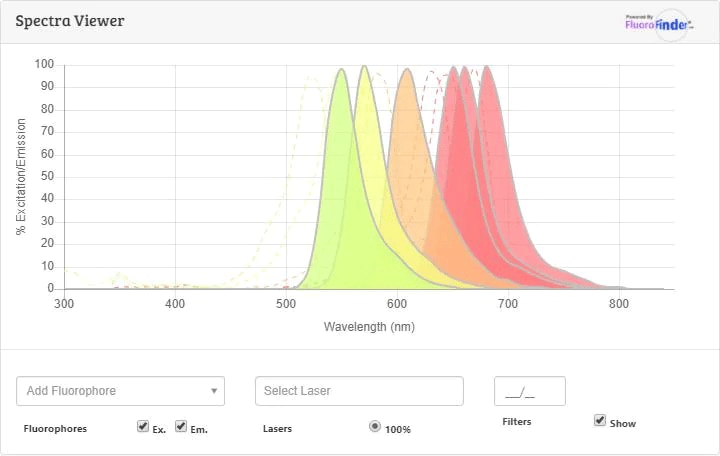
Allophycocyanin (Excitation = 620-650 nm, Emission = 660-670 nm)

Antibody Source

Monoclonal Mouse IgG2A Clone # 125923
Loading...

Product Specifications

Immunogen

S. frugiperda insect ovarian cell line Sf 21-derived recombinant human HB-EGF
Asp63-Leu148
Accession # Q53H93

Specificity

Detects human HB-EGF in direct ELISAs and Western blots. In direct ELISAs, approximately 5% cross-reactivity with recombinant mouse HB-EGF. Does not cross-react with recombinant human (rh) AR, rhBTC, rhHRG-alpha,rhHRG-beta, rhEGF, or rhTGF-alpha.

Clonality

Monoclonal

Host

Mouse

Isotype

IgG2A

Scientific Data Images for Human HB‑EGF APC‑conjugated Antibody

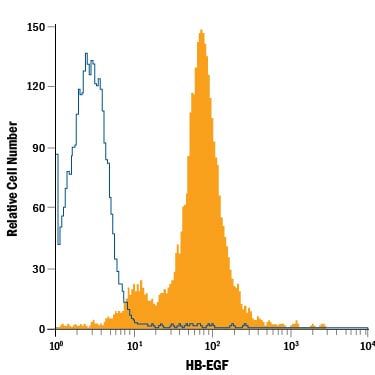
Detection of HB-EGF antibody in PC-3 Human Cell Line antibody by Flow Cytometry.

Detection of HB‑EGF in PC‑3 Human Cell Line by Flow Cytometry.

PC-3 human prostate cancer cell line was stained with Mouse Anti-Human HB-EGF APC-conjugated Monoclonal Antibody (Catalog # IC259A, filled histogram) or isotype control antibody (Catalog # IC003A, open histogram). To facilitate intracellular staining, cells were fixed with Flow Cytometry Fixation Buffer (Catalog # FC004) and permeabilized with Flow Cytometry Permeabilization/Wash Buffer I (Catalog # FC005). View our protocol for Staining Intracellular Molecules.

Applications for Human HB‑EGF APC‑conjugated Antibody

Application
Recommended Usage

Intracellular Staining by Flow Cytometry

10 µL/106 cells
Sample: PC‑3 human prostate cancer cell line fixed with Flow Cytometry Fixation Buffer (Catalog # FC004) and permeabilized with Flow Cytometry Permeabilization/Wash Buffer I (Catalog # FC005)

Spectra Viewer

Plan Your Experiments

Use our spectra viewer to interactively plan your experiments, assessing multiplexing options. View the excitation and emission spectra for our fluorescent dye range and other commonly used dyes.

Spectra Viewer

Flow Cytometry Panel Builder

Bio-Techne Knows Flow Cytometry

Save time and reduce costly mistakes by quickly finding compatible reagents using the Panel Builder Tool.

Advanced Features

  • Spectra Viewer - Custom analysis of spectra from multiple fluorochromes
  • Spillover Popups - Visualize the spectra of individual fluorochromes
  • Antigen Density Selector - Match fluorochrome brightness with antigen density
Build Your Panel Now

Formulation, Preparation, and Storage

Purification

Protein A or G purified from hybridoma culture supernatant

Formulation

Supplied in a saline solution containing BSA and Sodium Azide.

Shipping

The product is shipped with polar packs. Upon receipt, store it immediately at the temperature recommended below.

Stability & Storage

Protect from light. Do not freeze.
  • 12 months from date of receipt, 2 to 8 °C as supplied.

Background: HB-EGF

HB-EGF was originally purified based on its heparin-binding property and mitogenic activity on BALB-3T3 fibroblasts from the conditioned medium of the human U-937 histiocytic lymphoma cell line. The natural protein has an apparent molecular mass of 19-23 kDa and exists in multiple forms as a result of heterogenous O‑glycosylation and/or N-terminal truncation. In addition to fibroblasts, HB-EGF is also a potent mitogen for keratinocytes and smooth muscle cells but not for capillary endothelial cells. HB-EGF is produced in monocytes and macrophages. In addition, transcription of HB-EGF can be induced in vascular endothelial cells as well as aortic smooth muscle cells (SMC), suggesting that HB-EGF may have an important role in the pathogenesis of atherosclerosis.

HB-EGF is a member of the EGF family of mitogens which also include Transforming Growth Factor-alpha (TGF-alpha ), Amphiregulin (AR), rat Schwanoma-derived Growth Factor (SDGF), Vaccinia Growth Factor (VGF), and the various ligands for the HER2/ErbB2/Neu receptor. All these cytokines are derived from transmembrane precursors that contain one or several EGF structural units in their extracellular domain. Many of these transmembrane precursors are biologically active and seem to play a role in juxtacrine stimulation of adjacent cells. The cDNA for HB-EGF encodes a 204 amino acid residue transmembrane protein that is proteolytically cleaved to generate the soluble HB-EGF. Like EGF, TGF-alpha, and AR; HB-EGF binds to the EGF receptor and activates the receptor tyrosine kinase. HB-EGF is reported to be a more potent SMC mitogen than EGF. It has been suggested that the differential activities found for HB-EGF compared to EGF may be mediated by the heparin-binding properties of HB-EGF. A diphtheria toxin receptor that mediates the endocytosis of the bound toxin has been cloned and found to be identical to the transmembrane HB-EGF precursor.

Long Name

Heparin Binding EGF-like Growth Factor

Alternate Names

Dtr, Dts, HBEGF, Hegfl

Entrez Gene IDs

1839 (Human); 15200 (Mouse)

Gene Symbol

HBEGF

UniProt

Additional HB-EGF Products

Product Documents for Human HB‑EGF APC‑conjugated Antibody

Certificate of Analysis

To download a Certificate of Analysis, please enter a lot or batch number in the search box below.

Note: Certificate of Analysis not available for kit components.

Product Specific Notices for Human HB‑EGF APC‑conjugated Antibody

For research use only

Related Research Areas

Citations for Human HB‑EGF APC‑conjugated Antibody

Customer Reviews for Human HB‑EGF APC‑conjugated Antibody

There are currently no reviews for this product. Be the first to review Human HB‑EGF APC‑conjugated Antibody and earn rewards!

Have you used Human HB‑EGF APC‑conjugated Antibody?

Submit a review and receive an Amazon gift card!

$25/€18/£15/$25CAN/¥2500 Yen for a review with an image

$10/€7/£6/$10CAN/¥1110 Yen for a review without an image

Submit a review
Amazon Gift Card

FAQs for Human HB‑EGF APC‑conjugated Antibody

Showing  1 - 1 of 1 FAQ Showing All
  • Q: Why was intracellular staining performed instead of surface staining with IC259A? 

    A: Staining with IC259A worked optimally for our samples when intracellular Flow staining protocol was used. The antibody could be tried with both surface and intracellular staining protocols whan a different sample type is used.   

Showing  1 - 1 of 1 FAQ Showing All
View all FAQs for Antibodies
