


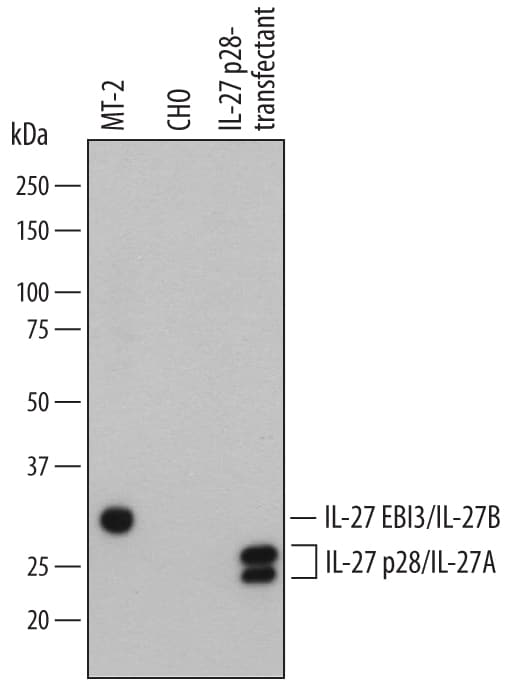
IL-27 is a heterodimeric group 2 receptor ligand molecule that belongs to the IL-6/IL-12 family of long type I cytokines (1). It is composed of EBI3 (EBV-induced gene 3), also known as IL27B, a 34 kDa glycoprotein that is related to the p40 subunit of IL-12 and IL-23, and p28, also known as IL27A, the 28 kDa glycoprotein that is related to the p35 chain of IL-12 (2-4). The human EBI3 gene encodes a 229 amino acid (aa) precursor that contains a 20 aa signal peptide and 209 aa mature protein (5). The mature region contains two potential N-linked glycosylation sites, two fibronectin type III domains, and two pairs of conserved cysteine residues with a WSXWS-like motif that places the molecule in the hematopoietin receptor family (5). Although p40, the EBI3 counterpart in IL-12, is known to form homodimers, there is no evidence to date that EBI3 also homodimerizes. Human EBI3 is 61% aa identical to mouse EBI3. The human p28 gene encodes a 243 aa precursor that contains a 28 aa signal sequence and 215 aa mature region (6). The mature region is characterized by the presence of four alpha -helices, placing it in the IL-6 family of helical cytokines. Human p28 is 74% aa identical to mouse p28. IL-27 is expressed by monocytes, endothelial cells and dendritic cells (7). IL-27 binds to and signals through a heterodimeric receptor complex composed of WSX-1 (TCCR) and gp130. Evidence suggests IL-27 interacts only with WSX-1 (6, 8, 9). IL-27 has both anti- and proinflammatory properties. As an anti‑inflammatory, IL-27 seems to induce a general negative feedback program that limits T and NK-T cell activity (3, 7). At the onset of infection, IL-27 induces an IL‑12 receptor on naïve CD4+ T cells, making them susceptible to subsequent IL-12 activity (and possible Th1 development) (10).
 Powered by Bioz

![Human IL-27 Antibody [Biotin] BAF2526](https://resources.rndsystems.com/images/reviews/review_baf2526_17021.jpg)
