
IL-27 is a heterodimeric group 2 receptor ligand molecule that belongs to the IL-6/IL-12 family of long type I cytokines (1). It is composed of EBI3 (EBV-induced gene 3), also known as IL27B, a 34 kDa glycoprotein that is related to the p40 subunit of IL-12 and IL-23, and p28, also known as IL27A, the 28 kDa glycoprotein that is related to the p35 chain of IL-12 (2-4). The human EBI3 gene encodes a 229 amino acid (aa) precursor that contains a 20 aa signal peptide and 209 aa mature protein (5). The mature region contains two potential N-linked glycosylation sites, two fibronectin type III domains, and two pairs of conserved cysteine residues with a WSXWS-like motif that places the molecule in the hematopoietin receptor family (5). Although p40, the EBI3 counterpart in IL-12, is known to form homodimers, there is no evidence to date that EBI3 also homodimerizes. Human EBI3 is 61% aa identical to mouse EBI3. The human p28 gene encodes a 243 aa precursor that contains a 28 aa signal sequence and 215 aa mature region (6). The mature region is characterized by the presence of four alpha -helices, placing it in the IL-6 family of helical cytokines. Human p28 is 74% aa identical to mouse p28. IL-27 is expressed by monocytes, endothelial cells and dendritic cells (7). IL-27 binds to and signals through a heterodimeric receptor complex composed of WSX-1 (TCCR) and gp130. Evidence suggests IL-27 interacts only with WSX-1 (6, 8, 9). IL-27 has both anti- and proinflammatory properties. As an anti‑inflammatory, IL-27 seems to induce a general negative feedback program that limits T and NK-T cell activity (3, 7). At the onset of infection, IL-27 induces an IL‑12 receptor on naïve CD4+ T cells, making them susceptible to subsequent IL-12 activity (and possible Th1 development) (10).

Scientific images may be resized, cropped, or adjusted for brightness or contrast for presentation purposes. These updates are limited to presentation and do not affect the underlying scientific interpretation of the data. Where available, additional source data may be provided upon request.
Key Product Details
Species Reactivity
Validated:
Cited:
Applications
Validated:
Cited:
Label
Antibody Source
Product Specifications
Immunogen
Arg21-Lys229 (IL-27 EBI-3 subunit), Phe29-Pro243 (IL-27 p28 subunit)
Accession # Q14213 (EBI-3 subunit), AAM34498 (p28 subunit)
Specificity
Clonality
Host
Isotype
Endotoxin Level
Scientific Data Images for Human IL-27 Antibody
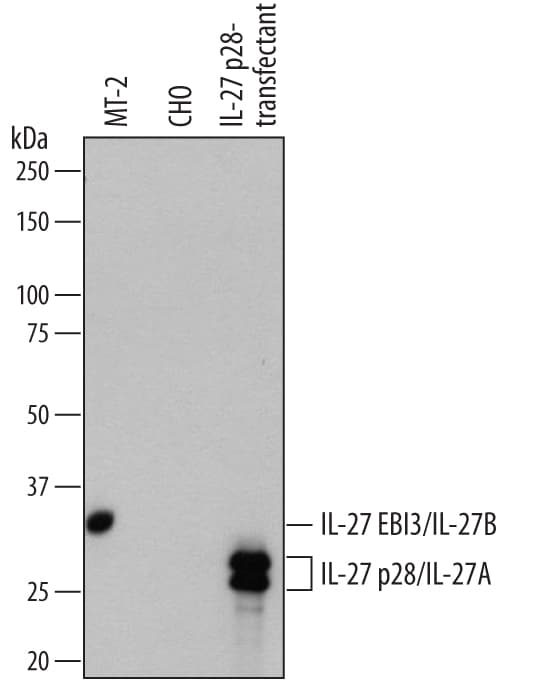
Detection of Human IL‑27 by Western Blot.
Western blot shows lysates of MT-2 human T cell line and CHO Chinese hamster ovary cell line either mock transfected or transfected with human IL-27 p28/IL-27A. PVDF membrane was probed with 1 µg/mL of Goat Anti-Human IL-27 Antigen Affinity-purified Polyclonal Antibody (Catalog # AF2526) followed by HRP-conjugated Anti-Goat IgG Secondary Antibody (HAF109). Specific bands were detected for the IL-27 EBI3/IL-27B at approximately 32 kDa and IL-27 p28/IL-27A at approximately 28 kDa (as indicated). This experiment was conducted under reducing conditions and using Immunoblot Buffer Group 1.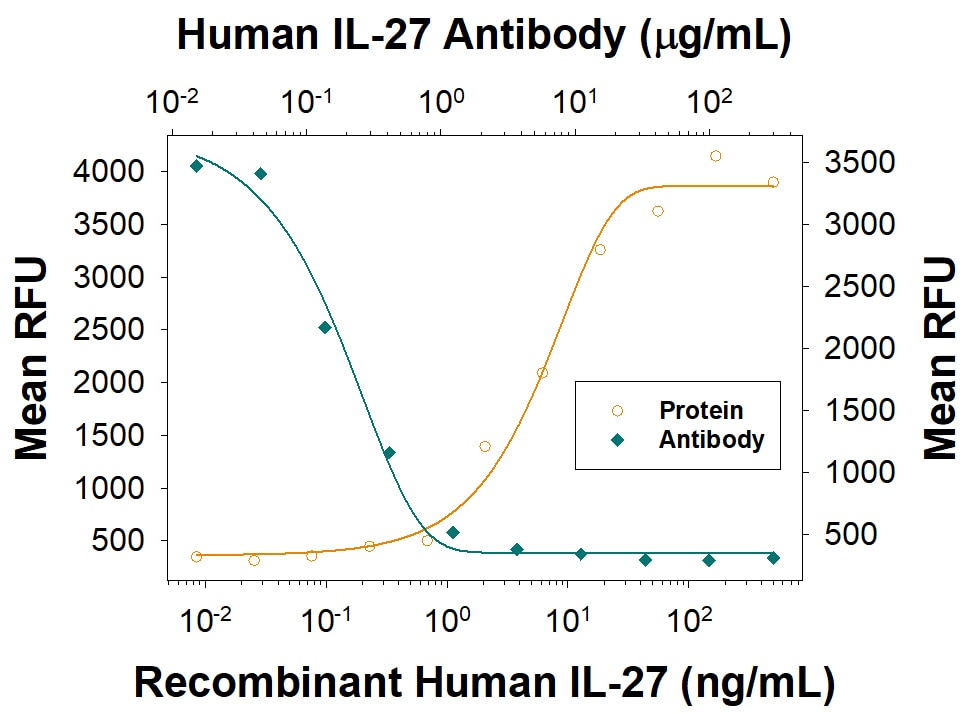
IL‑27 Inhibition of EMCV-induced Cytopathy and Neutralization by Human IL‑27 Antibody.
Recombinant Human IL-27 (Catalog # 2526-IL) reduces the Encephalo-myocarditis Virus (EMCV)-induced cytopathy in the HepG2 human hepatocellular carcinoma cell line in a dose-dependent manner (orange line). Inhibition of EMCV activity elicited by Recombinant Human IL-27 (25 ng/mL) is neutralized (green line) by increasing concen-trations of Goat Anti-Human IL-27 Antigen Affinity-purified Polyclonal Antibody (Catalog # AF2526). The ND50 is typically 0.200-2.40 µg/mL.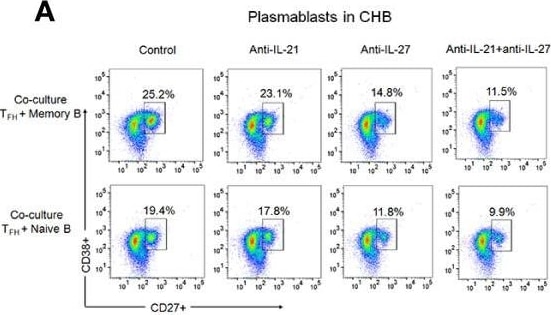
Detection of Human IL-27 by Flow Cytometry
IL-27 secreted by TFH cells support plasmablasts and plasma cell formation. (A–C) Mechanism of TFH mediated B cell response was determined by autologous TFH-B cell co-culture (CHB: n=5, HC-vacc: n=5). To imitate HBV-specific interactions between TFH and B cells, FACS-sorted TFH cells were first primed with HBsAg for 3 h, washed and then incubated with autologous CD19+CD27+ memory and CD19+CD27-IgD+ naïve B cells with and without of IL-21 and IL-27 neutralizing antibodies for 5 days. Generation of plasmablasts and plasma cells was analyzed by flow cytometry (D) expression of Blimp-1 (CHB: n=5, HC-vacc: n=5). Plasmablasts were gated as CD27+CD38+ cells and plasma cells were defined based on CD27+CD38+CD138. (E) Incubation of memory B and naïve B cells with rIL-27 for 5 days showed increased plasmablasts and plasma cell formation (CHB: n=5). Statistical analysis was performed using either Kruskal-Wallis test (ANOVA) with Dunn’s post hoc test for multiple comparisons or paired t test. Bars indicates mean and error bars designate standard deviation. * indicates p < 0.05, **p < 0.01 and ***p < 0.001. Image collected and cropped by CiteAb from the following open publication (https://pubmed.ncbi.nlm.nih.gov/33584666), licensed under a CC-BY license. Not internally tested by R&D Systems.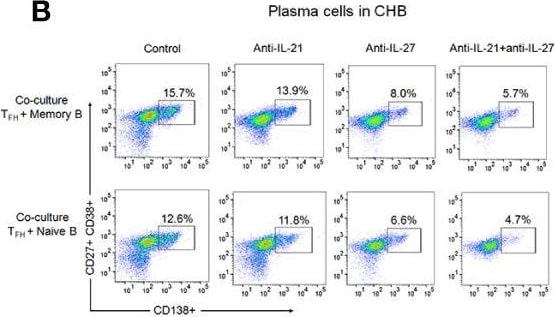
Detection of Human IL-27 by Flow Cytometry
IL-27 secreted by TFH cells support plasmablasts and plasma cell formation. (A–C) Mechanism of TFH mediated B cell response was determined by autologous TFH-B cell co-culture (CHB: n=5, HC-vacc: n=5). To imitate HBV-specific interactions between TFH and B cells, FACS-sorted TFH cells were first primed with HBsAg for 3 h, washed and then incubated with autologous CD19+CD27+ memory and CD19+CD27-IgD+ naïve B cells with and without of IL-21 and IL-27 neutralizing antibodies for 5 days. Generation of plasmablasts and plasma cells was analyzed by flow cytometry (D) expression of Blimp-1 (CHB: n=5, HC-vacc: n=5). Plasmablasts were gated as CD27+CD38+ cells and plasma cells were defined based on CD27+CD38+CD138. (E) Incubation of memory B and naïve B cells with rIL-27 for 5 days showed increased plasmablasts and plasma cell formation (CHB: n=5). Statistical analysis was performed using either Kruskal-Wallis test (ANOVA) with Dunn’s post hoc test for multiple comparisons or paired t test. Bars indicates mean and error bars designate standard deviation. * indicates p < 0.05, **p < 0.01 and ***p < 0.001. Image collected and cropped by CiteAb from the following open publication (https://pubmed.ncbi.nlm.nih.gov/33584666), licensed under a CC-BY license. Not internally tested by R&D Systems.
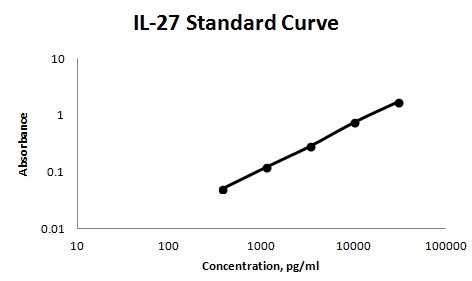
Human IL-27 ELISA Standard Curve
Recombinant Human IL‑27 (Catalog # 2526-IL) was serially diluted and captured by Goat Anti-Human IL‑27 Antigen Affinity-purified Polyclonal Antibody (Catalog # AF2526) coated on a Clear Polystyrene Microplate (Catalog # DY990). Goat Anti-Human IL‑27 Antigen Affinity-purified Polyclonal Antibody (Catalog # AF2526) was biotinylated and incubated with the protein captured on the plate. Detection of the standard curve was achieved by incubating Streptavidin-HRP (Catalog # DY998)
Human IL-27 ELISA Standard Curve
Recombinant Human IL‑27 (Catalog # 2526-IL) was serially diluted and captured by Goat Anti-Human IL‑27 Antigen Affinity-purified Polyclonal Antibody (Catalog # AF2526) coated on a Clear Polystyrene Microplate (Catalog # DY990). Goat Anti-Human IL‑27 Antigen Affinity-purified Polyclonal Antibody (Catalog # AF2526) was biotinylated and incubated with the protein captured on the plate. Detection of the standard curve was achieved by incubating Streptavidin-HRP (Catalog # DY998)Applications for Human IL-27 Antibody
Western Blot
Sample: MT‑2 human T cell line and CHO Chinese hamster ovary cell line transfected with human IL-27 p28
Neutralization
Human IL-27 Sandwich Immunoassay
Reviewed Applications
Read 1 review rated 4 using AF2526 in the following applications:
Formulation, Preparation, and Storage
Purification
Reconstitution
Reconstitute at 0.2 mg/mL in sterile PBS. For liquid material, refer to CoA for concentration.
Formulation
Shipping
Stability & Storage
- 12 months from date of receipt, -20 to -70 °C as supplied.
- 1 month, 2 to 8 °C under sterile conditions after reconstitution.
- 6 months, -20 to -70 °C under sterile conditions after reconstitution.
Calculators
Background: IL-27
References
- Boulay, J-L. et al. (2003) Immunity 19:159.
- Trinchieri, G. et al. (2003) Immunity 19:641.
- Murakami, M. et al. (2004) Growth Factors 22:75.
- Cordoba-Rodriguez, R. and D.M. Frucht (2003) Exp. Opin. Biol. Ther. 3:715.
- Devergne, O. et al. (1996) J. Virology 70:1143.
- Pflanz, S. et al. (2002) Immunity 16:779.
- Villarino, A.V. et al. (2004) J. Immunol. 173:715.
- Pflanz, S. et al. (2004) J Immunol 172:2225.
- Scheller, J. et al. (2005) Biochem. Biophys. Res. Commun. 326:724.
- Holscher, C. (2004) Med. Microbiol. Immunol. (Berl).193:1.
Long Name
Alternate Names
Gene Symbol
Additional IL-27 Products
Product Documents for Human IL-27 Antibody
Certificate of Analysis
To download a Certificate of Analysis, please enter a lot or batch number in the search box below.
Note: Certificate of Analysis not available for kit components.
Product Specific Notices for Human IL-27 Antibody
For research use only
Related Research Areas
Citations for Human IL-27 Antibody
 Powered by Bioz
Customer Reviews for Human IL-27 Antibody (1)
Have you used Human IL-27 Antibody?
Submit a review and receive an Amazon gift card!
$25/€18/£15/$25CAN/¥2500 for a review with an image
$10/€7/£6/$10CAN/¥1110 for a review without an image
Submit a review
Customer Images
-
Application: ELISASample Tested: Serum and PlasmaSpecies: HumanVerified Customer | Posted 11/27/2017AF2526 was used as the solid phase antibody, BAF2526 was used as the detection antibody. 2526-IL was used as the immunoassay standard. Sensitivity of the assay was around 100 pg/ml.

There are no reviews that match your criteria.
Protocols
Find general support by application which include: protocols, troubleshooting, illustrated assays, videos and webinars.
- Cellular Response to Hypoxia Protocols
- R&D Systems Quality Control Western Blot Protocol
- Troubleshooting Guide: Western Blot Figures
- Western Blot Conditions
- Western Blot Protocol
- Western Blot Protocol for Cell Lysates
- Western Blot Troubleshooting
- Western Blot Troubleshooting Guide
- View all Protocols, Troubleshooting, Illustrated assays and Webinars
Associated Pathways
