Human Midkine Antibody
Human Midkine Antibody Summary
Lys23-Asp143
Accession # P21741
Applications
Please Note: Optimal dilutions should be determined by each laboratory for each application. General Protocols are available in the Technical Information section on our website.
Scientific Data
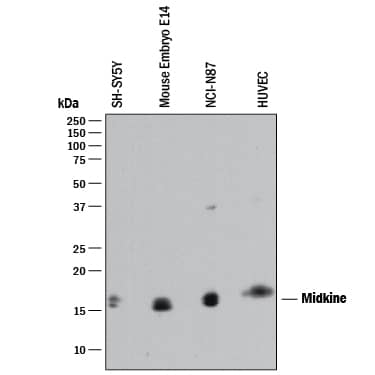 View Larger
Detection of Human Midkine by Western Blot. Western blot shows lysates of SH-SY5Y human neuroblastoma cell line, mouse embryo tissue, and NCI-N87 human gastric carcinoma cell line. PVDF membrane was probed with 0.5 µg/mL of Rabbit Anti-Human Midkine Monoclonal Antibody (Catalog # MAB258) followed by HRP-conjugated Anti-Rabbit IgG Secondary Antibody (Catalog # HAF008). A specific band was detected for Midkine at approximately 16 kDa (as indicated). This experiment was conducted under reducing conditions and using Immunoblot Buffer Group 1.
Reconstitution Calculator
Preparation and Storage
- 12 months from date of receipt, -20 °C, as supplied.
- 1 month, 2 to 8 °C under sterile conditions after opening.
- 6 months, -20 to -70 °C under sterile conditions after opening.
Background: Midkine
Midkine (MK) is a 15 kDa heparin-binding molecule originally cloned during a search for genes preferentially transcribed during retinoic acid (RA)-induced differentiation. Midkine belongs to a family of neurotrophic and developmentally-regulated heparin-binding molecules consisting of midkine, pleiotrophin (PTN/HBNF/OSF-1/HNGF-8) and the avian midkine homolog, RI-HB (for retinoic acid-inducible heparin-binding protein).
Midkine is a highly basic, nonglycosylated polypeptide that contains five intrachain disulfide bonds. The predicted molecular weight is approximately 13.3 kDa, based on a mature peptide length of 118 amino acid residues in the mouse and 121 amino acid residues in the human. Across species, MK shows 87% identity between the human and murine proteins. Between family members, human MK is approximately 50% identical to human PTN, with conservation of all 10 cysteines. Initial structure-function studies indicate that the C-terminal half of MK contains the principal heparin-binding site plus the molecule’s antigenicity and neurite-promoting sequences; while both the C- and N-termini are necessary for the molecule’s neurotrophic effects. Cells known to produce MK include endothelial cells, fetal astrocytes, renal proximal tubule epithelial cells and Wilms’ (kidney) tumor cells. MK has also been identified in the senile plaques of patients with Alzheimer’s disease. The pattern of expression of midkine during development strongly suggests a role for this factor both in epithelial-mesenchymal interactions and in development of the nervous system.
- Bohlen, P. and I. Kovesdi (1991) Prog. Growth Factor Res. 3:143.
- Muramatsu, T. (1993) Int. J. Dev. Biol. 37:183.
Product Datasheets
Product Specific Notices
* Contains <0.1% Sodium Azide, which is not hazardous at this concentration according to GHS classifications. Refer to SDS for additional information and handling instructions.FAQs
No product specific FAQs exist for this product, however you may
View all Antibody FAQsReviews for Human Midkine Antibody
There are currently no reviews for this product. Be the first to review Human Midkine Antibody and earn rewards!
Have you used Human Midkine Antibody?
Submit a review and receive an Amazon gift card.
$25/€18/£15/$25CAN/¥75 Yuan/¥2500 Yen for a review with an image
$10/€7/£6/$10 CAD/¥70 Yuan/¥1110 Yen for a review without an image
