
ADAMTS (a disintegrin and metalloproteinase with thrombospondin motifs) is a group of nineteen secreted zinc binding metalloproteases that is involved in development, inflammation, angiogenesis and several pathological conditions (1, 2). They are synthesized as zymogens which have a pro-domain that is removed by furin-like protein convertases. The mature secreted enzymes consist of catalytic, disintegrin-like, type I thrombospondin (TSP) motif, cysteine-rich, and spacer domains followed by zero to fourteen additional TSP motifs. Among ADAMTS proteases, ADAMTS1, -4, -5, -8, and -15 form a subfamily that possess aggrecanase activity (1 - 3). While ADAMTS4 and -5 (also known as aggrecanse-1 and -2, respectively) (4) have been well studied, the enzymatic activity of ADAMTS15 remains to be explored. It is suggested that ADAMTS15 may be involved in aggrecan degradation and breast cancer (5, 6). ADAMTS15 may also exhibit tumor suppressor activities since it contains genetic mutations in human colorectal carcinomas and restrains tumor growth and invasion in both in vitro and in vivo studies (7). The purified rhADAMTS15 is truncated and ends before the spacer domain.

Scientific images may be resized, cropped, or adjusted for brightness or contrast for presentation purposes. These updates are limited to presentation and do not affect the underlying scientific interpretation of the data. Where available, additional source data may be provided upon request.
Key Product Details
Species Reactivity
Applications
Label
Antibody Source
Product Specifications
Immunogen
Gly18-Cys682
Accession # Q8TE58
Specificity
Clonality
Host
Isotype
Scientific Data Images for ADAMTS15 Antibody
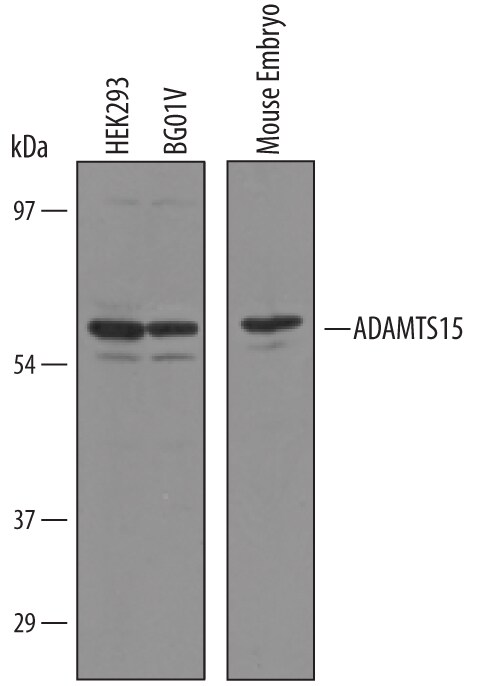
Detection of Human and Mouse ADAMTS15 by Western Blot.
Western blot shows lysates of HEK293 human embryonic kidney cell line, BG01V human embryonic stem cells, and mouse embryo tissue. PVDF Membrane was probed with 1 µg/mL of Human/Mouse ADAMTS15 Antigen Affinity-purified Polyclonal Antibody (Catalog # AF5149) followed by HRP-conjugated Anti-Sheep IgG Secondary Antibody (Catalog # HAF016). A specific band was detected for ADAMTS15 at approximately 75 kDa (as indicated). This experiment was conducted under reducing conditions and using Immunoblot Buffer Group 8.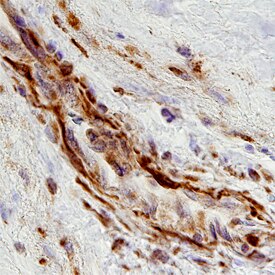
ADAMTS15 in Human Breast Cancer Tissue.
ADAMTS15 was detected in immersion fixed paraffin-embedded sections of human breast cancer tissue using Human/Mouse ADAMTS15 Antigen Affinity-purified Polyclonal Antibody (Catalog # AF5149) at 3 µg/mL overnight at 4 °C. Before incubation with the primary antibody, tissue was subjected to heat-induced epitope retrieval using Antigen Retrieval Reagent-Basic (Catalog # CTS013). Tissue was stained using the Anti-Sheep HRP-DAB Cell & Tissue Staining Kit (brown; Catalog # CTS019) and counterstained with hemotoxylin (blue). Specific staining was localized to stromal cells. View our protocol for Chromogenic IHC Staining of Paraffin-embedded Tissue Sections.Applications for ADAMTS15 Antibody
Immunohistochemistry
Sample: Immersion fixed paraffin-embedded sections of human breast cancer tissue
Immunoprecipitation
Sample: Conditioned cell culture medium spiked with Recombinant Human ADAMTS15 (Catalog # 5149-AD), see our available Western blot detection antibodies
Western Blot
Sample: HEK293 human embryonic kidney cell line, BG01V human embryonic stem cells, and mouse embryo tissue
Reviewed Applications
Read 1 review rated 4 using AF5149 in the following applications:
Formulation, Preparation, and Storage
Purification
Reconstitution
Formulation
Shipping
Stability & Storage
- 12 months from date of receipt, -20 to -70 °C as supplied.
- 1 month, 2 to 8 °C under sterile conditions after reconstitution.
- 6 months, -20 to -70 °C under sterile conditions after reconstitution.
Calculators
Background: ADAMTS15
References
- Porter, S. et al. (2005) Biochem. J. 386:15.
- Jones, G.C. and G.P. Riley (2005) Arthritis Res. Ther. 7:160.
- Nicholson, A.C. et al. (2005) BMC Evol. Biol. 5:11.
- Nagase, H. and M. Kashiwagi (2003) Arthritis Res. Ther. 5:94.
- Porter, S. et al. (2006) Intl. J. Cancer 118:1241.
- Kevorkian, L. et al. (2004) Arthritis Rheum. 50:131.
- Viloria, C.G. et al. (2009) Cancer Res. 69:4926.
Long Name
Alternate Names
Gene Symbol
UniProt
Additional ADAMTS15 Products
Product Documents for ADAMTS15 Antibody
Certificate of Analysis
To download a Certificate of Analysis, please enter a lot or batch number in the search box below.
Note: Certificate of Analysis not available for kit components.
Product Specific Notices for ADAMTS15 Antibody
For research use only
Related Research Areas
Citations for ADAMTS15 Antibody
 Powered by Bioz
Customer Reviews for ADAMTS15 Antibody (1)
Have you used ADAMTS15 Antibody?
Submit a review and receive an Amazon gift card!
$25/€18/£15/$25CAN/¥2500 for a review with an image
$10/€7/£6/$10CAN/¥1110 for a review without an image
Submit a review
Customer Images
-
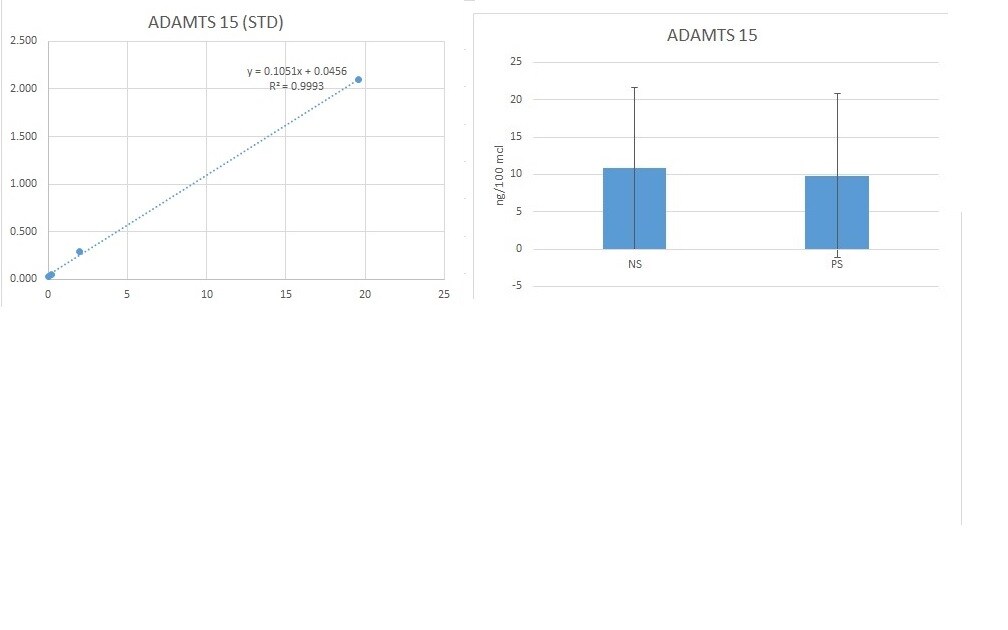
Application: ELISASample Tested: Serum and PlasmaSpecies: HumanVerified Customer | Posted 10/04/2019We used this antibody for developing a sandwich ELISA in combination with mAb (5149) and Protein std (5149-AD). This combination worked well and detected ADAMTD 15 efficiently in human serum and plasma samples.

There are no reviews that match your criteria.
Protocols
Find general support by application which include: protocols, troubleshooting, illustrated assays, videos and webinars.
- Antigen Retrieval Protocol (PIER)
- Antigen Retrieval for Frozen Sections Protocol
- Appropriate Fixation of IHC/ICC Samples
- Cellular Response to Hypoxia Protocols
- Chromogenic IHC Staining of Formalin-Fixed Paraffin-Embedded (FFPE) Tissue Protocol
- Chromogenic Immunohistochemistry Staining of Frozen Tissue
- ClariTSA™ Fluorophore Kits
- Detection & Visualization of Antibody Binding
- Fluorescent IHC Staining of Frozen Tissue Protocol
- Graphic Protocol for Heat-induced Epitope Retrieval
- Graphic Protocol for the Preparation and Fluorescent IHC Staining of Frozen Tissue Sections
- Graphic Protocol for the Preparation and Fluorescent IHC Staining of Paraffin-embedded Tissue Sections
- Graphic Protocol for the Preparation of Gelatin-coated Slides for Histological Tissue Sections
- IHC Sample Preparation (Frozen sections vs Paraffin)
- Immunofluorescent IHC Staining of Formalin-Fixed Paraffin-Embedded (FFPE) Tissue Protocol
- Immunohistochemistry (IHC) and Immunocytochemistry (ICC) Protocols
- Immunohistochemistry Frozen Troubleshooting
- Immunohistochemistry Paraffin Troubleshooting
- Immunoprecipitation Protocol
- Preparing Samples for IHC/ICC Experiments
- Preventing Non-Specific Staining (Non-Specific Binding)
- Primary Antibody Selection & Optimization
- Protocol for Heat-Induced Epitope Retrieval (HIER)
- Protocol for Making a 4% Formaldehyde Solution in PBS
- Protocol for VisUCyte™ HRP Polymer Detection Reagent
- Protocol for the Preparation & Fixation of Cells on Coverslips
- Protocol for the Preparation and Chromogenic IHC Staining of Frozen Tissue Sections
- Protocol for the Preparation and Chromogenic IHC Staining of Frozen Tissue Sections - Graphic
- Protocol for the Preparation and Chromogenic IHC Staining of Paraffin-embedded Tissue Sections
- Protocol for the Preparation and Chromogenic IHC Staining of Paraffin-embedded Tissue Sections - Graphic
- Protocol for the Preparation and Fluorescent IHC Staining of Frozen Tissue Sections
- Protocol for the Preparation and Fluorescent IHC Staining of Paraffin-embedded Tissue Sections
- Protocol for the Preparation of Gelatin-coated Slides for Histological Tissue Sections
- R&D Systems Quality Control Western Blot Protocol
- TUNEL and Active Caspase-3 Detection by IHC/ICC Protocol
- The Importance of IHC/ICC Controls
- Troubleshooting Guide: Immunohistochemistry
- Troubleshooting Guide: Western Blot Figures
- Western Blot Conditions
- Western Blot Protocol
- Western Blot Protocol for Cell Lysates
- Western Blot Troubleshooting
- Western Blot Troubleshooting Guide
- View all Protocols, Troubleshooting, Illustrated assays and Webinars