
Sirtuin 2, encoded by the SIRT2 gene, is also known as SIR2 (silent information regulator 2)-like protein 2. It is a nicotinamide adenine dinucleotide (NAD)-dependent histone/protein deacetylase (1, 2). The SIR2 family of enzymes is classified as class III histone deacetylases (HDACs) and has been implicated in many cellular processes that include histone deacetylation, gene silencing, chromosomal stability, and aging (3, 4). Unlike class I and class II HDACs, the enzymatic activity of class III HDACs is NAD dependent and insensitive to HDAC inhibitor trichostatin A (5).
Human Sirtuin 2/SIRT2 Antibody [Biotin]
R&D Systems | Catalog # BAF4358

Scientific images may be resized, cropped, or adjusted for brightness or contrast for presentation purposes. These updates are limited to presentation and do not affect the underlying scientific interpretation of the data. Where available, additional source data may be provided upon request.
Key Product Details
Species Reactivity
Human
Applications
Western Blot
Label
Biotin
Antibody Source
Polyclonal Sheep IgG
Loading...
Product Specifications
Immunogen
S. frugiperda insect ovarian cell line Sf 21-derived recombinant human Sirtuin 2/SIRT2
Ala2-Gln389
Accession # Q8IXJ6
Ala2-Gln389
Accession # Q8IXJ6
Specificity
Detects human Sirtuin 2/SIRT2 in Western blots. In Western blots, less than 1% cross-reactivity with recombinant human SIRT1 is observed.
Clonality
Polyclonal
Host
Sheep
Isotype
IgG
Scientific Data Images for Human Sirtuin 2/SIRT2 Antibody [Biotin]
Detection of Sirtuin 2/SIRT2 by Western Blot
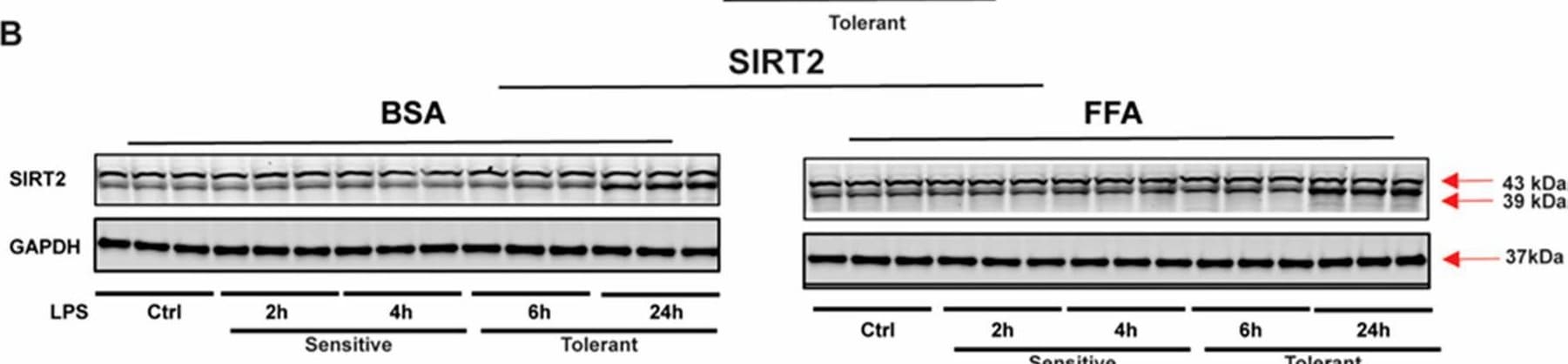
SIRT2 expression is increased in free fatty acid (FFA)-exposed tolerant RAW 264.7 cell macrophages (RAW) cells. Bovine serum albumin (BSA: vehicle for free fatty acid) or stearic acid (free fatty acid: FFA)-exposed RAW264.7 cell macrophages (RAW) were stimulated with either one or two doses of the LPS; second dose at indicated time points after 1st LPS. (A) TNF-alpha mRNA expression was evaluated by qRT–PCR analysis. (B) SIRT2 protein expression was detected by Western blot in BSA- or FFA-exposed RAW cells following a single dose of the LPS stimulation for indicated time periods. GAPDH was used as the loading control. (C) Western blot image quantification using image-J software (n = 3 each group; * p < 0.05). SIRT2 protein expression was normalized to GAPDH. (D,E). To inhibit SIRT2, after 4 h of 1st LPS exposure, cells were treated with SIRT2 inhibitor AK-7 (25 µM) and incubated further for 20 h in the presence or absence of the second dose of the LPS. TNF-alpha protein released in the cell culture media from FFA-exposed sensitive and tolerant cells was evaluated by ELISA. (* p < 0.05). IL6 (Figure 1E) protein released in the cell culture media from FFA-exposed sensitive and tolerant cells evaluated by ELISA. (* p < 0.05). Image collected and cropped by CiteAb from the following open publication (https://pubmed.ncbi.nlm.nih.gov/33810233), licensed under a CC-BY license. Not internally tested by R&D Systems.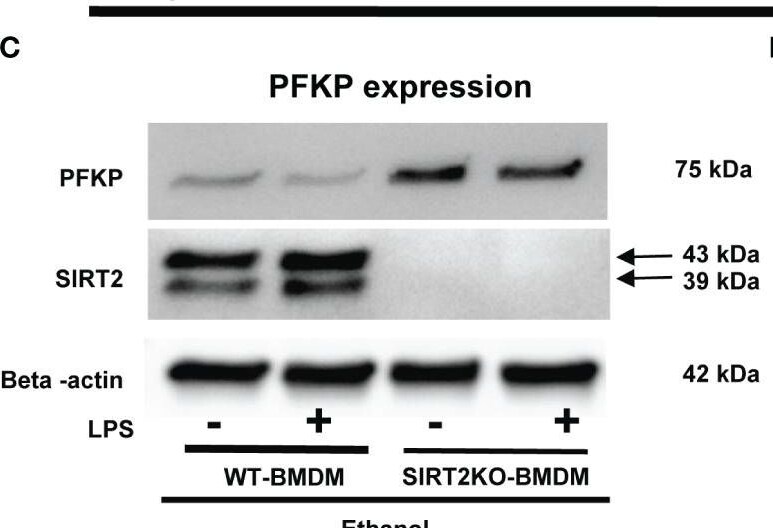
Detection of Sirtuin 2/SIRT2 by Western Blot
The effect of acute ethanol-exposure-induced SIRT2 on PFKP expression in macrophages. (A) PFKP expression in WT-BMDM exposed to vehicle or ethanol ± LPS by western blot analysis. (B) PFKP western blot image quantification of PFKP protein in vehicle vs. ethanol exposed WT-BMDM, Y axis represents fold of vehicle-LPS (fold of vehicle control) (n = 4 blots; * p < 0.05). (C) PFKP expression in Ethanol-exposed WT-BMDM and SIRT2KO-BMDM ± LPS. (D) Western blot image quantification of PFKP protein in ethanol exposed WT-BMDM and SIRT2KO-BMDM. Y axis represents fold of Ethanol-exposed WT-LPS (fold of WT- ethanol control) (n = 4 blots; * p < 0.05). (E) PFKP expression in Ethanol-exposed WT-BMDM treated with AK-7 or DMSO ± LPS. (F) Western blot image quantification of PFKP in AK-7 vs. DMSO treated-Ethanol-exposed WT-BMDM ± LPS, Y axis represents fold of Ethanol-exposed WT-LPS (fold of WT- ethanol control) (n = 4 blots; * p < 0.05). Image collected and cropped by CiteAb from the following open publication (https://pubmed.ncbi.nlm.nih.gov/36865524), licensed under a CC-BY license. Not internally tested by R&D Systems.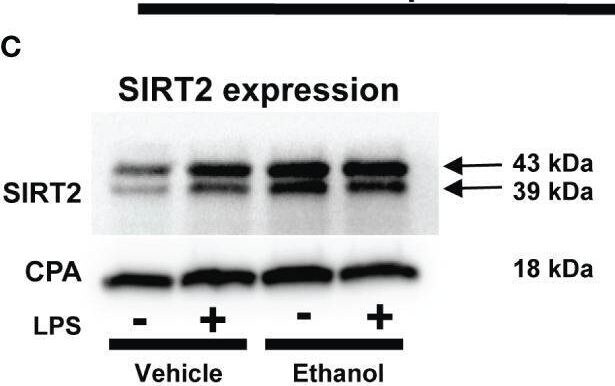
Detection of Sirtuin 2/SIRT2 by Western Blot
The effect of acute ethanol-exposure on mouse bone marrow derived macrophages (BMDM). Phagocytosis in BMDM exposed to vehicle or ethanol ± LPS to study phagocytosis using pHrodo bioparticles and SIRT2 expression. (A) Representative images of intracellular pHrodo bioparticles in vehicle or Ethanol-exposed WT-BMDM ± LPS. (B) Fluorescence quantification of pHrodo bioparticles in WT-BMDM (n=4 repetitions/group; * p<0.05). (C) SIRT2 protein expression detected by western blot in Vehicle- or Ethanol-exposed BMDM cells ± LPS. (D) Western blot image quantification of SIRT2 protein blot in vehicle or ethanol-exposed BMDM cells ± LPS (n = 4 blots/group; * p < 0.05). (E) Representative images of pHrodo bioparticles in Ethanol-exposed WT-BMDM and SIRT2KO-BMDM ± LPS. (F) Fluorescence quantification of pHrodo bioparticles in Ethanol-exposed WT-BMDM, and SIRT2KO-BMDM ± LPS. * p < 0.05. (G) Representative images of pHrodo bioparticles in Ethanol-exposed WT-BMDM, co-treated with SIRT2 inhibitor AK-7 or DMSO ± LPS. (H) Fluorescence quantification of pHrodo bioparticles in Ethanol-exposed WT-BMDM with AK-7/DMSO ± LPS stimulation. * p < 0.05. Image collected and cropped by CiteAb from the following open publication (https://pubmed.ncbi.nlm.nih.gov/36865524), licensed under a CC-BY license. Not internally tested by R&D Systems.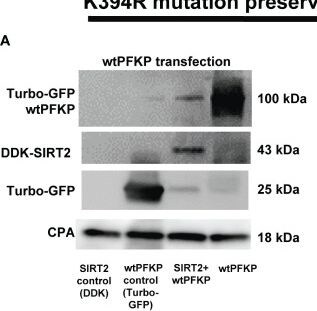
Detection of Sirtuin 2/SIRT2 by Western Blot
Effect of K394R mutation on PFKP. (A, B) HEK293T cells transfected with wtPFKP/mtPFKP in the presence or absence of SIRT2. Western blot analysis of Turbo-GFP-wtPFKP, DDK-SIRT2, turbo-GFP (control for wtPFKP plasmid transfected) and CPA. (C) mtPFKP transfection and IP using turbo-GFP-trap in HEK293T cells, in presence or absence of SIRT2 followed by IB analysis of acetyl lysine, turbo-GFP-mtPFKP and turbo-GFP (control for wtPFKP plasmid transfected). Pulldown with HEK293T cell lysate without transfection was used as a negative control. (D) Western blot analysis of turbo-GFP mtPFKP, DDK-SIRT2, turbo-GFP and CPA in whole cell lysate, used as an input for the turbo-GFP IP. (E) mtPFKP transfection and IP using magnetic-TUBEs in HEK293T cells, in presence or absence of SIRT2 followed by IB analysis of ubiquitination. (F) Western blot analysis of turbo-GFP mtPFKP, DDK-SIRT2, turbo-GFP and CPA in whole cell lysate used as input for the TUBE IP. Image collected and cropped by CiteAb from the following open publication (https://pubmed.ncbi.nlm.nih.gov/36865524), licensed under a CC-BY license. Not internally tested by R&D Systems.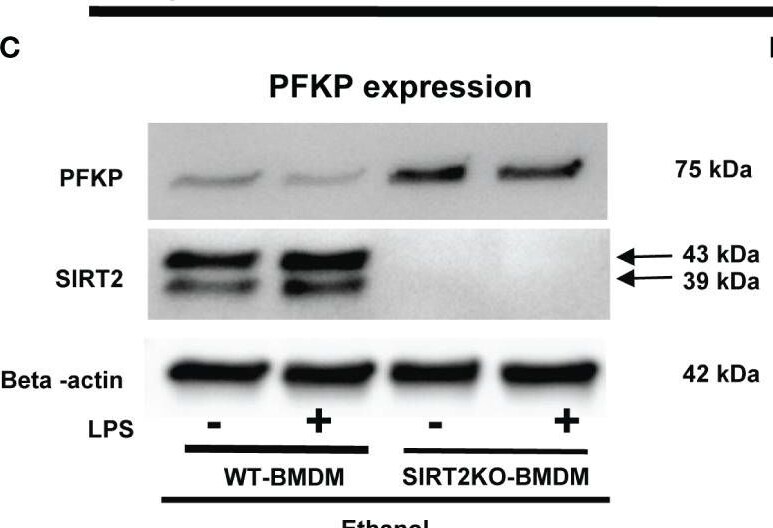
Detection of Sirtuin 2/SIRT2 by Western Blot
The effect of acute ethanol-exposure-induced SIRT2 on PFKP expression in macrophages. (A) PFKP expression in WT-BMDM exposed to vehicle or ethanol ± LPS by western blot analysis. (B) PFKP western blot image quantification of PFKP protein in vehicle vs. ethanol exposed WT-BMDM, Y axis represents fold of vehicle-LPS (fold of vehicle control) (n = 4 blots; * p < 0.05). (C) PFKP expression in Ethanol-exposed WT-BMDM and SIRT2KO-BMDM ± LPS. (D) Western blot image quantification of PFKP protein in ethanol exposed WT-BMDM and SIRT2KO-BMDM. Y axis represents fold of Ethanol-exposed WT-LPS (fold of WT- ethanol control) (n = 4 blots; * p < 0.05). (E) PFKP expression in Ethanol-exposed WT-BMDM treated with AK-7 or DMSO ± LPS. (F) Western blot image quantification of PFKP in AK-7 vs. DMSO treated-Ethanol-exposed WT-BMDM ± LPS, Y axis represents fold of Ethanol-exposed WT-LPS (fold of WT- ethanol control) (n = 4 blots; * p < 0.05). Image collected and cropped by CiteAb from the following open publication (https://pubmed.ncbi.nlm.nih.gov/36865524), licensed under a CC-BY license. Not internally tested by R&D Systems.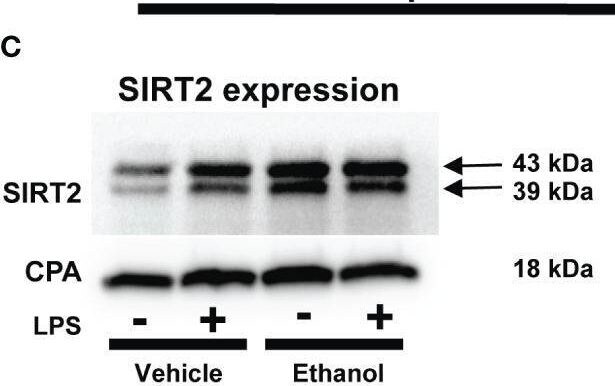
Detection of Sirtuin 2/SIRT2 by Western Blot
The effect of acute ethanol-exposure on mouse bone marrow derived macrophages (BMDM). Phagocytosis in BMDM exposed to vehicle or ethanol ± LPS to study phagocytosis using pHrodo bioparticles and SIRT2 expression. (A) Representative images of intracellular pHrodo bioparticles in vehicle or Ethanol-exposed WT-BMDM ± LPS. (B) Fluorescence quantification of pHrodo bioparticles in WT-BMDM (n=4 repetitions/group; * p<0.05). (C) SIRT2 protein expression detected by western blot in Vehicle- or Ethanol-exposed BMDM cells ± LPS. (D) Western blot image quantification of SIRT2 protein blot in vehicle or ethanol-exposed BMDM cells ± LPS (n = 4 blots/group; * p < 0.05). (E) Representative images of pHrodo bioparticles in Ethanol-exposed WT-BMDM and SIRT2KO-BMDM ± LPS. (F) Fluorescence quantification of pHrodo bioparticles in Ethanol-exposed WT-BMDM, and SIRT2KO-BMDM ± LPS. * p < 0.05. (G) Representative images of pHrodo bioparticles in Ethanol-exposed WT-BMDM, co-treated with SIRT2 inhibitor AK-7 or DMSO ± LPS. (H) Fluorescence quantification of pHrodo bioparticles in Ethanol-exposed WT-BMDM with AK-7/DMSO ± LPS stimulation. * p < 0.05. Image collected and cropped by CiteAb from the following open publication (https://pubmed.ncbi.nlm.nih.gov/36865524), licensed under a CC-BY license. Not internally tested by R&D Systems.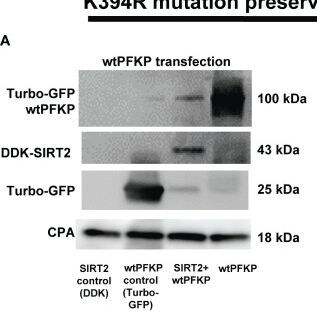
Detection of Sirtuin 2/SIRT2 by Western Blot
Effect of K394R mutation on PFKP. (A, B) HEK293T cells transfected with wtPFKP/mtPFKP in the presence or absence of SIRT2. Western blot analysis of Turbo-GFP-wtPFKP, DDK-SIRT2, turbo-GFP (control for wtPFKP plasmid transfected) and CPA. (C) mtPFKP transfection and IP using turbo-GFP-trap in HEK293T cells, in presence or absence of SIRT2 followed by IB analysis of acetyl lysine, turbo-GFP-mtPFKP and turbo-GFP (control for wtPFKP plasmid transfected). Pulldown with HEK293T cell lysate without transfection was used as a negative control. (D) Western blot analysis of turbo-GFP mtPFKP, DDK-SIRT2, turbo-GFP and CPA in whole cell lysate, used as an input for the turbo-GFP IP. (E) mtPFKP transfection and IP using magnetic-TUBEs in HEK293T cells, in presence or absence of SIRT2 followed by IB analysis of ubiquitination. (F) Western blot analysis of turbo-GFP mtPFKP, DDK-SIRT2, turbo-GFP and CPA in whole cell lysate used as input for the TUBE IP. Image collected and cropped by CiteAb from the following open publication (https://pubmed.ncbi.nlm.nih.gov/36865524), licensed under a CC-BY license. Not internally tested by R&D Systems.Applications for Human Sirtuin 2/SIRT2 Antibody [Biotin]
Application
Recommended Usage
Western Blot
0.1 µg/mL
Sample: Recombinant Human Sirtuin 2/SIRT2 (Catalog # 4358-DA)
Sample: Recombinant Human Sirtuin 2/SIRT2 (Catalog # 4358-DA)
Formulation, Preparation, and Storage
Purification
Antigen Affinity-purified
Reconstitution
Reconstitute at 0.2 mg/mL in sterile PBS.
Loading...
Formulation
Lyophilized from a 0.2 μm filtered solution in PBS with BSA as a carrier protein.
Shipping
The product is shipped at ambient temperature. Upon receipt, store it immediately at the temperature recommended below.
Stability & Storage
Use a manual defrost freezer and avoid repeated freeze-thaw cycles.
- 12 months from date of receipt, -20 to -70 °C as supplied.
- 1 month, 2 to 8 °C under sterile conditions after reconstitution.
- 6 months, -20 to -70 °C under sterile conditions after reconstitution.
Calculators
Background: Sirtuin 2/SIRT2
References
- Frye, R.A. (1999) Biochem. Biophys. Res. Commun. 260:273.
- North, B.J. et al. (2003) Mol. Cell. 11:437.
- North, B.J. and Verdin, E. (2004) Genome Biol. 5:224.
- Marmorstein, R. (2004) Biochem. Soc. Trans. 32:904.
- Gray, S.G. and Ekstrom, T.J. (2001) Exp. Cell Res. 262:75.
Long Name
Silent Mating Type Information Regulation 2 Homolog
Alternate Names
SIR2L2, SIRT2
Gene Symbol
SIRT2
UniProt
Additional Sirtuin 2/SIRT2 Products
Product Documents for Human Sirtuin 2/SIRT2 Antibody [Biotin]
Certificate of Analysis
To download a Certificate of Analysis, please enter a lot or batch number in the search box below.
Note: Certificate of Analysis not available for kit components.
Product Specific Notices for Human Sirtuin 2/SIRT2 Antibody [Biotin]
For research use only
Related Research Areas
Citations for Human Sirtuin 2/SIRT2 Antibody [Biotin]
 Powered by Bioz
Customer Reviews for Human Sirtuin 2/SIRT2 Antibody [Biotin]
There are currently no reviews for this product. Be the first to review Human Sirtuin 2/SIRT2 Antibody [Biotin] and earn rewards!
Have you used Human Sirtuin 2/SIRT2 Antibody [Biotin]?
Submit a review and receive an Amazon gift card!
$25/€18/£15/$25CAN/¥2500 for a review with an image
$10/€7/£6/$10CAN/¥1110 for a review without an image
Submit a review
Protocols
Find general support by application which include: protocols, troubleshooting, illustrated assays, videos and webinars.
- Cellular Response to Hypoxia Protocols
- R&D Systems Quality Control Western Blot Protocol
- Troubleshooting Guide: Western Blot Figures
- Western Blot Conditions
- Western Blot Protocol
- Western Blot Protocol for Cell Lysates
- Western Blot Troubleshooting
- Western Blot Troubleshooting Guide
- View all Protocols, Troubleshooting, Illustrated assays and Webinars
Loading...