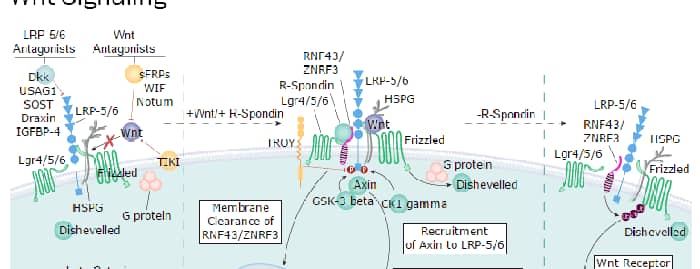
Syndecan-3, also called N-syndecan, is one of four vertebrate syndecans that are principal carriers of heparan sulfate and chondroitin sulfate glycosaminoglycans (GAGs) (1‑3). These type 1 transmembrane proteins show conserved cytoplasmic domains and divergent extracellular domains (1‑3). Human Syndecan-3 is synthesized as a 442 amino acid (aa) core protein with a 44 aa signal sequence, a 343 aa extracellular domain (ECD), a 21 aa transmembrane (TM) region and a 34 aa cytoplasmic tail with a binding site for PDZ domains (1). The ECD of human Syndecan-3 shares 83%, 83%, 92%, 91% and 91% aa identity with of mouse, rat, equine, bovine and canine Syndecan-3, respectively. Splice isoforms of 384 aa and 346 aa, containing either a 28 aa substitution for aa 1‑86 or deletion of aa 1‑96, have been reported (4). Syndecan-3 contains four conserved closely-spaced GAG attachment sites near the N-terminus and unique threonine-rich and mucin-like sequences near the membrane (4). Addition of glycan side chains results in an apparent size of 120‑150 kDa. Non-covalent homodimerization of Syndecan-3 or, potentially, heterodimerization with Syndecan-2 or -4, is dependent on the transmembrane domain (5). A cleavage site near the TM domain allows shedding of soluble ECD; the remainder of the molecule undergoes regulated intramembrane proteolysis (6). Syndecan-3 is expressed in the nervous system and at limb buds during development (1, 2). It is expressed on neuronal axons and Schwann cell perinodal processes, promoting nerve cell migration and synapse formation (7, 8). Roles in memory and body weight regulation have been described (2, 9, 10). Through localization of growth factors such as FGF2, HGF and TGF-beta, it regulates expression of molecules important for differentiation of muscle and bone, such as myogenin, BMP-2 and hedgehog family members (1, 2, 11‑13). In adults, it is upregulated during regeneration, such as following myocardial infarction (14).
Human Syndecan-3 Antibody (374412)
R&D Systems | Catalog # MAB35391

Scientific images may be resized, cropped, or adjusted for brightness or contrast for presentation purposes. These updates are limited to presentation and do not affect the underlying scientific interpretation of the data. Where available, additional source data may be provided upon request.
Key Product Details
Species Reactivity
Validated:
Cited:
Applications
Validated:
Cited:
Label
Antibody Source
Product Specifications
Immunogen
Gln48-Lys383
Accession # O75056
Specificity
Clonality
Host
Isotype
Scientific Data Images for Human Syndecan-3 Antibody (374412)
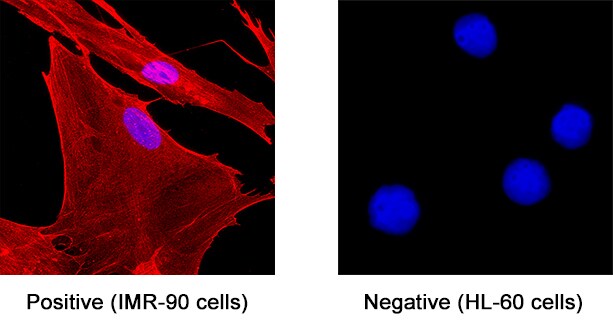
Syndecan‑3 in IMR‑90 Human Cell Line.
Syndecan‑3 was detected in immersion fixed IMR‑90 human lung fibroblast cell line (positive staining) and HL‑60 human acute promyelocytic leukemia cell line (negative staining) using Rat Anti-Human Syndecan‑3 Monoclonal Antibody (Catalog # MAB35391) at 8 µg/mL for 3 hours at room temperature. Cells were stained using the NorthernLights™ 557-conjugated Anti-Rat IgG Secondary Antibody (red; NL013) and counterstained with DAPI (blue). Specific staining was localized to cell membrane and cytoplasm. Staining was performed using our protocol for Fluorescent ICC Staining of Non-adherent Cells.Applications for Human Syndecan-3 Antibody (374412)
Immunocytochemistry
Sample: Immersion fixed IMR‑90 human lung fibroblast cell line
Formulation, Preparation, and Storage
Purification
Reconstitution
Formulation
Shipping
Stability & Storage
- 12 months from date of receipt, -20 to -70 °C as supplied.
- 1 month, 2 to 8 °C under sterile conditions after reconstitution.
- 6 months, -20 to -70 °C under sterile conditions after reconstitution.
Calculators
Background: Syndecan-3
References
- Tkachenko, E. et al. (2005) Circ. Res. 96:488.
- Reizes, O. et al. (2008) Int. J. Biochem. Cell Biol. 40:28.
- Carey, D.J. et al. (1997) J. Biol. Chem. 272:2873.
- ENTREZ protein Accession # O75056, EAX076736 and EAX07637.
- Dews, I.C. and K.R. MacKenzie (2007) Proc. Natl. Acad. Sci. USA 104:20782.
- Schultz, J.G. et al. (2003) J. Biol. Chem. 278:48651.
- Hienola, A. et al. (2006) J. Cell Biol. 174:569.
- Goutebroze, L. et al. (2003) BMC Neurosci. 4:29.
- Kaksonen, M. et al. (2002) Mol. Cell. Neurosci. 21:158.
- Strader. A.D. et al. (2004) J. Clin. Invest. 114:1354.
- Cornelison, D.D.W. et al. (2004) Genes Dev. 18:2231.
- Fisher, M.C. et al. (2006) Matrix Biol. 25:27.
- Pacifici, M. et al. (2005) J. Bone Miner. Metab. 23:191.
- Finsen, A.V. et al. (2004) Physiol. Genomics 16:301.
Alternate Names
Gene Symbol
UniProt
Additional Syndecan-3 Products
Product Documents for Human Syndecan-3 Antibody (374412)
Certificate of Analysis
To download a Certificate of Analysis, please enter a lot or batch number in the search box below.
Note: Certificate of Analysis not available for kit components.
Product Specific Notices for Human Syndecan-3 Antibody (374412)
For research use only
Related Research Areas
Citations for Human Syndecan-3 Antibody (374412)
 Powered by Bioz
Customer Reviews for Human Syndecan-3 Antibody (374412)
There are currently no reviews for this product. Be the first to review Human Syndecan-3 Antibody (374412) and earn rewards!
Have you used Human Syndecan-3 Antibody (374412)?
Submit a review and receive an Amazon gift card!
$25/€18/£15/$25CAN/¥2500 for a review with an image
$10/€7/£6/$10CAN/¥1110 for a review without an image
Submit a review
Protocols
Find general support by application which include: protocols, troubleshooting, illustrated assays, videos and webinars.
- Appropriate Fixation of IHC/ICC Samples
- Cellular Response to Hypoxia Protocols
- ClariTSA™ Fluorophore Kits
- Detection & Visualization of Antibody Binding
- ICC Cell Smear Protocol for Suspension Cells
- ICC Immunocytochemistry Protocol Videos
- ICC for Adherent Cells
- Immunocytochemistry (ICC) Protocol
- Immunocytochemistry Troubleshooting
- Immunofluorescence of Organoids Embedded in Cultrex Basement Membrane Extract
- Immunohistochemistry (IHC) and Immunocytochemistry (ICC) Protocols
- Preparing Samples for IHC/ICC Experiments
- Preventing Non-Specific Staining (Non-Specific Binding)
- Primary Antibody Selection & Optimization
- Protocol for VisUCyte™ HRP Polymer Detection Reagent
- Protocol for the Fluorescent ICC Staining of Cell Smears - Graphic
- Protocol for the Fluorescent ICC Staining of Cultured Cells on Coverslips - Graphic
- Protocol for the Preparation and Fluorescent ICC Staining of Cells on Coverslips
- Protocol for the Preparation and Fluorescent ICC Staining of Non-adherent Cells
- Protocol for the Preparation and Fluorescent ICC Staining of Stem Cells on Coverslips
- Protocol for the Preparation of a Cell Smear for Non-adherent Cell ICC - Graphic
- TUNEL and Active Caspase-3 Detection by IHC/ICC Protocol
- The Importance of IHC/ICC Controls
- View all Protocols, Troubleshooting, Illustrated assays and Webinars