Human TLR3 is a 116 kDa type I transmembrane glycoprotein that belongs to the mammalian Toll-Like Receptor family of pathogen pattern recognition molecules (1, 2). There are at least eleven mouse and ten human members that activate the innate immune system following exposure to a variety of microbial species (3). The human TLR3 cDNA encodes a 904 amino acid (aa) precursor that contains a 23 aa signal sequence, a 681 aa extracellular domain (ECD), a 21 aa transmembrane segment, and a 179 aa cytoplasmic region (4). The horseshoe shaped ECD (5, 6) contains 23 leucine rich repeats, and the cytoplasmic domain contains one Toll/IL-1 receptor (TIR) domain. The ECD of human TLR3 shares 80%, 79%, and 77% aa sequence identity with the ECD of rat, mouse, and bovine TLR3, respectively. TLR3 is found in phagosomes (7), where the acidic pH enables binding of internalized double stranded RNA and mRNA from viruses, parasites, and necrotic virally-infected cells (8 - 11). Ligand binding by TLR3 induces receptor dimerization (5, 6, 8) leading to the release of inflammatory cytokines and dendritic cell maturation (9, 11 - 13). TLR3 is expressed in dendritic cells, macrophages, microglia, and astrocytes (13 - 15) and is upregulated by IFN-beta and LPS (9, 14). TLR3 expression is also induced by lung fibroblasts and epithelial cells by respiratory syncytial virus infection (12).

Scientific images may be resized, cropped, or adjusted for brightness or contrast for presentation purposes. These updates are limited to presentation and do not affect the underlying scientific interpretation of the data. Where available, additional source data may be provided upon request.
Key Product Details
Species Reactivity
Validated:
Cited:
Applications
Validated:
Cited:
Label
Antibody Source
Product Specifications
Immunogen
Lys27-Ser711
Accession # O15455
Specificity
Clonality
Host
Isotype
Scientific Data Images for Human TLR3 Antibody
Detection of Human TLR3 by Western Blot
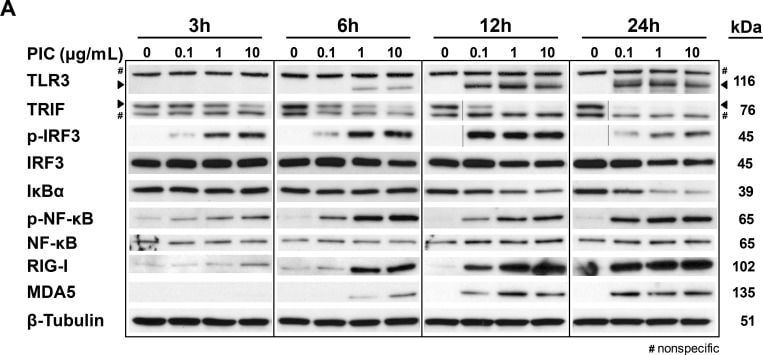
Poly(I:C) activates the TLR3/TRIF signaling.(A) HLECs were stimulated with Poly(I:C) at 0.1, 1 and 10 μg/mL for 3, 6, 12 and 24 h. Whole cell lysates were analyzed for TLR3, TRIF, phosphorylated-IRF3, total IRF3, I kappa B alpha, phosphorylated-NF-kappa B, NF-kappa B, RIG-I, MDA5, and beta -tubulin (as a loading control) by Western blot. Arrowheads indicate TLR3 (116 kDa, lower band) and TRIF (76 kDa, top band). #, indicates a nonspecific band. Immunoblots are representative of three separate experiments that all showed similar results. (B) Poly(I:C) induces nuclear translocation of NF-kappa B. HLEC were stimulated with medium (NT) or 5 μg/mL Poly(I:C) for 24 h. Immunofluorescence staining was performed using antibodies against NF-kappa B (red) and nuclei were counterstained with Hoechst 33342 (blue). Images are representative of three separate experiments (400x total magnification). Image collected and cropped by CiteAb from the following open publication (https://dx.plos.org/10.1371/journal.pone.0160875), licensed under a CC-BY license. Not internally tested by R&D Systems.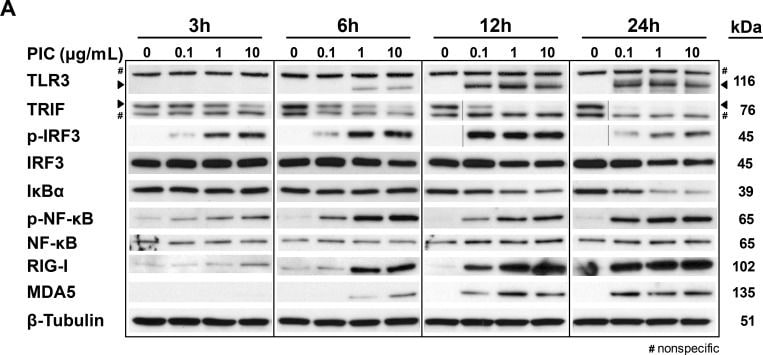
Detection of Human TLR3 by Western Blot
Poly(I:C) activates the TLR3/TRIF signaling.(A) HLECs were stimulated with Poly(I:C) at 0.1, 1 and 10 μg/mL for 3, 6, 12 and 24 h. Whole cell lysates were analyzed for TLR3, TRIF, phosphorylated-IRF3, total IRF3, I kappa B alpha, phosphorylated-NF-kappa B, NF-kappa B, RIG-I, MDA5, and beta -tubulin (as a loading control) by Western blot. Arrowheads indicate TLR3 (116 kDa, lower band) and TRIF (76 kDa, top band). #, indicates a nonspecific band. Immunoblots are representative of three separate experiments that all showed similar results. (B) Poly(I:C) induces nuclear translocation of NF-kappa B. HLEC were stimulated with medium (NT) or 5 μg/mL Poly(I:C) for 24 h. Immunofluorescence staining was performed using antibodies against NF-kappa B (red) and nuclei were counterstained with Hoechst 33342 (blue). Images are representative of three separate experiments (400x total magnification). Image collected and cropped by CiteAb from the following open publication (https://dx.plos.org/10.1371/journal.pone.0160875), licensed under a CC-BY license. Not internally tested by R&D Systems.Applications for Human TLR3 Antibody
Western Blot
Sample: Recombinant Human TLR3 (Catalog # 1487-TR)
Formulation, Preparation, and Storage
Purification
Reconstitution
Reconstitute at 0.2 mg/mL in sterile PBS. For liquid material, refer to CoA for concentration.
Formulation
Shipping
Stability & Storage
- 12 months from date of receipt, -20 to -70 °C as supplied.
- 1 month, 2 to 8 °C under sterile conditions after reconstitution.
- 6 months, -20 to -70 °C under sterile conditions after reconstitution.
Calculators
Background: TLR3
References
- Sen, G.C. and S.N. Sarkar (2005) Cytokine Growth Factor Rev. 16:1.
- Schroder, M. and A.G. Bowie (2005) Trends Immunol. 26:462.
- Hopkins, P.A. and S. Sriskandan (2005) Clin. Exp. Immunol. 140:395.
- Rock, F.L. et al. (1998) Proc. Natl. Acad. Sci. 95:588.
- Choe, J. et al. (2005) Science 309:581.
- Bell, J.K. et al. (2005) Proc. Natl. Acad. Sci. 102:10976.
- Nishiya, T. et al. (2002) J. Biol. Chem. 280:37107.
- de Bouteiller, O. et al. (2005) J. Biol. Chem. 280:38133.
- Alexopoulou, L. et al. (2001) Nature 413:732.
- Aksoy, E. et al. (2005) J. Biol. Chem. 280:277.
- Kariko, K. et al. (2004) J. Biol. Chem. 279:12542.
- Rudd, B.D. et al. (2005) J. Virol. 79:3350.
- Farina, C. et al. (2005) J. Neuroimmunol. 159:12.
- Heinz, S. et al. (2003) J. Biol. Chem. 278:21502.
- Wang, T. et al. (2004) Nat. Med. 10:1366.
Long Name
Alternate Names
Gene Symbol
UniProt
Additional TLR3 Products
Product Documents for Human TLR3 Antibody
Certificate of Analysis
To download a Certificate of Analysis, please enter a lot or batch number in the search box below.
Note: Certificate of Analysis not available for kit components.
Product Specific Notices for Human TLR3 Antibody
For research use only
Citations for Human TLR3 Antibody
 Powered by Bioz
Customer Reviews for Human TLR3 Antibody
There are currently no reviews for this product. Be the first to review Human TLR3 Antibody and earn rewards!
Have you used Human TLR3 Antibody?
Submit a review and receive an Amazon gift card!
$25/€18/£15/$25CAN/¥2500 for a review with an image
$10/€7/£6/$10CAN/¥1110 for a review without an image
Submit a review
Protocols
Find general support by application which include: protocols, troubleshooting, illustrated assays, videos and webinars.
- Cellular Response to Hypoxia Protocols
- R&D Systems Quality Control Western Blot Protocol
- Troubleshooting Guide: Western Blot Figures
- Western Blot Conditions
- Western Blot Protocol
- Western Blot Protocol for Cell Lysates
- Western Blot Troubleshooting
- Western Blot Troubleshooting Guide
- View all Protocols, Troubleshooting, Illustrated assays and Webinars