Human Total IL-18 Quantikine QuicKit ELISA
R&D Systems | Catalog # QK318


Key Product Details
Assay Length
Sample Type & Volume Required Per Well
Sensitivity
Assay Range
Product Summary for Human Total IL-18 Quantikine QuicKit ELISA
Product Specifications
Measurement
Detection Method
Conjugate
Species
Specificity
Cross-reactivity
Interference
Precision
Intra-Assay Precision (Precision within an assay) Two samples of known concentration were tested twenty times on one plate to assess intra-assay precision.
Inter-Assay Precision (Precision between assays) Two samples of known concentration were tested in ten separate assays to assess inter-assay precision. Assays were performed by at least three technicians.
Cell Culture Supernates
| Intra-Assay Precision | Inter-Assay Precision | |||
|---|---|---|---|---|
| Sample | 1 | 2 | 1 | 2 |
| n | 20 | 20 | 10 | 10 |
| Mean (pg/mL) | 105 | 507 | 114 | 552 |
| Standard Deviation | 4.15 | 12.8 | 6.12 | 43.8 |
| CV% | 4.0 | 2.5 | 5.4 | 7.9 |
EDTA Plasma, Heparin Plasma, Serum
| Intra-Assay Precision | Inter-Assay Precision | |||
|---|---|---|---|---|
| Sample | 1 | 2 | 1 | 2 |
| n | 20 | 20 | 10 | 10 |
| Mean (pg/mL) | 120 | 591 | 131 | 638 |
| Standard Deviation | 4.23 | 22.0 | 6.90 | 38.1 |
| CV% | 3.5 | 3.7 | 5.3 | 6.0 |
Recovery for Human Total IL-18 Quantikine QuicKit ELISA
The recovery of human IL-18 spiked to three different level throughout the range of the assay in various matrices was evaluated.
| Sample Type | Average % Recovery | Range % |
|---|---|---|
| Cell Culture Supernates (n=4) | 117 | 109-128 |
| EDTA Plasma (n=2) | 116 | 108-123 |
| Heparin Plasma (n=2) | 101 | 93-112 |
| Serum (n=2) | 101 | 85-117 |
Linearity
To assess the linearity of the assay, samples spiked with high concentrations of human IL-18 were serially diluted with the appropriate calibrator diluent to produce samples with values within the dynamic range of the assay.

Scientific Data Images for Human Total IL-18 Quantikine QuicKit ELISA
Human IL-18/IL-1F4 ELISA Serum/Plasma Standard Curve

Human IL-18 /IL-1F4 ELISA Cell Culture Supernate Standard Curve
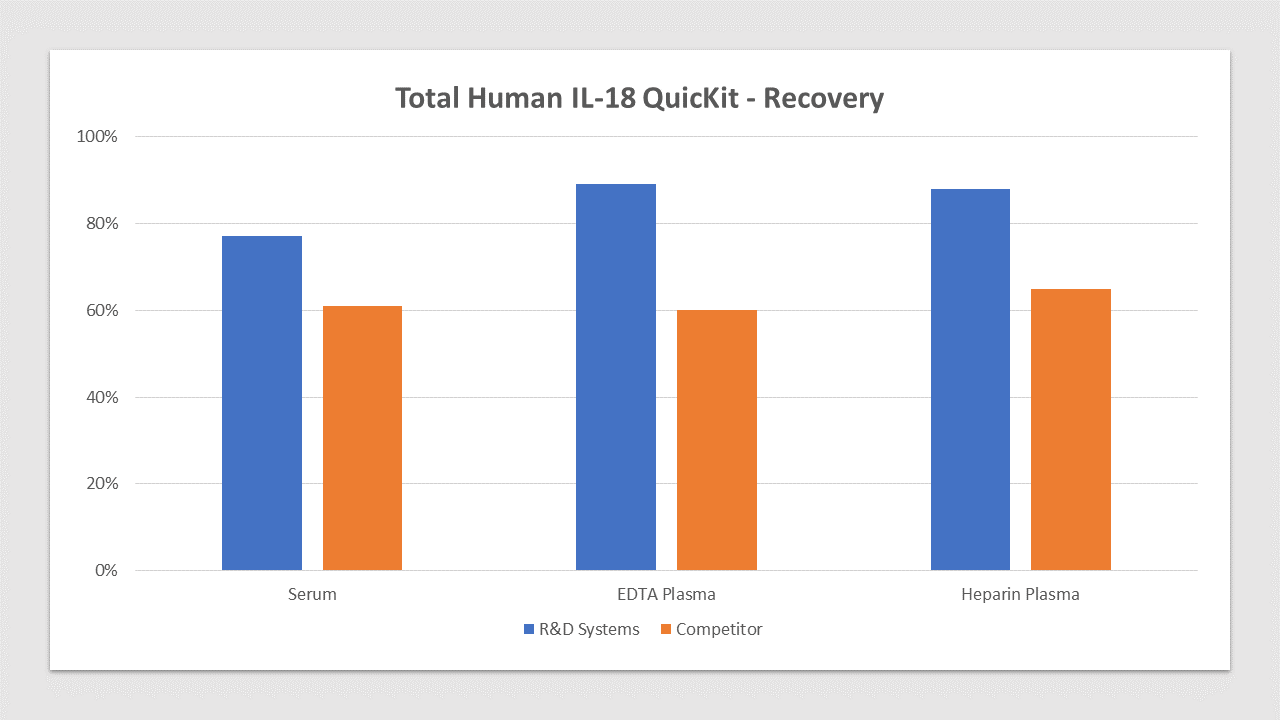
Human Total IL-18 QuicKit Spiked Recovery Competitor Comparison
Total IL-18 is spiked at three known concentrations throughout the range of the assay and run to measure response of the spiked sample matrix. Serum recovery is 77% compared to 61% for the top competitor. EDTA plasma recovery is 89% compared to 60% for the top competitor. Heparin plasma recovery is 88% compared to 65% for the top competitor. In spike and recovery experiments, natural samples are spiked with the recombinant target analyte of interest to identify interference caused by sample matrices.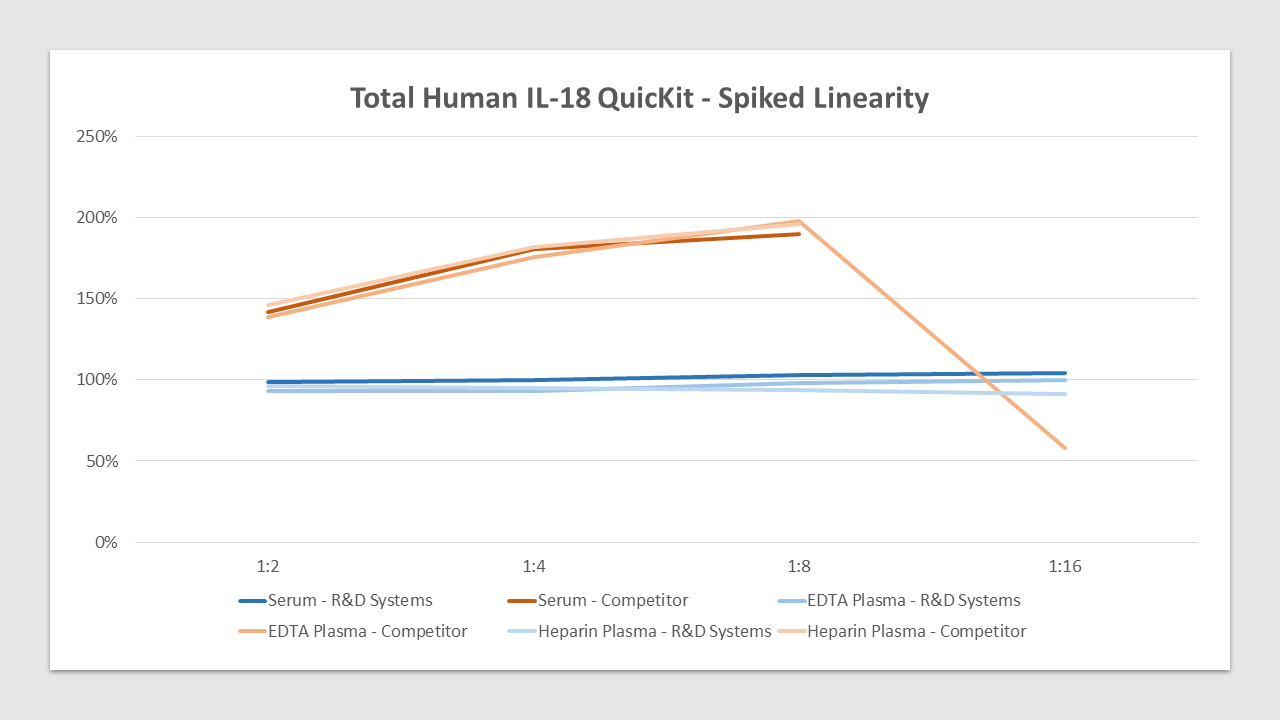
Human Total IL-18 QuicKit Spiked Linearity Competitor Comparison
Total IL-18 is spiked at high concentration in various matrices and diluted with appropriate Calibrator Diluent to produce samples with values within the dynamic range of the assay. The linearity is between 93%-104% compared to 58%-198% for the top competitor.Preparation and Storage
Shipping
Stability & Storage
Background: IL-18/IL-1F4
Long Name
Alternate Names
Gene Symbol
Additional IL-18/IL-1F4 Products
Product Documents for Human Total IL-18 Quantikine QuicKit ELISA
Certificate of Analysis
To download a Certificate of Analysis, please enter a lot or batch number in the search box below.
Note: Certificate of Analysis not available for kit components.
Product Specific Notices for Human Total IL-18 Quantikine QuicKit ELISA
For research use only
Citations for Human Total IL-18 Quantikine QuicKit ELISA
 Powered by Bioz
Customer Reviews for Human Total IL-18 Quantikine QuicKit ELISA
There are currently no reviews for this product. Be the first to review Human Total IL-18 Quantikine QuicKit ELISA and earn rewards!
Have you used Human Total IL-18 Quantikine QuicKit ELISA?
Submit a review and receive an Amazon gift card!
$25/€18/£15/$25CAN/¥2500 Yen for a review with an image
$10/€7/£6/$10CAN/¥1110 Yen for a review without an image
Submit a review
Protocols
View specific protocols for Human Total IL-18 Quantikine QuicKit ELISA (QK318):
These assays utilize an anti-tag coated microplate. Standards, samples, and controls are added to plate, followed by subsequent addition of an antibody cocktail. Following a 1 hour incubation, plates are washed and substrate is added and incubated for 20 minutes. Stop solution is then added and plates are read using a standard microplate reader.

Find general support by application which include: protocols, troubleshooting, illustrated assays, videos and webinars.
- ELISA Sample Preparation & Collection Guide
- ELISA Troubleshooting Guide
- How to Run an R&D Systems DuoSet ELISA
- How to Run an R&D Systems Quantikine ELISA
- How to Run an R&D Systems Quantikine™ QuicKit™ ELISA
- Quantikine HS ELISA Kit Assay Principle, Alkaline Phosphatase
- Quantikine HS ELISA Kit Principle, Streptavidin-HRP Polymer
- Sandwich ELISA (Colorimetric) – Biotin/Streptavidin Detection Protocol
- Sandwich ELISA (Colorimetric) – Direct Detection Protocol
- Troubleshooting Guide: ELISA
- View all Protocols, Troubleshooting, Illustrated assays and Webinars