
Human TRAIL R2, also known as DR5 and TRICK 2, is a type 1, TNF R family, transmembrane protein which is a receptor for TRAIL (APO2 Ligand). In the new TNF superfamily nomenclature, TRAIL R2 is referred to as TNFRSF10B. TRAIL R2 cDNA encodes a 440 amino acid residue precursor protein containing extracellular cysteine-rich domains, a transmembrane domain and a cytoplasmic death domain. Among TNF receptor family proteins, TRAIL R2 is most closely related to TRAIL R1/DR4, sharing 55% amino acid sequence identity. Binding of trimeric TRAIL to TRAIL R2 induces apoptosis. The induction of apoptosis likely requires oligomerization of the receptor. The human TRAIL R2/Fc chimera neutralizes the ability of TRAIL to induce apoptosis. Besides TRAIL R2, an additional TRAIL R1/DR4, which tranduces apoptosis signaling, and two TRAIL decoy receptors, which antagonize TRAIL-induced apoptosis, have been reported.
Human TRAIL R2/TNFRSF10B Antibody (71908) [PE]
R&D Systems | Catalog # FAB6311P

Scientific images may be resized, cropped, or adjusted for brightness or contrast for presentation purposes. These updates are limited to presentation and do not affect the underlying scientific interpretation of the data. Where available, additional source data may be provided upon request.
Key Product Details
Species Reactivity
Validated:
Cited:
Applications
Validated:
Cited:
Label
Antibody Source
Product Specifications
Immunogen
Ile56-Glu182
Accession # O14763
Specificity
Clonality
Host
Isotype
Scientific Data Images for Human TRAIL R2/TNFRSF10B Antibody (71908) [PE]
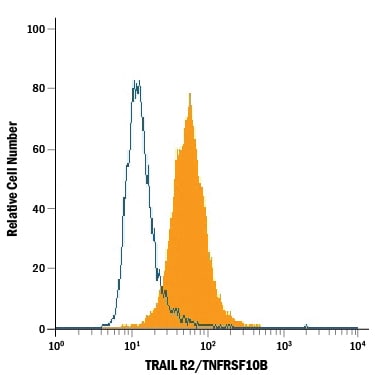
MDA‑MB‑231 Human Cell Line by Flow Cytometry.
MDA-MB-231 human breast cancer cell line was stained with Mouse Anti-Human TRAIL R2/TNFRSF10B PE-conjugated Monoclonal Antibody (Catalog # FAB6311P, filled histogram) or isotype control antibody (Catalog # IC0041P, open histogram). View our protocol for Staining Membrane-associated Proteins.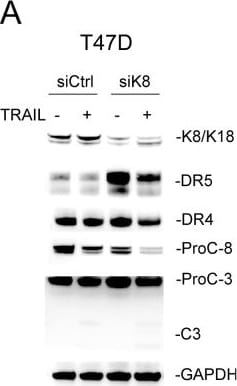
Detection of TRAIL R2/TNFRSF10B by Western Blot
Knockdown of K8 enhances TRAIL induced apoptosis(A-C) Cells were transfected with a control siRNA or siRNA specific to KRT8 transcript for 72 hours, followed by TRAIL stimulation (100 ng/ml [T47D and BT474] or 150 ng/ml [MCF7]) for 24 hours. The resultant cells were analyzed by immunoblotting using antibodies specific to K8/K18, DR4, DR5, caspase-3, caspase-8, and glyceraldehyde 3-phosphate dehydrogenase (GAPDH). Caspase activation was identified by decrease in pro-enzyme form (ProC-8 and ProC-3). (D-F) Cells were treated as above and analyzed by flow cytometry after staining with Annexin-V-FITC and propidium iodide (PI). Image collected and cropped by CiteAb from the following open publication (https://pubmed.ncbi.nlm.nih.gov/29796187), licensed under a CC-BY license. Not internally tested by R&D Systems.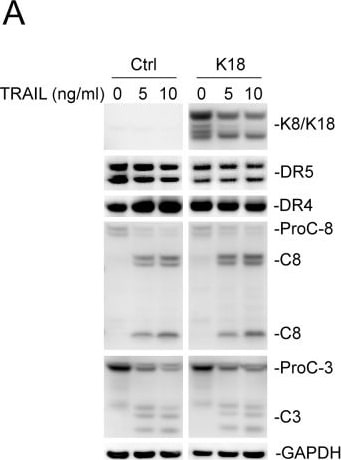
Detection of TRAIL R2/TNFRSF10B by Western Blot
Keratin 8/18 overexpression downregulates total DR5 protein levels(A) MDA-MB-231 cells were transfected with a control plasmid or plasmid encoding human keratin 18 for 24 hours, followed by TRAIL stimulation (0, 5, 10 ng/ml) for 3 hours. The resultant cells were analyzed by immunoblotting using antibodies against K8/K18, DR5, DR4, caspase-8, caspase-3, and glyceraldehyde 3-phosphate dehydrogenase (GAPDH). Caspase activation is indicated by a decrease in pro-enzyme form (ProC-8 and ProC-3) and by the simultaneous appearance of cleaved fragments. Results are from non-adjoining lanes from the same gel. (B) Relative total DR5 and DR4 protein levels were quantified using densitometry analysis of immunoblots in A and were normalized to GAPDH loading controls. P-values were determined using a student’s t-test. Image collected and cropped by CiteAb from the following open publication (https://pubmed.ncbi.nlm.nih.gov/29796187), licensed under a CC-BY license. Not internally tested by R&D Systems.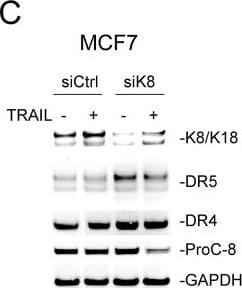
Detection of TRAIL R2/TNFRSF10B by Western Blot
Knockdown of K8 enhances TRAIL induced apoptosis(A-C) Cells were transfected with a control siRNA or siRNA specific to KRT8 transcript for 72 hours, followed by TRAIL stimulation (100 ng/ml [T47D and BT474] or 150 ng/ml [MCF7]) for 24 hours. The resultant cells were analyzed by immunoblotting using antibodies specific to K8/K18, DR4, DR5, caspase-3, caspase-8, and glyceraldehyde 3-phosphate dehydrogenase (GAPDH). Caspase activation was identified by decrease in pro-enzyme form (ProC-8 and ProC-3). (D-F) Cells were treated as above and analyzed by flow cytometry after staining with Annexin-V-FITC and propidium iodide (PI). Image collected and cropped by CiteAb from the following open publication (https://pubmed.ncbi.nlm.nih.gov/29796187), licensed under a CC-BY license. Not internally tested by R&D Systems.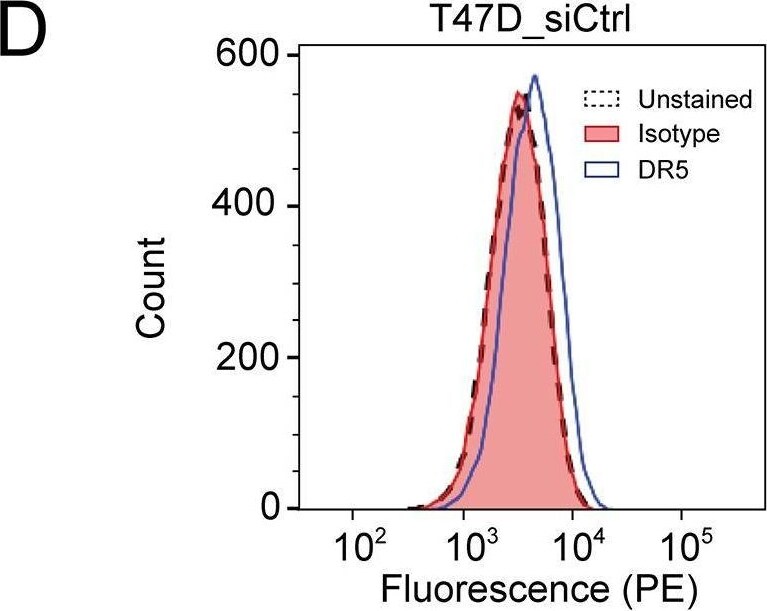
Detection of TRAIL R2/TNFRSF10B by Flow Cytometry
K8/K18 physically interacts with DR5(A) Cell lysates from MCF7 and T47D cell lines were subjected to immunoprecipitation (IP) with an anti-K8/K18 antibody immobilized to protein A-agarose (lane 2 and 4) or with protein A-agarose alone (lane 1 and 3). IP samples were immunoblotted for DR5. (B) Cells were fixed, permeabilized, stained with anti-DR5 antibody (red) and anti-keratin 8 antibody (green), and analyzed by confocal microscopy. All images were acquired using a 40x objective lens. (C) MCF7 cells were transfected with control siRNA or siRNA against KRT8 for 72 hr. The resultant cells were fixed, permeabilized, and stained with anti-DR5 antibody (red), DAPI (nuclei, blue), and fluorescent phalloidin 488 for actin visualization (green). All images were acquired using a 40x objective lens. (D-F) Flow cytometry analysis of cells transfected with control siRNA or siRNA against KRT8. The resultant cells were harvested using a non-enzymatic cell dissociation solution. The cell samples were incubated with PE conjugated anti-DR5 antibody (IgG2b) or its corresponding IgG2b isotype as a control. (D) Shown are representative histograms of unstained cells (black dashed line), cells stained with the isotype control (red fill), and cells stained with PE-anti-DR5 antibody (blue outline with no fill). The right shift represents the presence of DR5 on the cell surface membrane. Median PE-anti-DR5 antibody fluorescence intensity for cells transfected with control siRNA and siRNA targeting keratin 8 are shown after subtraction of isotype control median fluorescence intensity in two independent experiments for T47D cells (E) and MCF7 cells (F). Image collected and cropped by CiteAb from the following open publication (https://pubmed.ncbi.nlm.nih.gov/29796187), licensed under a CC-BY license. Not internally tested by R&D Systems.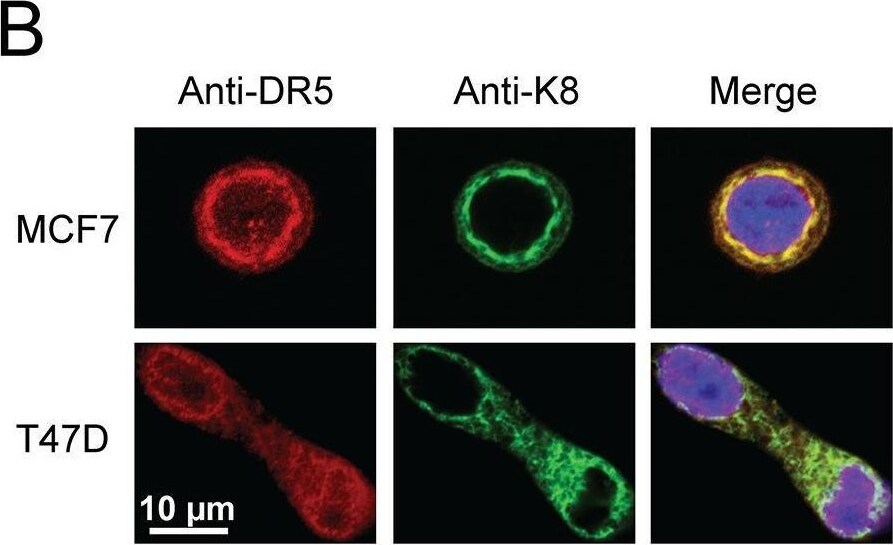
Detection of TRAIL R2/TNFRSF10B by Immunocytochemistry/ Immunofluorescence
K8/K18 physically interacts with DR5(A) Cell lysates from MCF7 and T47D cell lines were subjected to immunoprecipitation (IP) with an anti-K8/K18 antibody immobilized to protein A-agarose (lane 2 and 4) or with protein A-agarose alone (lane 1 and 3). IP samples were immunoblotted for DR5. (B) Cells were fixed, permeabilized, stained with anti-DR5 antibody (red) and anti-keratin 8 antibody (green), and analyzed by confocal microscopy. All images were acquired using a 40x objective lens. (C) MCF7 cells were transfected with control siRNA or siRNA against KRT8 for 72 hr. The resultant cells were fixed, permeabilized, and stained with anti-DR5 antibody (red), DAPI (nuclei, blue), and fluorescent phalloidin 488 for actin visualization (green). All images were acquired using a 40x objective lens. (D-F) Flow cytometry analysis of cells transfected with control siRNA or siRNA against KRT8. The resultant cells were harvested using a non-enzymatic cell dissociation solution. The cell samples were incubated with PE conjugated anti-DR5 antibody (IgG2b) or its corresponding IgG2b isotype as a control. (D) Shown are representative histograms of unstained cells (black dashed line), cells stained with the isotype control (red fill), and cells stained with PE-anti-DR5 antibody (blue outline with no fill). The right shift represents the presence of DR5 on the cell surface membrane. Median PE-anti-DR5 antibody fluorescence intensity for cells transfected with control siRNA and siRNA targeting keratin 8 are shown after subtraction of isotype control median fluorescence intensity in two independent experiments for T47D cells (E) and MCF7 cells (F). Image collected and cropped by CiteAb from the following open publication (https://pubmed.ncbi.nlm.nih.gov/29796187), licensed under a CC-BY license. Not internally tested by R&D Systems.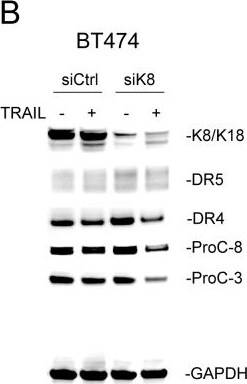
Detection of TRAIL R2/TNFRSF10B by Western Blot
Knockdown of K8 enhances TRAIL induced apoptosis(A-C) Cells were transfected with a control siRNA or siRNA specific to KRT8 transcript for 72 hours, followed by TRAIL stimulation (100 ng/ml [T47D and BT474] or 150 ng/ml [MCF7]) for 24 hours. The resultant cells were analyzed by immunoblotting using antibodies specific to K8/K18, DR4, DR5, caspase-3, caspase-8, and glyceraldehyde 3-phosphate dehydrogenase (GAPDH). Caspase activation was identified by decrease in pro-enzyme form (ProC-8 and ProC-3). (D-F) Cells were treated as above and analyzed by flow cytometry after staining with Annexin-V-FITC and propidium iodide (PI). Image collected and cropped by CiteAb from the following open publication (https://pubmed.ncbi.nlm.nih.gov/29796187), licensed under a CC-BY license. Not internally tested by R&D Systems.Applications for Human TRAIL R2/TNFRSF10B Antibody (71908) [PE]
Flow Cytometry
Sample: MDA‑MB‑231 human breast cancer cell line
Reviewed Applications
Read 1 review rated 4 using FAB6311P in the following applications:
Spectra Viewer
Plan Your Experiments
Use our spectra viewer to interactively plan your experiments, assessing multiplexing options. View the excitation and emission spectra for our fluorescent dye range and other commonly used dyes.
Spectra Viewer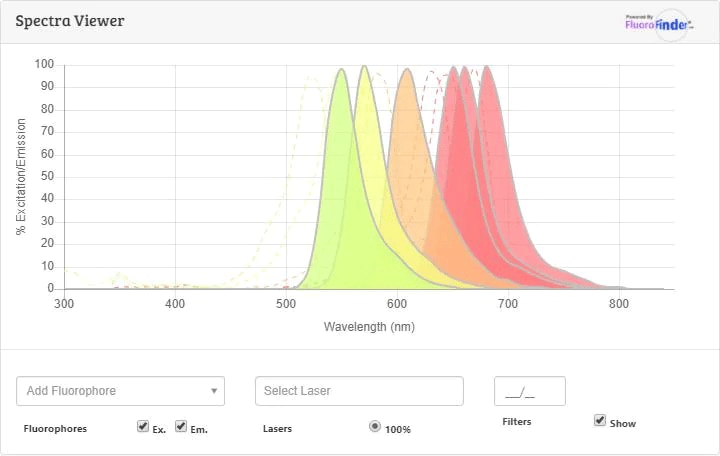
Flow Cytometry Panel Builder
Bio-Techne Knows Flow Cytometry
Save time and reduce costly mistakes by quickly finding compatible reagents using the Panel Builder Tool.
Advanced Features
- Spectra Viewer - Custom analysis of spectra from multiple fluorochromes
- Spillover Popups - Visualize the spectra of individual fluorochromes
- Antigen Density Selector - Match fluorochrome brightness with antigen density

Formulation, Preparation, and Storage
Purification
Formulation
Shipping
Stability & Storage
- 12 months from date of receipt, 2 to 8 °C as supplied.
Background: TRAIL R2/TNFRSF10B
Long Name
Alternate Names
Gene Symbol
UniProt
Additional TRAIL R2/TNFRSF10B Products
Product Documents for Human TRAIL R2/TNFRSF10B Antibody (71908) [PE]
Certificate of Analysis
To download a Certificate of Analysis, please enter a lot or batch number in the search box below.
Note: Certificate of Analysis not available for kit components.
Product Specific Notices for Human TRAIL R2/TNFRSF10B Antibody (71908) [PE]
For research use only
Citations for Human TRAIL R2/TNFRSF10B Antibody (71908) [PE]
 Powered by Bioz
Customer Reviews for Human TRAIL R2/TNFRSF10B Antibody (71908) [PE] (1)
Have you used Human TRAIL R2/TNFRSF10B Antibody (71908) [PE]?
Submit a review and receive an Amazon gift card!
$25/€18/£15/$25CAN/¥2500 for a review with an image
$10/€7/£6/$10CAN/¥1110 for a review without an image
Submit a review
-
Application: Flow CytometrySample Tested: See PMID: 22643355Species: HumanVerified Customer | Posted 01/27/2015
There are no reviews that match your criteria.
Protocols
Find general support by application which include: protocols, troubleshooting, illustrated assays, videos and webinars.
- 7-Amino Actinomycin D (7-AAD) Cell Viability Flow Cytometry Protocol
- Extracellular Membrane Flow Cytometry Protocol
- Flow Cytometry Protocol for Cell Surface Markers
- Flow Cytometry Protocol for Staining Membrane Associated Proteins
- Flow Cytometry Staining Protocols
- Flow Cytometry Troubleshooting Guide
- Intracellular Flow Cytometry Protocol Using Alcohol (Methanol)
- Intracellular Flow Cytometry Protocol Using Detergents
- Intracellular Nuclear Staining Flow Cytometry Protocol Using Detergents
- Intracellular Staining Flow Cytometry Protocol Using Alcohol Permeabilization
- Intracellular Staining Flow Cytometry Protocol Using Detergents to Permeabilize Cells
- Propidium Iodide Cell Viability Flow Cytometry Protocol
- Protocol for Liperfluo
- Protocol for the Characterization of Human Th22 Cells
- Protocol for the Characterization of Human Th9 Cells
- Protocol: Annexin V and PI Staining by Flow Cytometry
- Protocol: Annexin V and PI Staining for Apoptosis by Flow Cytometry
- Troubleshooting Guide: Fluorokine Flow Cytometry Kits
- View all Protocols, Troubleshooting, Illustrated assays and Webinars
Associated Pathways

