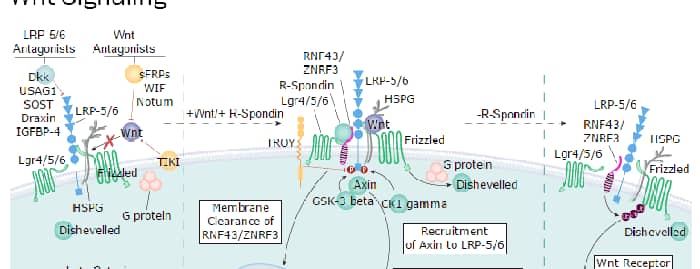
Wnt-5a is a 44-50 kDa member of the Wnt family of proteins (1-6). Based on its activity towards C57Mg mammary epithelium, it is classified as a nontransforming Wnt. Human Wnt‑5a is synthesized as a 380 amino acid (aa) precursor that contains a 37 aa signal sequence, a 25 aa prosegment, and a 319 aa mature region (1, 2, 3). The mature region has 24 cysteine residues that form multiple intrachain disulfide bonds, plus four N‑linked glycosylation sites that are utilized for proper secretion (3, 5, 7). There is also a palmitate adduct at Cys104 that is essential for activity, and a potential palmitoleic acid modification at Ser244 that may also contribute to secretion (7-9). One alternative start site is reported at Met16. Over aa 38-380, human and mouse Wnt‑5a are identical in amino acid sequence (1, 10). Cells known to express Wnt‑5a include brainstem astrocytes (11), mammary epithelium (12), CD34+ primitive progenitor stem cells (13), chondrocytes (14), CD34- pericytes and vascular smooth muscle cells (15), plus mesenchymal cells at various sites (16, 17). There are multiple receptors for Wnt‑5a. These include Fzd‑1, ‑2, ‑3, -4, -5, and -7 (3, 18-22), Ror2 (3), LRP6 (23), Ryk (24) and sFRP1 (25). All these molecules function within the context of a larger number of "co‑factors" that regulate signaling by the Wnts. Initially, it was suggested that there were three pathways for Wnt signaling; a beta -catenin-mediated canonical pathway, and two noncanonical pathways described as the Wnt/JNK (PCP) pathway and the Wnt/Ca++ pathway (26, 27). And it was assumed that various Wnts could be accommodated by these classifications. At present, it is now recognized that individual Wnts, through various combinations of receptor complex subunits, can have diverse effects, perhaps even within the same cell (3, 6, 27). Further complexity is introduced by the fact that Xenopus Wnt‑5a and Wnt‑11 are known to form bioactive heterodimers following Tyr sulfation (28). Thus, predicting the activity of Wnt‑5a, or any other Wnt, on any cell type will require substantial insight into the interaction between all the extracellular, cell surface and intracellular components of the Wnt signaling system.
Human Wnt-5a Antibody (871117R) [Alexa Fluor™ Plus 680]
R&D Systems | Catalog # FAB6452AFP680

![Human Wnt-5a Antibody (871117R) [Alexa Fluor™ Plus 680]](https://resources.rndsystems.com/images/icons/RnD-Default-Product-Image_Antibodies-Icon.svg "Human Wnt-5a Antibody (871117R) [Alexa Fluor™ Plus 680]")
Key Product Details
Species Reactivity
Applications
Label
Antibody Source
Product Specifications
Immunogen
Specificity
Clonality
Host
Isotype
Applications for Human Wnt-5a Antibody (871117R) [Alexa Fluor™ Plus 680]
ELISA
Formulation, Preparation, and Storage
Formulation
Shipping
Stability & Storage
Background: Wnt-5a
References
- Clark, C.C. et al. (1993) Genomics 18:249.
- LeJeune, S. et al. (1995) Clin. Cancer Res. 1:215.
- Mikels, A.J. & R. Nusse (2006) PLoS Biol. 4:e115.
- Nishita, M. et al. (2010) Trends Cell Biol. 20:346.
- Mikels, A.J. & R. Nusse (2006) Oncogene 25:7461.
- van Amerongen, R. & R. Nusse (2009) Development 136:3205.
- Kurayoshi, M. et al. (2007) Biochem. J. 402:515.
- Takada, R. et al. (2006) Dev. Cell 11:791.
- Port, F. & K. Basler (2010) Traffic May 3. [Epub ahead of print].
- Gavin, B.J. et al. (1990) Genes Dev. 4:2319.
- Castelo-Branco, G. et al. (2006) Mol. Cell. Neurosci. 31:251.
- Jonsson, M. et al. (1998) Br. J. Cancer 78:430.
- van Den Berg, D.J. et al. (1998) Blood 92:3189.
- Kruger, C. & C. Kappen (2010) PLoS One 5:e8978.
- Lin, G. et al. (2008) Stem Cells Dev. 17:1053.
- Lickert, H. et al. (2001) Mech. Dev. 105:181.
- Danielson, K.G. et al. (1995) J. Biol. Chem. 270:31225.
- Gazit, A. et al. (1999) Oncogene 18:5959.
- Bazhin, A. V. et al. (2010) Cell. Mol. Life Sci. 67:817.
- Kawasaki, A. et al. (2007) Cell. Signal. 19:2498.
- Blumenthal, A. et al. (2006) Blood 108:965.
- Umbhauer, M. et al. (2000) EMBO J. 19:4944.
- Bryja, V. et al. (2009) Mol. Biol. Cell 20:924.
- Keeble, T.R. et al. (2006) J. Neurosci. 26:5840.
- Lin, K. et al. (1997) Proc. Natl. Acad. Sci. USA 94:11196.
- Rao, T.P. & M. Kuhl (2010) Circ. Res. 106:1798.
- McDonald, S.L. & A. Silver (2009) Br. J. Cancer 101:209.
- Cha, S-W. et al. (2009) Curr. Biol. 19:1573.
Long Name
Alternate Names
Gene Symbol
UniProt
Additional Wnt-5a Products
Product Documents for Human Wnt-5a Antibody (871117R) [Alexa Fluor™ Plus 680]
Certificate of Analysis
To download a Certificate of Analysis, please enter a lot or batch number in the search box below.
Note: Certificate of Analysis not available for kit components.
Product Specific Notices for Human Wnt-5a Antibody (871117R) [Alexa Fluor™ Plus 680]
This conjugate is made on demand and is not held in inventory. Each order represents a unique lot. All conjugates are generated using validated conjugation protocols and meet strict degree of labeling (F/P) specifications; additional information is available upon request. The antibody concentration is provided on the individual product label.
Recommended applications are based on validated applications from the unconjugated base product MAB6452.
For specialized conjugation needs, like large quantities, specific concentrations, and defined F/P ratios, bulk and custom antibody conjugation services are available.
This product is provided under an intellectual property license from Life Technologies Corporation. The transfer of this product is conditioned on the buyer using the purchased product solely in research conducted by the buyer, excluding contract research or any fee for service research, and the buyer must not (1) use this product or its components for (a) diagnostic, therapeutic or prophylactic purposes; (b) testing, analysis or screening services, or information in return for compensation on a per-test basis; or (c) manufacturing or quality assurance or quality control, and/or (2) sell or transfer this product or its components for resale, whether or not resold for use in research. For information on purchasing a license to this product for purposes other than as described above, contact Life Technologies Corporation, 5781 Van Allen Way, Carlsbad, CA 92008 USA or outlicensing@thermofisher.com.
For research use only
Related Research Areas
Customer Reviews for Human Wnt-5a Antibody (871117R) [Alexa Fluor™ Plus 680]
There are currently no reviews for this product. Be the first to review Human Wnt-5a Antibody (871117R) [Alexa Fluor™ Plus 680] and earn rewards!
Have you used Human Wnt-5a Antibody (871117R) [Alexa Fluor™ Plus 680]?
Submit a review and receive an Amazon gift card!
$25/€18/£15/$25CAN/¥2500 for a review with an image
$10/€7/£6/$10CAN/¥1110 for a review without an image
Submit a review
Protocols
Find general support by application which include: protocols, troubleshooting, illustrated assays, videos and webinars.
- ELISA Sample Preparation & Collection Guide
- ELISA Troubleshooting Guide
- How to Run an R&D Systems DuoSet ELISA
- How to Run an R&D Systems Quantikine ELISA
- How to Run an R&D Systems Quantikine™ QuicKit™ ELISA
- Quantikine HS ELISA Kit Assay Principle, Alkaline Phosphatase
- Quantikine HS ELISA Kit Principle, Streptavidin-HRP Polymer
- Sandwich ELISA (Colorimetric) – Biotin/Streptavidin Detection Protocol
- Sandwich ELISA (Colorimetric) – Direct Detection Protocol
- Troubleshooting Guide: ELISA
- View all Protocols, Troubleshooting, Illustrated assays and Webinars