
Goat anti-Human IgG Fc Secondary Antibody
Novus Biologicals | Catalog # NB7446

![Immunohistochemistry: Goat anti-Human IgG Fc Secondary Antibody [NB7446]](https://resources.rndsystems.com/images/products/Goat-anti-Human-IgG-Fc-fragment-Secondary-Antibody-Immunohistochemistry-NB7446-img0002.jpg "Immunohistochemistry: Goat anti-Human IgG Fc Secondary Antibody [NB7446]")
Scientific images may be resized, cropped, or adjusted for brightness or contrast for presentation purposes. These updates are limited to presentation and do not affect the underlying scientific interpretation of the data. Where available, additional source data may be provided upon request.
Key Product Details
Species Reactivity
Applications
Label
Antibody Source
Product Specifications
Immunogen
Specificity
Clonality
Host
Isotype
Description
Scientific Data Images for Goat anti-Human IgG Fc Secondary Antibody
Immunohistochemistry: Goat anti-Human IgG Fc Secondary Antibody [NB7446]
Goat-anti-Human-IgG-Fc-fragment-Secondary-Antibody-Immunohistochemistry-NB7446-img0002.jpg![Western Blot: Goat anti-Human IgG Fc Secondary Antibody [NB7446]](https://resources.rndsystems.com/images/products/Goat-anti-Human-IgG-Fc-Secondary-Antibody-Western-Blot-NB7446-img0001.jpg "Western Blot: Goat anti-Human IgG Fc Secondary Antibody [NB7446]")
Western Blot: Goat anti-Human IgG Fc Secondary Antibody [NB7446]
Western Blot: Goat anti-Human IgG Fc Secondary Antibody [NB7446] - Image from verified customer review. Image using the HRP form of this antibody.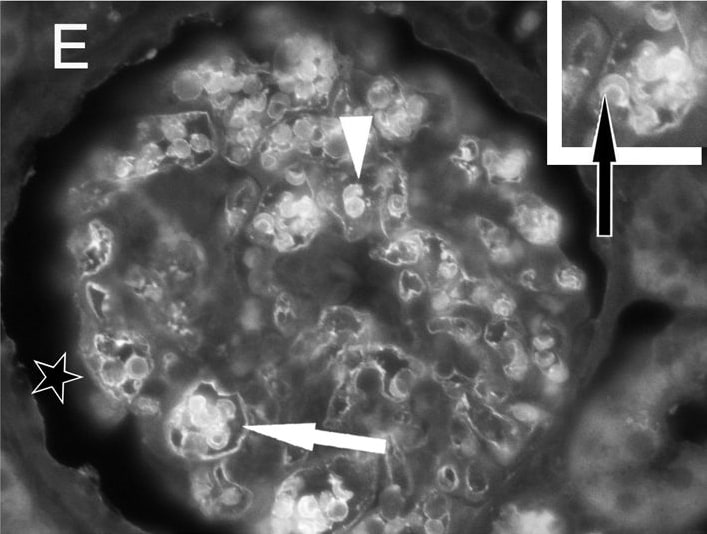
Immunohistochemistry: Goat anti-Human IgG Fc Secondary Antibody [NB7446] -
Immunohistochemistry: Goat anti-Human IgG Fc Secondary Antibody [NB7446] - Immune fluorescent photomicrographs of glomeruli from control (A), aflibercept-treated (B–D) & ranibizumab-treated (E–F) monkeys eyes.In all figures, the asterisks label the spaces of the Bowman capsule. A) Kidney sections from the control animal did not show any specific staining with anti-human IgG-Fc antibody in the glomeruli. Only the erythrocytes (arrow) within the capillaries showed a weak fluorescence. B) One day after aflibercept injection, the endothelium cell layer & material within the capillaries of a glomerulus were highly fluorescent (white arrow) after labelling with an antibody against the Fc region of IgG. In an adjacent glomerulus, only the endothelium was stained (white arrowhead) whereas the lumina of the vessels did not contain IgG-Fc positive material (black arrow). C) Erythrocytes within the glomeruli (arrowhead) as well as the endothelium (arrow) were highly fluorescent. D) Seven days after aflibercept injection, the fluorescent material within the capillaries (arrowhead) & the fluorescence intensity of the endothelium became weaker. E) One day after ranibizumab injection, the endothelium cell layer (white arrow) & erythrocytes (arrowhead & black arrow in the inset) were fluorescent after staining with an antibody against human Fab of IgG. F) The specific fluorescence of the endothelium (arrow) & erythrocytes (arrowhead) was nearly lost seven days after injection of ranibizumab. Image collected & cropped by CiteAb from the following publication (https://pubmed.ncbi.nlm.nih.gov/25415380), licensed under a CC-BY license. Not internally tested by Novus Biologicals.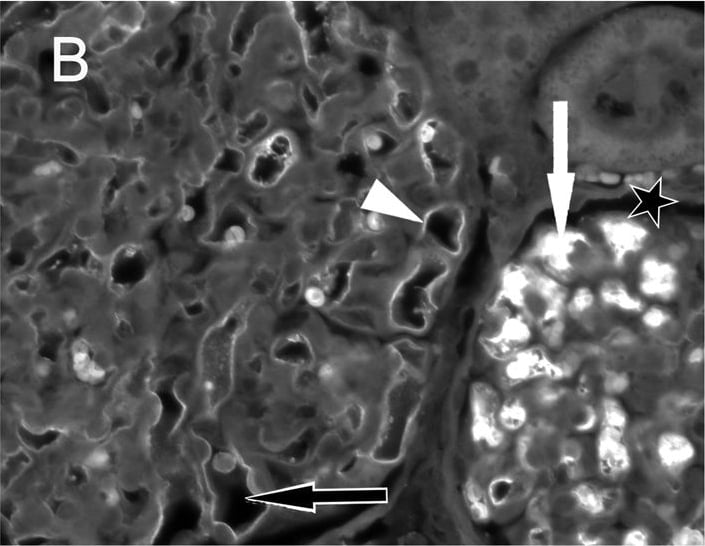
Immunohistochemistry: Goat anti-Human IgG Fc Secondary Antibody [NB7446] -
Immunohistochemistry: Goat anti-Human IgG Fc Secondary Antibody [NB7446] - Immune fluorescent photomicrographs of glomeruli from control (A), aflibercept-treated (B–D) & ranibizumab-treated (E–F) monkeys eyes.In all figures, the asterisks label the spaces of the Bowman capsule. A) Kidney sections from the control animal did not show any specific staining with anti-human IgG-Fc antibody in the glomeruli. Only the erythrocytes (arrow) within the capillaries showed a weak fluorescence. B) One day after aflibercept injection, the endothelium cell layer & material within the capillaries of a glomerulus were highly fluorescent (white arrow) after labelling with an antibody against the Fc region of IgG. In an adjacent glomerulus, only the endothelium was stained (white arrowhead) whereas the lumina of the vessels did not contain IgG-Fc positive material (black arrow). C) Erythrocytes within the glomeruli (arrowhead) as well as the endothelium (arrow) were highly fluorescent. D) Seven days after aflibercept injection, the fluorescent material within the capillaries (arrowhead) & the fluorescence intensity of the endothelium became weaker. E) One day after ranibizumab injection, the endothelium cell layer (white arrow) & erythrocytes (arrowhead & black arrow in the inset) were fluorescent after staining with an antibody against human Fab of IgG. F) The specific fluorescence of the endothelium (arrow) & erythrocytes (arrowhead) was nearly lost seven days after injection of ranibizumab. Image collected & cropped by CiteAb from the following publication (https://pubmed.ncbi.nlm.nih.gov/25415380), licensed under a CC-BY license. Not internally tested by Novus Biologicals.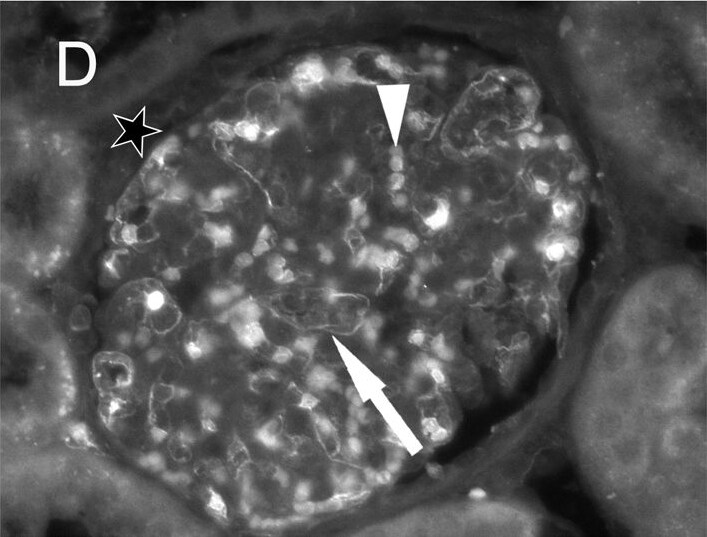
Immunohistochemistry: Goat anti-Human IgG Fc Secondary Antibody [NB7446] -
Immunohistochemistry: Goat anti-Human IgG Fc Secondary Antibody [NB7446] - Immune fluorescent photomicrographs of glomeruli from control (A), aflibercept-treated (B–D) & ranibizumab-treated (E–F) monkeys eyes.In all figures, the asterisks label the spaces of the Bowman capsule. A) Kidney sections from the control animal did not show any specific staining with anti-human IgG-Fc antibody in the glomeruli. Only the erythrocytes (arrow) within the capillaries showed a weak fluorescence. B) One day after aflibercept injection, the endothelium cell layer & material within the capillaries of a glomerulus were highly fluorescent (white arrow) after labelling with an antibody against the Fc region of IgG. In an adjacent glomerulus, only the endothelium was stained (white arrowhead) whereas the lumina of the vessels did not contain IgG-Fc positive material (black arrow). C) Erythrocytes within the glomeruli (arrowhead) as well as the endothelium (arrow) were highly fluorescent. D) Seven days after aflibercept injection, the fluorescent material within the capillaries (arrowhead) & the fluorescence intensity of the endothelium became weaker. E) One day after ranibizumab injection, the endothelium cell layer (white arrow) & erythrocytes (arrowhead & black arrow in the inset) were fluorescent after staining with an antibody against human Fab of IgG. F) The specific fluorescence of the endothelium (arrow) & erythrocytes (arrowhead) was nearly lost seven days after injection of ranibizumab. Image collected & cropped by CiteAb from the following publication (https://pubmed.ncbi.nlm.nih.gov/25415380), licensed under a CC-BY license. Not internally tested by Novus Biologicals.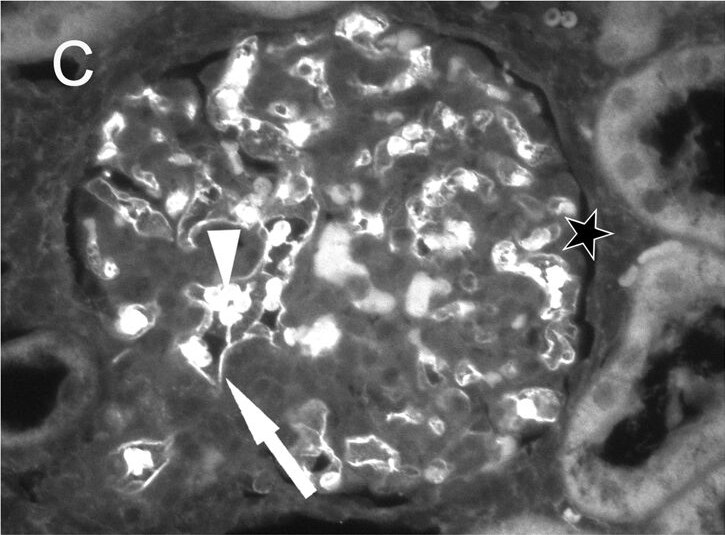
Immunohistochemistry: Goat anti-Human IgG Fc Secondary Antibody [NB7446] -
Immunohistochemistry: Goat anti-Human IgG Fc Secondary Antibody [NB7446] - Immune fluorescent photomicrographs of glomeruli from control (A), aflibercept-treated (B–D) & ranibizumab-treated (E–F) monkeys eyes.In all figures, the asterisks label the spaces of the Bowman capsule. A) Kidney sections from the control animal did not show any specific staining with anti-human IgG-Fc antibody in the glomeruli. Only the erythrocytes (arrow) within the capillaries showed a weak fluorescence. B) One day after aflibercept injection, the endothelium cell layer & material within the capillaries of a glomerulus were highly fluorescent (white arrow) after labelling with an antibody against the Fc region of IgG. In an adjacent glomerulus, only the endothelium was stained (white arrowhead) whereas the lumina of the vessels did not contain IgG-Fc positive material (black arrow). C) Erythrocytes within the glomeruli (arrowhead) as well as the endothelium (arrow) were highly fluorescent. D) Seven days after aflibercept injection, the fluorescent material within the capillaries (arrowhead) & the fluorescence intensity of the endothelium became weaker. E) One day after ranibizumab injection, the endothelium cell layer (white arrow) & erythrocytes (arrowhead & black arrow in the inset) were fluorescent after staining with an antibody against human Fab of IgG. F) The specific fluorescence of the endothelium (arrow) & erythrocytes (arrowhead) was nearly lost seven days after injection of ranibizumab. Image collected & cropped by CiteAb from the following publication (https://pubmed.ncbi.nlm.nih.gov/25415380), licensed under a CC-BY license. Not internally tested by Novus Biologicals.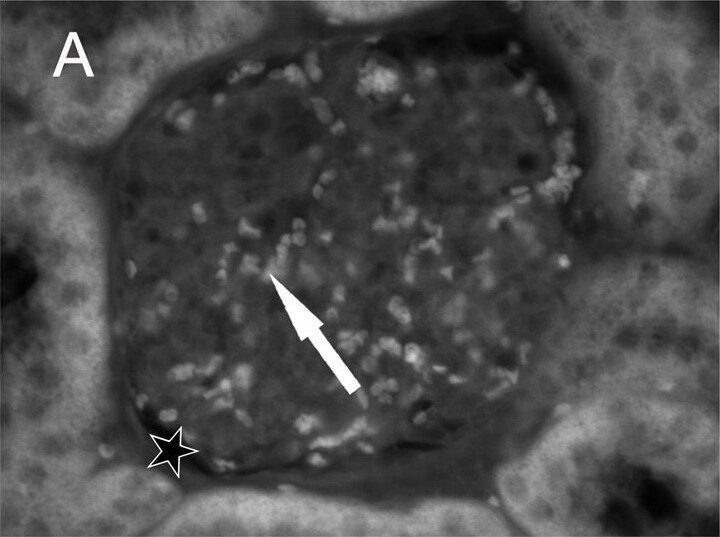
Immunohistochemistry: Goat anti-Human IgG Fc Secondary Antibody [NB7446] -
Immunohistochemistry: Goat anti-Human IgG Fc Secondary Antibody [NB7446] - Immune fluorescent photomicrographs of glomeruli from control (A), aflibercept-treated (B–D) & ranibizumab-treated (E–F) monkeys eyes.In all figures, the asterisks label the spaces of the Bowman capsule. A) Kidney sections from the control animal did not show any specific staining with anti-human IgG-Fc antibody in the glomeruli. Only the erythrocytes (arrow) within the capillaries showed a weak fluorescence. B) One day after aflibercept injection, the endothelium cell layer & material within the capillaries of a glomerulus were highly fluorescent (white arrow) after labelling with an antibody against the Fc region of IgG. In an adjacent glomerulus, only the endothelium was stained (white arrowhead) whereas the lumina of the vessels did not contain IgG-Fc positive material (black arrow). C) Erythrocytes within the glomeruli (arrowhead) as well as the endothelium (arrow) were highly fluorescent. D) Seven days after aflibercept injection, the fluorescent material within the capillaries (arrowhead) & the fluorescence intensity of the endothelium became weaker. E) One day after ranibizumab injection, the endothelium cell layer (white arrow) & erythrocytes (arrowhead & black arrow in the inset) were fluorescent after staining with an antibody against human Fab of IgG. F) The specific fluorescence of the endothelium (arrow) & erythrocytes (arrowhead) was nearly lost seven days after injection of ranibizumab. Image collected & cropped by CiteAb from the following publication (https://pubmed.ncbi.nlm.nih.gov/25415380), licensed under a CC-BY license. Not internally tested by Novus Biologicals.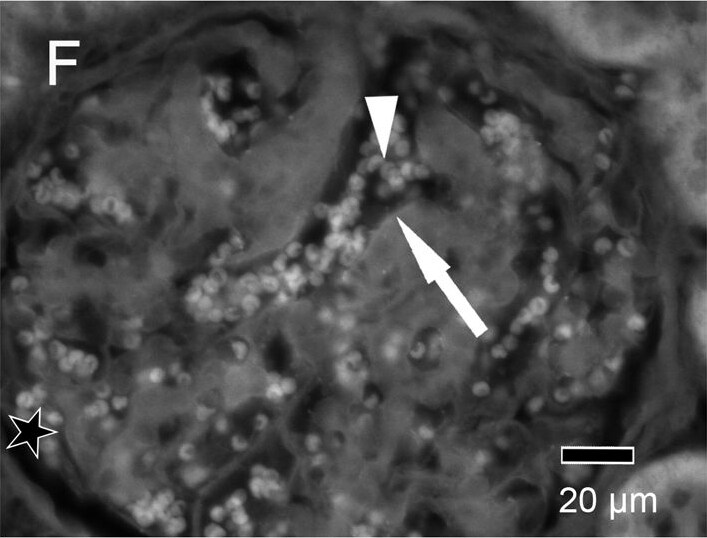
Immunohistochemistry: Goat anti-Human IgG Fc Secondary Antibody [NB7446] -
Immunohistochemistry: Goat anti-Human IgG Fc Secondary Antibody [NB7446] - Immune fluorescent photomicrographs of glomeruli from control (A), aflibercept-treated (B–D) & ranibizumab-treated (E–F) monkeys eyes.In all figures, the asterisks label the spaces of the Bowman capsule. A) Kidney sections from the control animal did not show any specific staining with anti-human IgG-Fc antibody in the glomeruli. Only the erythrocytes (arrow) within the capillaries showed a weak fluorescence. B) One day after aflibercept injection, the endothelium cell layer & material within the capillaries of a glomerulus were highly fluorescent (white arrow) after labelling with an antibody against the Fc region of IgG. In an adjacent glomerulus, only the endothelium was stained (white arrowhead) whereas the lumina of the vessels did not contain IgG-Fc positive material (black arrow). C) Erythrocytes within the glomeruli (arrowhead) as well as the endothelium (arrow) were highly fluorescent. D) Seven days after aflibercept injection, the fluorescent material within the capillaries (arrowhead) & the fluorescence intensity of the endothelium became weaker. E) One day after ranibizumab injection, the endothelium cell layer (white arrow) & erythrocytes (arrowhead & black arrow in the inset) were fluorescent after staining with an antibody against human Fab of IgG. F) The specific fluorescence of the endothelium (arrow) & erythrocytes (arrowhead) was nearly lost seven days after injection of ranibizumab. Image collected & cropped by CiteAb from the following publication (https://pubmed.ncbi.nlm.nih.gov/25415380), licensed under a CC-BY license. Not internally tested by Novus Biologicals.Applications for Goat anti-Human IgG Fc Secondary Antibody
Electron Microscopy
Immunocytochemistry/ Immunofluorescence
Immunohistochemistry
Immunohistochemistry-Paraffin
Western Blot
Reviewed Applications
Read 1 review rated 5 using NB7446 in the following applications:
Formulation, Preparation, and Storage
Purification
Formulation
Preservative
Concentration
Shipping
Stability & Storage
Product Documents for Goat anti-Human IgG Fc Secondary Antibody
Certificate of Analysis
To download a Certificate of Analysis, please enter a lot or batch number in the search box below.
Product Specific Notices for Goat anti-Human IgG Fc Secondary Antibody
Antiserum was solid phase adsorbed to ensure class specificity. The antibody was isolated by affinity chromatography using antigen coupled to agarose beads. Antibody concentration was determined by extinction coefficient: absorbance at 280 nm of 1.4 equals 1.0 mg of IgG. By immunoelectrophoresis and ELISA this antibody reacts specifically with human IgG. Cross reactivity with IgA, IgM and light chains is less than 0.1%. This antibody may cross react with IgG from other species.
This product is for research use only and is not approved for use in humans or in clinical diagnosis. Secondary Antibodies are guaranteed for 1 year from date of receipt.
Citations for Goat anti-Human IgG Fc Secondary Antibody
 Powered by Bioz
Customer Reviews for Goat anti-Human IgG Fc Secondary Antibody (1)
Have you used Goat anti-Human IgG Fc Secondary Antibody?
Submit a review and receive an Amazon gift card!
$25/€18/£15/$25CAN/¥2500 for a review with an image
$10/€7/£6/$10CAN/¥1110 for a review without an image
Submit a review
Customer Images

-
Application: ImmunofluorescenceSample Tested: Multiple myeloma cells lines LP-1 and MY5 cytospinsSpecies: HumanVerified Customer | Posted 09/06/2016IFF/ICC staining of LP-1 and MY4 cells with NB7446

There are no reviews that match your criteria.
Protocols
Find general support by application which include: protocols, troubleshooting, illustrated assays, videos and webinars.
- Antigen Retrieval Protocol (PIER)
- Antigen Retrieval for Frozen Sections Protocol
- Appropriate Fixation of IHC/ICC Samples
- Cellular Response to Hypoxia Protocols
- Chromogenic IHC Staining of Formalin-Fixed Paraffin-Embedded (FFPE) Tissue Protocol
- Chromogenic Immunohistochemistry Staining of Frozen Tissue
- ClariTSA™ Fluorophore Kits
- Detection & Visualization of Antibody Binding
- ELISA Sample Preparation & Collection Guide
- ELISA Troubleshooting Guide
- Fluorescent IHC Staining of Frozen Tissue Protocol
- Graphic Protocol for Heat-induced Epitope Retrieval
- Graphic Protocol for the Preparation and Fluorescent IHC Staining of Frozen Tissue Sections
- Graphic Protocol for the Preparation and Fluorescent IHC Staining of Paraffin-embedded Tissue Sections
- Graphic Protocol for the Preparation of Gelatin-coated Slides for Histological Tissue Sections
- How to Run an R&D Systems DuoSet ELISA
- How to Run an R&D Systems Quantikine ELISA
- How to Run an R&D Systems Quantikine™ QuicKit™ ELISA
- ICC Cell Smear Protocol for Suspension Cells
- ICC Immunocytochemistry Protocol Videos
- ICC for Adherent Cells
- IHC Sample Preparation (Frozen sections vs Paraffin)
- Immunocytochemistry (ICC) Protocol
- Immunocytochemistry Troubleshooting
- Immunofluorescence of Organoids Embedded in Cultrex Basement Membrane Extract
- Immunofluorescent IHC Staining of Formalin-Fixed Paraffin-Embedded (FFPE) Tissue Protocol
- Immunohistochemistry (IHC) and Immunocytochemistry (ICC) Protocols
- Immunohistochemistry Frozen Troubleshooting
- Immunohistochemistry Paraffin Troubleshooting
- Preparing Samples for IHC/ICC Experiments
- Preventing Non-Specific Staining (Non-Specific Binding)
- Primary Antibody Selection & Optimization
- Protocol for Heat-Induced Epitope Retrieval (HIER)
- Protocol for Making a 4% Formaldehyde Solution in PBS
- Protocol for VisUCyte™ HRP Polymer Detection Reagent
- Protocol for the Fluorescent ICC Staining of Cell Smears - Graphic
- Protocol for the Fluorescent ICC Staining of Cultured Cells on Coverslips - Graphic
- Protocol for the Preparation & Fixation of Cells on Coverslips
- Protocol for the Preparation and Chromogenic IHC Staining of Frozen Tissue Sections
- Protocol for the Preparation and Chromogenic IHC Staining of Frozen Tissue Sections - Graphic
- Protocol for the Preparation and Chromogenic IHC Staining of Paraffin-embedded Tissue Sections
- Protocol for the Preparation and Chromogenic IHC Staining of Paraffin-embedded Tissue Sections - Graphic
- Protocol for the Preparation and Fluorescent ICC Staining of Cells on Coverslips
- Protocol for the Preparation and Fluorescent ICC Staining of Non-adherent Cells
- Protocol for the Preparation and Fluorescent ICC Staining of Stem Cells on Coverslips
- Protocol for the Preparation and Fluorescent IHC Staining of Frozen Tissue Sections
- Protocol for the Preparation and Fluorescent IHC Staining of Paraffin-embedded Tissue Sections
- Protocol for the Preparation of Gelatin-coated Slides for Histological Tissue Sections
- Protocol for the Preparation of a Cell Smear for Non-adherent Cell ICC - Graphic
- Quantikine HS ELISA Kit Assay Principle, Alkaline Phosphatase
- Quantikine HS ELISA Kit Principle, Streptavidin-HRP Polymer
- R&D Systems Quality Control Western Blot Protocol
- Sandwich ELISA (Colorimetric) – Biotin/Streptavidin Detection Protocol
- Sandwich ELISA (Colorimetric) – Direct Detection Protocol
- TUNEL and Active Caspase-3 Detection by IHC/ICC Protocol
- The Importance of IHC/ICC Controls
- Troubleshooting Guide: ELISA
- Troubleshooting Guide: Immunohistochemistry
- Troubleshooting Guide: Western Blot Figures
- Western Blot Conditions
- Western Blot Protocol
- Western Blot Protocol for Cell Lysates
- Western Blot Troubleshooting
- Western Blot Troubleshooting Guide
- View all Protocols, Troubleshooting, Illustrated assays and Webinars