
IRF5 Antibody
Novus Biologicals | Catalog # NB100-1092

![Western Blot: IRF5 Antibody [NB100-1092]](https://resources.rndsystems.com/images/products/IRF5-Antibody-Western-Blot-NB100-1092-img0003.jpg "Western Blot: IRF5 Antibody [NB100-1092]")
![Western Blot: IRF5 Antibody [NB100-1092]](https://resources.rndsystems.com/images/products/IRF5-Antibody-Western-Blot-NB100-1092-img0004.jpg "Western Blot: IRF5 Antibody [NB100-1092]")
Scientific images may be resized, cropped, or adjusted for brightness or contrast for presentation purposes. These updates are limited to presentation and do not affect the underlying scientific interpretation of the data. Where available, additional source data may be provided upon request.
Key Product Details
Validated by
Species Reactivity
Validated:
Cited:
Predicted:
Applications
Validated:
Cited:
Label
Antibody Source
Product Specifications
Immunogen
Reactivity Notes
Specificity
Clonality
Host
Isotype
Theoretical MW
Disclaimer note: The observed molecular weight of the protein may vary from the listed predicted molecular weight due to post translational modifications, post translation cleavages, relative charges, and other experimental factors.
Scientific Data Images for IRF5 Antibody
Western Blot: IRF5 Antibody [NB100-1092]
Western Blot: IRF5 Antibody [NB100-1092] - Western blot analysis of Human Spleen (A) and A549 cell lysate (B) + peptide (C), 35 ug protein in RIPA buffer. Antibody at 1 ug/mL. Detected by chemiluminescence![Western Blot: IRF5 Antibody [NB100-1092]](https://resources.rndsystems.com/images/products/IRF5-Antibody-Western-Blot-NB100-1092-img0002.jpg "Western Blot: IRF5 Antibody [NB100-1092]")
Western Blot: IRF5 Antibody [NB100-1092]
IRF5-Antibody-Western-Blot-NB100-1092-img0002.jpg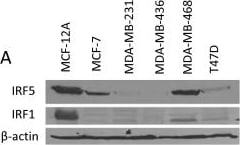
Western Blot: IRF5 Antibody [NB100-1092] -
Western Blot: IRF5 Antibody [NB100-1092] - Overexpression of IRF5 in MCF-7 & MDA-MB-231 cells sensitizes them to DNA damage-induced growth inhibition. A. Endogenous IRF expression was analyzed by Western blot in transformed mammary epithelial cell lines. Levels of beta -actin are shown as loading controls. B. Western blot analysis of stable cell lines generated to overexpress retroviral pBIRF5. C. Cell survival was measured in MCF-7 & MDA-MB-231 pBabe cell lines by colony formation assay before & after treatment. Cells were treated with 0.1 or 1 μM Doxorubicin (Dox) or 2, 5 & 10 Gy gamma -IR. The number of colonies is plotted on the y-axis as percent of control; 100% represents the number of colonies in empty pBabe control lines. Data are expressed as mean ± SD of three independent experiments performed in duplicate. Statistical significance was determined by comparing the difference between colonies in pBabe versus pBIRF5 cell lines after each treatment; * denotes P < 0.05, ** P < 0.001. Image collected & cropped by CiteAb from the following publication (http://breast-cancer-research.biomedcentral.com/articles/10.1186/bcr3053), licensed under a CC-BY license. Not internally tested by Novus Biologicals.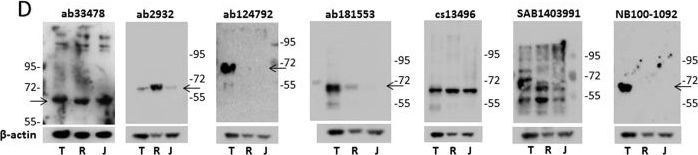
Western Blot: IRF5 Antibody [NB100-1092] -
Western Blot: IRF5 Antibody [NB100-1092] - Comparative analysis of IRF5 protein expression between immortalized lymphoid cell lines by immunoblot.(A) qRT-PCR analysis of IRF5 transcript expression in immortalized lymphoid cell lines. Data is presented as relative expression after normalization to beta -actin using the ∆∆Ct method. (B) Immunoblot analysis of endogenous IRF5 protein expression in immortalized cell lines. IRF5 expression was detected with the previously validated Cell Signaling antibody #3257 that is no longer available. beta -actin levels & apparent molecular weight standards are shown as loading controls & for size comparison, respectively. (C) Experimental details for the comparative analysis of alpha -IRF5 antibody specificity by immunoblot analysis. (D) Same as in (B)except lysates (T, THP-1; R, Ramos B cells; J, Jurkat T cells) were run on multiple independent blots for the analysis of antibody specificity; seven different commercially available alpha -IRF5 antibodies were evaluated. (E) Same as in (D) except antibodies were evaluated by IRF5 knockdown analysis. Ramos B cells were nucleofected with scrambled (Scr) or IRF5 (KD) siRNAs & lysates from same nucleofection run on multiple independent blots for comparative analysis. Arrows indicate detection of an appropriately sized band(s) corresponding to IRF5. Data (except in (C)) are representative of three independent experiments. Image collected & cropped by CiteAb from the following publication (https://www.nature.com/articles/srep31002), licensed under a CC-BY license. Not internally tested by Novus Biologicals.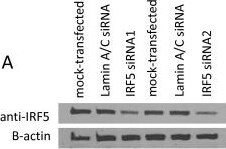
Western Blot: IRF5 Antibody [NB100-1092] -
Western Blot: IRF5 Antibody [NB100-1092] - Down-regulation of IRF5 protein expression by siRNAs alters sensitivity to DNA damage. A. MCF-12A cells were incubated with transfection reagent alone (mock-transfected), control Lamin A/C siRNAs or 5 nM IRF5 siRNAs once (IRF5 siRNA1) or twice (IRF5 siRNA2), as described in the Materials & methods. Western blot analysis shows > 70% reduction of endogenous IRF5 proteins after normalization to beta -actin levels. B. Cells were exposed to 5 Gy IR or the same dose plus IFN-gamma (IR/ gamma ) for 24 h. Percent of Annexin V-FITC stained positive cells is shown in the upper & lower right-hand quadrants. Representative histogram plots from three independent experiments performed in duplicate are shown. C. Same as in B, except cells were exposed to 1 μM Dox or Dox & IFN-gamma for five hours. Percent of Annexin V-FITC stained positive cells compared to control is plotted on y-axis. Data are expressed as mean ± SD of three independent experiments performed in duplicate. Statistical significance was determined by comparing the difference between cells transfected with Lamin A/C siRNAs (12Asicon) & IRF5 siRNAs (12AsiIRF5) after each treatment; ** denotes P < 0.001. D. Cells were treated with the indicated doses of Dox or IR after siRNA transfection. Number of colonies is plotted on y-axis as percent of control. A total of 100% represents the number of colonies in control untreated 12Asicon cells. Data are expressed as mean ± SD of three independent experiments performed in duplicate. Statistical significance was determined by comparing the difference between colonies in 12Asicon versus 12AsiIRF5 cells after each treatment; * denotes P < 0.05. Image collected & cropped by CiteAb from the following publication (http://breast-cancer-research.biomedcentral.com/articles/10.1186/bcr3053), licensed under a CC-BY license. Not internally tested by Novus Biologicals.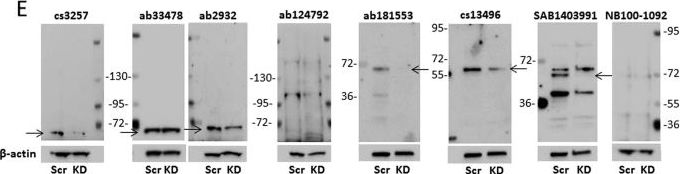
Western Blot: IRF5 Antibody [NB100-1092] -
Western Blot: IRF5 Antibody [NB100-1092] - Comparative analysis of IRF5 protein expression between immortalized lymphoid cell lines by immunoblot.(A) qRT-PCR analysis of IRF5 transcript expression in immortalized lymphoid cell lines. Data is presented as relative expression after normalization to beta -actin using the ∆∆Ct method. (B) Immunoblot analysis of endogenous IRF5 protein expression in immortalized cell lines. IRF5 expression was detected with the previously validated Cell Signaling antibody #3257 that is no longer available. beta -actin levels & apparent molecular weight standards are shown as loading controls & for size comparison, respectively. (C) Experimental details for the comparative analysis of alpha -IRF5 antibody specificity by immunoblot analysis. (D) Same as in (B)except lysates (T, THP-1; R, Ramos B cells; J, Jurkat T cells) were run on multiple independent blots for the analysis of antibody specificity; seven different commercially available alpha -IRF5 antibodies were evaluated. (E) Same as in (D) except antibodies were evaluated by IRF5 knockdown analysis. Ramos B cells were nucleofected with scrambled (Scr) or IRF5 (KD) siRNAs & lysates from same nucleofection run on multiple independent blots for comparative analysis. Arrows indicate detection of an appropriately sized band(s) corresponding to IRF5. Data (except in (C)) are representative of three independent experiments. Image collected & cropped by CiteAb from the following publication (https://www.nature.com/articles/srep31002), licensed under a CC-BY license. Not internally tested by Novus Biologicals.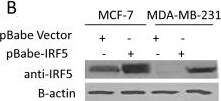
Western Blot: IRF5 Antibody [NB100-1092] -
Western Blot: IRF5 Antibody [NB100-1092] - Overexpression of IRF5 in MCF-7 & MDA-MB-231 cells sensitizes them to DNA damage-induced growth inhibition. A. Endogenous IRF expression was analyzed by Western blot in transformed mammary epithelial cell lines. Levels of beta -actin are shown as loading controls. B. Western blot analysis of stable cell lines generated to overexpress retroviral pBIRF5. C. Cell survival was measured in MCF-7 & MDA-MB-231 pBabe cell lines by colony formation assay before & after treatment. Cells were treated with 0.1 or 1 μM Doxorubicin (Dox) or 2, 5 & 10 Gy gamma -IR. The number of colonies is plotted on the y-axis as percent of control; 100% represents the number of colonies in empty pBabe control lines. Data are expressed as mean ± SD of three independent experiments performed in duplicate. Statistical significance was determined by comparing the difference between colonies in pBabe versus pBIRF5 cell lines after each treatment; * denotes P < 0.05, ** P < 0.001. Image collected & cropped by CiteAb from the following publication (http://breast-cancer-research.biomedcentral.com/articles/10.1186/bcr3053), licensed under a CC-BY license. Not internally tested by Novus Biologicals.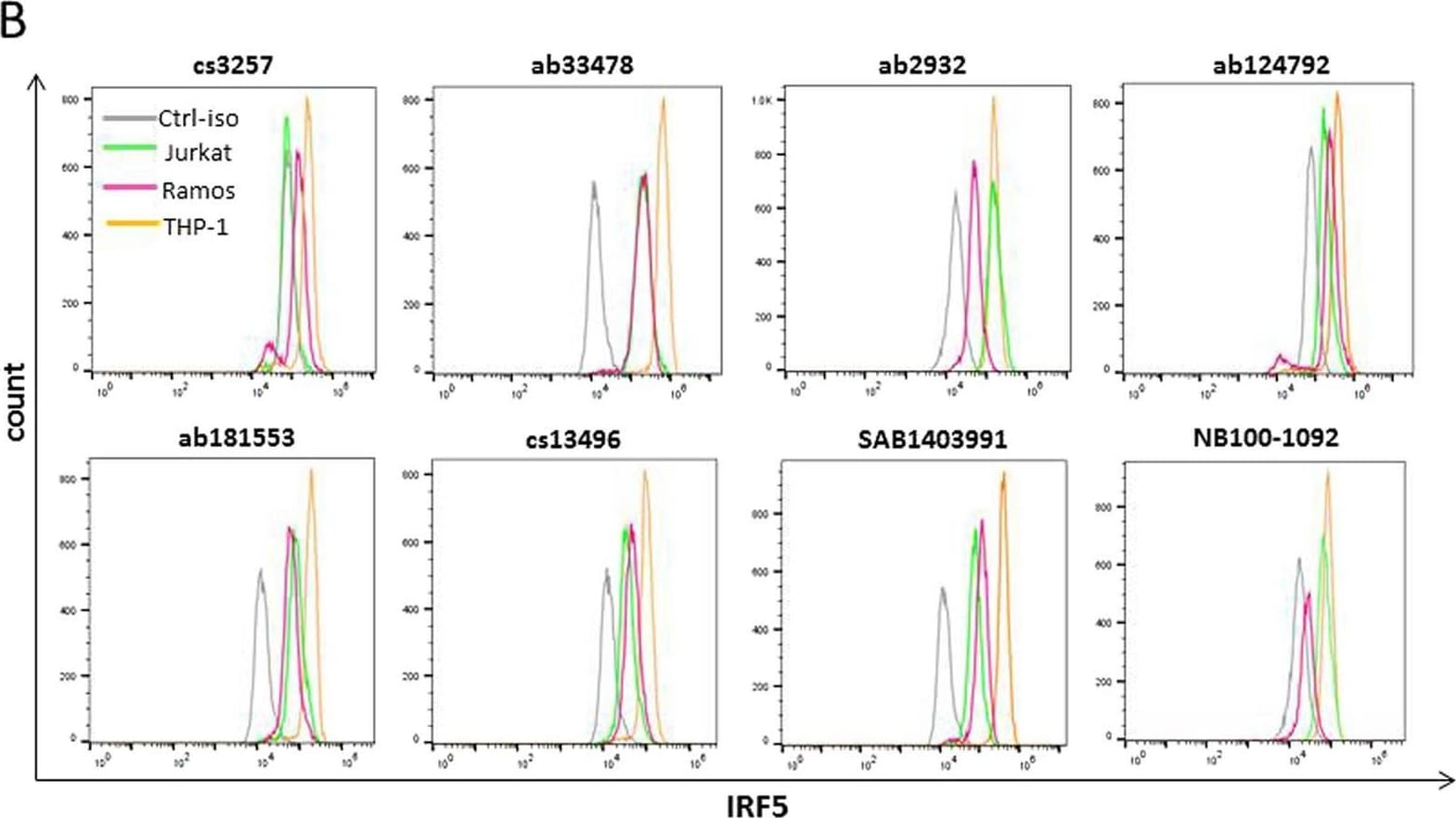
Flow Cytometry: IRF5 Antibody [NB100-1092] -
Comparative analysis of IRF5 protein expression between immortalized lymphoid cell lines using flow cytometry.(A) Experimental details for the comparative analysis of alpha -IRF5 antibody specificity by flow cytometry. (B) Representative histogram plots from flow cytometry analysis of intracellular IRF5 in immortalized cell lines using different alpha -IRF5 antibodies. Data are representative of three independent experiments. Ctrl-iso, matched isotype antibodies used as non-specific controls. Image collected and cropped by CiteAb from the following open publication (https://pubmed.ncbi.nlm.nih.gov/27481535), licensed under a CC-BY license. Not internally tested by Novus Biologicals.Applications for IRF5 Antibody
Peptide ELISA
Western Blot
Flow Cytometry Panel Builder
Bio-Techne Knows Flow Cytometry
Save time and reduce costly mistakes by quickly finding compatible reagents using the Panel Builder Tool.
Advanced Features
- Spectra Viewer - Custom analysis of spectra from multiple fluorochromes
- Spillover Popups - Visualize the spectra of individual fluorochromes
- Antigen Density Selector - Match fluorochrome brightness with antigen density

Formulation, Preparation, and Storage
Purification
Formulation
Preservative
Concentration
Shipping
Stability & Storage
Background: IRF5
Long Name
Alternate Names
Entrez Gene IDs
Gene Symbol
UniProt
Additional IRF5 Products
Product Documents for IRF5 Antibody
Certificate of Analysis
To download a Certificate of Analysis, please enter a lot or batch number in the search box below.
Product Specific Notices for IRF5 Antibody
This product is for research use only and is not approved for use in humans or in clinical diagnosis. Primary Antibodies are guaranteed for 1 year from date of receipt.
Related Research Areas
Citations for IRF5 Antibody
 Powered by Bioz
Customer Reviews for IRF5 Antibody
There are currently no reviews for this product. Be the first to review IRF5 Antibody and earn rewards!
Have you used IRF5 Antibody?
Submit a review and receive an Amazon gift card!
$25/€18/£15/$25CAN/¥2500 for a review with an image
$10/€7/£6/$10CAN/¥1110 for a review without an image
Submit a review
Protocols
Find general support by application which include: protocols, troubleshooting, illustrated assays, videos and webinars.
- 7-Amino Actinomycin D (7-AAD) Cell Viability Flow Cytometry Protocol
- Cellular Response to Hypoxia Protocols
- ChIP Protocol Video
- Chromatin Immunoprecipitation (ChIP) Protocol
- Chromatin Immunoprecipitation Protocol
- ELISA Sample Preparation & Collection Guide
- ELISA Troubleshooting Guide
- Extracellular Membrane Flow Cytometry Protocol
- Flow Cytometry Protocol for Cell Surface Markers
- Flow Cytometry Protocol for Staining Membrane Associated Proteins
- Flow Cytometry Staining Protocols
- Flow Cytometry Troubleshooting Guide
- How to Run an R&D Systems DuoSet ELISA
- How to Run an R&D Systems Quantikine ELISA
- How to Run an R&D Systems Quantikine™ QuicKit™ ELISA
- Intracellular Flow Cytometry Protocol Using Alcohol (Methanol)
- Intracellular Flow Cytometry Protocol Using Detergents
- Intracellular Nuclear Staining Flow Cytometry Protocol Using Detergents
- Intracellular Staining Flow Cytometry Protocol Using Alcohol Permeabilization
- Intracellular Staining Flow Cytometry Protocol Using Detergents to Permeabilize Cells
- Propidium Iodide Cell Viability Flow Cytometry Protocol
- Protocol for Liperfluo
- Protocol for the Characterization of Human Th22 Cells
- Protocol for the Characterization of Human Th9 Cells
- Protocol: Annexin V and PI Staining by Flow Cytometry
- Protocol: Annexin V and PI Staining for Apoptosis by Flow Cytometry
- Quantikine HS ELISA Kit Assay Principle, Alkaline Phosphatase
- Quantikine HS ELISA Kit Principle, Streptavidin-HRP Polymer
- R&D Systems Quality Control Western Blot Protocol
- Sandwich ELISA (Colorimetric) – Biotin/Streptavidin Detection Protocol
- Sandwich ELISA (Colorimetric) – Direct Detection Protocol
- Troubleshooting Guide: ELISA
- Troubleshooting Guide: Fluorokine Flow Cytometry Kits
- Troubleshooting Guide: Western Blot Figures
- Western Blot Conditions
- Western Blot Protocol
- Western Blot Protocol for Cell Lysates
- Western Blot Troubleshooting
- Western Blot Troubleshooting Guide
- View all Protocols, Troubleshooting, Illustrated assays and Webinars