
LYVE-1 Antibody (ALY7) - BSA Free
Novus Biologicals | Catalog # NBP1-43411

![Immunohistochemistry: LYVE-1 Antibody (ALY7) - BSA Free [NBP1-43411]](https://resources.rndsystems.com/images/products/LYVE-1-Antibody-ALY7-Immunohistochemistry-NBP1-43411-img0004.jpg "Immunohistochemistry: LYVE-1 Antibody (ALY7) - BSA Free [NBP1-43411]")
Key Product Details
Species Reactivity
Validated:
Mouse
Cited:
Mouse
Applications
Validated:
Immunohistochemistry, Immunohistochemistry-Frozen, Flow Cytometry, Immunocytochemistry/ Immunofluorescence
Cited:
Immunohistochemistry, Immunohistochemistry-Frozen, Western Blot, Flow Cytometry, IF/IHC
Label
Unconjugated
Antibody Source
Monoclonal Rat IgG1 Clone # ALY7
Format
BSA Free
Loading...
Product Specifications
Immunogen
This LYVE-1 Antibody (ALY7) was developed against mouse LYVE1.
Reactivity Notes
Use in Mouse reported in scientific literature (PMID: 33783987).
Marker
Lymphatic Vessel Marker
Clonality
Monoclonal
Host
Rat
Isotype
IgG1
Theoretical MW
35 kDa.
Disclaimer note: The observed molecular weight of the protein may vary from the listed predicted molecular weight due to post translational modifications, post translation cleavages, relative charges, and other experimental factors.
Disclaimer note: The observed molecular weight of the protein may vary from the listed predicted molecular weight due to post translational modifications, post translation cleavages, relative charges, and other experimental factors.
Scientific Data Images for LYVE-1 Antibody (ALY7) - BSA Free
Immunohistochemistry: LYVE-1 Antibody (ALY7) - BSA Free [NBP1-43411]
Immunohistochemistry: LYVE-1 Antibody (ALY7) [NBP1-43411] - Immunohistochemistry of cryosections of mouse intestine at 2.5 ug/ml of anti-mouse LYVE-1 antibody followed by Anti-Rat IgG Rhodamine (right). Phase image of same field (left).![Flow Cytometry: LYVE-1 Antibody (ALY7) - BSA Free [NBP1-43411]](https://resources.rndsystems.com/images/products/LYVE-1-Antibody-ALY7-Flow-Cytometry-NBP1-43411-img0006.jpg "Flow Cytometry: LYVE-1 Antibody (ALY7) - BSA Free [NBP1-43411]")
Flow Cytometry: LYVE-1 Antibody (ALY7) - BSA Free [NBP1-43411]
Flow Cytometry: LYVE-1 Antibody (ALY7) [NBP1-43411] - Analysis using the Biotin conjugate of NBP1-43411. Staining of LYVE-1 transfected cells with 0.06 ug of Rat IgG1 k Isotype Control Biotin (blue histogram) or 0.06 ug of Anti-Mouse Lyve-1 Biotin (purple histogram) followed by Streptavidin PE.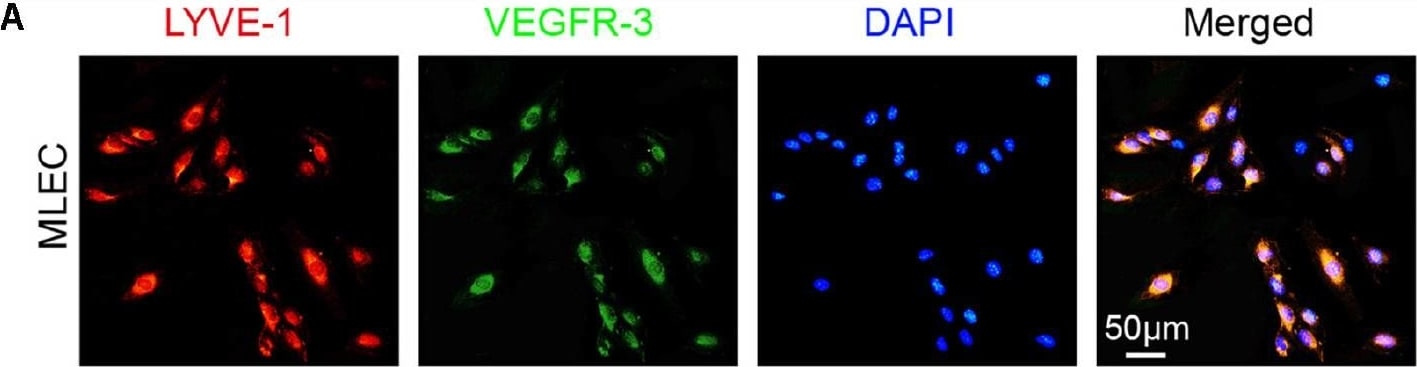
Immunocytochemistry/ Immunofluorescence: LYVE-1 Antibody (ALY7) - BSA Free [NBP1-43411] -
Immunocytochemistry/ Immunofluorescence: LYVE-1 Antibody (ALY7) - BSA Free [NBP1-43411] - Ang II treatment promotes lymphatic marker expression of LECs in vitro. (A) Immunofluorescence staining of LECs with anti-LYVE-1 & anti-VEGFR-3 antibodies. (B) LECs were treated with Ang II (500 nM) for 12 & 24 h, the mRNA levels of LYVE-1, VEGFR-3 & Prox1 were detected by qPCR, & the data were normalized using the reference gene GAPDH (n = 6). (C) The protein expression level of VEGFR-3 was measured by immunoblotting & normalized using beta -actin (n = 4). The results are expressed as the means ± SD, & n represents the number of independent experiments. *P < 0.05, **P < 0.01, & ***P < 0.001 versus Control. Image collected & cropped by CiteAb from the following publication (https://pubmed.ncbi.nlm.nih.gov/33013481), licensed under a CC-BY license. Not internally tested by Novus Biologicals.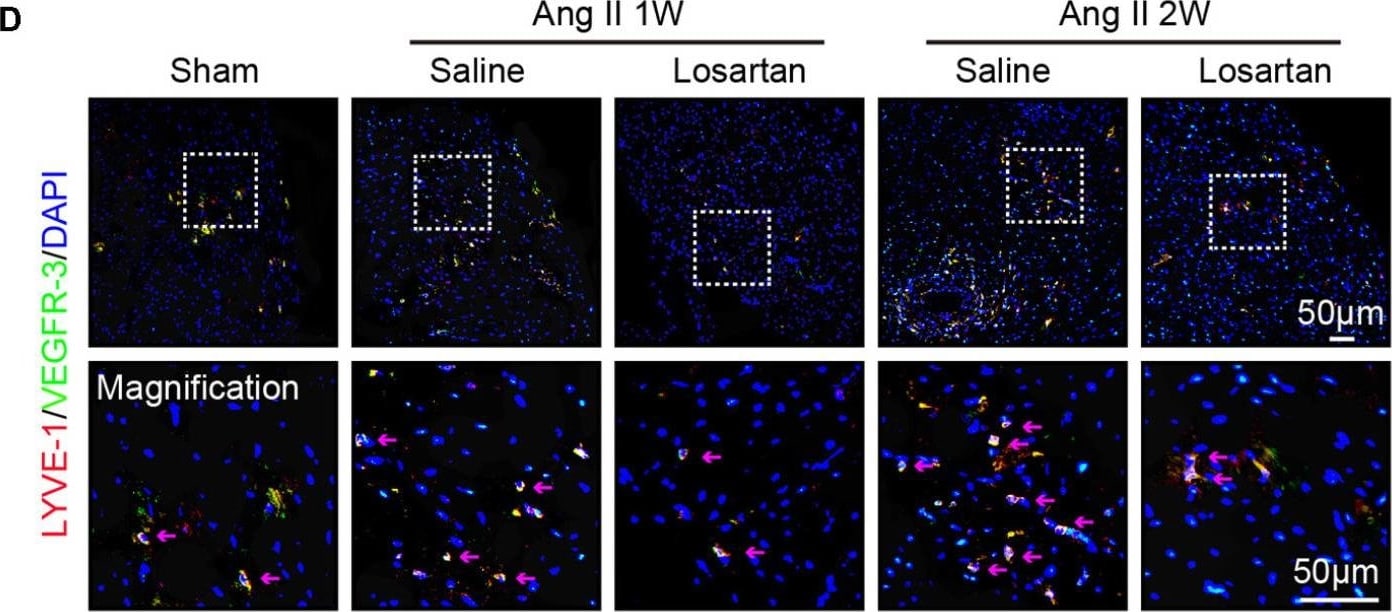
Immunocytochemistry/ Immunofluorescence: LYVE-1 Antibody (ALY7) - BSA Free [NBP1-43411] -
Immunocytochemistry/ Immunofluorescence: LYVE-1 Antibody (ALY7) - BSA Free [NBP1-43411] - Ang II infusion increases cardiac lymphangiogenesis via AT1R in vivo. (A) Wild-type mice were subcutaneously infused with Ang II (1,000 ng/kg/min) with or without losartan (10 mg/kg) for 1 or 2 weeks, & the systolic blood pressure was measured by the tail-cuff method (n = 6). (B) Cardiac mRNA expression level of LYVE-1 was measured by qPCR analysis (n = 3). (C) Cardiac mRNA expression level of VEGFR-3 was measured by qPCR analysis (n = 3). (D) Immunofluorescence staining of hearts with anti-LYVE-1 (Red) & anti- VEGFR-3 (Green) antibodies & DAPI (Blue) (Left, n = 6), & the quantification of the LYVE-1+ & Prox1+ lymphatic vessels in the hearts (Right, n = 6). The results are expressed as the means ± SD, & n represents the number of independent experiments. *P < 0.05, **P < 0.01, & ***P < 0.001 versus Sham group; #P < 0.05, ##P < 0.01, & ###P < 0.001 versus Ang II 1W + Saline group; $$$P < 0.001 versus Ang II 2W + Saline group. Image collected & cropped by CiteAb from the following publication (https://pubmed.ncbi.nlm.nih.gov/33013481), licensed under a CC-BY license. Not internally tested by Novus Biologicals.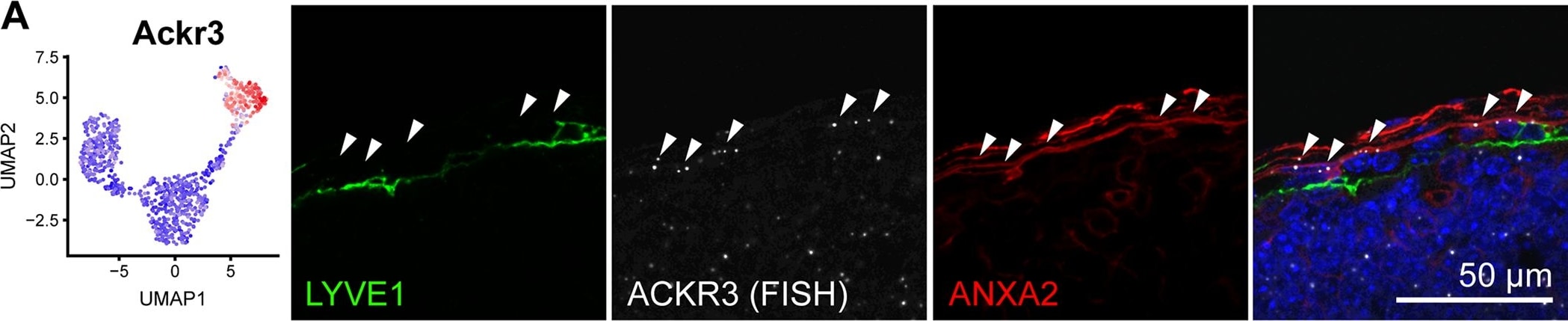
Immunocytochemistry/ Immunofluorescence: LYVE-1 Antibody (ALY7) - BSA Free [NBP1-43411] -
Immunocytochemistry/ Immunofluorescence: LYVE-1 Antibody (ALY7) - BSA Free [NBP1-43411] - Molecular characterization of LECs in the SCS ceiling with RNA FISH.(A-B) Expression of new cLEC/cluster 2 marker genes Ackr3 (A) & Btnl9 (B) by RNA sequencing (left panels) & RNA FISH (right panels). As GFP fluorescence is lost during tissue processing for RNA FISH, immunofluorescence staining for ANXA2 (red) & LYVE1 (green) served as markers for cLECs & fLECs, respectively. Arrows point to cLECs expressing Ackr3 & Btnl9 transcripts (white). ACKR3, atypical chemokine receptor 3; ANXA2, annexin A2; Btnl9, butyrophilin like 9; cLEC, ceiling LEC; FISH, fluorescence in situ hybridization; fLEC, floor-lining LEC; LEC, lymphatic endothelial cell; LYVE1, lymphatic vessel endothelial hyaluronan receptor 1; SCS, subcapsular sinus; UMAP, Uniform Manifold Approximation & Projection. Image collected & cropped by CiteAb from the following publication (https://pubmed.ncbi.nlm.nih.gov/32251437), licensed under a CC-BY license. Not internally tested by Novus Biologicals.
Immunocytochemistry/ Immunofluorescence: LYVE-1 Antibody (ALY7) - BSA Free [NBP1-43411] -
Immunocytochemistry/ Immunofluorescence: LYVE-1 Antibody (ALY7) - BSA Free [NBP1-43411] - Molecular characterization of LECs in the SCS ceiling with immunofluorescence staining.(A–C) Expression of new cLEC/cluster 2 marker genes ANXA2 (A), FABP4 (B), & CD36 (C) by RNA sequencing (left panels) & immunofluorescence staining (right panels) in Ackr4-GFP reporter mice. GFP (white) & immunofluorescence costaining for LYVE1 (green) served as markers for cLECs & fLECs, respectively. ACKR4, atypical chemokine receptor 4; ANXA2, annexin A2; CD, cluster of differentiation; cLEC, ceiling LEC; FABP4, fatty acid binding protein 4; fLEC, floor-lining LEC; GFP, green fluorescent protein; LEC, lymphatic endothelial cell; LYVE1, lymphatic vessel endothelial hyaluronan receptor 1; SCS, subcapsular sinus; UMAP, Uniform Manifold Approximation & Projection. Image collected & cropped by CiteAb from the following publication (https://pubmed.ncbi.nlm.nih.gov/32251437), licensed under a CC-BY license. Not internally tested by Novus Biologicals.
Immunocytochemistry/ Immunofluorescence: LYVE-1 Antibody (ALY7) - BSA Free [NBP1-43411] -
Immunocytochemistry/ Immunofluorescence: LYVE-1 Antibody (ALY7) - BSA Free [NBP1-43411] - Molecular characterization of LECs in the SCS ceiling with immunofluorescence staining.(A–C) Expression of new cLEC/cluster 2 marker genes ANXA2 (A), FABP4 (B), & CD36 (C) by RNA sequencing (left panels) & immunofluorescence staining (right panels) in Ackr4-GFP reporter mice. GFP (white) & immunofluorescence costaining for LYVE1 (green) served as markers for cLECs & fLECs, respectively. ACKR4, atypical chemokine receptor 4; ANXA2, annexin A2; CD, cluster of differentiation; cLEC, ceiling LEC; FABP4, fatty acid binding protein 4; fLEC, floor-lining LEC; GFP, green fluorescent protein; LEC, lymphatic endothelial cell; LYVE1, lymphatic vessel endothelial hyaluronan receptor 1; SCS, subcapsular sinus; UMAP, Uniform Manifold Approximation & Projection. Image collected & cropped by CiteAb from the following publication (https://pubmed.ncbi.nlm.nih.gov/32251437), licensed under a CC-BY license. Not internally tested by Novus Biologicals.
Immunocytochemistry/ Immunofluorescence: LYVE-1 Antibody (ALY7) - BSA Free [NBP1-43411] -
Immunocytochemistry/ Immunofluorescence: LYVE-1 Antibody (ALY7) - BSA Free [NBP1-43411] - Molecular characterization of LECs in the SCS ceiling with immunofluorescence staining.(A–C) Expression of new cLEC/cluster 2 marker genes ANXA2 (A), FABP4 (B), & CD36 (C) by RNA sequencing (left panels) & immunofluorescence staining (right panels) in Ackr4-GFP reporter mice. GFP (white) & immunofluorescence costaining for LYVE1 (green) served as markers for cLECs & fLECs, respectively. ACKR4, atypical chemokine receptor 4; ANXA2, annexin A2; CD, cluster of differentiation; cLEC, ceiling LEC; FABP4, fatty acid binding protein 4; fLEC, floor-lining LEC; GFP, green fluorescent protein; LEC, lymphatic endothelial cell; LYVE1, lymphatic vessel endothelial hyaluronan receptor 1; SCS, subcapsular sinus; UMAP, Uniform Manifold Approximation & Projection. Image collected & cropped by CiteAb from the following publication (https://pubmed.ncbi.nlm.nih.gov/32251437), licensed under a CC-BY license. Not internally tested by Novus Biologicals.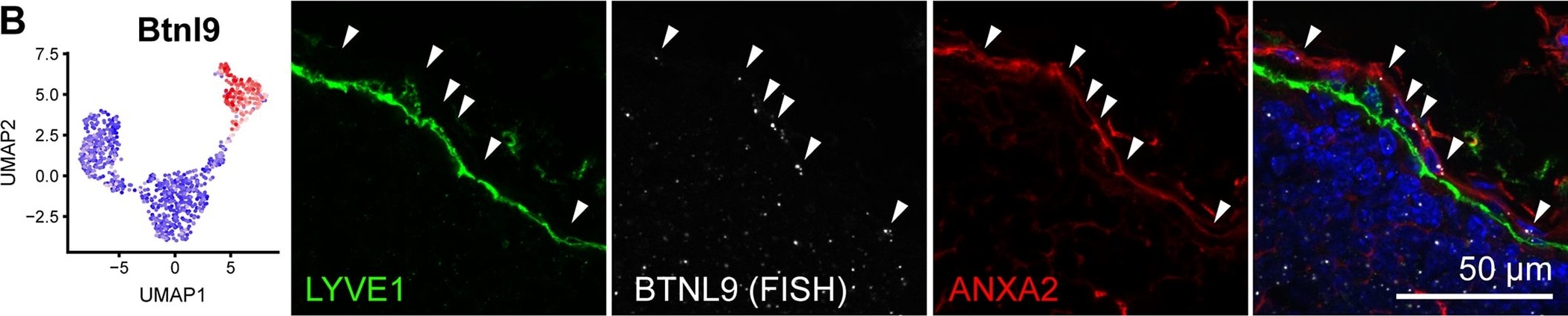
Immunocytochemistry/ Immunofluorescence: LYVE-1 Antibody (ALY7) - BSA Free [NBP1-43411] -
Immunocytochemistry/ Immunofluorescence: LYVE-1 Antibody (ALY7) - BSA Free [NBP1-43411] - Molecular characterization of LECs in the SCS ceiling with RNA FISH.(A-B) Expression of new cLEC/cluster 2 marker genes Ackr3 (A) & Btnl9 (B) by RNA sequencing (left panels) & RNA FISH (right panels). As GFP fluorescence is lost during tissue processing for RNA FISH, immunofluorescence staining for ANXA2 (red) & LYVE1 (green) served as markers for cLECs & fLECs, respectively. Arrows point to cLECs expressing Ackr3 & Btnl9 transcripts (white). ACKR3, atypical chemokine receptor 3; ANXA2, annexin A2; Btnl9, butyrophilin like 9; cLEC, ceiling LEC; FISH, fluorescence in situ hybridization; fLEC, floor-lining LEC; LEC, lymphatic endothelial cell; LYVE1, lymphatic vessel endothelial hyaluronan receptor 1; SCS, subcapsular sinus; UMAP, Uniform Manifold Approximation & Projection. Image collected & cropped by CiteAb from the following publication (https://pubmed.ncbi.nlm.nih.gov/32251437), licensed under a CC-BY license. Not internally tested by Novus Biologicals.Applications for LYVE-1 Antibody (ALY7) - BSA Free
Application
Recommended Usage
Flow Cytometry
0.125 ug/10^6 cells in 100 uL
Immunocytochemistry/ Immunofluorescence
1:10 - 1:500
Immunohistochemistry
1:10 - 1:500
Immunohistochemistry-Frozen
2.5 ug/mL
Application Notes
This ALY7 antibody has been tested by flow cytometric analysis of transfected cell line or immunofluorescent microscopy of cryosections of mouse intestine. This can be used at less than or equal to 0.125 ug per million cells in a 100 uL total staining volume for flow cytometry and 2.5 ug/mL for immunofluorescent micoscopy. Use in Immunocytochemistry/Immunofluorescence was reported in scientific literature.
Flow Cytometry Panel Builder
Bio-Techne Knows Flow Cytometry
Save time and reduce costly mistakes by quickly finding compatible reagents using the Panel Builder Tool.
Advanced Features
- Spectra Viewer - Custom analysis of spectra from multiple fluorochromes
- Spillover Popups - Visualize the spectra of individual fluorochromes
- Antigen Density Selector - Match fluorochrome brightness with antigen density

Formulation, Preparation, and Storage
Purification
Protein A or G purified
Formulation
PBS (pH 7.2)
Format
BSA Free
Preservative
0.09% Sodium Azide
Concentration
0.5 mg/ml
Shipping
The product is shipped with polar packs. Upon receipt, store it immediately at the temperature recommended below.
Stability & Storage
Store at 4C. Do not freeze.
Background: LYVE-1
LYVE-1 has been an important marker in studies of embryonic and tumor lymphangiogenesis, as many cancers are characterized by early metastasis to the lymph nodes (1-3, 5). One study of five different vascular tumors in infants used immunohistochemical analysis and found positive LYVE-1 expression in infantile hemangioma, tufted angioma, and kaposiform hemangioendothelioma (5). LYVE-1 along with other markers such as GLUT-1, CD31, CD34, Prox-1, and WT-1 can be used to help provide immunohistologic profiles of various tumors and, when used in conjunction with clinical and histopathologic approaches, may offer better overall diagnosis and disease treatment (5).
References
1. Jackson D. G. (2019). Hyaluronan in the lymphatics: The key role of the hyaluronan receptor LYVE-1 in leucocyte trafficking. Matrix Biology : Journal of the International Society for Matrix Biology. https://doi.org/10.1016/j.matbio.2018.02.001
2. Jackson D. G. (2004). Biology of the lymphatic marker LYVE-1 and applications in research into lymphatic trafficking and lymphangiogenesis. APMIS : acta pathologica, microbiologica, et immunologica Scandinavica. https://doi.org/10.1111/j.1600-0463.2004.apm11207-0811.x
3. Jackson D. G. (2003). The lymphatics revisited: new perspectives from the hyaluronan receptor LYVE-1. Trends in Cardiovascular Medicine. https://doi.org/10.1016/s1050-1738(02)00189-5
4. Unitprot (Q9Y5Y7)
5. Johnson, E. F., Davis, D. M., Tollefson, M. M., Fritchie, K., & Gibson, L. E. (2018). Vascular Tumors in Infants: Case Report and Review of Clinical, Histopathologic, and Immunohistochemical Characteristics of Infantile Hemangioma, Pyogenic Granuloma, Noninvoluting Congenital Hemangioma, Tufted Angioma, and Kaposiform Hemangioendothelioma. The American Journal of Dermatopathology. https://doi.org/10.1097/DAD.0000000000000983
Long Name
Lymphatic Vessel Endothelial Hyaluronan Receptor 1
Alternate Names
LYVE1, XLKD1
Entrez Gene IDs
114332 (Mouse)
Gene Symbol
LYVE1
UniProt
Additional LYVE-1 Products
Product Documents for LYVE-1 Antibody (ALY7) - BSA Free
Certificate of Analysis
To download a Certificate of Analysis, please enter a lot or batch number in the search box below.
Product Specific Notices for LYVE-1 Antibody (ALY7) - BSA Free
This product is for research use only and is not approved for use in humans or in clinical diagnosis. Primary Antibodies are guaranteed for 1 year from date of receipt.
Related Research Areas
Citations for LYVE-1 Antibody (ALY7) - BSA Free
 Powered by Bioz
Customer Reviews for LYVE-1 Antibody (ALY7) - BSA Free
There are currently no reviews for this product. Be the first to review LYVE-1 Antibody (ALY7) - BSA Free and earn rewards!
Have you used LYVE-1 Antibody (ALY7) - BSA Free?
Submit a review and receive an Amazon gift card!
$25/€18/£15/$25CAN/¥2500 Yen for a review with an image
$10/€7/£6/$10CAN/¥1110 Yen for a review without an image
Submit a review
Protocols
Find general support by application which include: protocols, troubleshooting, illustrated assays, videos and webinars.
- 7-Amino Actinomycin D (7-AAD) Cell Viability Flow Cytometry Protocol
- Antigen Retrieval Protocol (PIER)
- Antigen Retrieval for Frozen Sections Protocol
- Appropriate Fixation of IHC/ICC Samples
- Cellular Response to Hypoxia Protocols
- Chromogenic IHC Staining of Formalin-Fixed Paraffin-Embedded (FFPE) Tissue Protocol
- Chromogenic Immunohistochemistry Staining of Frozen Tissue
- ClariTSA™ Fluorophore Kits
- Detection & Visualization of Antibody Binding
- Extracellular Membrane Flow Cytometry Protocol
- Flow Cytometry Protocol for Cell Surface Markers
- Flow Cytometry Protocol for Staining Membrane Associated Proteins
- Flow Cytometry Staining Protocols
- Flow Cytometry Troubleshooting Guide
- Fluorescent IHC Staining of Frozen Tissue Protocol
- Graphic Protocol for Heat-induced Epitope Retrieval
- Graphic Protocol for the Preparation and Fluorescent IHC Staining of Frozen Tissue Sections
- Graphic Protocol for the Preparation and Fluorescent IHC Staining of Paraffin-embedded Tissue Sections
- Graphic Protocol for the Preparation of Gelatin-coated Slides for Histological Tissue Sections
- ICC Cell Smear Protocol for Suspension Cells
- ICC Immunocytochemistry Protocol Videos
- ICC for Adherent Cells
- IHC Sample Preparation (Frozen sections vs Paraffin)
- Immunocytochemistry (ICC) Protocol
- Immunocytochemistry Troubleshooting
- Immunofluorescence of Organoids Embedded in Cultrex Basement Membrane Extract
- Immunofluorescent IHC Staining of Formalin-Fixed Paraffin-Embedded (FFPE) Tissue Protocol
- Immunohistochemistry (IHC) and Immunocytochemistry (ICC) Protocols
- Immunohistochemistry Frozen Troubleshooting
- Immunohistochemistry Paraffin Troubleshooting
- Intracellular Flow Cytometry Protocol Using Alcohol (Methanol)
- Intracellular Flow Cytometry Protocol Using Detergents
- Intracellular Nuclear Staining Flow Cytometry Protocol Using Detergents
- Intracellular Staining Flow Cytometry Protocol Using Alcohol Permeabilization
- Intracellular Staining Flow Cytometry Protocol Using Detergents to Permeabilize Cells
- Preparing Samples for IHC/ICC Experiments
- Preventing Non-Specific Staining (Non-Specific Binding)
- Primary Antibody Selection & Optimization
- Propidium Iodide Cell Viability Flow Cytometry Protocol
- Protocol for Heat-Induced Epitope Retrieval (HIER)
- Protocol for Liperfluo
- Protocol for Making a 4% Formaldehyde Solution in PBS
- Protocol for VisUCyte™ HRP Polymer Detection Reagent
- Protocol for the Characterization of Human Th22 Cells
- Protocol for the Characterization of Human Th9 Cells
- Protocol for the Fluorescent ICC Staining of Cell Smears - Graphic
- Protocol for the Fluorescent ICC Staining of Cultured Cells on Coverslips - Graphic
- Protocol for the Preparation & Fixation of Cells on Coverslips
- Protocol for the Preparation and Chromogenic IHC Staining of Frozen Tissue Sections
- Protocol for the Preparation and Chromogenic IHC Staining of Frozen Tissue Sections - Graphic
- Protocol for the Preparation and Chromogenic IHC Staining of Paraffin-embedded Tissue Sections
- Protocol for the Preparation and Chromogenic IHC Staining of Paraffin-embedded Tissue Sections - Graphic
- Protocol for the Preparation and Fluorescent ICC Staining of Cells on Coverslips
- Protocol for the Preparation and Fluorescent ICC Staining of Non-adherent Cells
- Protocol for the Preparation and Fluorescent ICC Staining of Stem Cells on Coverslips
- Protocol for the Preparation and Fluorescent IHC Staining of Frozen Tissue Sections
- Protocol for the Preparation and Fluorescent IHC Staining of Paraffin-embedded Tissue Sections
- Protocol for the Preparation of Gelatin-coated Slides for Histological Tissue Sections
- Protocol for the Preparation of a Cell Smear for Non-adherent Cell ICC - Graphic
- Protocol: Annexin V and PI Staining by Flow Cytometry
- Protocol: Annexin V and PI Staining for Apoptosis by Flow Cytometry
- TUNEL and Active Caspase-3 Detection by IHC/ICC Protocol
- The Importance of IHC/ICC Controls
- Troubleshooting Guide: Fluorokine Flow Cytometry Kits
- Troubleshooting Guide: Immunohistochemistry
- View all Protocols, Troubleshooting, Illustrated assays and Webinars
Loading...