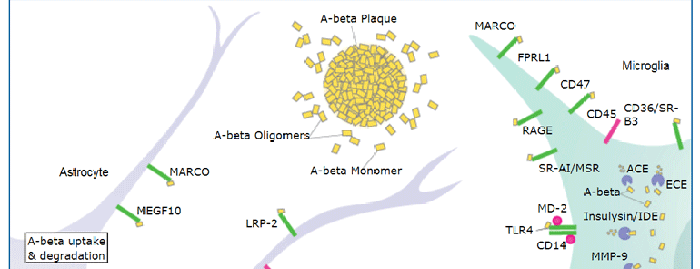
CD36 (alternatively known as platelet membrane glycoprotein IV (GPIV), thrombospondin receptor, fatty acid translocase (FAT), and scavenger receptor class B, member 3 (SR-B3)) is an 88 kDa, integral membrane glycoprotein that belongs to the class B scavenger receptor family (1, 2). The molecule is described as being ditopic, with two transmembrane segments connected by an extracellular loop (3). Mouse CD36 is synthesized as a 472 amino acid (aa) protein that contains a 6 aa N‑terminal cytoplasmic domain, a 22 aa N‑terminal transmembrane segment, a 420 aa extracellular “loop”, a 22 aa C‑terminal transmembrane segment, and a 9 aa C‑terminal cytoplasmic tail (4). Both cytoplasmic tails are palmitoylated, with the C‑terminal tail involved in oxidized LDL binding (5, 6). With respect to the extracellular loop, the N‑terminal region is believed to bind both thrombospondin-1 and Plasmodium-infected erythrocytes. Other ligands for CD36 include long-chain fatty acids, collagen, phospholipids and apoptotic cells (1). The extracellular loop of mouse CD36 is 94%, 92%, 84%, and 84% aa identical to the extracellular loops of rat, hamster, human, and bovine CD36, respectively. Cells known to express CD36 include capillary endothelium, adipocytes, skeletal muscle cells, intestinal epithelium, smooth muscle cells, and hematopoietic cells such as red blood cells, platelets, and monocytes (1). On the surface of cells, CD36 is suggested to exist as a dimer in response to ligation (7). CD36 is reported to regulate fatty uptake, act as an angiogenic with TSP-1, and participate in the clearance of apoptotic phagocytes (1, 8).
Mouse CD36/SR-B3 Antibody (324216)
R&D Systems | Catalog # MAB2519

Scientific images may be resized, cropped, or adjusted for brightness or contrast for presentation purposes. These updates are limited to presentation and do not affect the underlying scientific interpretation of the data. Where available, additional source data may be provided upon request.
Key Product Details
Species Reactivity
Validated:
Cited:
Applications
Validated:
Cited:
Label
Antibody Source
Product Specifications
Immunogen
Gly30-Lys439
Accession # Q08857
Specificity
Clonality
Host
Isotype
Scientific Data Images for Mouse CD36/SR-B3 Antibody (324216)
Detection of Mouse CD36/SR-B3 by Western Blot
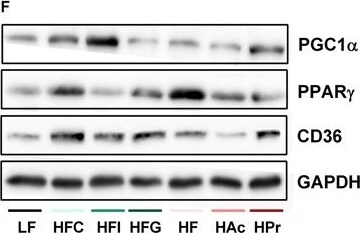
Inulin and SCFA prevent the onset of diet-induced hepatic steatosis by affecting lipid metabolism in different ways. Characterization of liver tissue in male C57BL/6JRj mice that were fed a semi-synthetic low-fat diet (LF) or high-fat diets (HF) supplemented with either 10% dietary fibre (HFC: 10% cellulose; HFI: 3% cellulose + 7% inulin; HFG: 3% cellulose + 7% guar gum; depicted in green hues) or 5% SCFA (depicted in red hues) with different Ac:Pr ratios, a high acetate (HAc; 10:1 Ac:Pr) or high propionate diet (HPr; 1:2.5 Ac:Pr) for 30 weeks. (A) Representative H&E staining of hepatocytes after intervention. (B) Liver tissue weight (n = 19–21) and corresponding (C) hepatic triglyceride (TG) concentration, n = 9–11. (D) Formation of odd-chain fatty acids (OCFA) in liver phospholipid fraction, n = 8. (E) Hepatic gene expression, (F) respective western blots with corresponding load control (GAPDH) and (G) analysis of protein expression (normalized to LF-diet as set to a value of 1), n = 4–8. Analysis of (H) citrate synthase (CS) and (I) cytochrome c oxidase (COX) activity in liver, n = 5–8. (J) Hepatic fatty acid synthase (FASN) activity and (K) calculated de novo lipogenesis (DNL)-Index by measurement of long-chain fatty acid amount in liver phospholipids, n = 8. Data are mean + SEM. *P < 0.05; **P < 0.01; ***P < 0.001. Image collected and cropped by CiteAb from the following publication (https://pubmed.ncbi.nlm.nih.gov/28733671), licensed under a CC-BY license. Not internally tested by R&D Systems.Applications for Mouse CD36/SR-B3 Antibody (324216)
Western Blot
Sample: Recombinant Mouse CD36/SR-B3 Fc Chimera (Catalog # 2519-CD)
Reviewed Applications
Read 1 review rated 5 using MAB2519 in the following applications:
Formulation, Preparation, and Storage
Purification
Reconstitution
Reconstitute at 0.5 mg/mL in sterile PBS. For liquid material, refer to CoA for concentration.
Formulation
Shipping
Stability & Storage
- 12 months from date of receipt, -20 to -70 °C as supplied.
- 1 month, 2 to 8 °C under sterile conditions after reconstitution.
- 6 months, -20 to -70 °C under sterile conditions after reconstitution.
Calculators
Background: CD36/SR-B3
References
- Febbraio, M. et al. (2001) J. Clin. Invest. 108:795.
- Silverstein, R.L. and M. Febbraio (2000) Curr. Opin. Lipid. 11:483.
- Gruarin, P. et al. (2000) Biochem. Biophys. Res. Commun. 275:446.
- Endemann, G. et al. (1993) J. Biol. Chem. 268:11811.
- Malaud, E. et al. (2002) Biochem. J. 364:507.
- Tao, N. et al. (1996) J. Biol. Chem. 271:22315.
- Daviet, L. et al. (1997) Thromb. Haemost. 78:897.
- Simantov, R. and R.L. Silverstein (2003) Front. Biosci. 8:s874.
Long Name
Alternate Names
Gene Symbol
UniProt
Additional CD36/SR-B3 Products
Product Documents for Mouse CD36/SR-B3 Antibody (324216)
Certificate of Analysis
To download a Certificate of Analysis, please enter a lot or batch number in the search box below.
Note: Certificate of Analysis not available for kit components.
Product Specific Notices for Mouse CD36/SR-B3 Antibody (324216)
For research use only
Citations for Mouse CD36/SR-B3 Antibody (324216)
 Powered by Bioz
Customer Reviews for Mouse CD36/SR-B3 Antibody (324216) (1)
Have you used Mouse CD36/SR-B3 Antibody (324216)?
Submit a review and receive an Amazon gift card!
$25/€18/£15/$25CAN/¥2500 for a review with an image
$10/€7/£6/$10CAN/¥1110 for a review without an image
Submit a review
-
Application: Western BlotSample Tested: See PMID 22632897Species: MouseVerified Customer | Posted 02/19/2015
There are no reviews that match your criteria.
Protocols
Find general support by application which include: protocols, troubleshooting, illustrated assays, videos and webinars.
- Cellular Response to Hypoxia Protocols
- R&D Systems Quality Control Western Blot Protocol
- Troubleshooting Guide: Western Blot Figures
- Western Blot Conditions
- Western Blot Protocol
- Western Blot Protocol for Cell Lysates
- Western Blot Troubleshooting
- Western Blot Troubleshooting Guide
- View all Protocols, Troubleshooting, Illustrated assays and Webinars