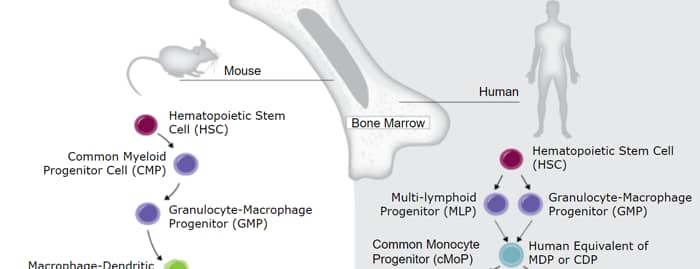
CLEC9a (C-type lectin domain family member A; also DNGR-1) is a 50-52 kDa member of the group V C-type lectin domain containing family of receptors. In mouse, it is an activation receptor expressed on both CD8 alpha + CD24+ and plasmacytoid dendritic cells (DC). It assists in endocytosis but not phagocytosis, and appears to induce cytotoxic antitumor T cells by participating in class I MHC antigen presentation. CD8 alpha + DCs are believed to be particularly important for the disposal of dead cell material. Mouse CLEC9a is a 264 amino acid (aa) type II transmembrane glycoprotein. It contains a 35 aa cytoplasmic segment (aa 1-35) and a 208 aa extracellular region (aa 57-264) that possesses one C-type lectin domain (aa 144-256). CLEC9a forms disulfide-linked homodimers on the cell surface. There are multiple splice variants. The CLEC9a SwissProt entry (Q8BRU4) is 238 aa in length and shows a deletion of aa 106-131. Other isoforms contain either a 43 or a 67 aa substitution for aa 106-264, a Val substitution for 31-58, and a combination of the just mentioned Val substitution coupled to a deletion of aa 106-131. Both rat and human CLEC9a appear to be absent aa 106-131 found in full-length mouse CLEC9a. Taking this into account, over aa 57-264, mouse CLEC9a shares 50% and 70% aa identity with human and rat CLEC9a, respectively.
Mouse CLEC9a Antibody
R&D Systems | Catalog # AF6776

Scientific images may be resized, cropped, or adjusted for brightness or contrast for presentation purposes. These updates are limited to presentation and do not affect the underlying scientific interpretation of the data. Where available, additional source data may be provided upon request.
Key Product Details
Species Reactivity
Validated:
Cited:
Applications
Validated:
Cited:
Label
Antibody Source
Product Specifications
Immunogen
Lys57-Ile264
Accession # EDK99924
Specificity
Clonality
Host
Isotype
Scientific Data Images for Mouse CLEC9a Antibody
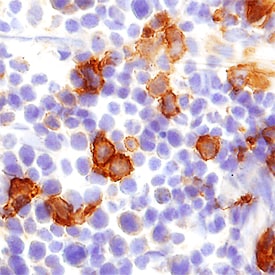
CLEC9a in Mouse Spleen.
CLEC9a was detected in perfusion fixed frozen sections of mouse spleen using Sheep Anti-Mouse CLEC9a Antigen Affinity-purified Polyclonal Antibody (Catalog # AF6776) at 1.7 µg/mL overnight at 4 °C. Tissue was stained using the Anti-Sheep HRP-DAB Cell & Tissue Staining Kit (brown; Catalog # CTS019) and counterstained with hematoxylin (blue). Specific staining was localized to dendritic cells. View our protocol for Chromogenic IHC Staining of Frozen Tissue Sections.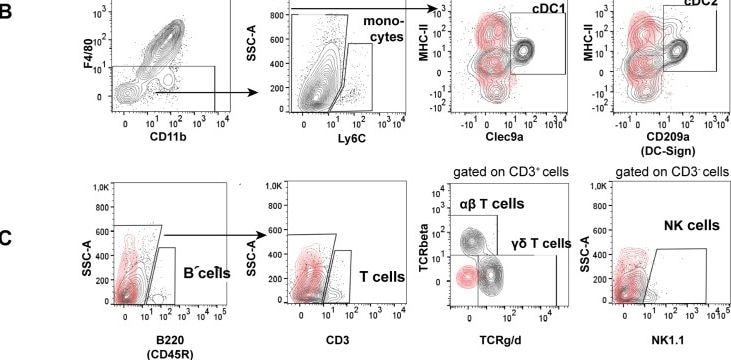
Detection of CLEC9a by Flow Cytometry
Gating strategy behind flow cytometry analyses of all immune cell populations under physiological conditions.(A) General gating that has been applied to each sample included exclusion of debris und sperm based on SSC-A vs. FSC-A, followed by a two-step single-cell gating (based on FSC and SSC), live cells were discriminated using a viability dye (see Appendix 1-key resources table), according to the respective panel all leukocytes were identified by CD45 staining. (B) F4/80-CD11blo-hi cells were further distinguished by Ly6C to identify monocytes (Ly6C+), and Ly6C- cells were segregated using MHC-II in combination with Clec9a and CD209a to differentiate cDC1 (MHC-IIhiClec9a+) and cDC2 (MHC-IIhiCD209a+), respectively. (C) Lymphocytes were segregated into B cells (B220+) and T cells (CD3+) that were further differentiated into alpha beta and gamma delta T cells, as well as NK cells (NK1.1+ cells). Representative plots are from the cauda due to the most diverse immune cell distribution in this region. Red overlays represent the respective isotype controls. Image collected and cropped by CiteAb from the following open publication (https://elifesciences.org/articles/82193), licensed under a CC-BY license. Not internally tested by R&D Systems.Applications for Mouse CLEC9a Antibody
Immunohistochemistry
Sample: Perfusion fixed frozen sections of mouse spleen
Formulation, Preparation, and Storage
Purification
Reconstitution
Sterile PBS to a final concentration of 0.2 mg/mL. For liquid material, refer to CoA for concentration.
Formulation
Shipping
Stability & Storage
- 12 months from date of receipt, -20 to -70 °C as supplied.
- 1 month, 2 to 8 °C under sterile conditions after reconstitution.
- 6 months, -20 to -70 °C under sterile conditions after reconstitution.
Calculators
Background: CLEC9a
Long Name
Alternate Names
Gene Symbol
UniProt
Additional CLEC9a Products
Product Documents for Mouse CLEC9a Antibody
Certificate of Analysis
To download a Certificate of Analysis, please enter a lot or batch number in the search box below.
Note: Certificate of Analysis not available for kit components.
Product Specific Notices for Mouse CLEC9a Antibody
For research use only
Citations for Mouse CLEC9a Antibody
 Powered by Bioz
Customer Reviews for Mouse CLEC9a Antibody
There are currently no reviews for this product. Be the first to review Mouse CLEC9a Antibody and earn rewards!
Have you used Mouse CLEC9a Antibody?
Submit a review and receive an Amazon gift card!
$25/€18/£15/$25CAN/¥2500 for a review with an image
$10/€7/£6/$10CAN/¥1110 for a review without an image
Submit a review
Protocols
Find general support by application which include: protocols, troubleshooting, illustrated assays, videos and webinars.
- Antigen Retrieval Protocol (PIER)
- Antigen Retrieval for Frozen Sections Protocol
- Appropriate Fixation of IHC/ICC Samples
- Cellular Response to Hypoxia Protocols
- Chromogenic IHC Staining of Formalin-Fixed Paraffin-Embedded (FFPE) Tissue Protocol
- Chromogenic Immunohistochemistry Staining of Frozen Tissue
- ClariTSA™ Fluorophore Kits
- Detection & Visualization of Antibody Binding
- Fluorescent IHC Staining of Frozen Tissue Protocol
- Graphic Protocol for Heat-induced Epitope Retrieval
- Graphic Protocol for the Preparation and Fluorescent IHC Staining of Frozen Tissue Sections
- Graphic Protocol for the Preparation and Fluorescent IHC Staining of Paraffin-embedded Tissue Sections
- Graphic Protocol for the Preparation of Gelatin-coated Slides for Histological Tissue Sections
- IHC Sample Preparation (Frozen sections vs Paraffin)
- Immunofluorescent IHC Staining of Formalin-Fixed Paraffin-Embedded (FFPE) Tissue Protocol
- Immunohistochemistry (IHC) and Immunocytochemistry (ICC) Protocols
- Immunohistochemistry Frozen Troubleshooting
- Immunohistochemistry Paraffin Troubleshooting
- Preparing Samples for IHC/ICC Experiments
- Preventing Non-Specific Staining (Non-Specific Binding)
- Primary Antibody Selection & Optimization
- Protocol for Heat-Induced Epitope Retrieval (HIER)
- Protocol for Making a 4% Formaldehyde Solution in PBS
- Protocol for VisUCyte™ HRP Polymer Detection Reagent
- Protocol for the Preparation & Fixation of Cells on Coverslips
- Protocol for the Preparation and Chromogenic IHC Staining of Frozen Tissue Sections
- Protocol for the Preparation and Chromogenic IHC Staining of Frozen Tissue Sections - Graphic
- Protocol for the Preparation and Chromogenic IHC Staining of Paraffin-embedded Tissue Sections
- Protocol for the Preparation and Chromogenic IHC Staining of Paraffin-embedded Tissue Sections - Graphic
- Protocol for the Preparation and Fluorescent IHC Staining of Frozen Tissue Sections
- Protocol for the Preparation and Fluorescent IHC Staining of Paraffin-embedded Tissue Sections
- Protocol for the Preparation of Gelatin-coated Slides for Histological Tissue Sections
- TUNEL and Active Caspase-3 Detection by IHC/ICC Protocol
- The Importance of IHC/ICC Controls
- Troubleshooting Guide: Immunohistochemistry
- View all Protocols, Troubleshooting, Illustrated assays and Webinars
Associated Pathways