
Receptors for the Fc region of IgG (Fc gamma Rs) are members of the Ig superfamily that function in the activation or inhibition of immune responses such as degranulation, phagocytosis, ADCC (antibody-dependent cellular toxicity), cytokine release, and B cell proliferation (1‑3). The Fc gamma Rs have been divided into three classes based on close relationships in their extracellular domains; these groups are designated Fc gamma RI (also known as CD64), Fc gamma RII (CD32), and Fc gamma RIII (CD16). Each group may be encoded by multiple genes and exist in different isoforms depending on species and cell type. The CD64 proteins are high affinity receptors (~10‑8‑10‑9 M) capable of binding monomeric IgG, whereas the CD16 and CD32 proteins bind IgG with lower affinities (~10-6‑10-7 M) only recognizing IgG aggregates surrounding multivalent antigens (1, 4). Fc gamma Rs that deliver an activating signal either have an intrinsic immunoreceptor tyrosine-based activation motif (ITAM) within their cytoplasmic domains or associate with one of the ITAM-bearing adapter subunits, Fc R gamma or zeta (3, 5). The only inhibitory member in human and mouse, Fc gamma RIIb, has an intrinsic cytoplasmic immunoreceptor tyrosine-based inhibitory motif (ITIM). The coordinated functioning of activating and inhibitory receptors is necessary for successful initiation, amplification, and termination of immune responses (5). Mouse Fc gamma RI is transmembrane protein with three extracellular Ig-like domains, and it delivers an activating signal via the associated Fc R gamma accessory chain (1, 2). The high affinity recognition of IgG by Fc gamma RI permits the triggering of effector responses at low IgG concentrations typical of early immune responses (2). Fc gamma RI is expressed constitutively on monocytes and macrophages and can be induced on neutrophils and eosinophils (1, 4). Its expression is up-regulated during bacterial infections and sepsis.
Mouse Fc gamma RI/CD64 Antibody (290305)
R&D Systems | Catalog # MAB2074

Scientific images may be resized, cropped, or adjusted for brightness or contrast for presentation purposes. These updates are limited to presentation and do not affect the underlying scientific interpretation of the data. Where available, additional source data may be provided upon request.
Key Product Details
Species Reactivity
Validated:
Cited:
Applications
Validated:
Cited:
Label
Antibody Source
Product Specifications
Immunogen
Glu25-Pro297
Accession # P26151
Specificity
Clonality
Host
Isotype
Scientific Data Images for Mouse Fc gamma RI/CD64 Antibody (290305)
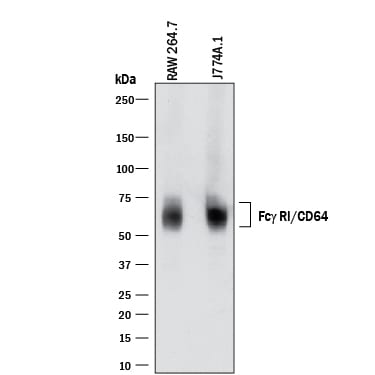
Detection of Mouse Fc gamma RI/CD64 by Western Blot.
Western blot shows lysates of RAW 264.7 mouse monocyte/macrophage cell line and J774A.1 mouse reticulum cell sarcoma macrophage cell line. PVDF membrane was probed with 2 µg/mL of Rat Anti-Mouse Fc gamma RI/CD64 Monoclonal Antibody (Catalog # MAB2074) followed by HRP-conjugated Anti-Rat IgG Secondary Antibody (Catalog # HAF005). A specific band was detected for Fc gamma RI/CD64 at approximately 60-75 kDa (as indicated). This experiment was conducted under reducing conditions and using Immunoblot Buffer Group 1.Applications for Mouse Fc gamma RI/CD64 Antibody (290305)
Western Blot
Sample: RAW 264.7 mouse monocyte/macrophage cell line and J774A.1 mouse reticulum cell sarcoma macrophage cell line
Formulation, Preparation, and Storage
Purification
Reconstitution
Reconstitute at 0.5 mg/mL in sterile PBS. For liquid material, refer to CoA for concentration.
Formulation
Shipping
Stability & Storage
- 12 months from date of receipt, -20 to -70 °C as supplied.
- 1 month, 2 to 8 °C under sterile conditions after reconstitution.
- 6 months, -20 to -70 °C under sterile conditions after reconstitution.
Calculators
Background: Fc gamma RI/CD64
References
- Van de Winkel, J. and P. Capes (1993) Immunol. Today 14:215.
- Raghaven, M. and P. Bjorkman (1996) Annu. Rev. Cell Dev. Biol. 12:181.
- Ravetch, J. and S. Bolland (2001) Annu. Rev. Immunol. 19:275.
- Takai, T. (2002) Nature Rev. Immunol. 2:580.
- Ravetch, J. and L. Lanier (2000) Science 290:84.
Long Name
Alternate Names
Gene Symbol
UniProt
Additional Fc gamma RI/CD64 Products
Product Documents for Mouse Fc gamma RI/CD64 Antibody (290305)
Certificate of Analysis
To download a Certificate of Analysis, please enter a lot or batch number in the search box below.
Note: Certificate of Analysis not available for kit components.
Product Specific Notices for Mouse Fc gamma RI/CD64 Antibody (290305)
For research use only
Related Research Areas
Citations for Mouse Fc gamma RI/CD64 Antibody (290305)
 Powered by Bioz
Customer Reviews for Mouse Fc gamma RI/CD64 Antibody (290305)
There are currently no reviews for this product. Be the first to review Mouse Fc gamma RI/CD64 Antibody (290305) and earn rewards!
Have you used Mouse Fc gamma RI/CD64 Antibody (290305)?
Submit a review and receive an Amazon gift card!
$25/€18/£15/$25CAN/¥2500 for a review with an image
$10/€7/£6/$10CAN/¥1110 for a review without an image
Submit a review
Protocols
Find general support by application which include: protocols, troubleshooting, illustrated assays, videos and webinars.
- Cellular Response to Hypoxia Protocols
- R&D Systems Quality Control Western Blot Protocol
- Troubleshooting Guide: Western Blot Figures
- Western Blot Conditions
- Western Blot Protocol
- Western Blot Protocol for Cell Lysates
- Western Blot Troubleshooting
- Western Blot Troubleshooting Guide
- View all Protocols, Troubleshooting, Illustrated assays and Webinars