Mouse Galectin-7 Antibody Summary
Ser2-Phe136
Accession # AAK29385
Applications
Mouse Galectin-7 Sandwich Immunoassay
Please Note: Optimal dilutions should be determined by each laboratory for each application. General Protocols are available in the Technical Information section on our website.
Scientific Data
View Larger
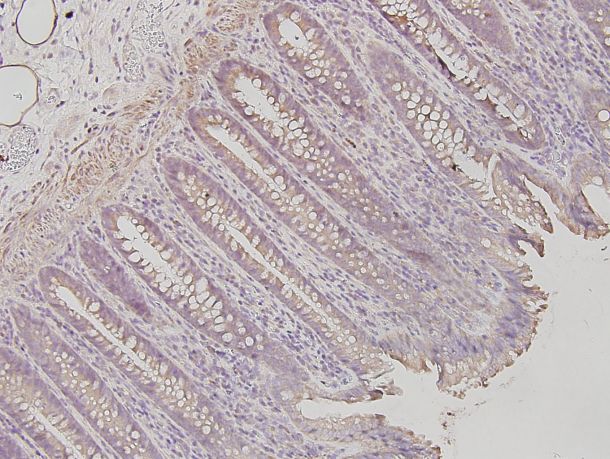
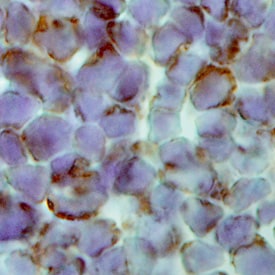
Galectin‑7 in Mouse Thymus. Galectin-7 was detected in perfusion fixed frozen sections of mouse thymus using Rat Anti-Mouse Galectin-7 Monoclonal Antibody (Catalog # MAB1304) at 25 µg/mL overnight at 4 °C. Tissue was stained using the Anti-Rat HRP-DAB Cell & Tissue Staining Kit (brown; Catalog # CTS017) and counterstained with hematoxylin (blue). Specific labeling was localized to the cytoplasm of lymphocytes. View our protocol for Chromogenic IHC Staining of Frozen Tissue Sections.
Reconstitution Calculator
Preparation and Storage
- 12 months from date of receipt, -20 to -70 °C as supplied.
- 1 month, 2 to 8 °C under sterile conditions after reconstitution.
- 6 months, -20 to -70 °C under sterile conditions after reconstitution.
Background: Galectin-7
The galectins constitute a large family of carbohydrate-binding proteins with specificity for N-acetyl-lactosamine-containing glycoproteins. At least 14 mammalian galectins, which share structural similarities in their carbohydrate recognition domains (CRD), have been identified. The galectins have been classified into the prototype galectins (-1, -2, -5, -7, -10, -11, -13, -14), which contain one CRD and exist either as a monomer or a noncovalent homodimer; the chimera galectins (Galectin-3) containing one CRD linked to a nonlectin domain; and the tandem-repeat galectins (-4, -6, -8, -9, -12) consisting of two CRDs joined by a linker peptide. Galectins lack a classical signal peptide and can be localized to the cytosolic compartments where they have intracellular functions. However, via one or more as yet unidentified non-classical secretory pathways, galectins can also be secreted to function extracellularly. Individual members of the galectin family have different tissue distribution profiles and exhibit subtle differences in their carbohydrate-binding specificities. Each family member may preferentially bind to a unique subset of cell-surface glycoproteins (1‑4).
Mouse Galectin-7 is a prototype monomeric galectin. It is expressed in stratified epithelia and is significantly down-regulated in squamous cell carcinomas. Galectin-7 is a pro-apoptotic protein that is highly induced by the tumor suppressor protein p53. It functions intracellularly upstream of JNK activation to enhance cytochrome c release during apoptosis (5). Galectin-7 may also be involved in cell-cell and cell-matrix interactions and exogenous galectin has been found to accelerate the re‑epithelialization of wounds (6).

- Rabinovich, A. et al. (2002) TRENDS in Immunol. 23:313.
- Rabinovich, A. et al. (2002) J. Leukocyte Biology 71:741.
- Hughes, R.C. (2002) Biochimie 83:667.
- R&D Systems' Cytokine Bulletin, Summer (2002).
- Kuwabara, I. et al. (2002) J. Biol. Chem. 277:3487.
- Cao, Z. et al. (2002) J. Biol. Chem. 277:42299.
Product Datasheets
FAQs
No product specific FAQs exist for this product, however you may
View all Antibody FAQsReviews for Mouse Galectin-7 Antibody
Average Rating: 5 (Based on 1 Review)
Have you used Mouse Galectin-7 Antibody?
Submit a review and receive an Amazon gift card.
$25/€18/£15/$25CAN/¥75 Yuan/¥2500 Yen for a review with an image
$10/€7/£6/$10 CAD/¥70 Yuan/¥1110 Yen for a review without an image
Filter by:
This version of antibody is very specific and works well at 1:500 dilution and is almost equal to polyclonal version.
Specificity: Specific
Sensitivity: Sensitive
Buffer: PBS
Dilution: 1:500