
Growth differentiation factor-9 (GDF-9) is a member of the transforming growth factor-beta (TGF-beta ) superfamily, and is an oocyte secreted paracrine factor essential for mammalian ovarian folliculogenesis (1‑2). Mouse GDF-9 is synthesized as a 441 amino acid (aa) prepropeptide that contains a 29 aa signal sequence, a 277 aa propeptide, and a 135 aa mature chain. Residues 340‑441 constitute a TGF-beta like domain. In addition, there is one potential site of N-linked glycosylation in the mature chain. Unlike other members of the TGF-beta superfamily, GDF-9 lacks the conserved cysteine residue that is believed to form the sole disulfide linkage between subunits in other family members (3). Mature mouse GDF-9 shares 90% aa sequence identity with mature human GDF 9. The protein is expressed throughout the development of the maturing follicle (2). GDF-9 functions as a paracrine factor in the regulation of granulosa cell proliferation and differentiation, and is essential for fertility (2, 4). Studies on GDF-9 null mice have demonstrated arrested follicular development at the primary follicle stage (5). Mouse GDF-9 induces Smad2 phosphorylation and inhibin production in rat diethylstilbestrol treated granulosa cells (6) and in human granulosa-luteal cells (7). The downstream signaling actions of GDF 9 are mediated by the type I receptor, activin receptor-like kinase 5 (ALK5), initiating the subsequent activation of Smad2 and Smad3 (2, 8). GDF 9 uses the BMP type II receptor (BMPRII) as its other signaling receptor (2, 9).

Scientific images may be resized, cropped, or adjusted for brightness or contrast for presentation purposes. These updates are limited to presentation and do not affect the underlying scientific interpretation of the data. Where available, additional source data may be provided upon request.
Key Product Details
Species Reactivity
Applications
Label
Antibody Source
Product Specifications
Immunogen
Met1-Arg441
Accession # Q07105
Specificity
Clonality
Host
Isotype
Endotoxin Level
Scientific Data Images for Mouse GDF-9 Antibody (785123)
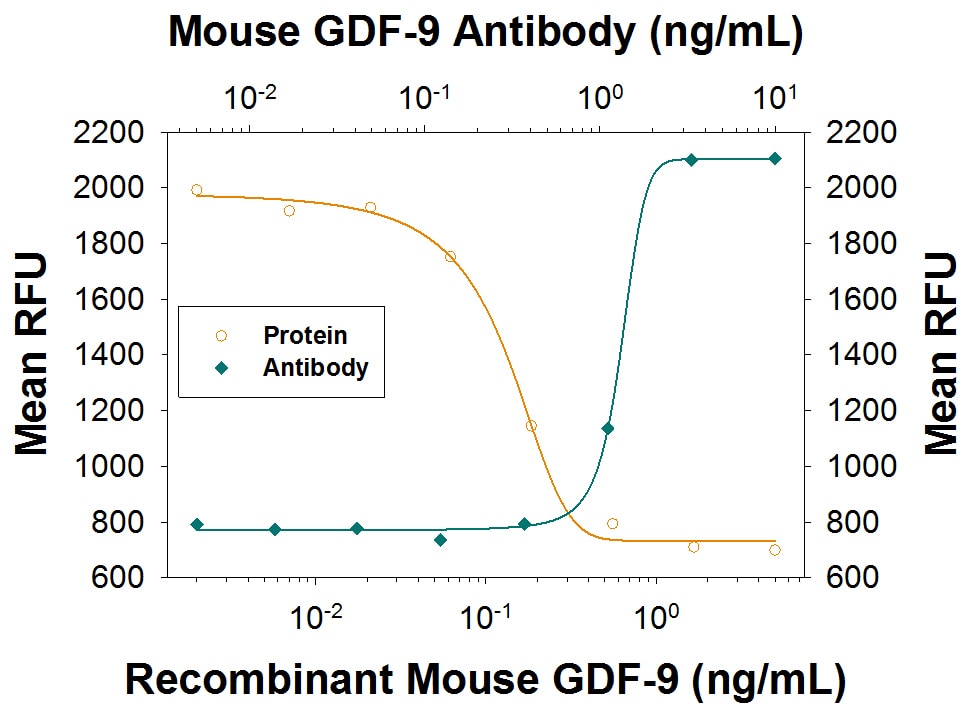
Growth Inhibition Induced by GDF‑9 and Neutralization by Mouse GDF‑9 Antibody.
Recombinant Mouse GDF-9 (739-G9) induces growth inhibition in the Mv1Lu mink lung epithelial cell line in the presence of in a dose-dependent manner (orange line), as measured by Resazurin (AR002). Growth Inhibition elicited by Recombinant Mouse GDF-9 (0.5 µg/mL) is neutralized (green line) by increasing concentrations of Rat Anti-Mouse GDF-9 Monoclonal Antibody (Catalog # MAB739). The ND50 is typically 0.4-2.4 µg/mL.Applications for Mouse GDF-9 Antibody (785123)
Neutralization
Formulation, Preparation, and Storage
Purification
Reconstitution
Reconstitute at 0.5 mg/mL in sterile PBS. For liquid material, refer to CoA for concentration.
Formulation
Shipping
Stability & Storage
- 12 months from date of receipt, -20 to -70 °C as supplied.
- 1 month, 2 to 8 °C under sterile conditions after reconstitution.
- 6 months, -20 to -70 °C under sterile conditions after reconstitution.
Calculators
Background: GDF-9
References
- McGrath, S.A. et al. (1995) Mol. Endocrinol. 9:131.
- Mottershead, D.G. et al. (2008) Mol. Cell. Endocrinol. 283:58.
- McPherron, A.C. and S.-J. Lee (1992) J. Biol. Chem. 268:3444.
- Gilchrist, R.B. et al. (2006) J. Cell. Sci. 119:3811.
- Dong, J. et al. (1996) Nature 383:531.
- Roh, J.S. et al. (2003) Endocrinology 144:172.
- Kaivo-Oja, N. et al. (2003) J. Clin. Endocrinol. Metab. 88:755.
- Mazerbourg, S. et al. (2004) Mol. Endocrinol. 18:653.
- Vitt, U.A. et al. (2002) Biol. Reprod. 67:473.
Long Name
Alternate Names
Gene Symbol
UniProt
Additional GDF-9 Products
Product Documents for Mouse GDF-9 Antibody (785123)
Certificate of Analysis
To download a Certificate of Analysis, please enter a lot or batch number in the search box below.
Note: Certificate of Analysis not available for kit components.
Product Specific Notices for Mouse GDF-9 Antibody (785123)
For research use only
Related Research Areas
Customer Reviews for Mouse GDF-9 Antibody (785123)
There are currently no reviews for this product. Be the first to review Mouse GDF-9 Antibody (785123) and earn rewards!
Have you used Mouse GDF-9 Antibody (785123)?
Submit a review and receive an Amazon gift card!
$25/€18/£15/$25CAN/¥2500 for a review with an image
$10/€7/£6/$10CAN/¥1110 for a review without an image
Submit a review