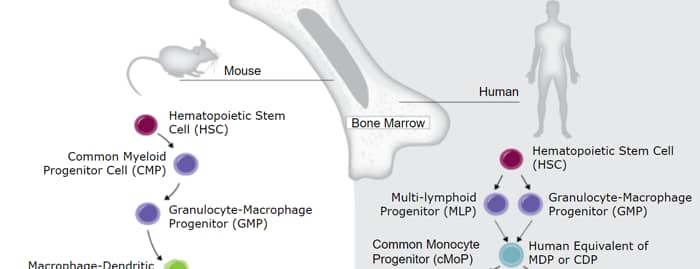
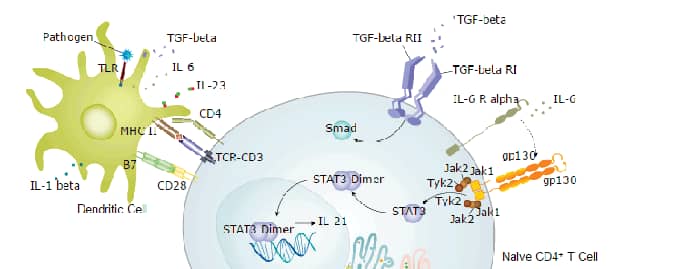
Interleukin 23 (IL-23) is a heterodimeric cytokine composed of two disulfide-linked subunits, a p19 subunit that is unique to IL-23, and a p40 subunit that is shared with IL-12 (1‑5). The p19 subunit has homology to the p35 subunit of IL-12, as well as to other single chain cytokines such as IL-6 and IL-11. The p40 subunit is homologous to the extracellular domains of the hematopoietic cytokine receptors. Mouse p19 cDNA encodes a 196 amino acid residue (aa) precursor protein with a putative 19 aa signal peptide and 177 aa mature protein. Human and mouse p19 share 70% aa sequence identity. Although p19 is expressed by activated macrophages, dendritic cells, T cells, and endothelial cells, only activated macrophages and dendritic cells express p40 concurrently to produce IL-23. The functional IL-23 receptor complex consists of two receptor subunits, the IL-12 receptor beta 1 subunit (IL-12 R beta 1) and the IL-23-specific receptor subunit (IL-23 R). IL-23 has biological activities that are similar to, but distinct from IL-12. Both IL-12 and IL-23 induce proliferation and IFN-gamma production by human T cells. While IL-12 acts on both naïve and memory human T cells, the effects of IL-23 is restricted to memory T cells. In mouse, IL-23 but not IL-12, has also been shown to induce memory T cells to secret IL-17, a potent proinflammatory cytokine. IL-12 and IL-23 can induce IL-12 production from mouse splenic DC of both the CD8- and CD8+ subtypes, however only IL-23 can act directly on CD8+ DC to mediate immunogenic presentation of poorly immunogenic tumor/self peptide.
Mouse IL-23 p19 Antibody (320229) [Alexa Fluor™ Plus 647]
R&D Systems | Catalog # FAB1619AFP647

![Mouse IL-23 p19 Antibody (320229) [Alexa Fluor™ Plus 647]](https://resources.rndsystems.com/images/icons/RnD-Default-Product-Image_Antibodies-Icon.svg "Mouse IL-23 p19 Antibody (320229) [Alexa Fluor™ Plus 647]")
Key Product Details
Species Reactivity
Applications
Label
Antibody Source
Product Specifications
Specificity
Clonality
Host
Isotype
Applications for Mouse IL-23 p19 Antibody (320229) [Alexa Fluor™ Plus 647]
Western Blot
Background: IL-23
References
- Oppmann, B. et al. (2000) Immunity 13:715.
- Lankford, C.S. and D.M. Frucht (2003) J. Leukoc. Biol. 73:49.
- Parham, C. et al. (2002) J. Immunol. 168:5699.
- Belladonna, M.L. et al. (2002) J. Immunol. 168:5448.
- Aggarwal, S. et al. (2003) J. Biol. Chem. 278:1910.
Long Name
Alternate Names
Gene Symbol
UniProt
Additional IL-23 Products
Product Documents for Mouse IL-23 p19 Antibody (320229) [Alexa Fluor™ Plus 647]
Certificate of Analysis
To download a Certificate of Analysis, please enter a lot or batch number in the search box below.
Note: Certificate of Analysis not available for kit components.
Product Specific Notices for Mouse IL-23 p19 Antibody (320229) [Alexa Fluor™ Plus 647]
This product is provided under an intellectual property license from Life Technologies Corporation. The transfer of this product is conditioned on the buyer using the purchased product solely in research conducted by the buyer, excluding contract research or any fee for service research, and the buyer must not (1) use this product or its components for (a) diagnostic, therapeutic or prophylactic purposes; (b) testing, analysis or screening services, or information in return for compensation on a per-test basis; or (c) manufacturing or quality assurance or quality control, and/or (2) sell or transfer this product or its components for resale, whether or not resold for use in research. For information on purchasing a license to this product for purposes other than as described above, contact Life Technologies Corporation, 5781 Van Allen Way, Carlsbad, CA 92008 USA or outlicensing@thermofisher.com.
For research use only
Customer Reviews for Mouse IL-23 p19 Antibody (320229) [Alexa Fluor™ Plus 647]
There are currently no reviews for this product. Be the first to review Mouse IL-23 p19 Antibody (320229) [Alexa Fluor™ Plus 647] and earn rewards!
Have you used Mouse IL-23 p19 Antibody (320229) [Alexa Fluor™ Plus 647]?
Submit a review and receive an Amazon gift card!
$25/€18/£15/$25CAN/¥2500 for a review with an image
$10/€7/£6/$10CAN/¥1110 for a review without an image
Submit a review
Protocols
Find general support by application which include: protocols, troubleshooting, illustrated assays, videos and webinars.
- Cellular Response to Hypoxia Protocols
- R&D Systems Quality Control Western Blot Protocol
- Troubleshooting Guide: Western Blot Figures
- Western Blot Conditions
- Western Blot Protocol
- Western Blot Protocol for Cell Lysates
- Western Blot Troubleshooting
- Western Blot Troubleshooting Guide
- View all Protocols, Troubleshooting, Illustrated assays and Webinars