
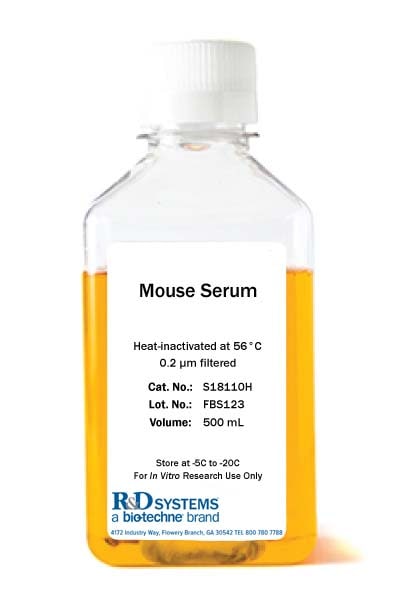
Mouse Serum, Heat Inactivated
R&D Systems | Catalog # S18110H
This item is in process of being discontinued.

Discontinued Product
S18110H has been discontinued.
View all Serum products.
Key Product Details
Features
Mouse Serum is used in various research applications. It is obtained from healthy laboratory animals.
Species
Mouse
Applications
Cell Culture
Product Summary for Mouse Serum, Heat Inactivated
Why Use Mouse Serum?
Mouse Serum is collected from healthy laboratory-grade animals that have not been exposed to or inoculated with adventitious agents. Stringent collection and production protocols are employed to maximize serum performance and minimize lot-to-lot variation. Mouse Serum is manufactured in our ISO 9001:2015 certified facility.
Serum products should be stored and handled correctly to assure long-term stability and to preserve growth performance consistency throughout its shelf-life. In addition, heat inactivation of serum is frequently desired to inactivate complement within the serum. Below are protocol links for serum storage/handling and heat inactivation.
Protocol for Fetal Bovine Serum Storage, Thawing, and Freezing.
Protocol for Heat Inactivation of Serum Products.
Serum products should be stored and handled correctly to assure long-term stability and to preserve growth performance consistency throughout its shelf-life. In addition, heat inactivation of serum is frequently desired to inactivate complement within the serum. Below are protocol links for serum storage/handling and heat inactivation.
Protocol for Fetal Bovine Serum Storage, Thawing, and Freezing.
Protocol for Heat Inactivation of Serum Products.
Why Heat Inactivate Serum?
The objective of heat inactivation is to destroy complement activity in the serum without affecting the growth-promoting characteristics of the product. Removal of complement activity from the serum is not required for most cell cultures, but may be necessary for cultures that are sensitive to the complement activity. Since heat inactivation of the serum may, to some extent, decrease the growth performance properties of the serum, this procedure should only be performed if actually required for optimal cell growth. Researchers should evaluate the applicability of heat inactivation in regards to their own application. If heat inactivation is required, the process should be carefully controlled to avoid increased formation of crystalline and flocculent precipitates, gelling of serum proteins and excessive loss of growth performance. Significant damage to serum can occur when it is subjected to higher than required temperatures or heated over extended lengths of time.
Loading...
Product Specifications
Sterility Testing
Pass
Formulation, Preparation, and Storage
Purification
0.2 μm filtered
Shipping
On Dry Ice
Storage
-5 to -20 °C, protected from light
Product Documents for Mouse Serum, Heat Inactivated
Certificate of Analysis
To download a Certificate of Analysis, please enter a lot or batch number in the search box below.
Note: Certificate of Analysis not available for kit components.
Customer Reviews for Mouse Serum, Heat Inactivated
There are currently no reviews for this product. Be the first to review Mouse Serum, Heat Inactivated and earn rewards!
Have you used Mouse Serum, Heat Inactivated?
Submit a review and receive an Amazon gift card!
$25/€18/£15/$25CAN/¥2500 Yen for a review with an image
$10/€7/£6/$10CAN/¥1110 Yen for a review without an image
Submit a review
Protocols
Find general support by application which include: protocols, troubleshooting, illustrated assays, videos and webinars.
- A Guide to the Colony Forming Cell Assay: Methods and Tips
- Cultrex UltiMatrix BME Protocol
- Culture of Mouse Enteric Organoids using Cultrex Basement Membrane Extract
- Culturing BG01V Human Embryonic Stem Cells with Mouse Embryonic Fibroblast (MEF)-Conditioned Media
- Culturing Mouse Cortical Stem Cells: Expansion using the Neurosphere System
- Culturing Rat Cortical Stem Cells: Expansion using the Monolayer System
- Culturing Rat Cortical Stem Cells: Expansion using the Neurosphere System
- Definitive Endoderm Differentiation of BG01V Human Embryonic Stem Cells
- General Support Buffers
- Immunofluorescence of Organoids Embedded in Cultrex Basement Membrane Extract
- Protocol for CEPT Cocktail Kit
- Protocol for Cell Counting Kit-8
- Protocol for Culturing Embryonic Chick Dorsal Root Ganglion Neurons
- Protocol for Culturing Embryonic Rat Spinal Motor Neurons
- Protocol for Culturing Rat Hippocampal Neurons
- Protocol for Culturing Rat Microglia
- Protocol for MortaLIVE™ Non-Toxic Dye
- Protocol for the Differentiation and Characterization of Human Th1 Cells
- Rat Cortical Stem Cell Culture Expansion Protocol
- The Human Colony Forming Cell (CFC) Assay using Methylcellulose-based Media
- The Mouse Colony Forming Cell (CFC) Assay using Methylcellulose-based Media
- The Mouse Pre-B Colony Forming Cell (CFC) Assay Using Methylcellulose-based Media
- Use of Cultrex Basement Membrane Extract to Improve Take and Growth of Xenografts in Mice
- View all Protocols, Troubleshooting, Illustrated assays and Webinars
Loading...