

![Immunohistochemistry-Paraffin: MUC2 Antibody (CCP58) [NBP2-25221]](https://resources.rndsystems.com/images/products/MUC2-Antibody-CCP58-Immunohistochemistry-Paraffin-NBP2-25221-img0003.jpg "Immunohistochemistry-Paraffin: MUC2 Antibody (CCP58) [NBP2-25221]")
Scientific images may be resized, cropped, or adjusted for brightness or contrast for presentation purposes. These updates are limited to presentation and do not affect the underlying scientific interpretation of the data. Where available, additional source data may be provided upon request.
Key Product Details
Species Reactivity
Validated:
Human
Cited:
Human, Mouse
Applications
Validated:
Immunohistochemistry, Immunohistochemistry-Paraffin, Western Blot
Cited:
Immunohistochemistry-Paraffin, Western Blot, IF/IHC
Label
Unconjugated
Antibody Source
Monoclonal Mouse IgG1 kappa Clone # CCP58
Loading...
Product Specifications
Immunogen
A synthetic peptide of 29 amino acids, KYPTTTPISTTTMVTPTPTPTGTQTPTTT from MUC2 protein, coupled to KLH. (Uniprot: Q02817)
Epitope
GTQTP(GlyThrGlnThrPro)
Localization
Cytoplasmic and Cell surface
Specificity
Recognizes a single glycoprotein of 520kDa, identified as mucin 2 (MUC2). This monoclonal antibody shows no cross-reaction with human milk fat globule membranes, MUC1, or MUC3. Its epitope has been defined as GTQTP(GlyThrGlnThrPro). Mucins are high molecular weight glycoproteins, which constitute the major component of the mucus layer that protects the gastric epithelium. MUC2 is specifically expressed in goblet cells of the small intestine in about 65% of colonic carcinomas and about 40% of gastric carcinomas. MUC2 is rarely expressed outside of the GI tract with the exceptions of mucinous carcinoma of breast and clear cell-type carcinomas of the ovary.
Clonality
Monoclonal
Host
Mouse
Isotype
IgG1 kappa
Theoretical MW
520 kDa.
Disclaimer note: The observed molecular weight of the protein may vary from the listed predicted molecular weight due to post translational modifications, post translation cleavages, relative charges, and other experimental factors.
Disclaimer note: The observed molecular weight of the protein may vary from the listed predicted molecular weight due to post translational modifications, post translation cleavages, relative charges, and other experimental factors.
Description
200ug/ml of antibody purified from Bioreactor Concentrate by Protein A or G. Prepared in 10 mM PBS with 0.05% BSA & 0.05% azide.
Antibody with azide - store at 2 to 8C.
Antibody with azide - store at 2 to 8C.
Scientific Data Images for MUC2 Antibody (CCP58)
Immunohistochemistry-Paraffin: MUC2 Antibody (CCP58) [NBP2-25221]
Immunohistochemistry-Paraffin: MUC2 Antibody (CCP58) [NBP2-25221] - Formalin-paraffin normal human intestine (20X) stained with MUC2 antibody (1:200), peroxidase-conjugate and DAB chromogen.![Western Blot: MUC2 Antibody (CCP58) [NBP2-25221]](https://resources.rndsystems.com/images/products/MUC2-Antibody-CCP58-Western-Blot-NBP2-25221-img0004.jpg "Western Blot: MUC2 Antibody (CCP58) [NBP2-25221]")
Western Blot: MUC2 Antibody (CCP58) [NBP2-25221]
Western Blot: MUC2 Antibody (CCP58) [NBP2-25221] - MDA MB 231 cells and HCC827 human non-small cell lung cancer cell line lysates. Image from verified customer review.![Immunohistochemistry-Paraffin: MUC2 Antibody (CCP58) [NBP2-25221]](https://resources.rndsystems.com/images/products/MUC2-Antibody-CCP58-Immunohistochemistry-Paraffin-NBP2-25221-img0005.jpg "Immunohistochemistry-Paraffin: MUC2 Antibody (CCP58) [NBP2-25221]")
Immunohistochemistry-Paraffin: MUC2 Antibody (CCP58) [NBP2-25221]
Immunohistochemistry-Paraffin: MUC2 Antibody (CCP58) [NBP2-25221] - Formalin-fixed, paraffin-embedded human Colon Carcinoma stained with MUC2 Antibody (CCP58).![Immunohistochemistry-Paraffin: MUC2 Antibody (CCP58) [NBP2-25221]](https://resources.rndsystems.com/images/products/MUC2-Antibody-CCP58-Immunohistochemistry-Paraffin-NBP2-25221-img0001.jpg "Immunohistochemistry-Paraffin: MUC2 Antibody (CCP58) [NBP2-25221]")
Immunohistochemistry-Paraffin: MUC2 Antibody (CCP58) [NBP2-25221]
Immunohistochemistry-Paraffin: MUC2 Antibody (CCP58) [NBP2-25221] - Formalin-fixed, paraffin-embedded normal human intestine (10X) stained with MUC2 antibody (1:200), peroxidase-conjugate and DAB chromogen.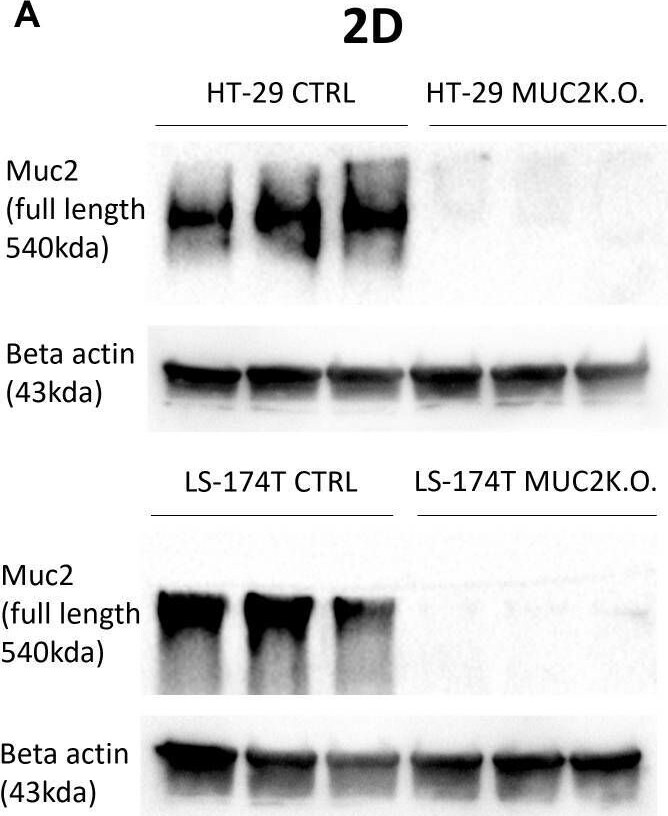
Western Blot: MUC2 Antibody (CCP58) [NBP2-25221] -
(A) Western blot of full-length MUC2 protein (540 kDa) and beta -actin (43 kDa) in different cell lines LS-174T CTRL, LS-174T MUC2 K.O., HT-29 CTRL, and HT-29 MUC2 K.O. grown in 2D (N = 3 biological replicates). (B) Western blot of full-length MUC2 protein (540 kDa) and beta -actin (43 kDa) in different cell lines LS-174T CTRL, LS-174T MUC2 K.O., HT-29 CTRL, and HT-29 MUC2 K.O. grown in 2D (N = 3 biological replicates). (C) Representative images of spheroids of HT-29 and LS-174T CTRL and MUC2 K.O. immunostaining with mouse anti-hMUC2 antibody (green) and counterstained with DAPI. Images acquired on confocal LS780. Scale bar, 100 um. Image collected and cropped by CiteAb from the following open publication (https://pubmed.ncbi.nlm.nih.gov/39926604), licensed under a CC-BY license. Not internally tested by Novus Biologicals.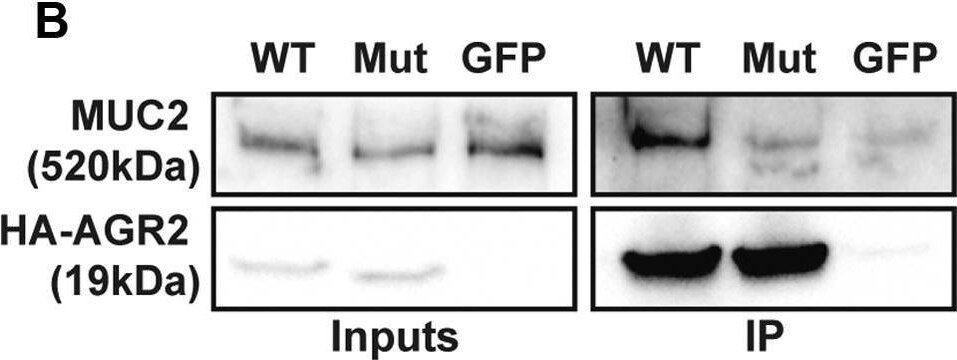
Western Blot: MUC2 Antibody (CCP58) [NBP2-25221] -
AGR2 H117Y has a reduced ability to interact with MUC2 and regulate ER stress in vitro. (A) HEK293T cells were transfected with equal amounts of WT or H117Y mutant (Mut) HA-tagged AGR2 (HA-AGR2) and blotted for AGR2 or beta -actin as a loading control. Mutant HA-AGR2 consistently showed lower expression when examined by Western blot. Data are representative of 3 independent experiments. (B and right panel of C) Mutant AGR2 was transfected at double the amount compared with WT plasmid to obtain the same level, or higher, of mutant AGR2 protein as WT. (B) LS174T cells were transfected with WT or H117Y mutant HA-AGR2 or Green Fluorescent Protein (GFP) as a transfection control. Transfected AGR2 was immunoprecipitated using anti-HA beads, and immunoprecipitates were blotted for MUC2 (clone CCP58) and HA-tag. (C) Immunoblots of the lysates of HEK293T cells overexpressing WT or Mut AGR2 or GFP and stressed with tunicamycin (Tun) 48 hours after transfection. Left: Data from cells transfected with equal amounts of WT or Mut (1×) plasmid. Right: Results in which twice (2×) the amount of mutant AGR2 plasmid was transfected than for WT. Blots were stained with antibodies against BiP (clone C50B12), AGR2 (clone D9V2F), HA (clone C29F4), and beta -actin. Experiment was repeated 3 independent times in HEK293T. Image collected and cropped by CiteAb from the following open publication (https://pubmed.ncbi.nlm.nih.gov/34237462), licensed under a CC-BY license. Not internally tested by Novus Biologicals.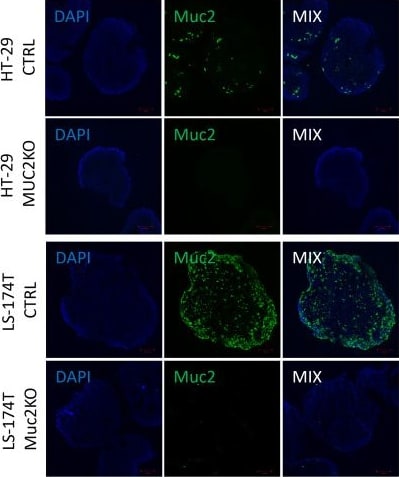
Immunocytochemistry/ Immunofluorescence: MUC2 Antibody (CCP58) [NBP2-25221] -
(A) Western blot of full-length MUC2 protein (540 kDa) and beta -actin (43 kDa) in different cell lines LS-174T CTRL, LS-174T MUC2 K.O., HT-29 CTRL, and HT-29 MUC2 K.O. grown in 2D (N = 3 biological replicates). (B) Western blot of full-length MUC2 protein (540 kDa) and beta -actin (43 kDa) in different cell lines LS-174T CTRL, LS-174T MUC2 K.O., HT-29 CTRL, and HT-29 MUC2 K.O. grown in 2D (N = 3 biological replicates). (C) Representative images of spheroids of HT-29 and LS-174T CTRL and MUC2 K.O. immunostaining with mouse anti-hMUC2 antibody (green) and counterstained with DAPI. Images acquired on confocal LS780. Scale bar, 100 um. Image collected and cropped by CiteAb from the following open publication (https://pubmed.ncbi.nlm.nih.gov/39926604), licensed under a CC-BY license. Not internally tested by Novus Biologicals.Applications for MUC2 Antibody (CCP58)
Application
Recommended Usage
Immunohistochemistry-Paraffin
1-2 ug/ml
Western Blot
0.5-1ug/ml
Application Notes
Immunohistochemistry (Formalin-fixed): 1-2ug/ml for 30 minutes at RT. Staining of formalin-fixed tissues requires heating tissue sections in 10mM Tris with 1mM EDTA, pH 9.0, for 45 min at 95C followed by cooling at RT for 20 minutes.
Optimal dilution for a specific application should be determined.
Western Blot reported in scientific literature (PMID: 27084834).
Optimal dilution for a specific application should be determined.
Western Blot reported in scientific literature (PMID: 27084834).
Reviewed Applications
Read 3 reviews rated 4.3 using NBP2-25221 in the following applications:
Formulation, Preparation, and Storage
Purification
Protein A or G purified
Formulation
10 mM PBS with 0.05% BSA
Preservative
0.05% Sodium Azide
Concentration
0.2 mg/ml
Shipping
The product is shipped with polar packs. Upon receipt, store it immediately at the temperature recommended below.
Stability & Storage
Store at 4C.
Background: MUC2
Changes or perturbations to MUC2 expression has been associated with a number of disease pathologies (1-4, 6). Specifically, altered MUC2 composition has been indicated in colorectal cancer, inflammatory bowel diseases (IBD) including ulcerative colitis and Chron's disease, and chronic obstructive pulmonary disease (COPD) (1-4, 6). In general, decreased or reduced MUC2 expression is associated with colorectal cancer disease progression and development of IBD (1-4, 6). Additionally, studies have found that upon intestinal infection due to parasites or bacteria MUC2 expression is increased, as is overall mucus secretion (3, 6).
References
1. Pothuraju, R., Krishn, S. R., Gautam, S. K., Pai, P., Ganguly, K., Chaudhary, S., Rachagani, S., Kaur, S., & Batra, S. K. (2020). Mechanistic and Functional Shades of Mucins and Associated Glycans in Colon Cancer. Cancers. https://doi.org/10.3390/cancers12030649
2. Ballester, B., Milara, J., & Cortijo, J. (2019). Mucins as a New Frontier in Pulmonary Fibrosis. Journal of Clinical Medicine. https://doi.org/10.3390/jcm8091447
3. Liu, Y., Yu, X., Zhao, J., Zhang, H., Zhai, Q., & Chen, W. (2020). The role of MUC2 mucin in intestinal homeostasis and the impact of dietary components on MUC2 expression. International Journal of Biological Macromolecules. https://doi.org/10.1016/j.ijbiomac.2020.07.191
4. Allen, A., Hutton, D. A., & Pearson, J. P. (1998). The MUC2 gene product: a human intestinal mucin. The International Journal of Biochemistry & Cell Biology. https://doi.org/10.1016/s1357-2725(98)00028-4
5. Uniprot (Q02817)
6. Kim, Y. S., & Ho, S. B. (2010). Intestinal goblet cells and mucins in health and disease: recent insights and progress. Current Gastroenterology Reports. https://doi.org/10.1007/s11894-010-0131-2
Alternate Names
Intestinal mucin-2, MLP, MUC2, MUC-2, mucin 2, intestinal/tracheal, mucin 2, oligomeric mucus/gel-forming, mucin-2, SMUC
Gene Symbol
MUC2
UniProt
Additional MUC2 Products
Product Documents for MUC2 Antibody (CCP58)
Certificate of Analysis
To download a Certificate of Analysis, please enter a lot or batch number in the search box below.
Product Specific Notices for MUC2 Antibody (CCP58)
This product is for research use only and is not approved for use in humans or in clinical diagnosis. Primary Antibodies are guaranteed for 1 year from date of receipt.
Citations for MUC2 Antibody (CCP58)
 Powered by Bioz
Customer Reviews for MUC2 Antibody (CCP58) (3)
4.3 out of 5
3 Customer Ratings
Have you used MUC2 Antibody (CCP58)?
Submit a review and receive an Amazon gift card!
$25/€18/£15/$25CAN/¥2500 for a review with an image
$10/€7/£6/$10CAN/¥1110 for a review without an image
Submit a review
Customer Images


Showing
1
-
3 of
3 reviews
Showing All
Filter By:
-
Application: Immunohistochemistry-ParaffinSample Tested: Breast cancer tissueSpecies: HumanVerified Customer | Posted 04/04/2020

-
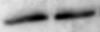
Application: Western BlotSample Tested: MDA MB 231 cellsSpecies: HumanVerified Customer | Posted 12/27/2019
-
Application: Western BlotSample Tested: MDA MB 231 cells and HCC827 human non-small cell lung cancer cell lineSpecies: HumanVerified Customer | Posted 10/17/2018
There are no reviews that match your criteria.
Protocols
Find general support by application which include: protocols, troubleshooting, illustrated assays, videos and webinars.
- Antigen Retrieval Protocol (PIER)
- Antigen Retrieval for Frozen Sections Protocol
- Appropriate Fixation of IHC/ICC Samples
- Cellular Response to Hypoxia Protocols
- Chromogenic IHC Staining of Formalin-Fixed Paraffin-Embedded (FFPE) Tissue Protocol
- Chromogenic Immunohistochemistry Staining of Frozen Tissue
- ClariTSA™ Fluorophore Kits
- Detection & Visualization of Antibody Binding
- Fluorescent IHC Staining of Frozen Tissue Protocol
- Graphic Protocol for Heat-induced Epitope Retrieval
- Graphic Protocol for the Preparation and Fluorescent IHC Staining of Frozen Tissue Sections
- Graphic Protocol for the Preparation and Fluorescent IHC Staining of Paraffin-embedded Tissue Sections
- Graphic Protocol for the Preparation of Gelatin-coated Slides for Histological Tissue Sections
- IHC Sample Preparation (Frozen sections vs Paraffin)
- Immunofluorescent IHC Staining of Formalin-Fixed Paraffin-Embedded (FFPE) Tissue Protocol
- Immunohistochemistry (IHC) and Immunocytochemistry (ICC) Protocols
- Immunohistochemistry Frozen Troubleshooting
- Immunohistochemistry Paraffin Troubleshooting
- Preparing Samples for IHC/ICC Experiments
- Preventing Non-Specific Staining (Non-Specific Binding)
- Primary Antibody Selection & Optimization
- Protocol for Heat-Induced Epitope Retrieval (HIER)
- Protocol for Making a 4% Formaldehyde Solution in PBS
- Protocol for VisUCyte™ HRP Polymer Detection Reagent
- Protocol for the Preparation & Fixation of Cells on Coverslips
- Protocol for the Preparation and Chromogenic IHC Staining of Frozen Tissue Sections
- Protocol for the Preparation and Chromogenic IHC Staining of Frozen Tissue Sections - Graphic
- Protocol for the Preparation and Chromogenic IHC Staining of Paraffin-embedded Tissue Sections
- Protocol for the Preparation and Chromogenic IHC Staining of Paraffin-embedded Tissue Sections - Graphic
- Protocol for the Preparation and Fluorescent IHC Staining of Frozen Tissue Sections
- Protocol for the Preparation and Fluorescent IHC Staining of Paraffin-embedded Tissue Sections
- Protocol for the Preparation of Gelatin-coated Slides for Histological Tissue Sections
- R&D Systems Quality Control Western Blot Protocol
- TUNEL and Active Caspase-3 Detection by IHC/ICC Protocol
- The Importance of IHC/ICC Controls
- Troubleshooting Guide: Immunohistochemistry
- Troubleshooting Guide: Western Blot Figures
- Western Blot Conditions
- Western Blot Protocol
- Western Blot Protocol for Cell Lysates
- Western Blot Troubleshooting
- Western Blot Troubleshooting Guide
- View all Protocols, Troubleshooting, Illustrated assays and Webinars
Loading...