
NALP4 Antibody - BSA Free
Novus Biologicals | Catalog # NB100-56156

![Immunohistochemistry: NALP4 Antibody [NB100-56156]](https://resources.rndsystems.com/images/products/NALP4-Antibody-Immunohistochemistry-NB100-56156-img0001.jpg "Immunohistochemistry: NALP4 Antibody [NB100-56156]")
Scientific images may be resized, cropped, or adjusted for brightness or contrast for presentation purposes. These updates are limited to presentation and do not affect the underlying scientific interpretation of the data. Where available, additional source data may be provided upon request.
Key Product Details
Species Reactivity
Validated:
Cited:
Applications
Validated:
Cited:
Label
Antibody Source
Format
Product Specifications
Immunogen
Specificity
Clonality
Host
Isotype
Scientific Data Images for NALP4 Antibody - BSA Free
Immunohistochemistry: NALP4 Antibody [NB100-56156]
Immunohistochemistry: NALP4 Antibody [NB100-56156] - Formalin-fixed, paraffin-embedded tissue cores from a human breast cancer microarray stained for Smac/Diablo using NB100-56156 at 1:2000. Hematoxylin-eosin counterstain. Differential Smac/DIABLO staining is seen between patient samples.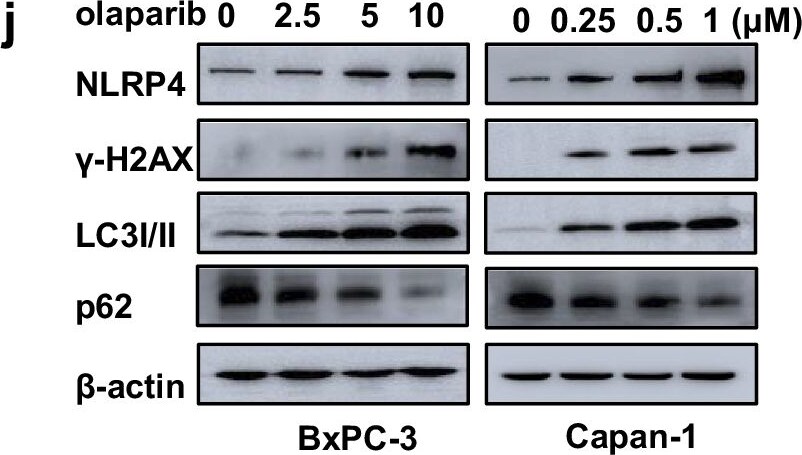
Western Blot: NALP4 Antibody - BSA Free [NB100-56156] -
NLRP4 expression induced olaparib resistance in pancreatic cancer cells.a, b MTS assays were performed to calculate the IC50 of olaparib in the indicated cells. c, d The indicated cells were treated with DMSO or olaparib (5 μM olaparib for BxPC-3 cells and 500 nM olaparib for Capan-1 cells). MTS assays were performed to investigate the effect of NLRP4 on olaparib resistance. The analysis of significant differences was performed with one-way ANOVA. ***p < 0.001. e The indicated cells were treated with DMSO or olaparib (5 μM olaparib for BxPC-3 cells and 500 nM olaparib for Capan-1 cells). Colony formation assays were performed to investigate the effect of NLRP4 on olaparib resistance. The analysis of significant differences was performed with Student’s t test. ***p < 0.001. **p < 0.01. f, g Flow cytometry results for annexin V/7-ADD staining in the indicated cell lines after exposure to DMSO or olaparib (5 μM olaparib for BxPC-3 cells and 500 nM olaparib for Capan-1 cells). The analysis of significant differences was performed with Student’s t test. ***p < 0.001. h Control or NLRP4-knockdown Capan-1 cells were treated with DMSO or olaparib (500 nM) for RNA sequencing and were subjected to GO pathway enrichment analysis. i Co-IP experiments were conducted in NLRP4 OE cells, followed by LC‒MS/MS analysis. j Control or NLRP4-knockdown BxPC-3 and Capan-1 cells were treated with the indicated dose of olaparib for 48 h. Western blotting was performed with the indicated antibodies. Image collected and cropped by CiteAb from the following open publication (https://www.nature.com/articles/s41419-024-06984-0), licensed under a CC-BY license. Not internally tested by Novus Biologicals.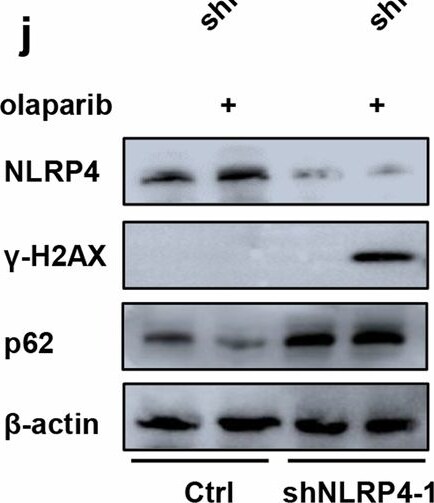
Western Blot: NALP4 Antibody - BSA Free [NB100-56156] -
Pancreatic tumors with higher NLRP4 expression are resistant to olaparib in vivo.a BxPC-3 xenografts obtained from mice in different groups treated with DMSO or olaparib (50 mg/kg per day). b Quantification of the weight of the tumors in different groups treated with DMSO or olaparib (50 mg/kg per day). The analysis of significant differences was performed with Student’s t test. **p < 0.01. c Quantification of tumor volume on the last day in different groups treated with DMSO or olaparib (50 mg/kg per day). The analysis of significant differences was performed with Student’s t test. p < 0.05, ** p <0.01. d Growth curves of cells treated with DMSO or olaparib. The analysis of significant differences was performed with one-way ANOVA. **p < 0.01, ***p < 0.001. e Tumor doubling time in different groups treated with DMSO or olaparib (50 mg/kg per day). The analysis of significant differences was performed with Student’s t test. *p<0.05. f–h Tumors were subjected to immunological staining to detect the indicated marker. f Representative IHC micrographs. Scale bar, 100 μm. g–i The histological score (H score) of the indicated markers was quantified. The analysis of significant differences was performed with Student’s t test. *p < 0.05,**p < 0.01,***p < 0.001. j Western blotting analysis was performed for the indicated antibodies. k Kaplan–Meier survival curves for the specified groups. The p value was calculated by the log rank test. ***p < 0.001. Image collected and cropped by CiteAb from the following open publication (https://www.nature.com/articles/s41419-024-06984-0), licensed under a CC-BY license. Not internally tested by Novus Biologicals.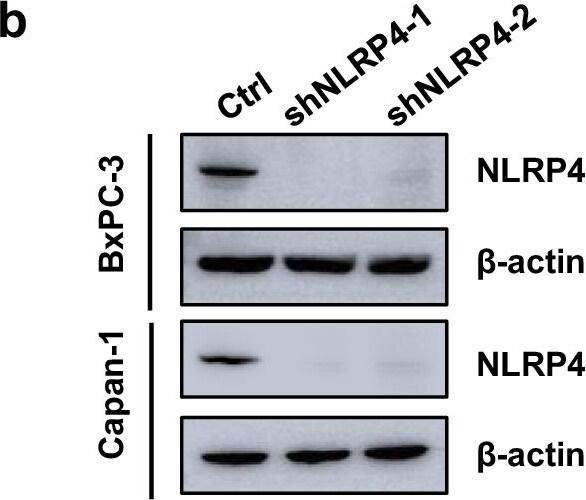
Western Blot: NALP4 Antibody - BSA Free [NB100-56156] -
NLRP4 expression promotes pancreatic cancer cell proliferation.a Volcano plot showing the suppression of NLRP4 led to a greater susceptibility to olaparib in pancreatic cancer cell lines. b Immunoblot of NLRP4 in control and NLRP4-knockdown BxPC-3 and Capan-1 cells. BxPC-3 and Capan-1 cells were stably transfected with shNC, shNLRP4-1 and shNLRP4-2, and then MTS assays (c, d) and colony formation assays (e, f) were performed. ***p < 0.001. **p < 0.01. The analysis of significant differences was performed with Student’s t test. g–j Control and NLRP4-knockdown BxPC-3 and Capan-1 cells were injected into the left flank of nude mice. Tumor volumes were measured every 3 days. Tumors were harvested on day 21, photographed and weighed. Tumor weights are shown in (h), BxPC-3 tumor volumes are shown in (i), and Capan-1 tumor volumes are shown in (j). Data are shown as the mean +/- SD (n = 5). ***p < 0.001. The analysis of significant differences was performed with Student’s t test. ***p < 0.001. **p < 0.01. k, l Flow cytometry analysis of annexin V/7-ADD staining in the indicated cell lines. Data are presented as the mean +/- SD from three independent experiments. The analysis of significant differences was performed with Student’s t test. Image collected and cropped by CiteAb from the following open publication (https://www.nature.com/articles/s41419-024-06984-0), licensed under a CC-BY license. Not internally tested by Novus Biologicals.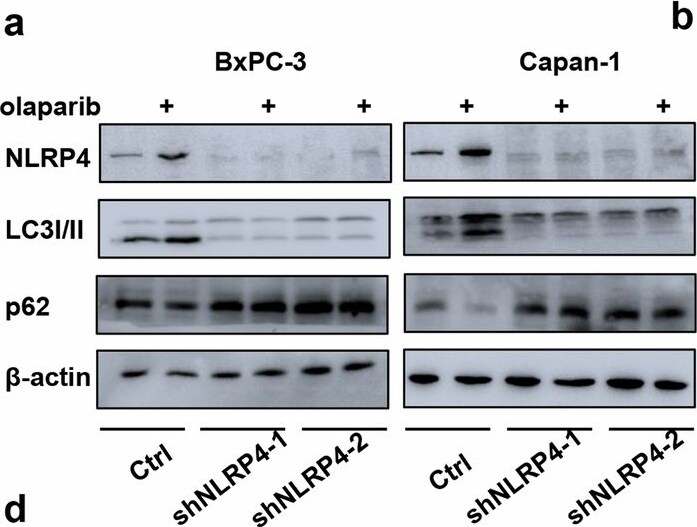
Western Blot: NALP4 Antibody - BSA Free [NB100-56156] -
Pancreatic cancer cells with high NLRP4 expression exhibit enhanced levels of autophagy in response to olaparib exposure.a–c Control or NLRP4-knockdown BxPC-3 and Capan-1 cells were treated with DMSO or olaparib (5 μM olaparib for BxPC-3 cells and 500 nM olaparib for Capan-1 cells) for 48 h. Western blotting analysis and quantification were performed. The analysis of significant differences was performed with Student's t test.**p < 0.01. d–f Effect of NLRP4 on the levels of autophagic flux. The mRFP-GFP-LC3 plasmid was transfected into the indicated cells for 24 h, and then the cells were treated with olaparib (5 μM olaparib for BxPC-3 cells and 500 nM olaparib for Capan-1 cells) for 48 h. Representative images were obtained by laser scanning confocal microscopy. The average fluorescence intensity of autophagic lysosomes (yellow dots in the merged images) and autophagic lysosomes (red in the merged images) in individual cells was quantified. Scale bar, 5 μm. The analysis of significant differences was performed with Student's t test. ***p < 0.001. g–i TEM-based ultrastructure analysis (autophagosomes) in the indicated cells. The analysis of significant differences was performed with Student’s t test. ***p < 0.001. Image collected and cropped by CiteAb from the following open publication (https://www.nature.com/articles/s41419-024-06984-0), licensed under a CC-BY license. Not internally tested by Novus Biologicals.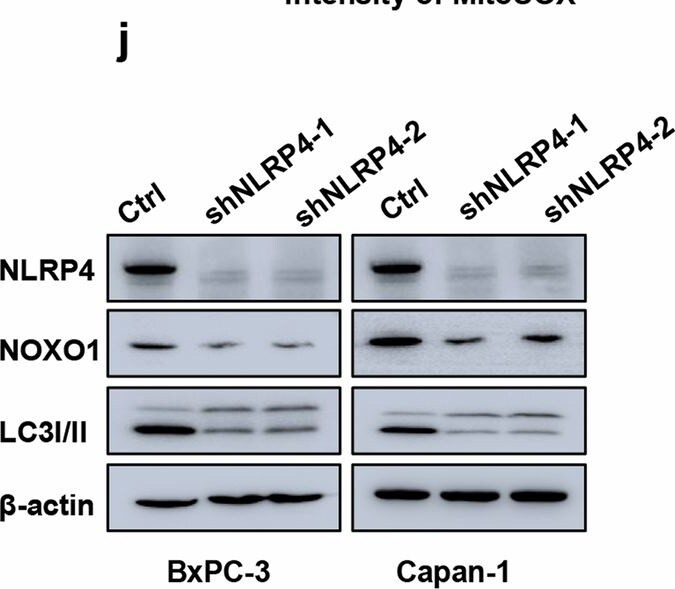
Western Blot: NALP4 Antibody - BSA Free [NB100-56156] -
NLRP4 induces mitochondrial ROS generation in pancreatic cancer cells in response to olaparib exposure.a Cells treated with DMSO or olaparib (5 μM olaparib for BxPC-3 cells and 500 nM olaparib for Capan-1 cells) for 48 h were incubated with an ROS indicator. Representative images were obtained. b, c Cells treated with DMSO or olaparib (5 μM olaparib for BxPC-3 cells and 500 nM olaparib for Capan-1 cells) for 48 h were incubated with an ROS indicator, and fluorescence intensity was assessed with flow cytometry. The analysis of significant differences was performed with Student’s t test. ***p < 0.001. d, e Cells treated with DMSO or olaparib (5 μM olaparib for BxPC-3 cells and 500 nM olaparib for Capan-1 cells) for 48 h were incubated with JC-1 working solution, and fluorescence intensity was assessed with flow cytometry. The analysis of significant differences was performed with Student’s t test. ***p < 0.001. f–h Cells treated with olaparib (5 μM olaparib for BxPC-3 cells and 500 nM olaparib for Capan-1 cells) plus DMSO or MitoQ for 48 h were incubated with MitoSOX. Representative images were obtained, and the fluorescence intensity was assessed with flow cytometry. The analysis of significant differences was performed with Student’s t test. ***p < 0.001. i Changes in ROS-related genes in control and NLRP4-knockdown Capan-1 cells after olaparib treatment (500 nM olaparib for Capan-1 cells). Scale bar, 5 μm. j Western blotting analysis was performed for the indicated antibodies. Image collected and cropped by CiteAb from the following open publication (https://www.nature.com/articles/s41419-024-06984-0), licensed under a CC-BY license. Not internally tested by Novus Biologicals.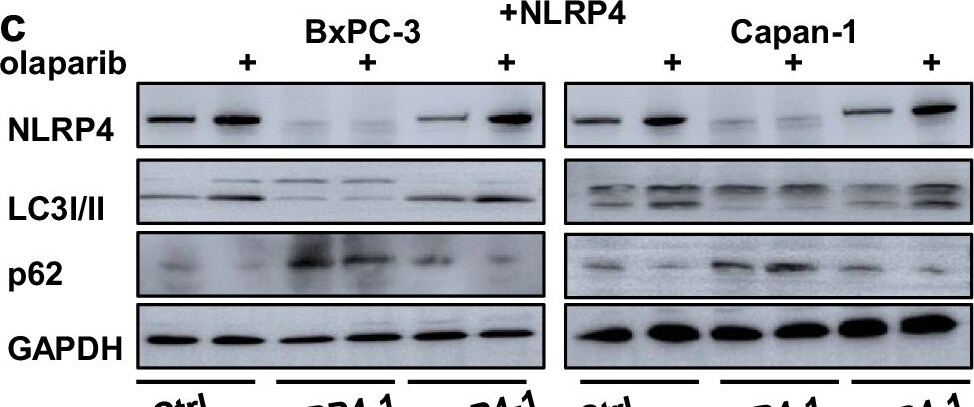
Western Blot: NALP4 Antibody - BSA Free [NB100-56156] -
Complementation of NLRP4 rescues DNA repair defects and autophagy levels in NLRP4-knockdown pancreatic cancer cells and results in olaparib resistance.a Representative immunofluorescence micrographs of gamma -H2AX foci in the indicated cells with or without olaparib treatment (5 μM olaparib for BxPC-3 cells and 500 nM olaparib for Capan-1 cells). b TEM-based ultrastructure analysis (autophagosomes) in the indicated cells. c Cells were treated with DMSO or olaparib (5 μM olaparib for BxPC-3 cells and 500 nM olaparib for Capan-1 cells) for 48 h. Western blotting analysis was performed for the indicated antibodies. d, e Cells treated with DMSO or olaparib (5 μM olaparib for BxPC-3 cells and 500 nM olaparib for Capan-1 cells) for 48 h were incubated with an ROS indicator, and fluorescence intensity was assessed with flow cytometry. The analysis of significant differences was performed with one-way ANOVA. ***p < 0.001. f, g The indicated cells were treated with DMSO or olaparib (5 μM olaparib for BxPC-3 cells and 500 nM olaparib for Capan-1 cells). MTS assays were performed to investigate the effect of NLRP4 on olaparib resistance. The analysis of significant differences was performed with one-way ANOVA. ***p < 0.001. h Flow cytometry results for annexin V/7-ADD staining in the indicated cell lines after exposure to DMSO or olaparib (5 μM olaparib for BxPC-3 cells and 500 nM olaparib for Capan-1 cells). The analysis of significant differences was performed with Student’s t test. ***p < 0.001. i Schematic model showing that NLRP4 renders pancreatic cancer resistant to PARPi through the promotion of the DNA damage response and ROS-induced autophagy. Image collected and cropped by CiteAb from the following open publication (https://www.nature.com/articles/s41419-024-06984-0), licensed under a CC-BY license. Not internally tested by Novus Biologicals.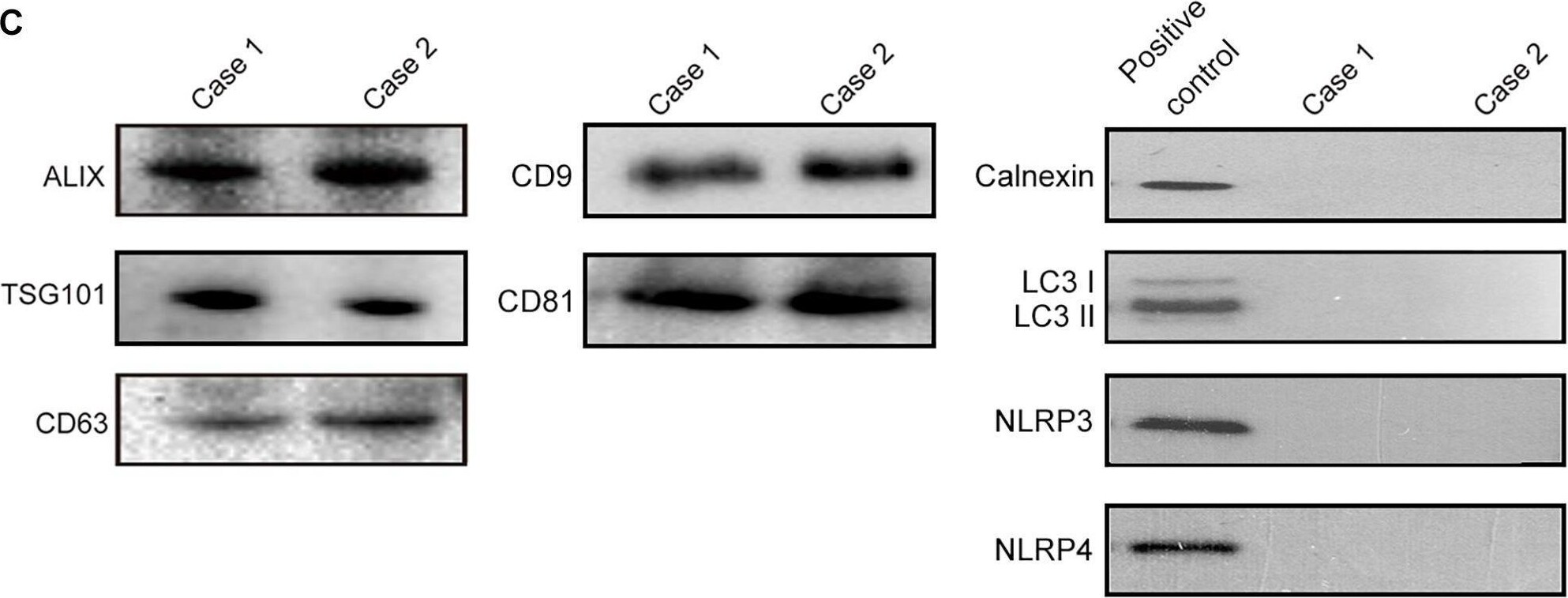
Western Blot: NALP4 Antibody - BSA Free [NB100-56156] -
Identification of salivary exosomes in periodontitis patients and normal subjects. (A) Transmission electron microscopy of exosomes isolated from human saliva. Scale bar: 100 nm. (B) Exosomes concentration and size distribution by NanoSight analysis of human saliva. (C) Immunoblotting showed the exosomal membrane markers (ALIX, TSG101 CD63, CD9 and CD81), the intracellular protein Calnexin, the marker of autophagosome LC3 and markers of inflammasome (NLRP3 and NLRP4) in exosomes isolated from the saliva of one normal subject (case 01) and one periodontitis patient (case 02). Positive control for Calnexin was TE1 cells, and positive control for LC3 was TE1 cells after starvation for 6 h. Positive control for NLRP3 and NLRP4 was THP-1 cells. Image collected and cropped by CiteAb from the following open publication (https://pubmed.ncbi.nlm.nih.gov/30923536), licensed under a CC-BY license. Not internally tested by Novus Biologicals.Applications for NALP4 Antibody - BSA Free
Immunohistochemistry-Paraffin
Western Blot
Formulation, Preparation, and Storage
Purification
Formulation
Format
Preservative
Concentration
Shipping
Stability & Storage
Background: NALP4
Alternate Names
Gene Symbol
Additional NALP4 Products
Product Documents for NALP4 Antibody - BSA Free
Certificate of Analysis
To download a Certificate of Analysis, please enter a lot or batch number in the search box below.
Product Specific Notices for NALP4 Antibody - BSA Free
This product is for research use only and is not approved for use in humans or in clinical diagnosis. Primary Antibodies are guaranteed for 1 year from date of receipt.
Citations for NALP4 Antibody - BSA Free
 Powered by Bioz
Customer Reviews for NALP4 Antibody - BSA Free
There are currently no reviews for this product. Be the first to review NALP4 Antibody - BSA Free and earn rewards!
Have you used NALP4 Antibody - BSA Free?
Submit a review and receive an Amazon gift card!
$25/€18/£15/$25CAN/¥2500 for a review with an image
$10/€7/£6/$10CAN/¥1110 for a review without an image
Submit a review
Protocols
Find general support by application which include: protocols, troubleshooting, illustrated assays, videos and webinars.
- Antigen Retrieval Protocol (PIER)
- Antigen Retrieval for Frozen Sections Protocol
- Appropriate Fixation of IHC/ICC Samples
- Cellular Response to Hypoxia Protocols
- Chromogenic IHC Staining of Formalin-Fixed Paraffin-Embedded (FFPE) Tissue Protocol
- Chromogenic Immunohistochemistry Staining of Frozen Tissue
- ClariTSA™ Fluorophore Kits
- Detection & Visualization of Antibody Binding
- Fluorescent IHC Staining of Frozen Tissue Protocol
- Graphic Protocol for Heat-induced Epitope Retrieval
- Graphic Protocol for the Preparation and Fluorescent IHC Staining of Frozen Tissue Sections
- Graphic Protocol for the Preparation and Fluorescent IHC Staining of Paraffin-embedded Tissue Sections
- Graphic Protocol for the Preparation of Gelatin-coated Slides for Histological Tissue Sections
- IHC Sample Preparation (Frozen sections vs Paraffin)
- Immunofluorescent IHC Staining of Formalin-Fixed Paraffin-Embedded (FFPE) Tissue Protocol
- Immunohistochemistry (IHC) and Immunocytochemistry (ICC) Protocols
- Immunohistochemistry Frozen Troubleshooting
- Immunohistochemistry Paraffin Troubleshooting
- Preparing Samples for IHC/ICC Experiments
- Preventing Non-Specific Staining (Non-Specific Binding)
- Primary Antibody Selection & Optimization
- Protocol for Heat-Induced Epitope Retrieval (HIER)
- Protocol for Making a 4% Formaldehyde Solution in PBS
- Protocol for VisUCyte™ HRP Polymer Detection Reagent
- Protocol for the Preparation & Fixation of Cells on Coverslips
- Protocol for the Preparation and Chromogenic IHC Staining of Frozen Tissue Sections
- Protocol for the Preparation and Chromogenic IHC Staining of Frozen Tissue Sections - Graphic
- Protocol for the Preparation and Chromogenic IHC Staining of Paraffin-embedded Tissue Sections
- Protocol for the Preparation and Chromogenic IHC Staining of Paraffin-embedded Tissue Sections - Graphic
- Protocol for the Preparation and Fluorescent IHC Staining of Frozen Tissue Sections
- Protocol for the Preparation and Fluorescent IHC Staining of Paraffin-embedded Tissue Sections
- Protocol for the Preparation of Gelatin-coated Slides for Histological Tissue Sections
- R&D Systems Quality Control Western Blot Protocol
- TUNEL and Active Caspase-3 Detection by IHC/ICC Protocol
- The Importance of IHC/ICC Controls
- Troubleshooting Guide: Immunohistochemistry
- Troubleshooting Guide: Western Blot Figures
- Western Blot Conditions
- Western Blot Protocol
- Western Blot Protocol for Cell Lysates
- Western Blot Troubleshooting
- Western Blot Troubleshooting Guide
- View all Protocols, Troubleshooting, Illustrated assays and Webinars