
Nbs1 [p Ser343] Antibody (SR2302) - BSA Free
Novus Biologicals | Catalog # NBP3-22663
Recombinant Monoclonal Antibody

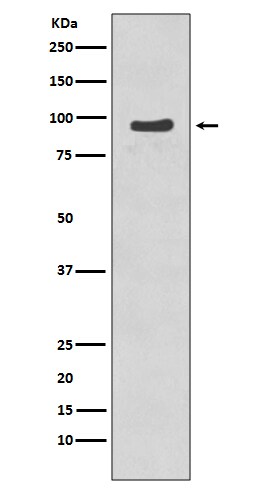
Scientific images may be resized, cropped, or adjusted for brightness or contrast for presentation purposes. These updates are limited to presentation and do not affect the underlying scientific interpretation of the data. Where available, additional source data may be provided upon request.
Loading...
Key Product Details
Validated by
Biological Validation
Species Reactivity
Human
Applications
Western Blot, Immunocytochemistry/ Immunofluorescence, Immunoprecipitation
Label
Unconjugated
Antibody Source
Recombinant Monoclonal Rabbit IgG Clone # SR2302 expressed in HEK293
Format
BSA Free
Loading...
Product Specifications
Immunogen
A synthesized peptide derived from human phospho-Nbs1 [Ser343] (Uniprot #: O60934)
Modification
p Ser343
Specificity
Detects endogenous levels of total phospho-Nbs1 [Ser343]
Clonality
Monoclonal
Host
Rabbit
Isotype
IgG
Theoretical MW
95 kDa.
Disclaimer note: The observed molecular weight of the protein may vary from the listed predicted molecular weight due to post translational modifications, post translation cleavages, relative charges, and other experimental factors.
Disclaimer note: The observed molecular weight of the protein may vary from the listed predicted molecular weight due to post translational modifications, post translation cleavages, relative charges, and other experimental factors.
Scientific Data Images for Nbs1 [p Ser343] Antibody (SR2302) - BSA Free
Applications for Nbs1 [p Ser343] Antibody (SR2302) - BSA Free
Application
Recommended Usage
Immunocytochemistry/ Immunofluorescence
1:50-1:200
Immunoprecipitation
1:50
Western Blot
1:500-1:2000
Formulation, Preparation, and Storage
Purification
Affinity purified
Formulation
PBS, pH 7.4, 150mM NaCl, 50% glycerol.
Format
BSA Free
Preservative
0.02% Sodium Azide
Concentration
Please see the vial label for concentration. If unlisted please contact technical services.
Shipping
The product is shipped with polar packs. Upon receipt, store it immediately at the temperature recommended below.
Stability & Storage
Store at 4C short term. Aliquot and store at -20C long term. Avoid freeze-thaw cycles.
Background: Nbs1
In DNA double strand break repair, the FHA/BRCT domains bind DNA damage sensor proteins including gamma H2AX (phospho Ser139), phosphorylated MDC1 and CtIP (CtBP-interacting protein). NBS1 then recruits the other members of the MRN complex, Mre11 and Rad50, to the proximity of DNA DSBs. The MRN complex has also been shown to interact with ATM or ATR kinases in the presence of DSBs or replication fork stalling, respectively. Phosphorylation of NBS1 at Ser 278 and Ser343 in response to ionizing radiation (IR) is dependent on ATM and is important for activation of the S phase checkpoint. The activation of ATM in response to DNA damage is also facilitated by MRN and may lead to induction of apoptosis (2, 3).
References
1. Bian L, Meng Y, Zhang M, Li D. (2019) MRE11-RAD50-NBS1 complex alterations and DNA damage response: implications for cancer treatment. Mol Cancer. 26;18(1):169. PMID: 31767017
2. Zhang Y, Zhou J, Lim CU. (2006) The role of NBS1 in DNA double strand break repair, telomere stability, and cell cycle checkpoint control. Cell Res. 16(1):45-54. PMID: 16467875
3. Komatsu K. NBS1 and multiple regulations of DNA damage response. (2016) J Radiat Res. 57 Suppl 1:i11-i17. PMID: 27068998
Long Name
Nijmegen Breakage Syndrome 1
Alternate Names
NBN, Nibrin, p95
Gene Symbol
NBN
Additional Nbs1 Products
Product Documents for Nbs1 [p Ser343] Antibody (SR2302) - BSA Free
Certificate of Analysis
To download a Certificate of Analysis, please enter a lot or batch number in the search box below.
Product Specific Notices for Nbs1 [p Ser343] Antibody (SR2302) - BSA Free
This product is for research use only and is not approved for use in humans or in clinical diagnosis. Primary Antibodies are guaranteed for 1 year from date of receipt.
Related Research Areas
Customer Reviews for Nbs1 [p Ser343] Antibody (SR2302) - BSA Free
There are currently no reviews for this product. Be the first to review Nbs1 [p Ser343] Antibody (SR2302) - BSA Free and earn rewards!
Have you used Nbs1 [p Ser343] Antibody (SR2302) - BSA Free?
Submit a review and receive an Amazon gift card!
$25/€18/£15/$25CAN/¥2500 for a review with an image
$10/€7/£6/$10CAN/¥1110 for a review without an image
Submit a review
Protocols
Find general support by application which include: protocols, troubleshooting, illustrated assays, videos and webinars.
- Appropriate Fixation of IHC/ICC Samples
- Cellular Response to Hypoxia Protocols
- ClariTSA™ Fluorophore Kits
- Detection & Visualization of Antibody Binding
- ICC Cell Smear Protocol for Suspension Cells
- ICC Immunocytochemistry Protocol Videos
- ICC for Adherent Cells
- Immunocytochemistry (ICC) Protocol
- Immunocytochemistry Troubleshooting
- Immunofluorescence of Organoids Embedded in Cultrex Basement Membrane Extract
- Immunohistochemistry (IHC) and Immunocytochemistry (ICC) Protocols
- Immunoprecipitation Protocol
- Preparing Samples for IHC/ICC Experiments
- Preventing Non-Specific Staining (Non-Specific Binding)
- Primary Antibody Selection & Optimization
- Protocol for VisUCyte™ HRP Polymer Detection Reagent
- Protocol for the Fluorescent ICC Staining of Cell Smears - Graphic
- Protocol for the Fluorescent ICC Staining of Cultured Cells on Coverslips - Graphic
- Protocol for the Preparation and Fluorescent ICC Staining of Cells on Coverslips
- Protocol for the Preparation and Fluorescent ICC Staining of Non-adherent Cells
- Protocol for the Preparation and Fluorescent ICC Staining of Stem Cells on Coverslips
- Protocol for the Preparation of a Cell Smear for Non-adherent Cell ICC - Graphic
- R&D Systems Quality Control Western Blot Protocol
- TUNEL and Active Caspase-3 Detection by IHC/ICC Protocol
- The Importance of IHC/ICC Controls
- Troubleshooting Guide: Western Blot Figures
- Western Blot Conditions
- Western Blot Protocol
- Western Blot Protocol for Cell Lysates
- Western Blot Troubleshooting
- Western Blot Troubleshooting Guide
- View all Protocols, Troubleshooting, Illustrated assays and Webinars
FAQs for Nbs1 [p Ser343] Antibody (SR2302) - BSA Free
Showing
1
-
4 of
4 FAQs
Showing All
-
Q: If this product is used in an application or species as a part of a customer review, will that validate this product in the application/species?
A: Yes, if this product is used in an untested application or species and it is shown to work through images from customer reviews or through publications, this validates the application/species for this product.
-
Q: What is NBS1?
A: NBS1 is Nijmegen breakage syndrome protein 1, or Nibrin. Please refer to the background listed in the datasheet for a full summary of this common name.
-
Q: What is the theoretical molecular weight of Nbs1 antibodies?
A: In general, there is only one isoform described for this target. The TMW of the human form of the target protein is 85kDa. The mouse form is 84kDa. However, the observed molecular weight may vary.
-
Q: What research areas can this product be used in?
A: All Nbs1 products can be used in Breast Cancer, Cancer, Checkpoint signaling, Chromatin Research, DNA Double Strand Break Repair, DNA Repair, Homologous Recombination, Non-homologous end-joining, Tumor Suppressors, and Cell Cycle and Replication.
-
Q: If this product is used in an application or species as a part of a customer review, will that validate this product in the application/species?
A: Yes, if this product is used in an untested application or species and it is shown to work through images from customer reviews or through publications, this validates the application/species for this product.
-
Q: What is NBS1?
A: NBS1 is Nijmegen breakage syndrome protein 1, or Nibrin. Please refer to the background listed in the datasheet for a full summary of this common name.
-
Q: What is the theoretical molecular weight of Nbs1 antibodies?
A: In general, there is only one isoform described for this target. The TMW of the human form of the target protein is 85kDa. The mouse form is 84kDa. However, the observed molecular weight may vary.
-
Q: What research areas can this product be used in?
A: All Nbs1 products can be used in Breast Cancer, Cancer, Checkpoint signaling, Chromatin Research, DNA Double Strand Break Repair, DNA Repair, Homologous Recombination, Non-homologous end-joining, Tumor Suppressors, and Cell Cycle and Replication.
-
Q: If this product is used in an application or species as a part of a customer review, will that validate this product in the application/species?
A: Yes, if this product is used in an untested application or species and it is shown to work through images from customer reviews or through publications, this validates the application/species for this product.
-
Q: What is NBS1?
A: NBS1 is Nijmegen breakage syndrome protein 1, or Nibrin. Please refer to the background listed in the datasheet for a full summary of this common name.
-
Q: What is the theoretical molecular weight of Nbs1 antibodies?
A: In general, there is only one isoform described for this target. The TMW of the human form of the target protein is 85kDa. The mouse form is 84kDa. However, the observed molecular weight may vary.
-
Q: What research areas can this product be used in?
A: All Nbs1 products can be used in Breast Cancer, Cancer, Checkpoint signaling, Chromatin Research, DNA Double Strand Break Repair, DNA Repair, Homologous Recombination, Non-homologous end-joining, Tumor Suppressors, and Cell Cycle and Replication.
-
Q: If this product is used in an application or species as a part of a customer review, will that validate this product in the application/species?
A: Yes, if this product is used in an untested application or species and it is shown to work through images from customer reviews or through publications, this validates the application/species for this product.
-
Q: What is NBS1?
A: NBS1 is Nijmegen breakage syndrome protein 1, or Nibrin. Please refer to the background listed in the datasheet for a full summary of this common name.
-
Q: What is the theoretical molecular weight of Nbs1 antibodies?
A: In general, there is only one isoform described for this target. The TMW of the human form of the target protein is 85kDa. The mouse form is 84kDa. However, the observed molecular weight may vary.
-
Q: What research areas can this product be used in?
A: All Nbs1 products can be used in Breast Cancer, Cancer, Checkpoint signaling, Chromatin Research, DNA Double Strand Break Repair, DNA Repair, Homologous Recombination, Non-homologous end-joining, Tumor Suppressors, and Cell Cycle and Replication.
Loading...