
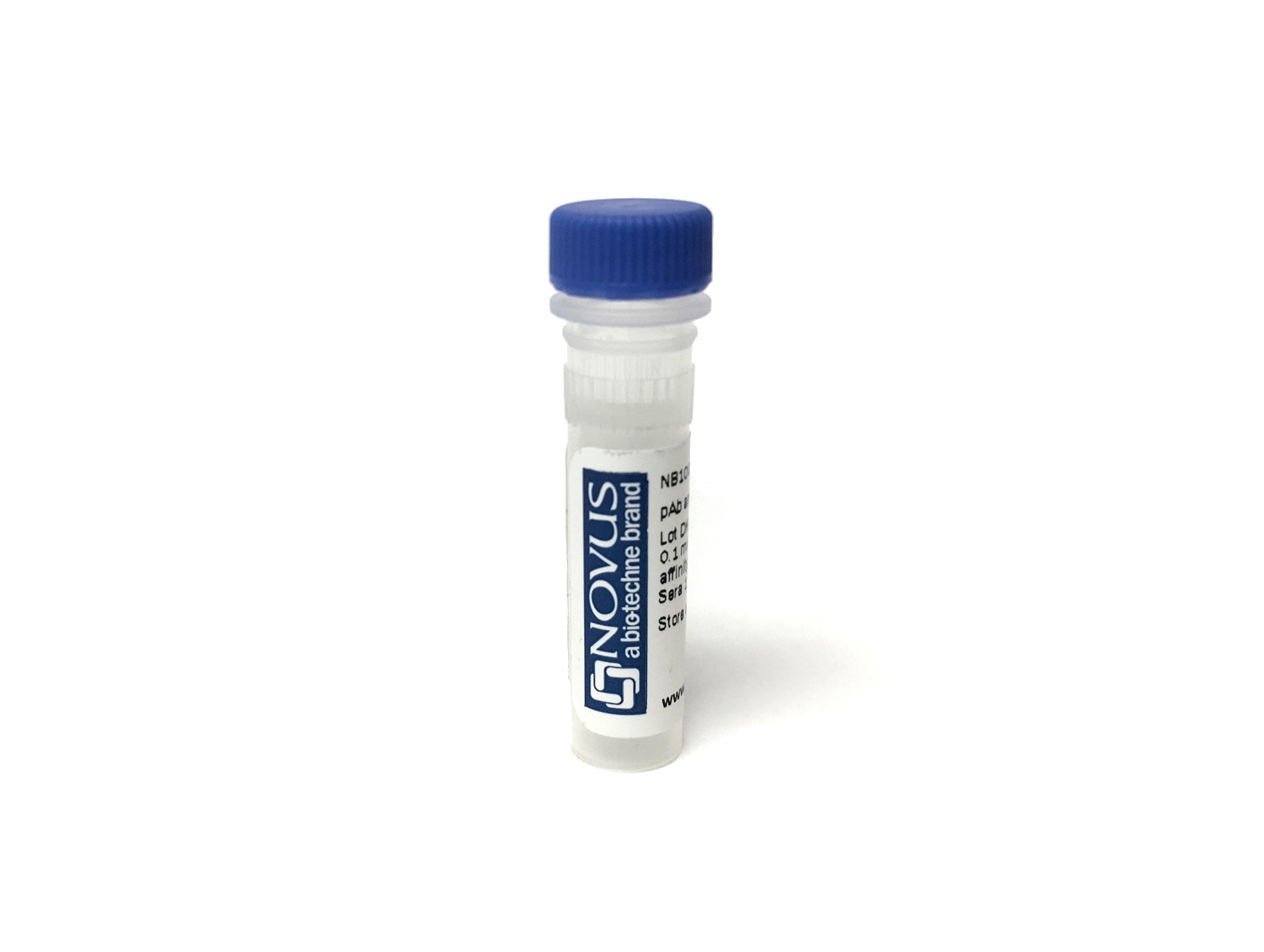
NKp46/NCR1 Antibody (259018) [DyLight 350]
Novus Biologicals | Catalog # FAB2225D

Key Product Details
Species Reactivity
Mouse
Applications
Western Blot
Label
DyLight 350 (Excitation = 353 nm, Emission = 432 nm)
Antibody Source
Monoclonal Rat IgG2A Clone # 259018
Loading...
Product Specifications
Immunogen
Mouse myeloma cell line NS0-derived recombinant mouse NKp46
Glu22-Asn255
Accession # Q8C567
Glu22-Asn255
Accession # Q8C567
Specificity
Detects mouse NKp46 in direct ELISAs and Western blots. In direct ELISAs and Western blots, this antibody shows 10 ‑ 20% cross‑reactivity with recombinant human (rh) NKp46 and no cross-reactivity with rhNKp30 or rhNKp80.
Clonality
Monoclonal
Host
Rat
Isotype
IgG2A
Description
This conjugate is made on demand and is not held in inventory. Each order represents a unique lot. All conjugates are generated using validated conjugation protocols and meet strict degree of labeling (F/P) specifications; additional information is available upon request. The antibody concentration is provided on the individual product label.
For specialized conjugation needs, like large quantities, specific concentrations, and defined F/P ratios, bulk and custom antibody conjugation services are available.
For specialized conjugation needs, like large quantities, specific concentrations, and defined F/P ratios, bulk and custom antibody conjugation services are available.
Applications for NKp46/NCR1 Antibody (259018) [DyLight 350]
Application
Recommended Usage
Western Blot
Optimal dilutions of this antibody should be experimentally determined.
Application Notes
Recommended applications are based on validated applications from the unconjugated base product MAB2225. This conjugated antibody is not kept in inventory and is made to order using validated conjugation protocols.
Formulation, Preparation, and Storage
Purification
Protein A or G purified from hybridoma culture supernatant
Formulation
50mM Sodium Borate
Preservative
0.05% Sodium Azide
Concentration
Please see the vial label for concentration. If unlisted please contact technical services.
Shipping
The product is shipped with polar packs. Upon receipt, store it immediately at the temperature recommended below.
Stability & Storage
Store at 4C in the dark.
Background: NKp46/NCR1
NKp46 plays a critical role in the NK-cell lysis of allogenic, autologous, and xenogeneic cells (3). Activation of NKp46 signaling is mediated via its association with immunoreceptor tyrosine-based activation motif (ITAM) bearing molecules CD3zeta and FcRgamma (3). Upon receptor-engagement NK-cell cytotoxic activity and cytokine release occurs (3). This NKp46 signaling can be blocked with anti-NKp46 monoclonal antibody mediated cross-linking which causes calcium release and interferon-gamma (IFN-gamma) and tumor necrosis factor-alpha (TNF-alpha) secretion (3). NKp46 recognizes multiple ligands presented on tumor cells or pathogens and infected cells including influenza virus hemagglutinin and the parainfluenza virus hemagglutinin neuraminidase (2). Additional ligands for the NKp46 receptor include heparan sulfate (HS) glycosaminoglycans (GAGs), hemagglutinin of human vaccina virus, and vimentin expressed on cells infected with Mycobacterium tuberculosis (3).
NKp46 and its NCR counterparts have shown to be successful targets for cancer immunotherapy. More specifically, human and mouse NKp46 has shown promise in virotherapy due to its ability to stimulate NK cell activation by binding to reovirus sigma1 protein in a sialic acid-dependent manner (3). Another approach for NKp46 in cancer immunotherapy is through the use of NCR based chimeric antigen receptors (CARs). In this therapy, NCR1 supplied human T cells with anti-tumor properties via cytokine secretion, upregulation of activation markers, improved expansion, and cytotoxicity in both mouse and in vitro models (3).
References
1. Barrow, A. D., Martin, C. J., & Colonna, M. (2019). The Natural Cytotoxicity Receptors in Health and Disease. Frontiers in immunology, 10, 909. https://doi.org/10.3389/fimmu.2019.00909
2. Mandelboim, O., & Porgador, A. (2001). NKp46. The international journal of biochemistry & cell biology, 33(12), 1147-1150. https://doi.org/10.1016/S1357-2725(01)00078-4
3. Barrow, A. D., Martin, C. J., & Colonna, M. (2019). The Natural Cytotoxicity Receptors in Health and Disease. Frontiers in immunology, 10, 909. https://doi.org/10.3389/fimmu.2019.00909
Alternate Names
CD335, Ly94, MAR-1, NCR1
Gene Symbol
NCR1
Additional NKp46/NCR1 Products
Product Documents for NKp46/NCR1 Antibody (259018) [DyLight 350]
Certificate of Analysis
To download a Certificate of Analysis, please enter a lot or batch number in the search box below.
Product Specific Notices for NKp46/NCR1 Antibody (259018) [DyLight 350]
DyLight (R) is a trademark of Thermo Fisher Scientific Inc. and its subsidiaries.
This product is for research use only and is not approved for use in humans or in clinical diagnosis. Primary Antibodies are guaranteed for 1 year from date of receipt.
Customer Reviews for NKp46/NCR1 Antibody (259018) [DyLight 350]
There are currently no reviews for this product. Be the first to review NKp46/NCR1 Antibody (259018) [DyLight 350] and earn rewards!
Have you used NKp46/NCR1 Antibody (259018) [DyLight 350]?
Submit a review and receive an Amazon gift card!
$25/€18/£15/$25CAN/¥2500 for a review with an image
$10/€7/£6/$10CAN/¥1110 for a review without an image
Submit a review
Protocols
Find general support by application which include: protocols, troubleshooting, illustrated assays, videos and webinars.
- Cellular Response to Hypoxia Protocols
- R&D Systems Quality Control Western Blot Protocol
- Troubleshooting Guide: Western Blot Figures
- Western Blot Conditions
- Western Blot Protocol
- Western Blot Protocol for Cell Lysates
- Western Blot Troubleshooting
- Western Blot Troubleshooting Guide
- View all Protocols, Troubleshooting, Illustrated assays and Webinars
Loading...
Associated Pathways

