
OTUD6A Antibody - BSA Free
Novus Biologicals | Catalog # NBP1-91498

![Western Blot: OTUD6A Antibody [NBP1-91498]](https://resources.rndsystems.com/images/products/OTUD6A-Antibody-Western-Blot-NBP1-91498-img0003.jpg "Western Blot: OTUD6A Antibody [NBP1-91498]")
Loading...
Key Product Details
Species Reactivity
Validated:
Human
Cited:
Human, Rat
Applications
Validated:
Western Blot, Immunocytochemistry/ Immunofluorescence
Cited:
Western Blot, Immunocytochemistry/ Immunofluorescence
Label
Unconjugated
Antibody Source
Polyclonal Rabbit IgG
Format
BSA Free
Loading...
Product Specifications
Immunogen
Synthetic peptide directed towards the middle region of human OTUD6A. Peptide sequence KMNLENRPPRSSKAHRKRERMESEERERQESIFQAEMSEHLAGFKREEEE. The peptide sequence for this immunogen was taken from within the described region.
Clonality
Polyclonal
Host
Rabbit
Isotype
IgG
Theoretical MW
32 kDa.
Disclaimer note: The observed molecular weight of the protein may vary from the listed predicted molecular weight due to post translational modifications, post translation cleavages, relative charges, and other experimental factors.
Disclaimer note: The observed molecular weight of the protein may vary from the listed predicted molecular weight due to post translational modifications, post translation cleavages, relative charges, and other experimental factors.
Description
The addition of 50% glycerol is optional for those storing this antibody at -20C and not aliquoting smaller units. However, please note that glycerol may interrupt some downstream antibody applications and should be added with caution.
Scientific Data Images for OTUD6A Antibody - BSA Free
Western Blot: OTUD6A Antibody [NBP1-91498]
Western Blot: OTUD6A Antibody [NBP1-91498] - Titration: 2 ug/ml Positive Control: Human HeLa Cell line.![Western Blot: OTUD6A Antibody [NBP1-91498]](https://resources.rndsystems.com/images/products/OTUD6A-Antibody-Western-Blot-NBP1-91498-img0002.jpg "Western Blot: OTUD6A Antibody [NBP1-91498]")
Western Blot: OTUD6A Antibody [NBP1-91498]
Western Blot: OTUD6A Antibody [NBP1-91498] - Titration: 0.2-1 ug/ml, Positive Control: Jurkat cell lysate.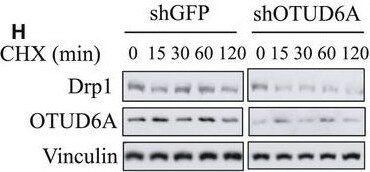
Western Blot: OTUD6A Antibody [NBP1-91498] -
Western Blot: OTUD6A Antibody [NBP1-91498] - OTUD6A deubiquitinates & affects Drp1 stability. Cells were infected with pLKO‐shOTUD6A or mock virus, selected by puromycin for 3 days to eliminate noninfected cells. (A) Depletion of OTUD6A in cells leads to decreased Drp1. Relative OTUD6A (B) & Drp1 (C) expression of (A) was further quantified. (D) Exogenous expression of OTUD6A causes the accumulation of Drp1 in HCT116 (left) & DLD1 (right) cells. (E) Relative Drp1 expression of (D) was further quantified. (F) HCT116 cells transfected with pLKO‐shOTUD6A were left untreated or treated with proteasome inhibitor MG132 (10 μm, 12 h), & the proteins were extracted & subjected to western blotting. (G) Relative Drp1 expression of (F) was further quantified. (H, I) Half‐life analysis of Drp1 in HCT116 cells with & without knockdown of OTUD6A. (J, K) Half‐life analysis of Drp1 in DLD1 cells expressing OTUD6A. (L) OTUD6A inhibits Drp1 ubiquitination in cells. IB analysis of Ni‐NTA pull‐down products & WCL derived from HEK293 cells transfected with the indicated constructs. (M) OTUD6A WT but not the mutant C152A deubiquitinates Drp1. The mean ± SD for three independent experiments is shown. For two groups, data were analyzed by unpaired, two‐tailed Student's t‐test. **P < 0.01, ***P < 0.001. Other data were analyzed by one‐way ANOVA, followed by a Bonferroni post hoc test. **P < 0.01, ***P < 0.001. Image collected & cropped by CiteAb from the following publication (https://pubmed.ncbi.nlm.nih.gov/33070427), licensed under a CC-BY license. Not internally tested by Novus Biologicals.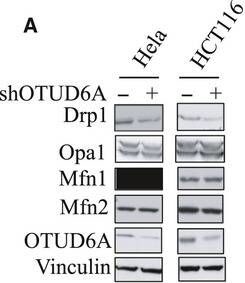
Western Blot: OTUD6A Antibody [NBP1-91498] -
Western Blot: OTUD6A Antibody [NBP1-91498] - OTUD6A deubiquitinates & affects Drp1 stability. Cells were infected with pLKO‐shOTUD6A or mock virus, selected by puromycin for 3 days to eliminate noninfected cells. (A) Depletion of OTUD6A in cells leads to decreased Drp1. Relative OTUD6A (B) & Drp1 (C) expression of (A) was further quantified. (D) Exogenous expression of OTUD6A causes the accumulation of Drp1 in HCT116 (left) & DLD1 (right) cells. (E) Relative Drp1 expression of (D) was further quantified. (F) HCT116 cells transfected with pLKO‐shOTUD6A were left untreated or treated with proteasome inhibitor MG132 (10 μm, 12 h), & the proteins were extracted & subjected to western blotting. (G) Relative Drp1 expression of (F) was further quantified. (H, I) Half‐life analysis of Drp1 in HCT116 cells with & without knockdown of OTUD6A. (J, K) Half‐life analysis of Drp1 in DLD1 cells expressing OTUD6A. (L) OTUD6A inhibits Drp1 ubiquitination in cells. IB analysis of Ni‐NTA pull‐down products & WCL derived from HEK293 cells transfected with the indicated constructs. (M) OTUD6A WT but not the mutant C152A deubiquitinates Drp1. The mean ± SD for three independent experiments is shown. For two groups, data were analyzed by unpaired, two‐tailed Student's t‐test. **P < 0.01, ***P < 0.001. Other data were analyzed by one‐way ANOVA, followed by a Bonferroni post hoc test. **P < 0.01, ***P < 0.001. Image collected & cropped by CiteAb from the following publication (https://pubmed.ncbi.nlm.nih.gov/33070427), licensed under a CC-BY license. Not internally tested by Novus Biologicals.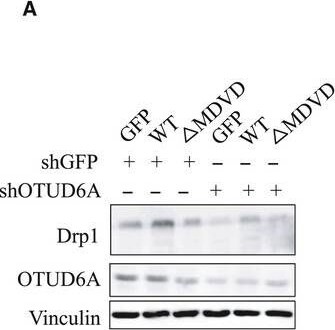
Western Blot: OTUD6A Antibody [NBP1-91498] -
Western Blot: OTUD6A Antibody [NBP1-91498] - Decreased cancer cell growth induced by OTUD6A can be partly restored by Drp1 expression. (A) HeLa cells were infected with pLKO‐shOTUD6A, selected by puromycin for 3 days. OTUD6A−/− cells were then infected with Drp1‐WT or Drp1‐ delta MDVD, selected by hygro for 3 days. (B) Fluorescence staining of mitochondrial morphology in HeLa cells stably knockdown OTUD6A & express Drp1‐WT or Drp1‐ delta MDVD. The magnification of the images is 400×. (C) The length of mitochondrial fragments in the indicated HeLa cells. (D) Cell growth of indicated cells. (E) Colony formation of the indicated cells. (F) Relative colony numbers were further quantified to determine the extent of the colony formation. The mean ± SD for three independent experiments is shown. Data were analyzed by one‐way or two‐way ANOVA, followed by a Bonferroni post hoc test. *P < 0.05, **P < 0.01, ***P < 0.001. For image C & F, *P < 0.05, ***P < 0.001 GFP vs WT. #P < 0.05, ###P < 0.001 WT vs. delta MDVD; ^P < 0.05, ^^P < 0.01, ^^^P < 0.001 shGFP + GFP vs. shOTUD6A. For image D, ***P < 0.001 shGFP + GFP vs. shOTUD6A + GFP; ^^^P < 0.001 shGFP + GFP vs. shOTUD6A + delta MDVD. Scale bar represents 40 μm. Image collected & cropped by CiteAb from the following publication (https://pubmed.ncbi.nlm.nih.gov/33070427), licensed under a CC-BY license. Not internally tested by Novus Biologicals.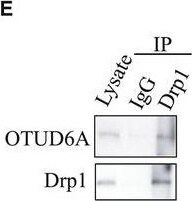
Western Blot: OTUD6A Antibody [NBP1-91498] -
Western Blot: OTUD6A Antibody [NBP1-91498] - OTUD6A interacts with Drp1. (A) Drp1 specifically interacts with OTUD6A in cells. IB analysis of IP & WCL derived from HEK293 cells transfected with HA‐Drp1 & the indicated Flag‐DUBs for 48 h. (B) Overview of OTUD6A & Drp1 structures. (C) OTUD6A WT but not mutant C152A specifically interacts with Drp1. (D) HEK293 cells transfected with the Drp1 constructs were subjected to IP with the anti‐HA or anti‐Flag antibodies. (E) Drp1 interacts with endogenous OTUD6A in cells. HEK293 cell lysates were subjected to pull down by anti‐Drp1 antibody & protein A/G agarose, followed by IB analysis with the indicated antibodies. (F) HeLa cells were fixed & immunostained with anti‐Drp1 & anti‐OTUD6A before confocal microscopy. The magnification of the images is 400×. (G) Quantification of the colocalization between Drp1 & OTUD6A. Scale bar represents 40 μm. Image collected & cropped by CiteAb from the following publication (https://pubmed.ncbi.nlm.nih.gov/33070427), licensed under a CC-BY license. Not internally tested by Novus Biologicals.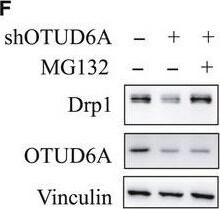
Western Blot: OTUD6A Antibody [NBP1-91498] -
Western Blot: OTUD6A Antibody [NBP1-91498] - OTUD6A deubiquitinates & affects Drp1 stability. Cells were infected with pLKO‐shOTUD6A or mock virus, selected by puromycin for 3 days to eliminate noninfected cells. (A) Depletion of OTUD6A in cells leads to decreased Drp1. Relative OTUD6A (B) & Drp1 (C) expression of (A) was further quantified. (D) Exogenous expression of OTUD6A causes the accumulation of Drp1 in HCT116 (left) & DLD1 (right) cells. (E) Relative Drp1 expression of (D) was further quantified. (F) HCT116 cells transfected with pLKO‐shOTUD6A were left untreated or treated with proteasome inhibitor MG132 (10 μm, 12 h), & the proteins were extracted & subjected to western blotting. (G) Relative Drp1 expression of (F) was further quantified. (H, I) Half‐life analysis of Drp1 in HCT116 cells with & without knockdown of OTUD6A. (J, K) Half‐life analysis of Drp1 in DLD1 cells expressing OTUD6A. (L) OTUD6A inhibits Drp1 ubiquitination in cells. IB analysis of Ni‐NTA pull‐down products & WCL derived from HEK293 cells transfected with the indicated constructs. (M) OTUD6A WT but not the mutant C152A deubiquitinates Drp1. The mean ± SD for three independent experiments is shown. For two groups, data were analyzed by unpaired, two‐tailed Student's t‐test. **P < 0.01, ***P < 0.001. Other data were analyzed by one‐way ANOVA, followed by a Bonferroni post hoc test. **P < 0.01, ***P < 0.001. Image collected & cropped by CiteAb from the following publication (https://pubmed.ncbi.nlm.nih.gov/33070427), licensed under a CC-BY license. Not internally tested by Novus Biologicals.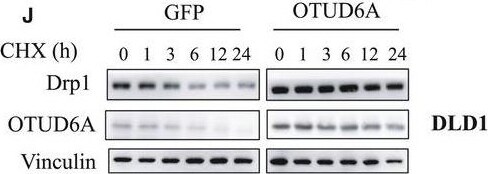
Western Blot: OTUD6A Antibody [NBP1-91498] -
Western Blot: OTUD6A Antibody [NBP1-91498] - OTUD6A deubiquitinates & affects Drp1 stability. Cells were infected with pLKO‐shOTUD6A or mock virus, selected by puromycin for 3 days to eliminate noninfected cells. (A) Depletion of OTUD6A in cells leads to decreased Drp1. Relative OTUD6A (B) & Drp1 (C) expression of (A) was further quantified. (D) Exogenous expression of OTUD6A causes the accumulation of Drp1 in HCT116 (left) & DLD1 (right) cells. (E) Relative Drp1 expression of (D) was further quantified. (F) HCT116 cells transfected with pLKO‐shOTUD6A were left untreated or treated with proteasome inhibitor MG132 (10 μm, 12 h), & the proteins were extracted & subjected to western blotting. (G) Relative Drp1 expression of (F) was further quantified. (H, I) Half‐life analysis of Drp1 in HCT116 cells with & without knockdown of OTUD6A. (J, K) Half‐life analysis of Drp1 in DLD1 cells expressing OTUD6A. (L) OTUD6A inhibits Drp1 ubiquitination in cells. IB analysis of Ni‐NTA pull‐down products & WCL derived from HEK293 cells transfected with the indicated constructs. (M) OTUD6A WT but not the mutant C152A deubiquitinates Drp1. The mean ± SD for three independent experiments is shown. For two groups, data were analyzed by unpaired, two‐tailed Student's t‐test. **P < 0.01, ***P < 0.001. Other data were analyzed by one‐way ANOVA, followed by a Bonferroni post hoc test. **P < 0.01, ***P < 0.001. Image collected & cropped by CiteAb from the following publication (https://pubmed.ncbi.nlm.nih.gov/33070427), licensed under a CC-BY license. Not internally tested by Novus Biologicals.Applications for OTUD6A Antibody - BSA Free
Application
Recommended Usage
Western Blot
1.0 ug/ml
Application Notes
Use in ICC/IF reported in scientific literature (PMID:35768646).
Formulation, Preparation, and Storage
Purification
Affinity purified
Formulation
PBS, 2% Sucrose
Format
BSA Free
Preservative
0.09% Sodium Azide
Concentration
0.5 mg/ml
Shipping
The product is shipped with polar packs. Upon receipt, store it immediately at the temperature recommended below.
Stability & Storage
Store at 4C short term. Aliquot and store at -20C long term. Avoid freeze-thaw cycles.
Background: OTUD6A
Long Name
OTU Domain-containing Protein 6A
Alternate Names
DUBA2
Gene Symbol
OTUD6A
UniProt
Additional OTUD6A Products
Product Documents for OTUD6A Antibody - BSA Free
Certificate of Analysis
To download a Certificate of Analysis, please enter a lot or batch number in the search box below.
Product Specific Notices for OTUD6A Antibody - BSA Free
This product is for research use only and is not approved for use in humans or in clinical diagnosis. Primary Antibodies are guaranteed for 1 year from date of receipt.
Related Research Areas
Citations for OTUD6A Antibody - BSA Free
 Powered by Bioz
Customer Reviews for OTUD6A Antibody - BSA Free
There are currently no reviews for this product. Be the first to review OTUD6A Antibody - BSA Free and earn rewards!
Have you used OTUD6A Antibody - BSA Free?
Submit a review and receive an Amazon gift card!
$25/€18/£15/$25CAN/¥2500 Yen for a review with an image
$10/€7/£6/$10CAN/¥1110 Yen for a review without an image
Submit a review
Protocols
Find general support by application which include: protocols, troubleshooting, illustrated assays, videos and webinars.
- Appropriate Fixation of IHC/ICC Samples
- Cellular Response to Hypoxia Protocols
- ClariTSA™ Fluorophore Kits
- Detection & Visualization of Antibody Binding
- ICC Cell Smear Protocol for Suspension Cells
- ICC Immunocytochemistry Protocol Videos
- ICC for Adherent Cells
- Immunocytochemistry (ICC) Protocol
- Immunocytochemistry Troubleshooting
- Immunofluorescence of Organoids Embedded in Cultrex Basement Membrane Extract
- Immunohistochemistry (IHC) and Immunocytochemistry (ICC) Protocols
- Preparing Samples for IHC/ICC Experiments
- Preventing Non-Specific Staining (Non-Specific Binding)
- Primary Antibody Selection & Optimization
- Protocol for VisUCyte™ HRP Polymer Detection Reagent
- Protocol for the Fluorescent ICC Staining of Cell Smears - Graphic
- Protocol for the Fluorescent ICC Staining of Cultured Cells on Coverslips - Graphic
- Protocol for the Preparation and Fluorescent ICC Staining of Cells on Coverslips
- Protocol for the Preparation and Fluorescent ICC Staining of Non-adherent Cells
- Protocol for the Preparation and Fluorescent ICC Staining of Stem Cells on Coverslips
- Protocol for the Preparation of a Cell Smear for Non-adherent Cell ICC - Graphic
- R&D Systems Quality Control Western Blot Protocol
- TUNEL and Active Caspase-3 Detection by IHC/ICC Protocol
- The Importance of IHC/ICC Controls
- Troubleshooting Guide: Western Blot Figures
- Western Blot Conditions
- Western Blot Protocol
- Western Blot Protocol for Cell Lysates
- Western Blot Troubleshooting
- Western Blot Troubleshooting Guide
- View all Protocols, Troubleshooting, Illustrated assays and Webinars
Loading...