Recombinant Equine IL-2 (Cys141Ser) Protein

R&D Systems | Catalog # 1613-IL

R&D Systems
Loading...

Key Product Details

  • R&D Systems E. coli-derived Recombinant Equine IL-2 (Cys141Ser) Protein (1613-IL)
  • Quality control testing to verify active proteins with lot specific assays by in-house scientists
  • All R&D Systems proteins are covered with a 100% guarantee

Source

E. coli

Accession Number

Applications

Bioactivity
Loading...

Product Specifications

Source

E. coli-derived equine IL-2 protein
Ala21-Thr149 (Cys141Ser), with and without an N-terminal Met

Purity

>97%, by SDS-PAGE under reducing conditions and visualized by silver stain.

Endotoxin Level

<0.01 EU per 1 μg of the protein by the LAL method.

N-terminal Sequence Analysis

Met & Ala21

Predicted Molecular Mass

15 kDa

Activity

Measured in a cell proliferation assay using CTLL‑2 mouse cytotoxic T cells. Gearing, A.J.H. and C.B. Bird (1987) in Lymphokines and Interferons, A Practical Approach. Clemens, M.J. et al. (eds): IRL Press. 295.
The ED50 for this effect is 0.3‑1.5 µg/mL.

Formulation, Preparation, and Storage

Carrier Free
What does CF mean?

CF stands for Carrier Free (CF). We typically add Bovine Serum Albumin (BSA) as a carrier protein to our recombinant proteins. Adding a carrier protein enhances protein stability, increases shelf-life, and allows the recombinant protein to be stored at a more dilute concentration. The carrier free version does not contain BSA.

What formulation is right for me?

In general, we advise purchasing the recombinant protein with BSA for use in cell or tissue culture, or as an ELISA standard. In contrast, the carrier free protein is recommended for applications, in which the presence of BSA could interfere.

Carrier: 1613-IL
Formulation Lyophilized from a 0.2 μm filtered solution in Sodium Acetate with BSA as a carrier protein.
Reconstitution Reconstitute at 200 μg/mL in sterile PBS containing at least 0.1% human or bovine serum albumin.
Shipping The product is shipped at ambient temperature. Upon receipt, store it immediately at the temperature recommended below.
Stability & Storage Use a manual defrost freezer and avoid repeated freeze-thaw cycles.
  • 12 months from date of receipt, -20 to -70 °C as supplied.
  • 1 month, 2 to 8 °C under sterile conditions after reconstitution.
  • 3 months, -20 to -70 °C under sterile conditions after reconstitution.
Carrier Free: 1613-IL/CF
Formulation Lyophilized from a 0.2 μm filtered solution in Sodium Acetate.
Reconstitution Reconstitute at 200 μg/mL in sterile PBS.
Shipping The product is shipped at ambient temperature. Upon receipt, store it immediately at the temperature recommended below.
Stability & Storage Use a manual defrost freezer and avoid repeated freeze-thaw cycles.
  • 12 months from date of receipt, -20 to -70 °C as supplied.
  • 1 month, 2 to 8 °C under sterile conditions after reconstitution.
  • 3 months, -20 to -70 °C under sterile conditions after reconstitution.

Calculators

The reconstitution calculator allows you to quickly calculate the volume of a reagent to reconstitute your vial. Simply enter the mass of reagent and the target concentration and the calculator will determine the rest.

=
÷

Background: IL-2

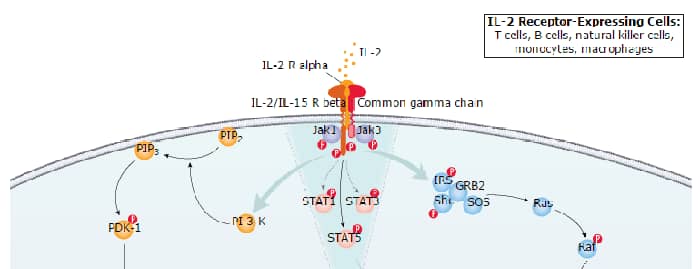
Interleukin 2 was initially identified as a T cell growth factor that is produced by T cells following activation by mitogens or antigens (1). IL-2 has since been found to also stimulate the growth and differentiation of B cells, natural killer (NK) cells, lymphocyte activated killer (LAK) cells, monocytes/macrophages and oligodendrocytes (2).

The biological activity of IL-2 is mediated by the binding of IL-2 to cell surface receptor complexes. The functional high-affinity receptor that mediate IL‑2 signals is composed of three polypeptide chains, the IL-2 receptor alpha, beta  and gamma subunits (3). IL-2 also signals via the intermediate affinity receptor complex of the beta and gamma subunits (4). In T cells, the beta  and gamma subunits are shared with the IL-15 receptor complex (5). The gamma subunit of the IL-2 receptor complex has also been shown to be a subunit of the receptor complexes of IL-4, IL-7, IL-9 and IL-21 (6).

At the amino acid sequence level, equine IL-2 shares 72%, 70%, 56% and 54% sequence similarities with human, porcine, rat and mouse IL-2, respectively. It has been reported that equine IL-2 augmented proliferation in equine peripheral blood mononuclear cells, but has no effect on mouse CTLL-2 cells (7).

References

  1. Morgan, D.A. et al. (1976) Science 193:1007.
  2. Smith, K.A. et al. (1988) Science 240:1169.
  3. Taniguchi, T. and Y. Minami (1993) Cell 73:5.
  4. Giri, J. et al. (1994) EMBO J. 13:2822.
  5. Waldmann, T. et al. (1998) Int. Rev. Immunol. 16:205.
  6. Nelson, B.H. and D.M. Willeford (1998) Adv. Immunol. 70:1.
  7. E.V. Vandergrift and D.W. Horohov (1993) Vet. Immunol. Immunopathol. 39:395.

Long Name

Interleukin 2

Alternate Names

Aldesleukin, IL2, Proleukin, TCGF

Entrez Gene IDs

3558 (Human); 16183 (Mouse); 116562 (Rat); 396868 (Porcine); 280822 (Bovine); 403989 (Canine); 100034204 (Equine); 751114 (Feline); 100302458 (Rabbit)

Gene Symbol

IL2

UniProt

Additional IL-2 Products

Product Documents for Recombinant Equine IL-2 (Cys141Ser) Protein

Certificate of Analysis

To download a Certificate of Analysis, please enter a lot or batch number in the search box below.

Note: Certificate of Analysis not available for kit components.

Product Specific Notices for Recombinant Equine IL-2 (Cys141Ser) Protein

For research use only

Citations for Recombinant Equine IL-2 (Cys141Ser) Protein

Customer Reviews for Recombinant Equine IL-2 (Cys141Ser) Protein

There are currently no reviews for this product. Be the first to review Recombinant Equine IL-2 (Cys141Ser) Protein and earn rewards!

Have you used Recombinant Equine IL-2 (Cys141Ser) Protein?

Submit a review and receive an Amazon gift card!

$25/€18/£15/$25CAN/¥2500 Yen for a review with an image

$10/€7/£6/$10CAN/¥1110 Yen for a review without an image

Submit a review
Amazon Gift Card

FAQs

No product specific FAQs exist for this product.

View all FAQs for Proteins and Enzymes