
Recombinant Escherichia T7 phage RNA polymerase Protein, CF
R&D Systems | Catalog # 11662-T7
His-tag

Loading...
Key Product Details
- R&D Systems E. coli-derived Recombinant Escherichia T7 phage RNA polymerase Protein (11662-T7)
- Quality control testing to verify active proteins with lot specific assays by in-house scientists
- All R&D Systems proteins are covered with a 100% guarantee
Source
E. coli
Accession Number
Applications
Enzyme Activity
Loading...
Product Specifications
Source
E. coli-derived e. coli T7 phage RNA polymerase protein
Asn2-Ala883 with a N-terminal Met and 6-His tag
Asn2-Ala883 with a N-terminal Met and 6-His tag
Purity
>95%, by SDS-PAGE visualized with Silver Staining and quantitative densitometry by Coomassie® Blue Staining.
Endotoxin Level
<0.10 EU per 1 μg of the protein by the LAL method.
N-terminal Sequence Analysis
Met
Predicted Molecular Mass
100 kDa
SDS-PAGE
89-98 kDa, under reducing conditions
Activity
Measured by its ability to produce 4.1 kB RNA per agarose gel electrophoresis from a defined linearized DNA plasmid template quantified using a fluorescent detection assay.
The RNA yield is >2500 ng, as measured under the described conditions.
The RNA yield is >2500 ng, as measured under the described conditions.
Scientific Data Images for Recombinant Escherichia T7 phage RNA polymerase Protein, CF
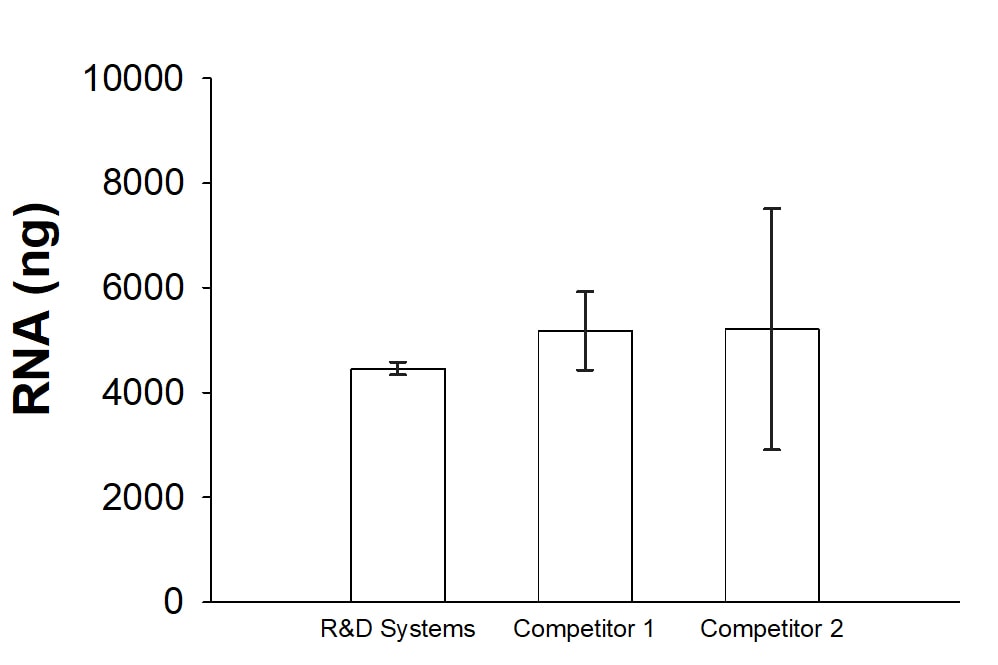
Recombinant E. coli T7 phage RNA polymerase His-tag Protein Enzyme Activity.
Recombinant T7phage RNA polymerase (T7 RNAP) (Catalog # 11662-T7) from R&D Systems and other competitors produce similar amounts of RNA in direct side-by-side comparison using the insert assay protocol described.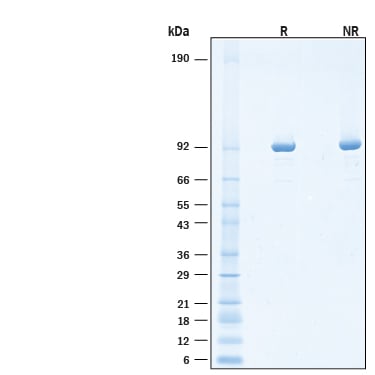
Recombinant E. coli T7 phage RNA polymerase His-tag Protein SDS-PAGE.
2 μg/lane of Recombinant E. coli T7 phage RNA polymerase His-tag Protein (Catalog # 11662-T7) was resolved with SDS-PAGE under reducing (R) and non-reducing (NR) conditions and visualized by Coomassie® Blue staining, showing bands at 89-98 kDa, under reducing conditions.Formulation, Preparation, and Storage
11662-T7
| Formulation | Supplied as a 0.2 μm filtered solution in Sodium Phosphate, NaCl, TCEP and Glycerol. |
| Shipping | The product is shipped with dry ice or equivalent. Upon receipt, store it immediately at the temperature recommended below. |
| Stability & Storage | Use a manual defrost freezer and avoid repeated freeze-thaw cycles.
|
Background: T7 phage RNA polymerase
References
- Chung, Y.B. and D.C. Hickle (1990) J. Biol. Chem. 216:927.
- Zhang, X. and F.W. Studier (2004) J. Mol Biol. 340:707.
- Jeruzalmi, D. and T.A. Steitz (1998) EMBO J. 17:4101.
- Sousa, R. and S. Mukherjee (2003) Prog. Nucleic Acid Res. Mol. Biol. 73:1.
- Wang, W. et al. (2018) Biotechnol. Adv. 36:2129.
- Lyakhoc, D.L. et al. (1998) J. Mol. Biol. 280:201.
- Cheetham, G.M. and T.A. Steitz (2000) Curr. Opin. Struct. Biol. 10:117.
- Yunitskaya, V.L. and S.N. Kochetkov (2002) Biochemistry 67:1124.
- Borkotoky, S. and A. Murali (2018) Int. J. Biol. Macromol. 118:49.
- Rong, M. et. al. (1998) Proc. Natl. Acad. Sci. USA. 95:515.
- Nair, A. and Z. Kis (2024) Front. Mol. Biosci. 11:1504876.
Long Name
Escherichia T7 phage RNA polymerase
Alternate Names
T7p07
Entrez Gene IDs
1261050 (Viral)
Gene Symbol
T7P07
UniProt
Additional T7 phage RNA polymerase Products
Product Documents for Recombinant Escherichia T7 phage RNA polymerase Protein, CF
Certificate of Analysis
To download a Certificate of Analysis, please enter a lot or batch number in the search box below.
Note: Certificate of Analysis not available for kit components.
Product Specific Notices for Recombinant Escherichia T7 phage RNA polymerase Protein, CF
For research use only
Customer Reviews for Recombinant Escherichia T7 phage RNA polymerase Protein, CF
There are currently no reviews for this product. Be the first to review Recombinant Escherichia T7 phage RNA polymerase Protein, CF and earn rewards!
Have you used Recombinant Escherichia T7 phage RNA polymerase Protein, CF?
Submit a review and receive an Amazon gift card!
$25/€18/£15/$25CAN/¥2500 Yen for a review with an image
$10/€7/£6/$10CAN/¥1110 Yen for a review without an image
Submit a review
Protocols
View specific protocols for Recombinant Escherichia T7 phage RNA polymerase Protein, CF (11662-T7):
Materials
- Assay Buffer: 20 mM Sodium Phosphate, 100 mM NaCl, 1 mM TCEP, and 10% (v/v) Glycerol, pH 7.5
- rT7 phage RNA polymerase His-tag (rT7 RNAP) (Catalog # 11662-T7)
- Template DNA: Linearized DNA Plasmid
- Ribonucleotides (ATP, CTP, GTP, UTP)
- Ultrapure DNase/RNase-Free Distilled Water
- DNase I
- RNA Fluorescent detection system
- Plate Reader with Fluorescence Read Capability
- Dilute rT7 RNAP to 60 ng/µL using Assay Buffer.
- Dilute Template DNA to 20 ng/µL using Assay Buffer.
- Create a ribonucleotide mix containing 20 mM of each using Assay Buffer.
- Add 10 µL ribonucleotide mix, 5 µL rT7 RNAP, and 5 µL of Template DNA to an RNase-free tube. Create a negative control with Assay Buffer in place of rT7 RNAP.
- Incubate reaction at 37 °C for 2 hours.
- Add 30 µL Ultrapure DNase/RNase-Free Distilled Water to all reaction tubes.
- Add DNase I to reaction tubes and incubate at 37 °C for 15 minutes to remove template DNA.
- Precipitate and isolate RNA.
- Resuspend RNA in Ultrapure DNase/RNase-Free Distilled Water.
- Quantify RNA concentration with fluorescent detection kit.
- Calculate RNA yield based on detection system.
Per Reaction:
- rT7 RNAP: 0.3 µg
- Template DNA: 0.1 µg
- Ribonucleotides: 10 mM each
Loading...