
Recombinant Human DPEP1 His-tag Protein, CF
R&D Systems | Catalog # 11524-DP

Loading...
Key Product Details
- R&D Systems CHO-derived Recombinant Human DPEP1 His-tag Protein (11524-DP)
- Quality control testing to verify active proteins with lot specific assays by in-house scientists
- All R&D Systems proteins are covered with a 100% guarantee
Source
CHO
Accession Number
Applications
Enzyme Activity
Loading...
Product Specifications
Source
Chinese Hamster Ovary cell line, CHO-derived human DPEP1 protein
Asp17-Ser384, with C-terminal 6-His tag
Asp17-Ser384, with C-terminal 6-His tag
Purity
>95%, by SDS-PAGE visualized with Silver Staining and quantitative densitometry by Coomassie® Blue Staining.
Endotoxin Level
<0.10 EU per 1 μg of the protein by the LAL method.
N-terminal Sequence Analysis
Asp17
Predicted Molecular Mass
42 kDa
SDS-PAGE
39-49 kDa, under reducing conditions
Activity
Measured by its ability to cleave carnosine ( beta -Ala-L-His) in a two-step assay.
The specific activity is >5 pmol/min/μg, as measured under the described conditions.
The specific activity is >5 pmol/min/μg, as measured under the described conditions.
Scientific Data Images for Recombinant Human DPEP1 His-tag Protein, CF
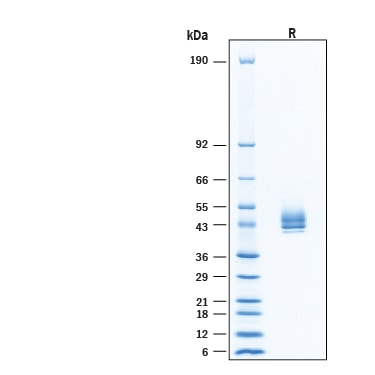
Recombinant Human DPEP1 His-tag Protein SDS-PAGE.
2 μg/lane of Recombinant Human DPEP1 His-tag Protein (Catalog # 11524-DP) was resolved with SDS-PAGE under reducing (R) condition and visualized by Coomassie® Blue staining, showing bands at 39-49 kDa, under reducing conditions.Formulation, Preparation, and Storage
11524-DP
| Formulation | Supplied as a 0.2 μm filtered solution in Tris and NaCl. |
| Shipping | The product is shipped with polar packs. Upon receipt, store it immediately at the temperature recommended below. |
| Stability & Storage | Use a manual defrost freezer and avoid repeated freeze-thaw cycles.
|
Background: DPEP1
References
- Nitanai, Y. et. al. (2002) J. Mol. Biol. 321:177.
- Li, Y. et. al. (2024) Int. Immunopharmacol. 133:111955.
- Campbell, B.J. et. al. (1988) Biochim. Biophys. Acta 956:110.
- Tachibana, K. et. al. (2017) Biomed. Rep. 6:423.
- Xiang, C. et. al. (2023) J. Cell Mol. Med. 27:1947.
- Zhu, W. et. al. (2023) Heliyon 9:e18870.
- Allison, S.J. (2021) Nat. Rev. Nephrol. 17:707.
- Satoh, S. et. al. (1993) Biochim. Biophys. Acta 1172:181.
- Choudhury, S.R. et. al. (2019) Cell 178:1205.
- Wang, M. (2022) Nat. Rev. Nephrol. 18:199.
- Tutanov. O.S. et. al. (2023) Extracell. Vesicles Circ. Nucl. Acids. 4:195.
Long Name
Dipeptidase 1
Alternate Names
HRDP, Microsomal Dipeptidase, Renal Dipeptidase
Entrez Gene IDs
1800 (Human)
Gene Symbol
DPEP1
UniProt
Additional DPEP1 Products
Product Documents for Recombinant Human DPEP1 His-tag Protein, CF
Certificate of Analysis
To download a Certificate of Analysis, please enter a lot or batch number in the search box below.
Note: Certificate of Analysis not available for kit components.
Product Specific Notices for Recombinant Human DPEP1 His-tag Protein, CF
For research use only
Customer Reviews for Recombinant Human DPEP1 His-tag Protein, CF
There are currently no reviews for this product. Be the first to review Recombinant Human DPEP1 His-tag Protein, CF and earn rewards!
Have you used Recombinant Human DPEP1 His-tag Protein, CF?
Submit a review and receive an Amazon gift card!
$25/€18/£15/$25CAN/¥2500 for a review with an image
$10/€7/£6/$10CAN/¥1110 for a review without an image
Submit a review
Protocols
View specific protocols for Recombinant Human DPEP1 His-tag Protein, CF (11524-DP):
Materials
- Assay Buffer: 50 mM Tris, pH 7.5
- Recombinant Human DPEP1 (rhDEP1) (Catalog # 11524-DP)
- Substrate: L-Carnosine, 100 mM stock in deionized water
- Trichloroacetic acid (TCA), 10% stock in deionized water
- o-Phthaldialdehyde (OPA), 50 mg/mL stock in DMSO
- Sodium Hydroxide (NaOH), 2 M stock in deionized water
- Black 96-well plate
- Plate Reader with Fluorescence Read Capability
- Dilute rhDPEP1 to 20 µg/mL in Assay Buffer.
- Dilute Substrate to 4 mM in Assay Buffer.
- Dilute 10% TCA to 1% in Assay Buffer (prepare right before adding to Substrate Blank(s) in step 4).
- Mix 60 μL of 20 µg/mL rhDPEP1 and 60 μL 4 mM Substrate for a final concentration of 10 µg/mL and 2 mM respectively. Include a Substrate Blank containing 60 μL of 20 µg/mL rhDPEP1, 60 μL 1% TCA added 1 minute prior to substrate addition, and 60 μL Substrate.
- Incubate reactions for 1 hour at 37 °C.
- Dilute 10% TCA to 1% in Assay Buffer (prepare right before adding to reactions in step 7).
- Stop reactions by adding 60 μL of 1% TCA (do not add to Substrate Blank(s)) and incubate for 10 minutes at room temperature.
- Dilute OPA to 5 mg/mL in 2 M NaOH.
- Add 60 μL of 5 mg/mL OPA to each reaction.
- Incubate for 1 hour at room temperature.
- Load 200 µL of each incubated sample into the plate.
- Read at excitation and emission wavelengths of 360 nm and 460 nm (top read), respectively, in endpoint mode.
- Calculate Specific Activity:
Specific Activity (pmol/min/µg) = | Adjusted Fluorescence* (RFU) x Conversion Factor** (pmol/RFU) |
| Incubation time (min) x amount of enzyme (µg) |
*Adjusted for Substrate Blank
**Derived using calibration standard L-Histidine.
Per Well:- rhDPEP1: 1.0 µg
- Substrate: 1 mM
Loading...