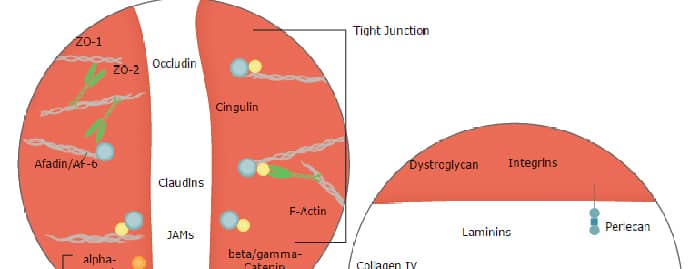
Integrin alpha 1 beta 1, also called VLA1 is the only alpha 1 integrin family adhesion receptor, one of twelve integrins that share the beta 1 subunit, and one of four collagen‑binding integrins (1‑5). It is the non‑covalent heterodimer of 190‑210 kDa alpha 1 (CD49a) and 130 kDa beta 1 (CD29) type I transmembrane glycoprotein subunits. It is found on cells including activated T cells, B cells, monocytes, vascular smooth muscle cells, osteoblasts and adipocytes (2, 6‑8). The alpha 1 extracellular domain (ECD) contains an I (inserted) domain which includes the ligand binding site (2, 4). The beta 1 ECD contains a vWFA domain, which participates in binding (3). Each subunit then has a transmembrane sequence and a short cytoplasmic tail. Divalent cations and intracellular (inside-out) signaling convert the dimer from the folded, inactive form to its most active, extended conformation (1, 2). The 1113 amino acid (aa) human alpha 1 extracellular domain (ECD) shares 88‑92% aa sequence identity with mouse, rat, canine, bovine and equine alpha 1, while the 708 aa human beta 1 ECD shares 92‑96% aa sequence identity with rat, bovine, mouse, and feline beta 1. Potential alpha 1 splice variants show two or four aa substitutions for aa 765‑1179. alpha 1 beta 1 preferentially binds collagens I, IV, VI, XIII and XVI, but also binds laminin (4‑10). alpha 1 beta 1 is reported to down‑regulate EGF R signaling, increase expression of caveolin-1, reduce production of reactive oxygen species, regulate collagen expression, control MMP collagenase and gelatinase activity, and mediate the renal basement membrane disorder Alport syndrome (10‑12). These effects may begin by alpha 1 beta 1 binding of caveolin-1, initiating signaling pathways that involve the phosphatase TC-PTP, kinases ERK and p38, and the transcription factor PPAR-gamma (10‑13). alpha 1 beta 1 down‑regulates MMP-mediated angiostatin formation, enhancing tumor vascularization (8). alpha 1 beta 1-null mice are deficient in fibroblast collagen IV and laminin-mediated cell spreading and migration, show defects in bone healing, and are resistant to Alport renal fibrosis (9‑11, 14). When expressed in the same epithelial cells, alpha 1 beta 1 negatively regulates integrin alpha 2 beta 1‑mediated cell adhesion and migration (15).
Recombinant Human Integrin alpha 1 beta 1 Protein, CF
R&D Systems | Catalog # 7064-AB

Key Product Details
- R&D Systems CHO-derived Recombinant Human Integrin alpha 1 beta 1 Protein (7064-AB)
- Quality control testing to verify active proteins with lot specific assays by in-house scientists
- All R&D Systems proteins are covered with a 100% guarantee
Source
Accession Number
Applications
Product Specifications
Source
| Human Integrin alpha 1 (Met1-Pro1141) Accession # P56199 |
GGGSGGGSGGGS | Acidic Tail | HHHHHH |
| Human Integrin beta 1 (Gln21-Asp728) Accession # P05556 |
GGGSGGGSGGGS | Basic Tail | |
| N-terminus | C-terminus | ||
Purity
Endotoxin Level
N-terminal Sequence Analysis
Predicted Molecular Mass
SDS-PAGE
Activity
When Collagen I is immobilized at 5 µg/mL, Recombinant Human Integrin alpha 1 beta 1 can bind with an apparent KD <5 nM.
Optimal dilutions should be determined by each laboratory for each application.
Formulation, Preparation, and Storage
7064-AB
| Formulation | Lyophilized from a 0.2 μm filtered solution in PBS. |
| Reconstitution | Reconstitute at 100 μg/mL in PBS.
Loading...
|
| Shipping | The product is shipped at ambient temperature. Upon receipt, store it immediately at the temperature recommended below. |
| Stability & Storage | Use a manual defrost freezer and avoid repeated freeze-thaw cycles.
|
Calculators
Background: Integrin alpha 1 beta 1
References
- Takada, Y. et al. (2007) Genome Biol. 8:215.
- Luo, B-H. et al. (2007) Annu. Rev. Immunol. 25:619.
- Argraves, W.S. et al. (1987) J. Cell Biol. 105:1183.
- Briesewitz, R. et al. (1993) J. Biol. Chem. 268:2989.
- Tulla, M. et al. (2001) J. Biol. Chem. 276:48206.
- Eble, J.A. et al. (2006) J. Biol. Chem. 281:25745.
- Hall, D.E. et al. (1990) J. Cell Biol. 110:2175.
- Pozzi, A. et al. (2000) Proc. Natl. Acad. Sci. USA 97:2202.
- Gardner, H. et al. (1999) J. Cell Sci. 112:263.
- Dennis, J. et al. (2010) Am. J. Pathol. 177:2527.
- Cosgrove, D. et al. (2008) Am. J. Pathol. 172:761.
- Chen, X. et al. (2010) Mol. Cell. Biol. 30:3048.
- Borza, C.M. et al. (2010) J. Biol. Chem. 285:40114.
- Gardner, H. et al. (1996) Dev. Biol. 175:301.
- Abair, T.D. et al. (2008) Exp. Cell Res. 314:3593.
Entrez Gene IDs
Gene Symbol
Additional Integrin alpha 1 beta 1 Products
Product Documents for Recombinant Human Integrin alpha 1 beta 1 Protein, CF
Certificate of Analysis
To download a Certificate of Analysis, please enter a lot or batch number in the search box below.
Note: Certificate of Analysis not available for kit components.
Product Specific Notices for Recombinant Human Integrin alpha 1 beta 1 Protein, CF
For research use only
Related Research Areas
Citations for Recombinant Human Integrin alpha 1 beta 1 Protein, CF
 Powered by Bioz
Customer Reviews for Recombinant Human Integrin alpha 1 beta 1 Protein, CF
There are currently no reviews for this product. Be the first to review Recombinant Human Integrin alpha 1 beta 1 Protein, CF and earn rewards!
Have you used Recombinant Human Integrin alpha 1 beta 1 Protein, CF?
Submit a review and receive an Amazon gift card!
$25/€18/£15/$25CAN/¥2500 for a review with an image
$10/€7/£6/$10CAN/¥1110 for a review without an image
Submit a review
FAQs for Recombinant Human Integrin alpha 1 beta 1 Protein, CF
-
Q: What is the amino acid sequence of the acidic and basic tails?
A: Acidic and basic tails are added to the protein to help facilitate optimal activity. While we generally include sequence information on the product datasheet, the sequences of these tails are considered confidential information.
Associated Pathways