
KIR3DS1 (3DS1, CD158e2) is a type I transmembrane protein that belongs to the killer cell Ig-like receptor (KIR) family. KIRs are expressed on CD56dim NK cells and T cell subsets where they differentiate normal from abnormal cells, and regulate effector functions in the innate immune system (1 - 3). KIRs are named for the number of Ig-like domains (2D or 3D) in the extracellular domain (ECD), and whether they have long or short (L, S) cytoplasmic tails. Like other activating KIRs, KIR3DS1 has a short cytoplasmic tail and a positively charged amino acid (aa) within the transmembrane domain that interacts with the ITAM-bearing signaling adaptor, DAP12 (2, 4). Crosslinking of KIR3DS1 activates cytolysis and induces IFN-gamma production, confirming it to be an activating receptor (4). Approximately 38% of the population expresses KIR3DS1 on the surface of NK cells (1, 4, 5). Variants lacking the N-terminal Ig-like domain and/or with substitutions in the cytoplasmic tail have been described (1, 6). The 50 kDa, 387 aa KIR3DS1 shows 97% aa identity with KIR3DL1 within the ECD, and the two segregate as alleles (3, 7). Some activating KIRs bind weakly to the ligands recognized by their corresponding inhibitory KIR. KIR3DS1 does not bind appreciably to cells transfected with ligands for HLA-Bw4 KIR3DL1 (4, 5). However, HIV-infected people who express the combined phenotype of KIR3DS1 with Bw4 alleles that contain an isoleucine at aa 80, show delayed progression to AIDS and fewer AIDS-related opportunistic infections (7, 8). KIR receptors have no structural orthologs in nonprimates, although mouse Ly-49 proteins perform similar functions (2).
Recombinant Human KIR3DS1/CD158e2 Fc Chimera Protein, CF
R&D Systems | Catalog # 4136-KR

Discontinued Product
4136-KR has been discontinued.
View all KIR3DS1/CD158e2 products.
Key Product Details
Source
CHO
Accession Number
Structure / Form
Disulfide-linked homodimer
Applications
Binding Activity
Loading...
Product Specifications
Source
Chinese Hamster Ovary cell line, CHO-derived human KIR3DS1/CD158e2 protein
| Human KIR3DS1 (His22-His340) Accession #Q14943 |
IEGRMD | Human IgG1 (Pro100-Lys330) |
| N-terminus | C-terminus |
Purity
>90%, by SDS-PAGE under reducing conditions and visualized by silver stain.
Endotoxin Level
<0.01 EU per 1 μg of the protein by the LAL method.
N-terminal Sequence Analysis
His22
Predicted Molecular Mass
61.9 kDa (monomer)
SDS-PAGE
75-90 kDa, reducing conditions
Activity
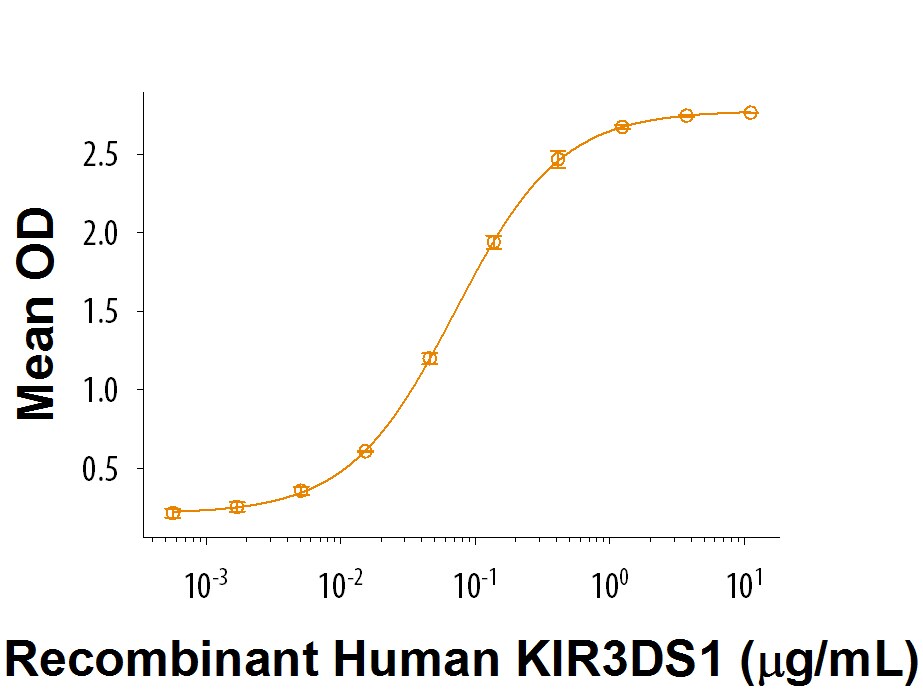
Measured by its ability to bind HLA on MDA‑MB‑231 human breast cancer cells.
The ED50 for this effect is 0.03-0.18 μg/mL.
The ED50 for this effect is 0.03-0.18 μg/mL.
Scientific Data Images for Recombinant Human KIR3DS1/CD158e2 Fc Chimera Protein, CF
Recombinant Human KIR3DS1/CD158e2 Fc Chimera Protein Bioactivity
Recombinant Human KIR3DS1/CD158e2 Fc Chimera (Catalog # 4136-KR) binds to MDA-MB-231 human breast cancer cells. The ED50 for this effect is 0.03-0.18 μg/mL.Formulation, Preparation, and Storage
4136-KR
| Formulation | Lyophilized from a 0.2 μm filtered solution in PBS. |
| Reconstitution | Reconstitute at 100 μg/mL in sterile PBS. |
| Shipping | The product is shipped at ambient temperature. Upon receipt, store it immediately at the temperature recommended below. |
| Stability & Storage | Use a manual defrost freezer and avoid repeated freeze-thaw cycles.
|
Calculators
Background: KIR3DS1/CD158e2
References
- Dohring, C. et al. (1996) Immunogenetics 44:227.
- Lanier, L. L. (2005) Annu. Rev. Immunol. 23:225.
- Uhrberg, M. et al. (1997) Immunity 7:753.
- Carr, W. H. et al. (2007) J. Immunol. 178:647.
- O’Connor, G. M. et al. (2007) J. Immunol. 178:235.
- Valiante, N. M. et al. (1997) Immunity 7:739.
- Martin, M. P. et al. (2002) Nat. Genet. 31:429.
- Qi, Y. et al. (2006) PloS Pathog. 2:e79.
Long Name
Killer Cell Immunoglobulin-like Receptor, Three Domains, Long Cytoplasmic Tail, 1
Alternate Names
CD158e2, KIR-G1, nkat10
Entrez Gene IDs
3813 (Human)
Gene Symbol
KIR3DS1
UniProt
Additional KIR3DS1/CD158e2 Products
Product Documents for Recombinant Human KIR3DS1/CD158e2 Fc Chimera Protein, CF
Certificate of Analysis
To download a Certificate of Analysis, please enter a lot or batch number in the search box below.
Note: Certificate of Analysis not available for kit components.
Product Specific Notices for Recombinant Human KIR3DS1/CD158e2 Fc Chimera Protein, CF
For research use only
Citations for Recombinant Human KIR3DS1/CD158e2 Fc Chimera Protein, CF
 Powered by Bioz
Customer Reviews for Recombinant Human KIR3DS1/CD158e2 Fc Chimera Protein, CF
There are currently no reviews for this product. Be the first to review Recombinant Human KIR3DS1/CD158e2 Fc Chimera Protein, CF and earn rewards!
Have you used Recombinant Human KIR3DS1/CD158e2 Fc Chimera Protein, CF?
Submit a review and receive an Amazon gift card!
$25/€18/£15/$25CAN/¥2500 for a review with an image
$10/€7/£6/$10CAN/¥1110 for a review without an image
Submit a review
Loading...