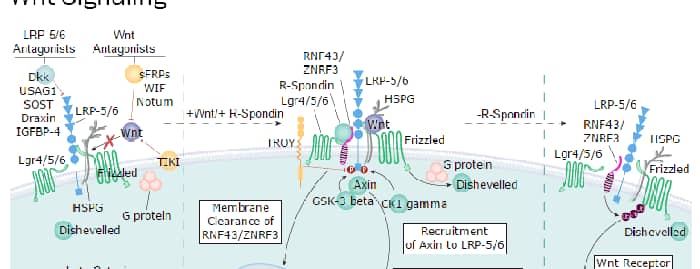
Lgr5 (leucine-rich repeat G-protein coupled receptor 5), also called GPR49, is a seven-transmembrane glycoprotein receptor in the Lgr family of cell surface receptors (1, 2). While this family includes receptors for hormones such as LH, FSH, TSH, and HCG, the subfamily comprising Lgr4, Lgr5, and Lgr6 are G-protein independent mediators of the potentiating effect of R-Spondins on Wnt signaling (1-6). Lgr5 binds and forms complexes with R-Spondins, Frizzled Wnt receptors and LRP Wnt coreceptors (3-5). It acts at least in part by enhancing Wnt-dependent LRP phosphorylation, internalization of LRPs, and accumulation of beta -catenin (3-5). Human Lgr5 cDNA encodes 907 amino acids (aa), including a long N-terminal extracellular domain (ECD, aa 22-561) with 16-17 LRR domains that mediate ligand interaction (2). The LRR-containing ECD of human Lgr5 shares 90% aa sequence identity with mouse and rat Lgr4, and 50-60% aa identity with human Lgr4 and Lgr6. Lgr5 is expressed by embryonic and adult epithelial stem cells, especially in the intestines, stomach, hair follicles, inner ear and mammary glands (1, 5, 6). Lgr4 is also present in epithelial stem cells, but shows wider expression elsewhere, making Lgr5 the preferred marker for these cells (5). Lgr5+ stem cells are sufficient to produce all epithelial cell types of the intestinal crypts in vivo or in vitro, when supported by secreted factors from neighboring Paneth or goblet cells (1, 7). In the embryo, Lgr5 is involved in development of the kidney and craniofacial structures (1). It is up-regulated in stem cells that give rise to cancers such as intestinal, hepatocellular, pancreatic and ovarian carcinomas, and may promote carcinogenesis (6).
Recombinant Human Lgr5/GPR49 Fc Chimera Protein, CF
R&D Systems | Catalog # 8078-GP

Loading...
Key Product Details
- R&D Systems CHO-derived Recombinant Human Lgr5/GPR49 Fc Chimera Protein (8078-GP)
- Quality control testing to verify active proteins with lot specific assays by in-house scientists
- All R&D Systems proteins are covered with a 100% guarantee
Source
CHO
Accession Number
Structure / Form
Disulfide-linked homodimer
Applications
Bioactivity
Loading...
Product Specifications
Source
Chinese Hamster Ovary cell line, CHO-derived human Lgr5/GPR49 protein
| Human LGR-5/GPR49 (Gly22-Ile560) Accession # O75473 |
IEGRMD | Human IgG1 (Pro100-Lys330) |
| N-terminus | C-terminus |
Purity
>90%, by SDS-PAGE under reducing conditions and visualized by silver stain.
Endotoxin Level
<0.10 EU per 1 μg of the protein by the LAL method.
N-terminal Sequence Analysis
Gly22
Predicted Molecular Mass
87 kDa (monomer)
SDS-PAGE
90-110 kDa, reducing conditions
Activity
Measured by its binding ability in a functional ELISA.
When Recombinant Human R‑Spondin 3 (Catalog # 3500-RS/CF) is coated at 0.5 μg/mL, Recombinant Human Lgr5/GPR49 Fc Chimera binds with an apparent Kd <0.1 nM.
Measured by its ability to inhibit Topflash reporter activity in HEK293T human embryonic kidney cells.
The ED50 for this effect is 1.5-7.5 µg/mL in the presence of 20 ng/mL Recombinant Human R‑Spondin 2 (Catalog # 3266-RS) and 5 ng/mL Recombinant Mouse Wnt‑3a (Catalog # 1324-WN).
When Recombinant Human R‑Spondin 3 (Catalog # 3500-RS/CF) is coated at 0.5 μg/mL, Recombinant Human Lgr5/GPR49 Fc Chimera binds with an apparent Kd <0.1 nM.
Measured by its ability to inhibit Topflash reporter activity in HEK293T human embryonic kidney cells.
The ED50 for this effect is 1.5-7.5 µg/mL in the presence of 20 ng/mL Recombinant Human R‑Spondin 2 (Catalog # 3266-RS) and 5 ng/mL Recombinant Mouse Wnt‑3a (Catalog # 1324-WN).
Reviewed Applications
Read 1 review rated 4 using 8078-GP in the following applications:
Formulation, Preparation, and Storage
8078-GP
| Formulation | Lyophilized from a 0.2 μm filtered solution in PBS. |
| Reconstitution | Reconstitute at 100 μg/mL in PBS.
Loading...
|
| Shipping | The product is shipped at ambient temperature. Upon receipt, store it immediately at the temperature recommended below. |
| Stability & Storage | Use a manual defrost freezer and avoid repeated freeze-thaw cycles.
|
Calculators
Background: Lgr5/GPR49
References
- Barker, N. et al. (2013) Development 140:2484.
- Hsu, S.Y. et al. (1998) Mol. Endocrinol. 12:1830.
- Carmon, K.S. et al. (2011) Proc. Natl. Acad. Sci. USA 108:11452.
- Glinka, A. et al. (2011) EMBO Rep. 12:1055.
- de Lau, W. et al. (2011) Nature 476:293.
- Leushacke, M. and N. Barker (2012) Oncogene 31:3009.
- Sato, T. et al. (2011) Nature 469:415.
Long Name
Leucine-rich Repeat Containing G Protein-coupled Receptor 5
Alternate Names
FEX, GPR49, GPR67, HG38
Gene Symbol
LGR5
UniProt
Additional Lgr5/GPR49 Products
Product Documents for Recombinant Human Lgr5/GPR49 Fc Chimera Protein, CF
Certificate of Analysis
To download a Certificate of Analysis, please enter a lot or batch number in the search box below.
Note: Certificate of Analysis not available for kit components.
Product Specific Notices for Recombinant Human Lgr5/GPR49 Fc Chimera Protein, CF
For research use only
Related Research Areas
Citations for Recombinant Human Lgr5/GPR49 Fc Chimera Protein, CF
 Powered by Bioz
Customer Reviews for Recombinant Human Lgr5/GPR49 Fc Chimera Protein, CF (1)
4 out of 5
1 Customer Rating
Have you used Recombinant Human Lgr5/GPR49 Fc Chimera Protein, CF?
Submit a review and receive an Amazon gift card!
$25/€18/£15/$25CAN/¥2500 for a review with an image
$10/€7/£6/$10CAN/¥1110 for a review without an image
Submit a review
Showing
1
-
1 of
1 review
Showing All
Filter By:
-
Application: ELISA standardVerified Customer | Posted 06/09/2020We used this protein in an in-house ELISA along with mAb & pAb's from Santacruz to quantify Lgr5 in human serum and plasma. This combination could not detect Lgr5 in our samples.
There are no reviews that match your criteria.