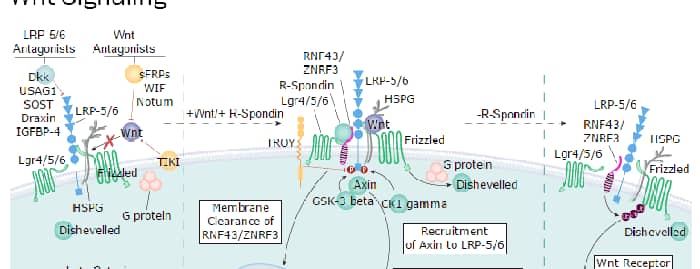
The low-density lipoprotein (LDL) receptor-related protein 5 (LRP5) and LRP6 constitute a distinct subgroup of the LDL receptor family. Both LRP5 and LRP6 are type I transmembrane proteins that function as co-receptors with Frizzled (FZD) in the canonical Wnt signaling pathway (1, 2). LRP6 cDNA encodes a 1613 amino acid residue (aa) precursor with a 19 aa signal sequence, a 1353 aa extracellular region, a 23 aa transmembrane (TM) segment and a 218 aa cytoplasmic domain (3). The extracellular region contains four N-terminal cysteine-rich EGF-like repeats, followed by three cysteine-rich LDLR repeats. This pattern of the EGF and LDLR repeat arrangement is different than that typically found in other LDL receptor family proteins. The intracellular region of LRP6 contains protein-protein interaction motifs and is required for canonical Wnt signal transduction (4). Human LRP-6 shares 98% and 74% aa sequence identity with mouse LRP-6 and human LRP-5, respectively. Based on the current model, canonical Wnt signaling requires the interaction of Wnt with FZD and LRP to form a trimeric complex which signals downstream to stabilize cytoplasmic beta -catenin. The stabilized beta -catenin is then translocated to the nucleus where it complexes with the transcription factor LEF/TCF to regulate the transcription of target genes (5). LRP6 has also been shown to interact with the Dickkopf proteins (DKKs), which are modulators of Wnt signaling (6 - 8). Binding of DKK-1 to LRP6 dissociates LRP6 from FZD, and antagonizes the formation of the functional receptor complex. On cells where the transmembrane proteins Kremens are also present, a ternary complex of LRP6, DKK-1 and Kremen is formed to trigger the internalization of the complex and removal LRP6 from the cell surface. Thus, DKK-1 and Kremen function synergistically to antagonize LRP6-mediated Wnt activity. Although DKK-2 also functions as a Wnt antagonist on cells that express Kremen, DKK-2 binding to LRP-6 in the absence of Kremen activates rather than inhibits LRP mediated beta -catenin signaling (9, 10).
Recombinant Human LRP-6 Fc Chimera Protein, CF
R&D Systems | Catalog # 1505-LR

Loading...
Key Product Details
- R&D Systems NS0-derived Recombinant Human LRP-6 Fc Chimera Protein (1505-LR)
- Quality control testing to verify active proteins with lot specific assays by in-house scientists
- All R&D Systems proteins are covered with a 100% guarantee
Source
NS0
Accession Number
Structure / Form
Disulfide-linked homodimer
Applications
Binding Activity
Loading...
Product Specifications
Source
Mouse myeloma cell line, NS0-derived human LRP-6 protein
| Human LRP-6 (Ala20 - Pro1368) Accession # O75581 |
IEGRMD | Human IgG1 (Pro100 - Lys330) |
| N-terminus | C-terminus |
Purity
>80%, by SDS-PAGE under reducing conditions and visualized by silver stain.
Endotoxin Level
<0.1 EU per 1 μg of the protein by the LAL method.
N-terminal Sequence Analysis
Ala20
Predicted Molecular Mass
180 kDa (monomer)
SDS-PAGE
200 kDa, reducing conditions
Activity
Measured by its binding ability in a functional ELISA.
rhLRP-6/Fc Chimera binds rhDkk-1, biotin with an apparent KD <25 nM.
Biotinylated rmWnt-3a immobilized on a streptavidin-coated plate at 1 µg/mL can bind rhLRP-6/Fc Chimera with a linear range of 0.2-10 µg/mL.
Optimal concentrations should be determined by each laboratory for each application.
rhLRP-6/Fc Chimera binds rhDkk-1, biotin with an apparent KD <25 nM.
Biotinylated rmWnt-3a immobilized on a streptavidin-coated plate at 1 µg/mL can bind rhLRP-6/Fc Chimera with a linear range of 0.2-10 µg/mL.
Optimal concentrations should be determined by each laboratory for each application.
Formulation, Preparation, and Storage
1505-LR
| Formulation | Lyophilized from a 0.2 μm filtered solution in PBS. |
| Reconstitution | Reconstitute at 200 μg/mL in sterile PBS.
Loading...
|
| Shipping | The product is shipped at ambient temperature. Upon receipt, store it immediately at the temperature recommended below. |
| Stability & Storage | Use a manual defrost freezer and avoid repeated freeze-thaw cycles.
|
Calculators
Background: LRP-6
References
- Howell, B.W. and J. Herz (2001) Curr. Op. Neurobiology 11:74.
- Pinson, K.I. et al. (2000) Nature 407:535.
- Brown, S.D. et al. (1998) Biochem. Biophys. Res. Commun. 248:879.
- Tamai, K. et al. (2000) Nature 407:530.
- Schweizer, L. and H. Varmus (2003) BMC Cell Biology 4:4.
- Mao, B. et al. (2001) Nature 411:321.
- Semenov, M.V. et al. (2001) Curr. Biol. 11:951.
- Bafico, A. et al. (2001) Nature Cell Biol. 3:683.
- Zorn, A.M. (2001) Curr. Biol. 11:R592.
- Mao, B. et al. (2002) Nature 417:664.
Long Name
LDL Receptor-related Protein 6
Alternate Names
ADCAD2, FLJ90062, FLJ90421, LRP6
Gene Symbol
LRP6
UniProt
Additional LRP-6 Products
Product Documents for Recombinant Human LRP-6 Fc Chimera Protein, CF
Certificate of Analysis
To download a Certificate of Analysis, please enter a lot or batch number in the search box below.
Note: Certificate of Analysis not available for kit components.
Product Specific Notices for Recombinant Human LRP-6 Fc Chimera Protein, CF
For research use only
Related Research Areas
Citations for Recombinant Human LRP-6 Fc Chimera Protein, CF
 Powered by Bioz
Customer Reviews for Recombinant Human LRP-6 Fc Chimera Protein, CF
There are currently no reviews for this product. Be the first to review Recombinant Human LRP-6 Fc Chimera Protein, CF and earn rewards!
Have you used Recombinant Human LRP-6 Fc Chimera Protein, CF?
Submit a review and receive an Amazon gift card!
$25/€18/£15/$25CAN/¥2500 for a review with an image
$10/€7/£6/$10CAN/¥1110 for a review without an image
Submit a review
Loading...
Associated Pathways