
Matrix metalloproteinases are a family of zinc and calcium dependent endopeptidases with the combined ability to degrade all the components of the extracellular matrix. MMP-1 (interstitial collagenase), can degrade a broad range of substrates including types I, II, III, VII, VIII, and X collagens as well as casein, gelatin, alpha ‑1 antitrypsin, myelin basic protein, L-Selectin, pro-TNF, IL-1 beta, IGF-BP3, IGF-BP5, pro MMP-2 and pro MMP-9. A significant role of MMP-1 is the degradation of fibrillar collagens in extracellular matrix remodeling, characterized by the cleavage of the interstitial collagen triple helix into ¾, ¼ fragments. However, as the list of substrates above illustrates, the role of MMP-1 is more diverse than originally envisaged, and may involve enzyme cascades, cytokine regulation and cell surface molecule modulation. MMP-1 is expressed by fibroblasts, keratinocytes, endothelial cells, monocytes and macrophages. Structurally, MMP-1 may be divided into several distinct domains; a pro-domain which is cleaved upon activation; a catalytic domain containing the zinc binding site; a short hinge region and a carboxyl terminal (hemopexin-like) domain.
Recombinant Human MMP-1 Protein, CF
R&D Systems | Catalog # 901-MP

Key Product Details
- R&D Systems NS0-derived Recombinant Human MMP-1 Protein (901-MP)
- Quality control testing to verify active proteins with lot specific assays by in-house scientists
- All R&D Systems proteins are covered with a 100% guarantee
Source
Accession Number
Structure / Form
Applications
Product Specifications
Source
Phe20-Asn469
Purity
Endotoxin Level
N-terminal Sequence Analysis
Predicted Molecular Mass
SDS-PAGE
Activity
The specific activity is > 400 pmol/min/µg, as measured under the described conditions.
Reviewed Applications
Read 2 reviews rated 4.5 using 901-MP in the following applications:
Formulation, Preparation, and Storage
901-MP
| Formulation | Supplied as a 0.2 μm filtered solution in MES, NaCl, CaCl2 and Brij-35. |
| Shipping | The product is shipped with dry ice or equivalent. Upon receipt, store it immediately at the temperature recommended below. |
| Stability & Storage | Use a manual defrost freezer and avoid repeated freeze-thaw cycles.
|
Background: MMP-1
References
- Cawston, T.E. (2004) in Interstitial Collagenase. Barrett, A.J. et al. (eds): Handbook of Proteolytic Enzymes, San Diego: Academic Press, p. 472.
Long Name
Alternate Names
Gene Symbol
UniProt
Additional MMP-1 Products
Product Documents for Recombinant Human MMP-1 Protein, CF
Certificate of Analysis
To download a Certificate of Analysis, please enter a lot or batch number in the search box below.
Note: Certificate of Analysis not available for kit components.
Product Specific Notices for Recombinant Human MMP-1 Protein, CF
For research use only
Related Research Areas
Citations for Recombinant Human MMP-1 Protein, CF
 Powered by Bioz
Customer Reviews for Recombinant Human MMP-1 Protein, CF (2)
Have you used Recombinant Human MMP-1 Protein, CF?
Submit a review and receive an Amazon gift card!
$25/€18/£15/$25CAN/¥2500 for a review with an image
$10/€7/£6/$10CAN/¥1110 for a review without an image
Submit a review
Customer Images
-
Application: Enzymatic activity in vitroVerified Customer | Posted 11/06/2020
-
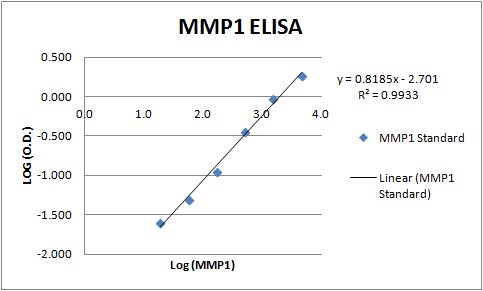
Application: Immunoassay StandardVerified Customer | Posted 11/09/2017The recombinant human MMP-1 was used to build an ELISA standard to measure MMP-1 in human serum and plasma samples.

There are no reviews that match your criteria.
Protocols
View specific protocols for Recombinant Human MMP-1 Protein, CF (901-MP):
- Assay Buffer: 50 mM Tris, 10 mM CaCl2, 150 mM NaCl, 0.05% (w/v) Brij-35, pH 7.5 (TCNB)
- Recombinant Human MMP-1 (rhMMP-1) (Catalog # 901-MP)
- p-aminophenylmercuric acetate (APMA), (Sigma, Catalog # A-9563), 100 mM stock in DMSO
- Substrate: MCA-Lys-Pro-Leu-Gly-Leu-DPA-Ala-Arg-NH2 (R&D Systems, Catalog # ES010)
- F16 Black Maxisorp Plate (Nunc, Catalog # 475515)
- Fluorescent Plate Reader (Model: SpectraMax Gemini EM by Molecular Devices) or equivalent
- Dilute rhMMP-1 to 50 µg/mL in Assay Buffer.
- Activate 50 µg/mL rhMMP-1 by adding APMA to a final concentration of 1 mM.
- Incubate at 37 °C for 2 hours.
- Dilute activated rhMMP-1 to 1 ng/µL in Assay Buffer.
- Dilute Substrate to 20 µM in Assay Buffer.
- Load into a black well plate 50 µL of 1 ng/µL rhMMP-1 and start the reaction by adding 50 µL of 20 µM Substrate. Include a Substrate Blank containing 50 µL Assay Buffer, 50 µL Substrate, and no rhMMP-1.
- Read at excitiation and emission wavelengths of 320 nm and 405 nm, respectively, in kinetic mode for 5 minutes.
- Calculate specific activity:
|
Specific Activity (pmol/min/µg) = |
Adjusted Vmax* (RFU/min) x Conversion Factor** (pmol/RFU) |
| amount of enzyme (µg) |
*Adjusted for Substrate Blank
**Derived using calibration standard MCA-Pro-Leu-OH (Bachem, Catalog # M-1975).
Per Well:- rhMMP-1: 0.050 µg
- Substrate: 10 µM
FAQs for Recombinant Human MMP-1 Protein, CF
-
Q: Can the enzyme be stored after activation, or do I need to use it immediately after activation?
A: We recommend only activating the amount of enzyme needed for your assay, and recommend activating the enzyme immediately prior to use. Any unactivated enzyme should be stored in aliquots at either the stock concentration at which the enzyme was supplied, or the reconstitution concentration, according to the product datasheet.
-
Q: Do I need to add zinc to this assay buffer?
A: In our experience, assaying the activity of this MMP with a fluorogenic substrate does not require the addition of zinc to the assay buffer.
-
Q: Does this MMP enzyme need to be activated to work?
A: Yes, this enzyme requires activation prior to use.
-
Q: If I use this enzyme at a higher concentration, do I need to change the concentration of APMA to activate it?
A: We have only optimized activation conditions for one particular concentration of this MMP enzyme as part of our regular QC testing for enzymatic activity. Activating the enzyme at any different concentration would have to be optimized by the end user.
-
Q: What is the activity of this enzyme in units/µg?
A: We supply this enzyme as a mass and calculate its activity relative to mass (pmol/min/µg). We have not calibrated this enzyme to an international standard unit, so we are unable to provide a conversion to units/µg.
-
Q: Can the enzyme be stored after activation, or do I need to use it immediately after activation?
A: We recommend only activating the amount of enzyme needed for your assay, and recommend activating the enzyme immediately prior to use. Any unactivated enzyme should be stored in aliquots at either the stock concentration at which the enzyme was supplied, or the reconstitution concentration, according to the product datasheet.
-
Q: Do I need to add zinc to this assay buffer?
A: In our experience, assaying the activity of this MMP with a fluorogenic substrate does not require the addition of zinc to the assay buffer.
-
Q: Does this MMP enzyme need to be activated to work?
A: Yes, this enzyme requires activation prior to use.
-
Q: If I use this enzyme at a higher concentration, do I need to change the concentration of APMA to activate it?
A: We have only optimized activation conditions for one particular concentration of this MMP enzyme as part of our regular QC testing for enzymatic activity. Activating the enzyme at any different concentration would have to be optimized by the end user.
-
Q: What is the activity of this enzyme in units/µg?
A: We supply this enzyme as a mass and calculate its activity relative to mass (pmol/min/µg). We have not calibrated this enzyme to an international standard unit, so we are unable to provide a conversion to units/µg.
-
Q: Can the enzyme be stored after activation, or do I need to use it immediately after activation?
A: We recommend only activating the amount of enzyme needed for your assay, and recommend activating the enzyme immediately prior to use. Any unactivated enzyme should be stored in aliquots at either the stock concentration at which the enzyme was supplied, or the reconstitution concentration, according to the product datasheet.
-
Q: Do I need to add zinc to this assay buffer?
A: In our experience, assaying the activity of this MMP with a fluorogenic substrate does not require the addition of zinc to the assay buffer.
-
Q: Does this MMP enzyme need to be activated to work?
A: Yes, this enzyme requires activation prior to use.
-
Q: If I use this enzyme at a higher concentration, do I need to change the concentration of APMA to activate it?
A: We have only optimized activation conditions for one particular concentration of this MMP enzyme as part of our regular QC testing for enzymatic activity. Activating the enzyme at any different concentration would have to be optimized by the end user.
-
Q: What is the activity of this enzyme in units/µg?
A: We supply this enzyme as a mass and calculate its activity relative to mass (pmol/min/µg). We have not calibrated this enzyme to an international standard unit, so we are unable to provide a conversion to units/µg.
-
Q: Can the enzyme be stored after activation, or do I need to use it immediately after activation?
A: We recommend only activating the amount of enzyme needed for your assay, and recommend activating the enzyme immediately prior to use. Any unactivated enzyme should be stored in aliquots at either the stock concentration at which the enzyme was supplied, or the reconstitution concentration, according to the product datasheet.
-
Q: Do I need to add zinc to this assay buffer?
A: In our experience, assaying the activity of this MMP with a fluorogenic substrate does not require the addition of zinc to the assay buffer.
-
Q: Does this MMP enzyme need to be activated to work?
A: Yes, this enzyme requires activation prior to use.
-
Q: If I use this enzyme at a higher concentration, do I need to change the concentration of APMA to activate it?
A: We have only optimized activation conditions for one particular concentration of this MMP enzyme as part of our regular QC testing for enzymatic activity. Activating the enzyme at any different concentration would have to be optimized by the end user.
-
Q: What is the activity of this enzyme in units/µg?
A: We supply this enzyme as a mass and calculate its activity relative to mass (pmol/min/µg). We have not calibrated this enzyme to an international standard unit, so we are unable to provide a conversion to units/µg.
-
Q: Can the enzyme be stored after activation, or do I need to use it immediately after activation?
A: We recommend only activating the amount of enzyme needed for your assay, and recommend activating the enzyme immediately prior to use. Any unactivated enzyme should be stored in aliquots at either the stock concentration at which the enzyme was supplied, or the reconstitution concentration, according to the product datasheet.
-
Q: Do I need to add zinc to this assay buffer?
A: In our experience, assaying the activity of this MMP with a fluorogenic substrate does not require the addition of zinc to the assay buffer.
-
Q: Does this MMP enzyme need to be activated to work?
A: Yes, this enzyme requires activation prior to use.
-
Q: If I use this enzyme at a higher concentration, do I need to change the concentration of APMA to activate it?
A: We have only optimized activation conditions for one particular concentration of this MMP enzyme as part of our regular QC testing for enzymatic activity. Activating the enzyme at any different concentration would have to be optimized by the end user.
-
Q: What is the activity of this enzyme in units/µg?
A: We supply this enzyme as a mass and calculate its activity relative to mass (pmol/min/µg). We have not calibrated this enzyme to an international standard unit, so we are unable to provide a conversion to units/µg.