
Myeloperoxidase (MPO) is a heme-containing enzyme belonging to the XPO subfamily of peroxidases. It is an abundant neutrophil and monocyte glycoprotein that catalyzes the hydrogen peroxide-dependent conversion of chloride, bromide, and iodide to multiple reactive species (1). Post-translational processing of MPO involves the insertion of a heme moiety and the proteolytic removal of both a propeptide and a 6 aa internal peptide (2). This results in a disulfide-linked dimer composed of a 60 kDa heavy and 12 kDa light chain that associate into a 150 kDa enzymatically active tetramer. The tetramer contains two heme groups and one disulfide bond between the heavy chains (2). Alternate splicing generates two additional isoforms of MPO, one with a 32 aa insertion in the light chain, and another with a deletion of the signal sequence and part of the propeptide (3). Human and mouse MPO share 87% aa sequence identity. MPO activity results in protein nitrosylation and the formation of 3-chlorotyrosine and dityrosine crosslinks (4‑6). Modification of ApoB100, as well as the lipid and cholesterol components of LDL and HDL, promotes the development of atherosclerosis (5, 7‑9). MPO is also associated with a variety of other diseases (1), and inhibits vasodilation in inflammation by depleting the levels of NO (10). Serum albumin functions as a carrier protein during MPO movement to the basolateral side of epithelial cells (11). MPO is stored in neutrophil azurophilic granules. Upon cellular activation, it is deposited into pathogen-containing phagosomes (2). While mice lacking MPO are impaired in clearing select microbial infections, MPO deficiency in humans does not necessarily result in heightened susceptibility to infections (12, 13).
Recombinant Human Myeloperoxidase Protein, CF
R&D Systems | Catalog # 3174-MP


Key Product Details
- R&D Systems NS0-derived Recombinant Human Myeloperoxidase Protein (3174-MP)
- Quality control testing to verify active proteins with lot specific assays by in-house scientists
- All R&D Systems proteins are covered with a 100% guarantee
Source
Accession Number
Applications
Product Specifications
Source
Ala49-Ser745, with a C-terminal 10-His tag
Purity
Endotoxin Level
N-terminal Sequence Analysis
Predicted Molecular Mass
SDS-PAGE
Activity
The specific activity is >50,000 pmol/min/µg, as measured under the described conditions.
Reviewed Applications
Read 2 reviews rated 5 using 3174-MP in the following applications:
Formulation, Preparation, and Storage
3174-MP
| Formulation | Lyophilized from a 0.2 μm filtered solution in Tris and NaCl. |
| Reconstitution | Reconstitute at 0.5-1 mg/mL in sterile, deionized water.
Loading...
|
| Shipping | The product is shipped with polar packs. Upon receipt, store it immediately at the temperature recommended below. |
| Stability & Storage | Use a manual defrost freezer and avoid repeated freeze-thaw cycles.
|
Calculators
Background: Myeloperoxidase/MPO
References
- Klebanoff, S.J. (2005) J. Leukoc. Biol. 77:598.
- Hansson, M. et al. (2006) Arch. Biochem. Biophys. 445:214.
- Hashinaka, K. et al. (1988) Biochemistry 27:5906.
- van Dalen, C.J. et al. (2000) J. Biol. Chem. 275:11638.
- Hazen, S.L. and J.W. Heinecke (1997) J. Clin. Invest. 99:2075.
- Heinecke, J.W. et al. (1993) J. Clin. Invest. 91:2866.
- Podrez, E.A. et al. (1999) J. Clin. Invest. 103:1547.
- Bergt, C. et al. (2004) Proc. Natl. Acad. Sci. 101:13032.
- Hazen, S.L. et al. (1996) J. Biol. Chem. 271:23080.
- Eiserich, J.P. et al. (2002) Science 296:2391.
- Tiruppathi, C. et al. (2004) Proc. Natl. Acad. Sci. 101:7699.
- Aratani Y. et al. (2000) J. Infect. Dis. 182:1276.
- Kutter, D. (1998) J. Mol. Med. 76:669.
Alternate Names
Gene Symbol
UniProt
Additional Myeloperoxidase/MPO Products
Product Documents for Recombinant Human Myeloperoxidase Protein, CF
Certificate of Analysis
To download a Certificate of Analysis, please enter a lot or batch number in the search box below.
Note: Certificate of Analysis not available for kit components.
Product Specific Notices for Recombinant Human Myeloperoxidase Protein, CF
For research use only
Related Research Areas
Citations for Recombinant Human Myeloperoxidase Protein, CF
 Powered by Bioz
Customer Reviews for Recombinant Human Myeloperoxidase Protein, CF (2)
Have you used Recombinant Human Myeloperoxidase Protein, CF?
Submit a review and receive an Amazon gift card!
$25/€18/£15/$25CAN/¥2500 for a review with an image
$10/€7/£6/$10CAN/¥1110 for a review without an image
Submit a review
Customer Images
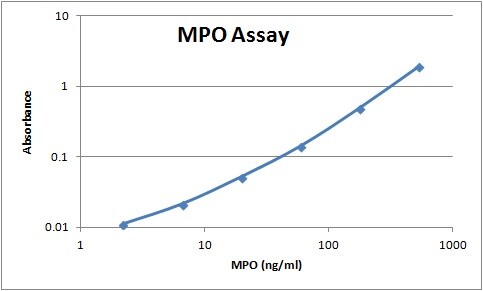
-
Application: Immunoassay StandardVerified Customer | Posted 11/07/2018The protein was used as a calibrator in an in vitro immunoassay.

-
Application: Standard in in vitro MPO activity assays.Verified Customer | Posted 05/23/2016
There are no reviews that match your criteria.
Protocols
View specific protocols for Recombinant Human Myeloperoxidase Protein, CF (3174-MP):
- Assay Buffer: 50 mM NaH2PO4, pH 7.0
- Recombinant Human Myeloperoxidase/MPO (rhMPO) (Catalog # 3174-MP)
- Hydrogen Peroxide Solution, 30% (v/v) (H2O2) (Sigma, Catalog # H1009)
- Guaiacol (Acros Organics, Catalog # AC120192500)
- Clear StripWell Microplate (Costar, Catalog # 92592)
- Plate Reader with Absorbance reading capability (Model: Spectramax Plus by Molecular Devices) or equivalent
- Prepare 100 mM guaiacol in Assay Buffer by shaking or stirring for 30 minutes at room temperature prior to use. Note: Protect guaiacol solution from light.
- Dilute rhMPO to 1 µg/mL in Assay Buffer.
- Dilute hydrogen peroxide from 30% to 0.00667% in Assay Buffer.
- Load in a clear microplate 20 µL of 1 µg/mL of rhMPO and 30 µL 0.00667% hydrogen peroxide, and start the reaction by adding 50 µL of 100 mM guaiacol.
- Read at 470 nm in kinetic mode for 5 minutes.
- Calculate specific activity:
|
Specific Activity (pmol/min/µg) = |
Adjusted Vmax* (OD/min) x Conversion Factor** (pmol/OD) |
| amount of enzyme (µg) |
*Adjusted for Substrate Blank
**Derived using known concentrations of hydrogen peroxide ranging from 20 to 300 µM. Each point contains 10 µg/mL of rhMPO (an amount so that the reaction will be completed in a short period of time) and 50 mM guaiacol. After each reaction is complete, the product is measured at 470 nm (read endpoint about every 20 seconds to find the maximum absorbance for each point). The maximum values of Abs470 (y-axis) and pmol of hydrogen peroxide (x axis) for each point is plotted linearly (y = mx + b) and the slope is calculated (m). The conversion factor is derived from the following equation as a unit of pmol/OD. It is multiplied by 2 because one mol of hydrogen peroxide is equal to two mol of oxidized guaicol (product).
Conversion Factor = (1/slope(m)) x 2 = pmol/OD
- rhMPO: 0.020 μg
- Hydrogen Peroxide: 0.002%
- Guaiacol: 50 mM
Associated Pathways
