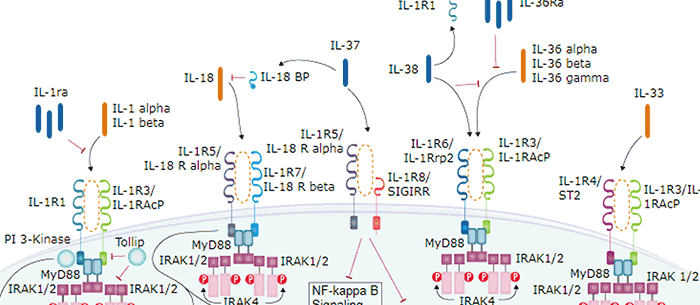
IL-33, also known as NF-HEV and DVS 27, is a 30 kDa proinflammatory protein that may also regulate gene transcription (1‑3). DVS 27 was identifed as a gene that is up‑regulated in vasospastic cerebral arteries (1). NF-HEV was described as a nuclear factor that is preferentially expressed in the endothelial cells of high endothelial venules relative to endothelial cells from other tissues (2). IL-33 was identified based on sequence and structural homology with IL-1 family cytokines (3). DVS 27, NF-HEV, and IL-33 share 100% amino acid sequence identity. IL-33 is constitutively expressed in smooth muscle and airway epithelia. It is up‑regulated in arterial smooth muscle, dermal fibroblasts, and keratinocytes following IL-1 alpha or IL‑1 beta stimulation (1, 3). Similar to IL-1, IL-33 can be cleaved in vitro by caspase‑1, generating an N‑terminal fragment that is slightly shorter than the C‑terminal fragment (3, 4). The N‑terminal portion of full length IL-33 contains a predicted bipartite nuclear localization sequence and a homeodomain-like helix-turn-helix DNA binding domain. By immunofluorescence, full length IL-33 localizes to the nucleus in HUVECs and transfectants (2). The C‑terminal fragment, corresponding to mature IL-33, binds and triggers signaling through mast cell IL‑1 R4/ST2L, a longtime orphan receptor involved in the augmentation of Th2 cell responses (3, 5‑7). A ternary signaling complex is formed by the subsequent association of IL-33 and ST2L with IL‑1 RAcP (8). Stimulation of Th2 polarized lymphocytes with mature IL-33 in vitro induces IL-5 and IL-13 secretion (3). In vivo administration of mature IL-33 promotes increased production of IL-5, IL-13, IgE, and IgA, as well as splenomegaly and inflammatory infiltration of mucosal tissues (3). Full length and mature mouse IL-33 share approximately 55% and 90% aa sequence identity with human and rat IL-33, respectively. Mouse IL-33 shares less than 25% aa sequence identity with other IL-1 family proteins.
Recombinant Mouse IL-33 Protein
R&D Systems | Catalog # 3626-ML


Key Product Details
- R&D Systems E. coli-derived Recombinant Mouse IL-33 Protein (3626-ML)
- Quality control testing to verify active proteins with lot specific assays by in-house scientists
- All R&D Systems proteins are covered with a 100% guarantee
Source
Accession Number
Applications
Product Specifications
Source
Ser109-Ile266
Purity
Endotoxin Level
N-terminal Sequence Analysis
Predicted Molecular Mass
SDS-PAGE
Activity
The ED50 for this effect is 0.0125-0.05 ng/mL.
Reviewed Applications
Read 9 reviews rated 4.7 using 3626-ML in the following applications:
Formulation, Preparation, and Storage
Carrier Free
What does CF mean?CF stands for Carrier Free (CF). We typically add Bovine Serum Albumin (BSA) as a carrier protein to our recombinant proteins. Adding a carrier protein enhances protein stability, increases shelf-life, and allows the recombinant protein to be stored at a more dilute concentration. The carrier free version does not contain BSA.
What formulation is right for me?In general, we advise purchasing the recombinant protein with BSA for use in cell or tissue culture, or as an ELISA standard. In contrast, the carrier free protein is recommended for applications, in which the presence of BSA could interfere.
Carrier: 3626-ML
| Formulation | Lyophilized from a 0.2 μm filtered solution in PBS, EDTA and DTT with BSA as a carrier protein. |
| Reconstitution | Reconstitute at 100 μg/mL in sterile PBS. |
| Shipping | The product is shipped at ambient temperature. Upon receipt, store it immediately at the temperature recommended below. |
| Stability & Storage | Use a manual defrost freezer and avoid repeated freeze-thaw cycles.
|
Carrier Free: 3626-ML/CF
| Formulation | Lyophilized from a 0.2 μm filtered solution in PBS, EDTA and DTT. |
| Reconstitution | Reconstitute at 100 μg/mL in sterile PBS. |
| Shipping | The product is shipped at ambient temperature. Upon receipt, store it immediately at the temperature recommended below. |
| Stability & Storage | Use a manual defrost freezer and avoid repeated freeze-thaw cycles.
|
Calculators
Background: IL-33
References
- Onda, H. et al. (1999) J. Cereb. Blood Flow Metab. 19:1279.
- Baekkevold, E.S. et al. (2003) Am. J. Pathol. 163:69.
- Schmitz, J. et al. (2005) Immunity 23:479.
- Black, R.A. et al. (1989) J. Biol. Chem. 264:5323.
- Xu, D. et al. (1998) J. Exp. Med. 187:787.
- Lohning, M. et al. (1998) Proc. Natl. Acad. Sci. 95:6930.
- Dinarello, C.A. (2005) Immunity 23:461.
- Chackerian, A.A. et al. (2007) J. Immunol. 179:2551.
Long Name
Alternate Names
Gene Symbol
UniProt
Additional IL-33 Products
Product Documents for Recombinant Mouse IL-33 Protein
Certificate of Analysis
To download a Certificate of Analysis, please enter a lot or batch number in the search box below.
Note: Certificate of Analysis not available for kit components.
Product Specific Notices for Recombinant Mouse IL-33 Protein
For research use only
Related Research Areas
Citations for Recombinant Mouse IL-33 Protein
 Powered by Bioz
Customer Reviews for Recombinant Mouse IL-33 Protein (9)
Have you used Recombinant Mouse IL-33 Protein?
Submit a review and receive an Amazon gift card!
$25/€18/£15/$25CAN/¥2500 for a review with an image
$10/€7/£6/$10CAN/¥1110 for a review without an image
Submit a review
Customer Images

-
Application: In vivo studyVerified Customer | Posted 09/27/2022
-
Application: In vivo studyVerified Customer | Posted 10/19/2021
-
Application: In vivo studyVerified Customer | Posted 04/17/2020
-
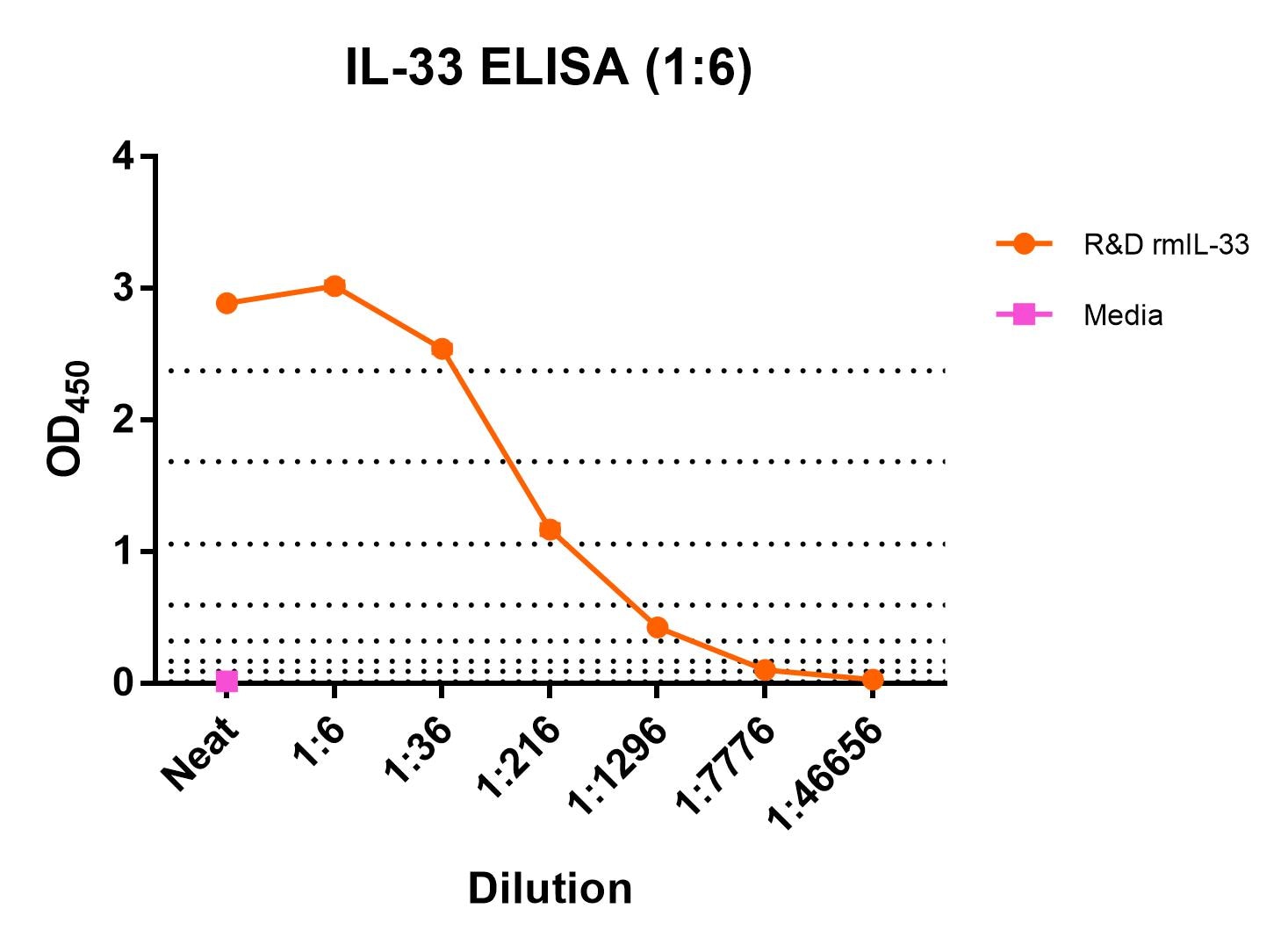
Application: ELISA positive controlVerified Customer | Posted 09/16/2019

-
Verified Customer | Posted 01/07/2019Western blot used to confirm IL-33 knockout in mice; kidney samples from WT, +/-, and -/- IL-33 mice were prepared and blotted
-
Application: Immunoassay StandardVerified Customer | Posted 05/15/2018
-
Application: Immunoassay StandardVerified Customer | Posted 05/14/2018
-
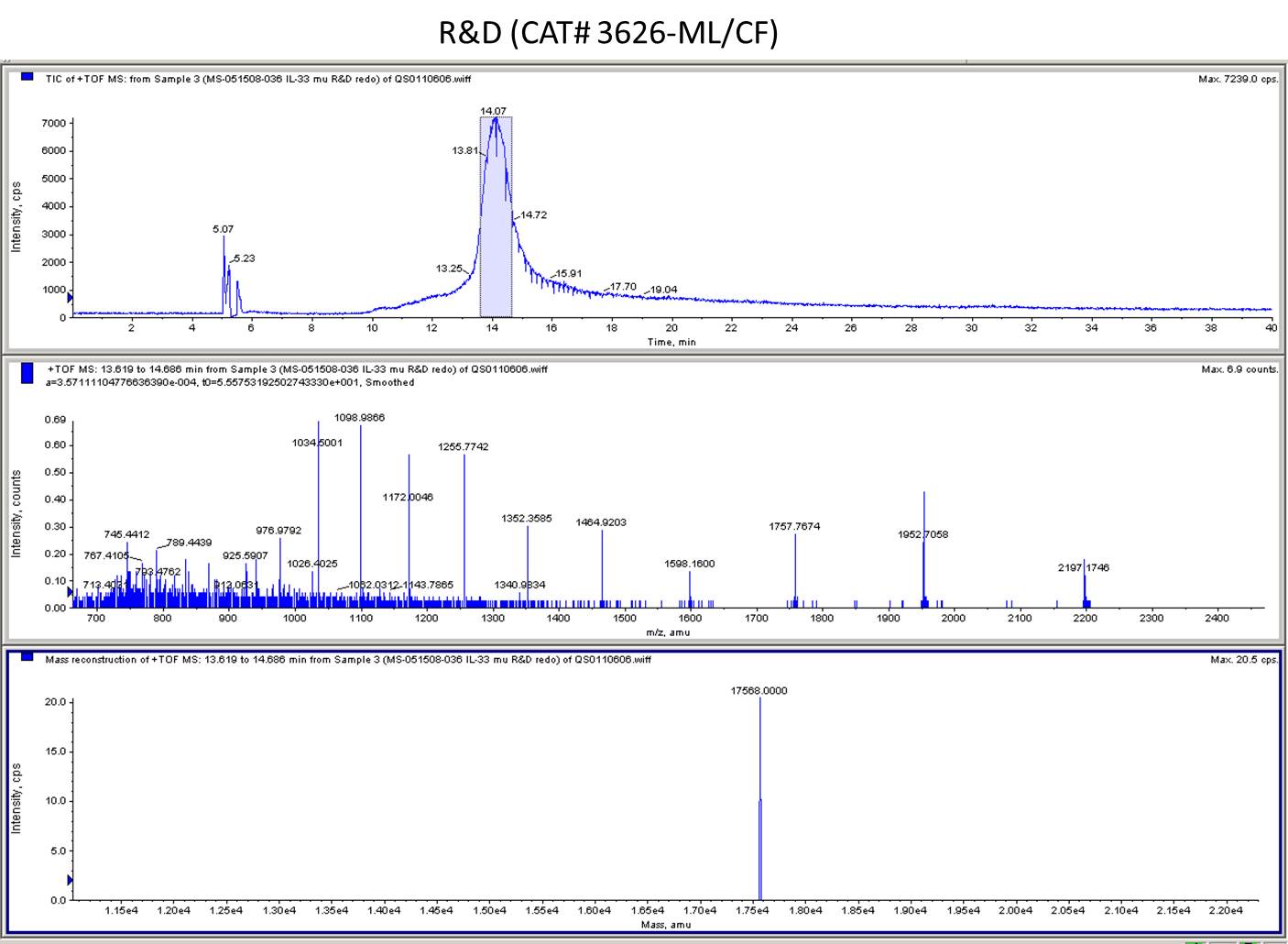
Application: Characterization prior to use.Verified Customer | Posted 02/12/2018
-
Application: Cell migration/motilityVerified Customer | Posted 05/18/2016
There are no reviews that match your criteria.
FAQs for Recombinant Mouse IL-33 Protein
-
Q: Has R&D Systems conducted testing to determine the half life or other details, such as administration or dosing, of this protein in an in vivo setting?
A: We do not perform any in vivo testing, therefore, details relating to half-life, administration, or dosing should be verified within the available literature. Specific references pertaining to this product used in an in vivo setting can be found in the Citations tab on this product page - the results can be filtered by application of interest.
-
Q: Is the Recombinant Mouse IL-33 Protein (Catalog # 3626-ML) provided as the full-length or cleaved version?
A: The Recombinant Mouse IL-33 Protein (Catalog # 3626-ML) is supplied as the cleaved form (Ser109-Ile266, accession # Q8BVZ5).
-
Q: Has R&D Systems conducted testing to determine the half life or other details, such as administration or dosing, of this protein in an in vivo setting?
A: We do not perform any in vivo testing, therefore, details relating to half-life, administration, or dosing should be verified within the available literature. Specific references pertaining to this product used in an in vivo setting can be found in the Citations tab on this product page - the results can be filtered by application of interest.
-
Q: Is the Recombinant Mouse IL-33 Protein (Catalog # 3626-ML) provided as the full-length or cleaved version?
A: The Recombinant Mouse IL-33 Protein (Catalog # 3626-ML) is supplied as the cleaved form (Ser109-Ile266, accession # Q8BVZ5).
Associated Pathways