Integrin alpha 3 beta 1, also known as VLA-3 (Very Late Antigen 3), is a member of the integrin family, beta 1 subfamily, of cell membrane adhesion molecules (1-3). It is a non-covalent heterodimer composed of two type I transmembrane glycoprotein subunits, a 130-150 kDa alpha 3 (CD49c) subunit and a 130-140 kDa beta 1 (CD29) subunit. Integrin alpha 3 only associates with the beta 1 subunit. It is synthesized as a 1051 amino acid (aa) precursor that undergoes proteolytic cleavage to generate a disulfide-linked 110 kDa, 842 aa extracellular heavy chain and a 30 kDa, 176 aa TM/cytoplasmic light chain (1, 4, 5, 6). The heavy chain contains seven 60 aa repeats that fold into a propeller-like structure (7). Sequences involving the first three repeats are associated with ligand binding (1). Mouse alpha 3 heavy chain is 88% aa identical to human heavy chain. Unlike the alpha 3 subunit, the mouse beta 1 subunit does not undergo proteolytic cleavage (8). The molecule contains a 708 aa extracellular region, a 23 aa TM segment, and a 47 aa cytoplasmic domain. The extracellular region contains one von Willebrand factor-like A domain and four cysteine-rich repeats. Mouse beta 1 extracellular domain shares 93% and 98% aa sequence identity with human and rat beta 1, respectively. Integrin alpha 3 beta 1 is known to bind fibronectin, collagen, and laminin-1, 5, 8, 10 and 11 (1). It also binds tetraspanins such as CD9, CD63 and CD151. CD151 binding may actually stabilize it, enabling it to bind to additional factors (9).
Recombinant Mouse Integrin alpha 3 beta 1/VLA-3 Protein, CF
R&D Systems | Catalog # 9374-A3

Key Product Details
- R&D Systems CHO-derived Recombinant Mouse Integrin alpha 3 beta 1/VLA-3 Protein (9374-A3)
- Quality control testing to verify active proteins with lot specific assays by in-house scientists
- All R&D Systems proteins are covered with a 100% guarantee
Source
Accession Number
Structure / Form
Applications
Product Specifications
Source
| Mouse Integrin alpha 3 (Phe33-Glu993) Accession # Q62470-1 |
His-Pro | GGGSGGGS | Acidic Tail | 6-His tag |
| Mouse Integrin beta 1 (Gln21-Asp728) Accession # P09055-1 |
His-Pro | GGGSGGGS | Basic Tail | |
| N-terminus | C-terminus | |||
Purity
Endotoxin Level
N-terminal Sequence Analysis
Predicted Molecular Mass
SDS-PAGE
Activity
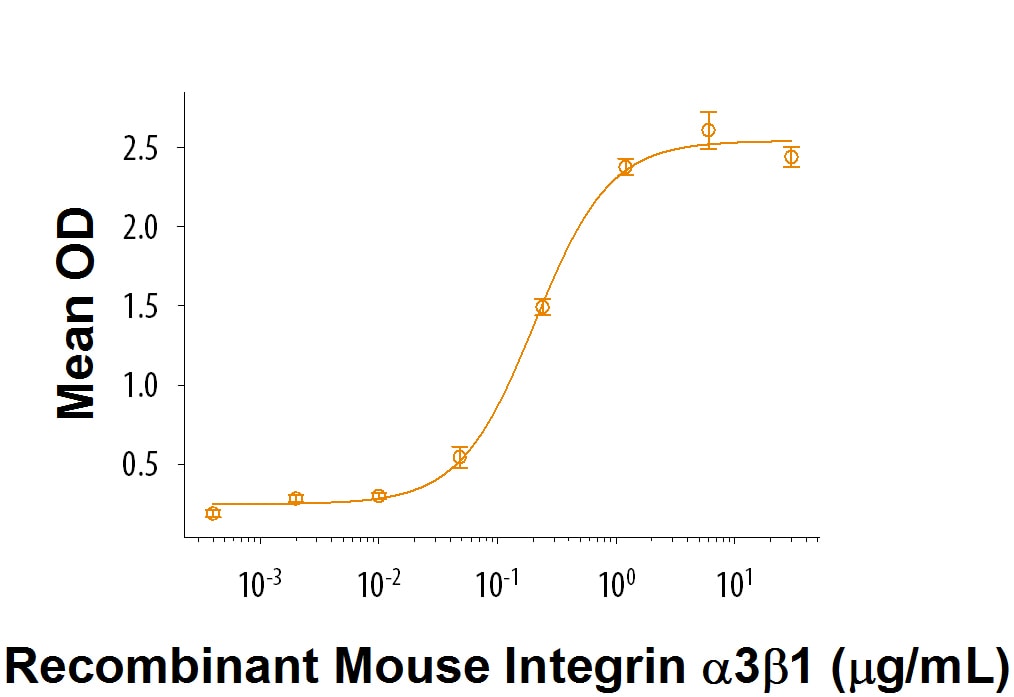
When Cultrex® Mouse Laminin I (Catalog # 3400-010-01) is coated at 2 µg/mL, Recombinant alpha 3 beta 1/VLA-3 binds with an
ED50 = 150-900 ng/mL.
Scientific Data Images for Recombinant Mouse Integrin alpha 3 beta 1/VLA-3 Protein, CF
Recombinant Mouse Integrin alpha 3 beta 1/VLA-3 Protein Bioactivity
When Cultrex® Mouse Laminin-I (Catalog # 3400-010-01) is coated at 2 µg/mL, Recombinant Integrin a3 beta 1/VLA-3 (Catalog # 9374-A3) binds with an ED50 = 150-900 ng/mL.Formulation, Preparation, and Storage
9374-A3
| Formulation | Lyophilized from a 0.2 μm filtered solution in PBS. |
| Reconstitution | Reconstitute at 500 μg/mL in PBS.
Loading...
|
| Shipping | The product is shipped at ambient temperature. Upon receipt, store it immediately at the temperature recommended below. |
| Stability & Storage | Use a manual defrost freezer and avoid repeated freeze-thaw cycles.
|
Calculators
Background: Integrin alpha 3 beta 1/VLA-3
References
- Tsuji, T. et al. (2004) J. Membr. Biol. 200:115.
- Gu, J. and N. Taniguchi (2004) Glycoconj. J. 21:9.
- Kreidberg, J.A. (2000) Curr. Opin. Cell Biol. 12:548.
- Takada, Y. et al. (1991) J. Cell. Biol. 115:257.
- de Melker, A.A. et al. (1997) Lab. Invest. 76:547.
- Krokhin, O.V. et al. (2003) Biochemistry 42:12950.
- Springer, T.A. (2002) Curr. Opin. Struct. Biol. 12:802.
- Argraves, W.S. et al. (1987) J. Cell Biol. 105:1183.
- Nishiuchi, R. et al. (2005) Proc. Natl. Acad. Sci. USA 102:1939.
Alternate Names
Entrez Gene IDs
Gene Symbol
Additional Integrin alpha 3 beta 1/VLA-3 Products
Product Documents for Recombinant Mouse Integrin alpha 3 beta 1/VLA-3 Protein, CF
Certificate of Analysis
To download a Certificate of Analysis, please enter a lot or batch number in the search box below.
Note: Certificate of Analysis not available for kit components.
Product Specific Notices for Recombinant Mouse Integrin alpha 3 beta 1/VLA-3 Protein, CF
For research use only
Related Research Areas
Citations for Recombinant Mouse Integrin alpha 3 beta 1/VLA-3 Protein, CF
 Powered by Bioz
Customer Reviews for Recombinant Mouse Integrin alpha 3 beta 1/VLA-3 Protein, CF
There are currently no reviews for this product. Be the first to review Recombinant Mouse Integrin alpha 3 beta 1/VLA-3 Protein, CF and earn rewards!
Have you used Recombinant Mouse Integrin alpha 3 beta 1/VLA-3 Protein, CF?
Submit a review and receive an Amazon gift card!
$25/€18/£15/$25CAN/¥2500 for a review with an image
$10/€7/£6/$10CAN/¥1110 for a review without an image
Submit a review
FAQs for Recombinant Mouse Integrin alpha 3 beta 1/VLA-3 Protein, CF
-
Q: What is the amino acid sequence of the acidic and basic tails?
A: Acidic and basic tails are added to the protein to help facilitate optimal activity. While we generally include sequence information on the product datasheet, the sequences of these tails are considered confidential information.
Associated Pathways