
Noggin is a secreted homodimeric glycoprotein that is an antagonist of bone morphogenetic proteins (BMPs) (1, 2). Human Noggin cDNA encodes a 232 amino acid (aa) precursor protein; cleavage of a 19 aa signal peptide generates the 213 aa mature protein which contains an N‑terminal acidic region, a central basic
heparin‑binding segment and a C‑terminal cysteine‑knot structure (2). Secreted Noggin probably remains close to the cell surface due to its binding of
heparin‑containing proteoglycans (3). Noggin is very highly conserved among vertebrates, such that mature mouse Noggin shares 99%, 100%, 98%, 97% and 87% aa sequence identity with human, rat, bovine, equine and chicken Noggin, respectively. Noggin binds some BMPs such as BMP‑4 with high affinity and others such as BMP‑7 with lower affinity. It antagonizes BMP bioactivities by blocking epitopes on BMPs that are needed for binding to both type I and type II receptors (2, 4). During embryogenesis, Noggin antagonizes specific BMPs at defined times, for example, during neural tube, somite and cardiomyocyte growth and patterning (5-7). During skeletal development, Noggin prevents chondrocyte hyperplasia, thus allowing proper formation of joints (4). Mutations within the cysteine‑knot region of human Noggin are linked to multiple types of skeletal dysplasias that result in apical joint fusions (8). Noggin is expressed in defined areas of the adult central nervous system and peripheral tissues such as lung, skeletal muscle and skin (1). During culture of human embryonic stem cells (hESC) or neural stem cells under certain conditions, addition of Noggin to antagonize BMP activity may allow stem cells to proliferate while maintaining their undifferentiated state, or alternatively, to differentiate into dopaminergic neurons (6, 9-13). Noggin also appears to maintain adult stem cell populations in vivo, for example, maintaining neural stem cells within the hippocampus (13).
Recombinant Mouse Noggin (aa 28-232) Protein
R&D Systems | Catalog # 6997-NG


Key Product Details
- R&D Systems NS0-derived Recombinant Mouse Noggin (aa 28-232) Protein (6997-NG)
- Quality control testing to verify active proteins with lot specific assays by in-house scientists
- All R&D Systems proteins are covered with a 100% guarantee
Source
Accession Number
Applications
Product Specifications
Source
Gln28-Cys232
Purity
Endotoxin Level
N-terminal Sequence Analysis
Predicted Molecular Mass
SDS-PAGE
Activity
The ED50 for this effect is 0.04-0.16 μg/mL in the presence of 50 ng/mL of Recombinant Human BMP-4 (Catalog # 314-GP).
Reviewed Applications
Read 2 reviews rated 5 using 6997-NG in the following applications:
Scientific Data Images for Recombinant Mouse Noggin (aa 28-232) Protein
Recombinant Mouse Noggin (aa 28‑232) Protein SEC-MALS.
Recombinant Mouse Noggin Protein (Catalog # 6997-NG) has a molecular weight (MW) of 55.7 kDa as analyzed by SEC-MALS, suggesting that this protein is a homodimer. MW may differ from predicted MW due to post-translational modifications (PTMs) present (i.e. Glycosylation).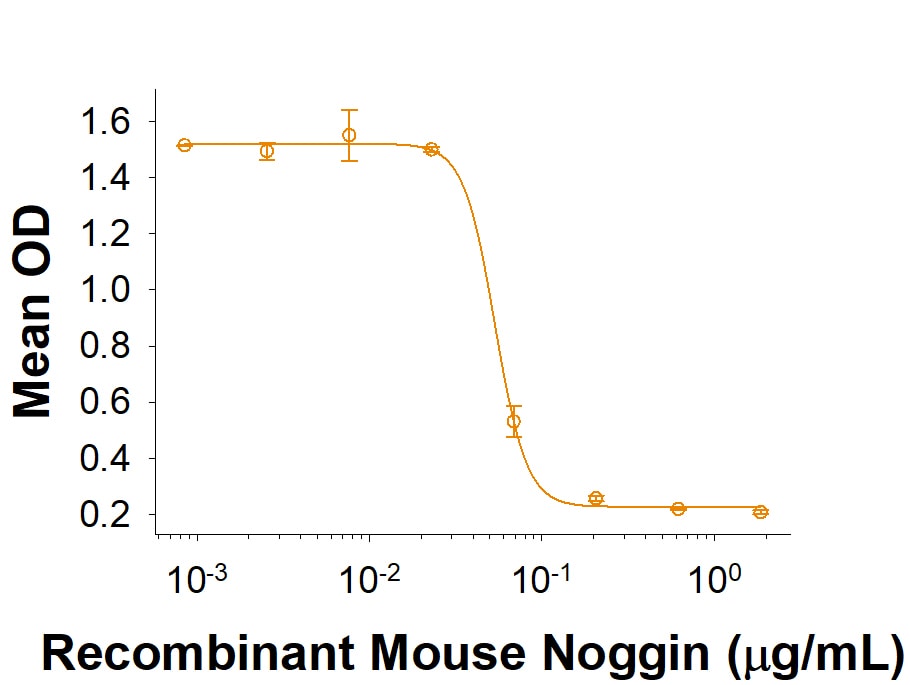
Recombinant Mouse Noggin (aa 28-232) Protein Bioactivity
Measured by its ability to inhibit BMP-4-induced alkaline phosphatase production by ATDC5 mouse chondrogenic cells. The ED50 for this effect is 0.04-0.16 μg/mL in the presence of 50 ng/mL of Recombinant Human BMP-4 (314-BP).Formulation, Preparation, and Storage
Carrier Free
What does CF mean?CF stands for Carrier Free (CF). We typically add Bovine Serum Albumin (BSA) as a carrier protein to our recombinant proteins. Adding a carrier protein enhances protein stability, increases shelf-life, and allows the recombinant protein to be stored at a more dilute concentration. The carrier free version does not contain BSA.
What formulation is right for me?In general, we advise purchasing the recombinant protein with BSA for use in cell or tissue culture, or as an ELISA standard. In contrast, the carrier free protein is recommended for applications, in which the presence of BSA could interfere.
Carrier: 6997-NG
| Formulation | Lyophilized from a 0.2 μm filtered solution in PBS with BSA as a carrier protein. |
| Reconstitution | Reconstitute at 100 μg/mL in PBS containing at least 0.1% human or bovine serum albumin. |
| Shipping | The product is shipped at ambient temperature. Upon receipt, store it immediately at the temperature recommended below. |
| Stability & Storage | Use a manual defrost freezer and avoid repeated freeze-thaw cycles.
|
Carrier Free: 6997-NG/CF
| Formulation | Lyophilized from a 0.2 μm filtered solution in PBS. |
| Reconstitution | Reconstitute at 100 μg/mL in PBS. |
| Shipping | The product is shipped at ambient temperature. Upon receipt, store it immediately at the temperature recommended below. |
| Stability & Storage | Use a manual defrost freezer and avoid repeated freeze-thaw cycles.
|
Calculators
Background: Noggin
References
- Valenzuela, D.M. et al. (1995) J. Neurosci. 15:6077.
- Groppe, J. et al. (2002) Nature 420:636.
- Paine-Saunders, S et al. (2002) J. Biol. Chem. 277:2089.
- Brunet, L. J. et al. (1998) Science 280:1455.
- McMahon, J. A. et al. (1998) Genes Dev. 12:1438.
- Itsykson, P. et al. (2005) Mol. Cell. Neurosci. 30:24.
- Yuasa, S. et al. (2005) Nat. Biotechnol. 23:607.
- Gong, Y. et al. (1999) Nat. Genet. 21:302.
- Xu, R.-H. et al. (2005) Nat. Methods 2:185.
- Wang, G. et al. (2005) Biochem. Biophys. Res. Commun. 330:934.
- Chaturvedi, G. et al. (2009) Cell Prolif. 42:425.
- Chiba, S. et al. (2008) Stem Cells 26:2810.
- Bonaguidi, M.A. et al. (2008) J. Neurosci. 28:9194.
Alternate Names
Gene Symbol
UniProt
Additional Noggin Products
Product Documents for Recombinant Mouse Noggin (aa 28-232) Protein
Certificate of Analysis
To download a Certificate of Analysis, please enter a lot or batch number in the search box below.
Note: Certificate of Analysis not available for kit components.
Product Specific Notices for Recombinant Mouse Noggin (aa 28-232) Protein
For research use only
Related Research Areas
Citations for Recombinant Mouse Noggin (aa 28-232) Protein
 Powered by Bioz
Customer Reviews for Recombinant Mouse Noggin (aa 28-232) Protein (2)
Have you used Recombinant Mouse Noggin (aa 28-232) Protein?
Submit a review and receive an Amazon gift card!
$25/€18/£15/$25CAN/¥2500 for a review with an image
$10/€7/£6/$10CAN/¥1110 for a review without an image
Submit a review
Customer Images
-
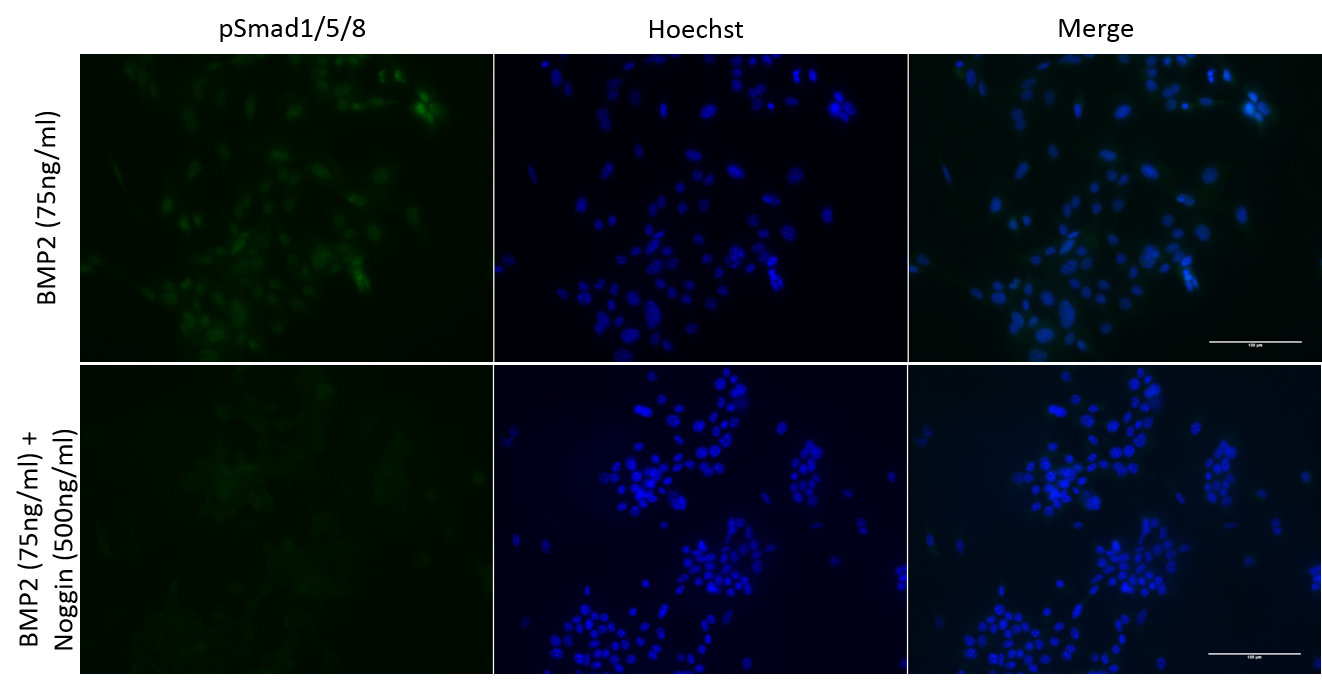
Application: ImmunostainingVerified Customer | Posted 10/26/2018Immunostaining with pSmad 1/5/8 after treatment with BMP2 or BMP2 + Noggin

-
Application: 3D Cell CultureVerified Customer | Posted 09/08/2017
There are no reviews that match your criteria.

