Recombinant Mouse Osteoprotegerin/TNFRSF11B Fc Chimera, CF

R&D Systems | Catalog # 459-MO

R&D Systems
Loading...

Key Product Details

  • R&D Systems NS0-derived Recombinant Mouse Osteoprotegerin/TNFRSF11B Fc Chimera (459-MO)
  • Quality control testing to verify active proteins with lot specific assays by in-house scientists
  • All R&D Systems proteins are covered with a 100% guarantee

Source

NS0

Accession Number

Structure / Form

Disulfide-linked homodimer

Applications

Bioactivity
Loading...

Product Specifications

Source

Mouse myeloma cell line, NS0-derived mouse Osteoprotegerin/TNFRSF11B protein
Mouse OPG
Glu22-Leu401 (Gln138Arg)
Accession # Q6PI12
IEGRMD Human IgG1
(Pro100-Lys330)
(Thr276Ala)
6-His tag
N-terminus C-terminus

Purity

>95%, by SDS-PAGE visualized with Silver Staining and quantitative densitometry by Coomassie® Blue Staining.

Endotoxin Level

<0.10 EU per 1 μg of the protein by the LAL method.

N-terminal Sequence Analysis

Glu22

Predicted Molecular Mass

70.9 kDa (monomer)

SDS-PAGE

85-95 kDa, reducing conditions

Activity

Measured by its ability to inhibit TRAIL-mediated cytotoxicity using L‑929 mouse fibroblast cells treated with TRAIL.
The ED50 for this effect is 3-15 ng/mL in the presence of 12 ng/mL of cross-linked Recombinant Human TRAIL/TNFSF10 (Catalog #s 375-TL and MAB050).

Reviewed Applications

Read 1 review rated 5 using 459-MO in the following applications:

Formulation, Preparation, and Storage

459-MO
Formulation Lyophilized from a 0.2 μm filtered solution in PBS.
Reconstitution

Reconstitute at 100 μg/mL in sterile PBS.


Loading...
Shipping The product is shipped at ambient temperature. Upon receipt, store it immediately at the temperature recommended below.
Stability & Storage Use a manual defrost freezer and avoid repeated freeze-thaw cycles.
  • 12 months from date of receipt, -20 to -70 °C as supplied.
  • 1 month, 2 to 8 °C under sterile conditions after reconstitution.
  • 3 months, -20 to -70 °C under sterile conditions after reconstitution.

Calculators

The reconstitution calculator allows you to quickly calculate the volume of a reagent to reconstitute your vial. Simply enter the mass of reagent and the target concentration and the calculator will determine the rest.

=
÷

Background: Osteoprotegerin/TNFRSF11B

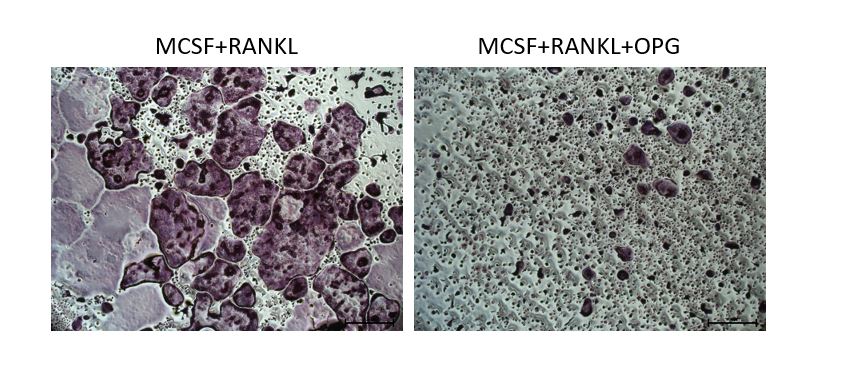
Osteoprotegerin (OPG), also called OCIF (osteoclastogenesis inhibitory factor) is a secreted 55-60 kDa protein that regulates bone density (1-3). As a member of the tumor necrosis factor receptor (TNFR) superfamily of proteins, it is designated TNFRSF11B (1-4). Mouse OPG cDNA encodes 401 amino acids (aa) including a 21 aa signal peptide and a 380 aa mature soluble protein with four TNFR domains, two death domains and a heparin‑binding region (4). The cysteine‑rich TNFR domains are essential for ligand interaction, while a cysteine at the C‑terminus mediates homodimerization (4). Mature mouse OPG shares 86%, 94%, 86%, 86% and 83% amino acid sequence identity with human, rat, equine, canine and bovine OPG, respectively. OPG is widely expressed and constitutively released as a homodimer by mesenchymal stem cells, fibroblasts and endothelial cells (1, 2, 5, 7). Regulation of its expression by estrogen, parathyroid hormone and cytokines is complex and changes with age (2). OPG has been called a decoy receptor for the TNF superfamily ligands, TRANCE (tumor necrosis factor‑related activation‑induced cytokine), also called RANK L (receptor activator of NF kappa B ligand), and TRAIL (TNF‑related apoptosis‑inducing ligand), which also bind TNF family receptors RANK and TRAIL receptors 1-4, respectively (2, 6). TRAIL decreases the release of OPG from cells that express it, while OPG inhibits TRAIL‑induced apoptosis (5, 6). Expression of RANK L on the cell surface, and thus its ability to stimulate osteoclastogenesis, is regulated by OPG by intracellular and extracellular mechanisms (7). Within osteoblasts, interaction of the basic domain of OPG with RANK L in the Golgi inhibits RANK L secretion (7). Extracellularly, OPG binding to RANK L results in clathrin‑mediated internalization and degradation of both proteins (7, 8). Binding of OPG by syndecan‑1 heparin sulfates on multiple myeloma cells also results in OPG internalization and degradation, contributing to bone loss (8, 9). OPG deficiency can cause juvenile Paget’s disease in humans, and insufficient OPG to balance with RANK L and RANK can produce osteoporosis and vascular calcification in both mice and humans (2, 10, 11).

References

  1. Simonet, W.S. et al. (1997) Cell 89:309.
  2. Trouvin, A-P. and V. Goeb 2010) Clin. Interv. Aging 5:345.
  3. Yasuda, H. et al. (1998) Proc. Natl. Acad. Sci. USA 95:3597.
  4. Yamaguchi, K. et al. (1998) J. Biol. Chem. 273:5117.
  5. Corallini, F. et al. (2010) J. Cell. Physiol. Dec. 6 [Epub ahead of print].
  6. Emery, J.G. et al. (1998) J. Biol. Chem. 273:14363.
  7. Aoki, S. et al. (2010) J. Bone Miner. Res. 25:1907.
  8. Tat, S.K. et al. (2006) Bone 39:706.
  9. Standal, T. et al. (2002) Blood 100:3002.
  10. Whyte, M.P. et al. (2002) N. Engl. J. Med. 347:175.
  11. Van Campenhout, A. and J. Golledge (2009) Atherosclerosis 204:321.

Alternate Names

OCIF, TNFRSF11B

Entrez Gene IDs

4982 (Human); 18383 (Mouse)

Gene Symbol

TNFRSF11B

UniProt

Additional Osteoprotegerin/TNFRSF11B Products

Product Documents for Recombinant Mouse Osteoprotegerin/TNFRSF11B Fc Chimera, CF

Certificate of Analysis

To download a Certificate of Analysis, please enter a lot or batch number in the search box below.

Note: Certificate of Analysis not available for kit components.

Product Specific Notices for Recombinant Mouse Osteoprotegerin/TNFRSF11B Fc Chimera, CF

For research use only

Citations for Recombinant Mouse Osteoprotegerin/TNFRSF11B Fc Chimera, CF

Customer Reviews for Recombinant Mouse Osteoprotegerin/TNFRSF11B Fc Chimera, CF (1)

5 out of 5
1 Customer Rating
5 Stars
100%
4 Stars
0%
3 Stars
0%
2 Stars
0%
1 Stars
0%

Have you used Recombinant Mouse Osteoprotegerin/TNFRSF11B Fc Chimera, CF?

Submit a review and receive an Amazon gift card!

$25/€18/£15/$25CAN/¥2500 Yen for a review with an image

$10/€7/£6/$10CAN/¥1110 Yen for a review without an image

Submit a review

Amazon Gift Card

Customer Images


Showing  1 - 1 of 1 review Showing All
Filter By:
  • Recombinant Mouse Osteoprotegerin/TNFRSF11B Fc Chimera, CF
    Name: Anonymous
    Application: In vitro bioactivity in cell culture
    Verified Customer | Posted 10/11/2020
    Recombinant Mouse Osteoprotegerin/TNFRSF11B Fc Chimera, CF 459-MO

There are no reviews that match your criteria.

Showing  1 - 1 of 1 review Showing All

FAQs for Recombinant Mouse Osteoprotegerin/TNFRSF11B Fc Chimera, CF

Showing  1 - 1 of 1 FAQ Showing All
  • Q:

    This protein datasheet indicates I need to use a cross-linking antibody, Catalog # MAB050, for biological activity. What is this antibody and is it really necessary?

    A: The antibody is directed against a 6x histidine repeat and is recommended for use as a cross-linker of proteins with 6x his-tag. Crosslinking is often used for proteins that require receptor trimerization and can result greater biological activity. R&D Systems Quality Control tests the performance of these proteins in the presence of the cross-linking antibody. Therefore, it is necessary to use this antibody when trying to achieve the same level of specific activity described in the datasheet.

Showing  1 - 1 of 1 FAQ Showing All
View all FAQs for Proteins and Enzymes