
Serpin F1 is a multifunctional protein that is synthesized by multiple cell types and is expressed in many tissues including the retinal pigment epithelium, liver, bone, connective, heart, and adipose tissues (1, 3, 5, 7, 8). It has been shown to bind to several different cell surface molecules including the PEDF Receptor, Laminin Receptor, LRP-6, and the F1 ATP Synthase (5, 9-13). It also has binding affinity for several extracellular matrix components, such as Heparin, Heparin Sulphate, Hyaluronan, and Collagens (5, 3). It is believed that the multiple and varied biological activities attributed to Serpin F1 are due to its interactions with these different cell surface molecules. Serpin F1 has been shown to be involved in neurogenesis, neuronal cell survival, angiogenesis, tumorgenesis, stem cell survival and multipotency, and inflammation (2-5, 10, 12-15). In humans, Serpin F1 has been suggested to play a role in choroidal neovascularization, obesity and insulin resistance, cardiovascular disease, osteogenesis imperfecta, and cancer (3-5, 15-19).
Recombinant Mouse Serpin F1/PEDF Protein, CF
R&D Systems | Catalog # 8295-SF

Loading...
Key Product Details
- R&D Systems NS0-derived Recombinant Mouse Serpin F1/PEDF Protein (8295-SF)
- Quality control testing to verify active proteins with lot specific assays by in-house scientists
- All R&D Systems proteins are covered with a 100% guarantee
Source
NS0
Accession Number
Applications
Bioactivity
Loading...
Product Specifications
Source
Mouse myeloma cell line, NS0-derived mouse Serpin F1/PEDF protein
Gln20-Thr417, with a C-terminal 6-His tag
Gln20-Thr417, with a C-terminal 6-His tag
Purity
>95%, by SDS-PAGE with silver staining.
Endotoxin Level
<0.10 EU per 1 μg of the protein by the LAL method.
N-terminal Sequence Analysis
No results obtained: Gln20 inferred from enzymatic pyroglutamate treatment revealing Asn21.
Predicted Molecular Mass
45 kDa
SDS-PAGE
50-56 kDa, reducing conditions
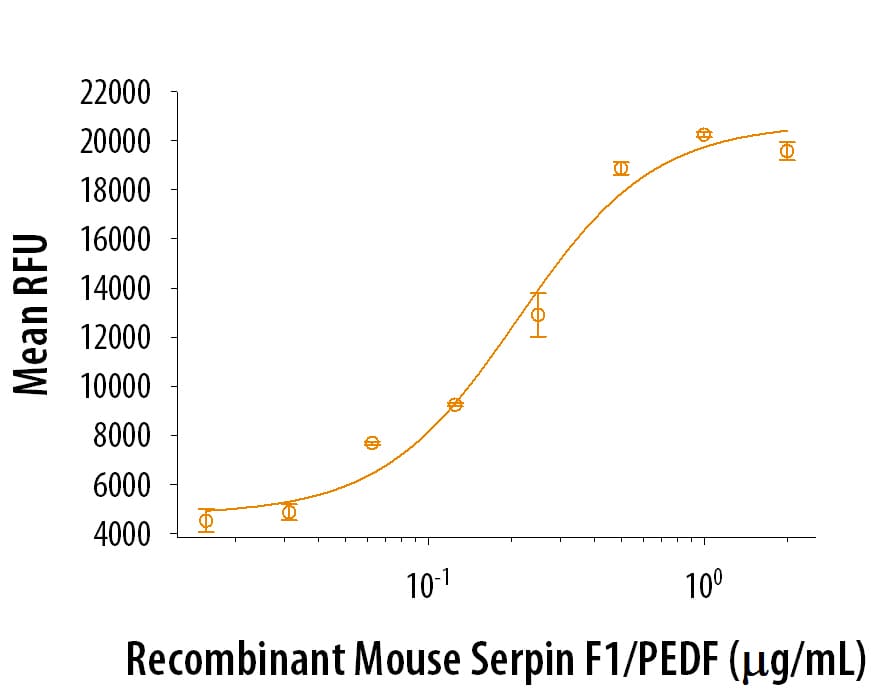
Activity
Measured by its ability to enhance the adhesion of Saos‑2 human osteosarcoma cells to bovine Collagen I coated plate. Eth, E.K. et al. (2007) Cancer Gene Therapy. 14:616.
The ED50 for this effect is ≤ 2.00 μg/mL.
The ED50 for this effect is ≤ 2.00 μg/mL.
Scientific Data Images for Recombinant Mouse Serpin F1/PEDF Protein, CF
Serpin F1/PEDF-induced Adhesion.
Recombinant Mouse Serpin F1/PEDF enhances the adhesion of Saos‑2 human osteosarcoma cells to a bovine Collagen I coated plate. The ED50 for this effect is ≤ 2.00 μg/mL.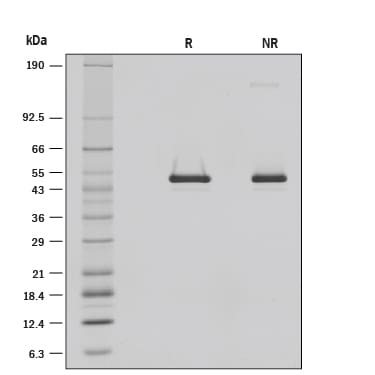
Serpin F1/PEDF-induced Adhesion.
1 μg/lane of Recombinant Mouse Serpin F1/PEDF was resolved with SDS-PAGE under reducing (R) and non-reducing (NR) conditions and visualized by silver staining, showing R bands at 48.8, 42.5 kDa and NR bands at 140.8, 47.9, 42.1 kDa.Formulation, Preparation, and Storage
8295-SF
| Formulation | Lyophilized from a 0.2 μm filtered solution in PBS and NaCl. |
| Reconstitution | Reconstitute at 250 μg/mL in steril PBS.
Loading...
|
| Shipping | The product is shipped at ambient temperature. Upon receipt, store it immediately at the temperature recommended below. |
| Stability & Storage | Use a manual defrost freezer and avoid repeated freeze-thaw cycles.
|
Calculators
Background: Serpin F1/PEDF
References
- Kozaki, K. et al. (1998) J. Biol. Chem. 273:15125.
- Filleur, S. et al. (2009) J. Cell. Biochem. 106:769.
- Kawaguchi, T. et al. (2010) Curr. Mol. Med. 10:302.
- Chandolu, V. and C.R. Dass (2012) J. Biomed. Biotechnol. 2012:740295.
- Becerra, S.P. and V. Notario (2013) Nat. Rev. Cancer 13:258.
- Wu, Y.Q. and S.P. Becerra (1996) Invest. Ophthalmol. Vis. Sci. 37:1984.
- Singh, V.K. et al. (1998) Mol. Vis. 4:7.
- Tombran-Tink, J. and C.J. Barnstable (2004) Biochem. Biophys. Res. Commun. 316:573.
- Notari, L. et al. (2006) J. Biol. Chem. 281:38022.
- Notari, L. et al. (2010) FEBS J. 277:2192.
- Park, K. et al. (2011) Mol. Cell. Biol. 31:3038.
- Bernard, A. et al. (2009) J. Biol. Chem. 284:10480.
- Matsui, T. et al. (2014) Biochem. Biophys. Res. Commun. 443:847.
- Elahy, M. et al. (2012) J. Biomed. Biotechol. 2012:239091.
- Chavan, S.S. et al. (2012) Mol. Med. 18:1161.
- Wang, P. et al. (2008) Eur. J. Endocrinol. 159:713.
- Homan, E.P. et al. (2011) J. Bone Miner. Res. 26:2798.
- Taube, A. et al. (2012) Am. J. Physiol. Heart Circ. Physiol. 302:H2148.
- Venturi, G. et al. (2012) J. Bone Miner. Res. 27:723.
Long Name
Serpine F1/Pigment Epithelium-derived Factor
Alternate Names
EPC-1, PEDF
Gene Symbol
SERPINF1
UniProt
Additional Serpin F1/PEDF Products
Product Documents for Recombinant Mouse Serpin F1/PEDF Protein, CF
Certificate of Analysis
To download a Certificate of Analysis, please enter a lot or batch number in the search box below.
Note: Certificate of Analysis not available for kit components.
Product Specific Notices for Recombinant Mouse Serpin F1/PEDF Protein, CF
For research use only
Related Research Areas
Citations for Recombinant Mouse Serpin F1/PEDF Protein, CF
 Powered by Bioz
Customer Reviews for Recombinant Mouse Serpin F1/PEDF Protein, CF
There are currently no reviews for this product. Be the first to review Recombinant Mouse Serpin F1/PEDF Protein, CF and earn rewards!
Have you used Recombinant Mouse Serpin F1/PEDF Protein, CF?
Submit a review and receive an Amazon gift card!
$25/€18/£15/$25CAN/¥2500 for a review with an image
$10/€7/£6/$10CAN/¥1110 for a review without an image
Submit a review
Loading...