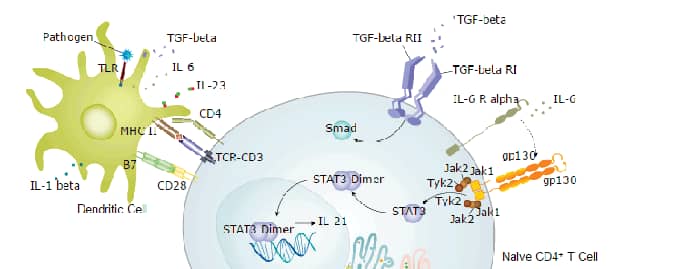
TLR5 (Toll-like receptor 5) is an approximately 100 kDa cell surface type I transmembrane glycoprotein of the TLR family of pathogen‑associated molecular pattern (PAMP) receptors (1‑3). TLR5 recognizes flagellins, proteins found on flagella of both gram‑positive and gram‑negative pathogenic bacteria (2, 3). The 859 amino acid (aa) mouse TLR5 precursor includes a 21 aa signal sequence, a 621 aa extracellular domain (ECD) with 9 potential N‑glycosylation sites and 16 leucine‑rich repeats (LRR) that contain the flagellin‑binding site, a transmembrane domain, and a 197 aa cytoplasmic region with a TIR (Toll/ IL-1 R) domain (1, 4). The mouse TLR5 ECD shares 84% aa sequence identity with rat and 69‑73% with human, feline, porcine and bovine TLR5. TLR5 is expressed on mucosal epithelia in the gastrointestinal tract, airways, and other areas of potential contact with bacteria, and on alveolar macrophages, monocytes, neutrophils, CD4+ T lymphocytes, and dendritic cell subsets (3‑7). In some portions of the intestine, epithelial TLR5 is expressed only on the basolateral surface (3, 4). Flagellin engagement induces signaling via direct interaction of TLR5 with MyD88, which activates NFkB and stimulates production of inflammatory cytokines such as TNF‑ alpha, IL‑1 beta, IL‑6 and IL‑8, depending on the cell type (2‑6, 8, 9). TLR5 allows recognition of pathogenic bacteria such as Pseudomonas, Salmonella and Listeria, without reaction to non‑flagellated commensal bacteria (3, 4). It stimulates massive neutrophil recruitment and EGF R‑mediated mucus production by airway epithelia (4, 9, 10). It promotes Th2 polarization and IgA secretion, and restrains local regulatory T cell generation (4, 7). Deletion of mouse TLR5 promotes colitis, probably due to TLR4‑mediated inappropriate responses to commensal bacteria (11).
Recombinant Mouse TLR5 Fc Chimera Protein, CF
R&D Systems | Catalog # 7915-TR


Loading...
Key Product Details
- R&D Systems CHO-derived Recombinant Mouse TLR5 Fc Chimera Protein (7915-TR)
- Quality control testing to verify active proteins with lot specific assays by in-house scientists
- All R&D Systems proteins are covered with a 100% guarantee
Source
CHO
Accession Number
Structure / Form
Disulfide-linked homodimer
Applications
Bioactivity
Loading...
Product Specifications
Source
Chinese Hamster Ovary cell line, CHO-derived mouse TLR5 protein
| Mouse TLR5 (Ile21-Phe641) Accession # Q9JLF7 |
IEGRMDP | Mouse IgG2A (Glu98-Lys330) |
| N-terminus | C-terminus |
Purity
>95%, by SDS-PAGE under reducing conditions and visualized by silver stain.
Endotoxin Level
<0.01 EU per 1 μg of the protein by the LAL method.
N-terminal Sequence Analysis
Ile21
Predicted Molecular Mass
97.3 kDa (monomer)
SDS-PAGE
100-125 kDa, reducing conditions
Activity
Measured by its ability to inhibit Flagellin-induced IL-8 secretion in HT‑29 human colon adenocarcinoma cells.
The ED50 for this effect is 4-24 ng/mL
The ED50 for this effect is 4-24 ng/mL
Formulation, Preparation, and Storage
7915-TR
| Formulation | Lyophilized from a 0.2 μm filtered solution in PBS. |
| Reconstitution | Reconstitute at 100 μg/mL in PBS.
Loading...
|
| Shipping | The product is shipped at ambient temperature. Upon receipt, store it immediately at the temperature recommended below. |
| Stability & Storage | Use a manual defrost freezer and avoid repeated freeze-thaw cycles.
|
Calculators
Background: TLR5
References
- Sebastiani, G. et al. (2000) Genomics 64:230.
- Hayashi, F. et al. (2001) Nature 410:1099.
- Gewirtz, A.T. et al. (2001) J. Immunol. 167:1882.
- Rumbo, M. et al. (2006) FEBS Lett. 580:2976.
- Descamps, D. et al. (2012) Proc. Natl. Acad. Sci. USA 109:16619.
- Shibata, T. et al. (2012) Int. Immunol. 24:613.
- Feng, T. et al. (2012) PLoS ONE 7:e35918.
- Hawn, T.R. et al. (2003) J. Exp. Med. 198:1563.
- Ben Mohamed, F. et al. (2012) PLoS ONE 7:e39888.
- Yu, H. et al. (2012) Exp. Cell Res. 318:723.
- Vijay-Kumar, M. et al. (2007) J. Clin. Invest. 117:3909.
Long Name
Toll-like Receptor 5
Alternate Names
TIL-3
Gene Symbol
TLR5
UniProt
Additional TLR5 Products
Product Documents for Recombinant Mouse TLR5 Fc Chimera Protein, CF
Certificate of Analysis
To download a Certificate of Analysis, please enter a lot or batch number in the search box below.
Note: Certificate of Analysis not available for kit components.
Product Specific Notices for Recombinant Mouse TLR5 Fc Chimera Protein, CF
For research use only
Citations for Recombinant Mouse TLR5 Fc Chimera Protein, CF
 Powered by Bioz
Customer Reviews for Recombinant Mouse TLR5 Fc Chimera Protein, CF
There are currently no reviews for this product. Be the first to review Recombinant Mouse TLR5 Fc Chimera Protein, CF and earn rewards!
Have you used Recombinant Mouse TLR5 Fc Chimera Protein, CF?
Submit a review and receive an Amazon gift card!
$25/€18/£15/$25CAN/¥2500 for a review with an image
$10/€7/£6/$10CAN/¥1110 for a review without an image
Submit a review