
Recombinant S. cerevisiae ATP Sulfurylase/MET3 Protein, CF
R&D Systems | Catalog # 7175-AS

Key Product Details
- R&D Systems E. coli-derived Recombinant S. cerevisiae ATP Sulfurylase/MET3 Protein (7175-AS)
- Quality control testing to verify active proteins with lot specific assays by in-house scientists
- All R&D Systems proteins are covered with a 100% guarantee
Source
Accession Number
Applications
Product Specifications
Source
Pro2-Phe511, with N-terminal Met and 6-His tag
Purity
Endotoxin Level
N-terminal Sequence Analysis
Predicted Molecular Mass
SDS-PAGE
Activity
The specific activity is >2,500 pmol/min/μg, as measured under the described conditions.
Scientific Data Images for Recombinant S. cerevisiae ATP Sulfurylase/MET3 Protein, CF
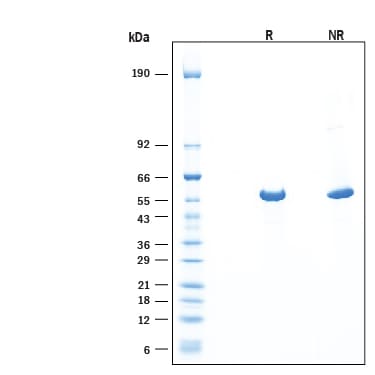
Recombinant Yeast ATP‑Sulfurylase/MET3 SDS-PAGE.
2 μg/lane of Recombinant Yeast ATP‑Sulfurylase/MET3 (Catalog # 7175-AS) was resolved with SDS-PAGE under reducing (R) and non-reducing (NR) conditions and visualized by Coomassie® Blue staining, showing bands at 57-58 kDa.Formulation, Preparation, and Storage
7175-AS
| Formulation | Supplied as a 0.2 μm filtered solution in Tris, NaCl, Glycerol and DTT. |
| Shipping | The product is shipped with dry ice or equivalent. Upon receipt, store it immediately at the temperature recommended below. |
| Stability & Storage | Use a manual defrost freezer and avoid repeated freeze-thaw cycles.
|
Background: ATP-Sulfurylase/MET3
References
- Robbins, P. W. and Lipmann, F. (1958) J. Biol. Chem. 233:686.
- MacRae, I.J. et al. (1998) J. Biol. Chem. 273:28583.
- Strott, C.A. (2002) Endocr. Rev. 23:703.
- Hawes, C.S. and Nicholas, D.J.D. (1973) Biochem. J. 133: 541.
- Wu, Z.L. et al. (2002) The FASEB J. 16:539.
- Lin, C.H. et al. (1995) J. Am.Chem. Soc. 117:8031.
Alternate Names
Entrez Gene IDs
Gene Symbol
UniProt
Additional ATP-Sulfurylase/MET3 Products
Product Documents for Recombinant S. cerevisiae ATP Sulfurylase/MET3 Protein, CF
Certificate of Analysis
To download a Certificate of Analysis, please enter a lot or batch number in the search box below.
Note: Certificate of Analysis not available for kit components.
Product Specific Notices for Recombinant S. cerevisiae ATP Sulfurylase/MET3 Protein, CF
For research use only
Related Research Areas
Citations for Recombinant S. cerevisiae ATP Sulfurylase/MET3 Protein, CF
 Powered by Bioz
Customer Reviews for Recombinant S. cerevisiae ATP Sulfurylase/MET3 Protein, CF
There are currently no reviews for this product. Be the first to review Recombinant S. cerevisiae ATP Sulfurylase/MET3 Protein, CF and earn rewards!
Have you used Recombinant S. cerevisiae ATP Sulfurylase/MET3 Protein, CF?
Submit a review and receive an Amazon gift card!
$25/€18/£15/$25CAN/¥2500 for a review with an image
$10/€7/£6/$10CAN/¥1110 for a review without an image
Submit a review
Protocols
View specific protocols for Recombinant S. cerevisiae ATP Sulfurylase/MET3 Protein, CF (7175-AS):
- Assay Buffer: 25 mM Tris, 1 mM MgCl2, 20 mM Na2SO4, pH 8.0
- Recombinant Yeast ATP Sulfurylase/MET3 (ryMET3) (Catalog # 7175-AS)
- Recombinant Human Inorganic Pyrophosphatase/PPA1 (rhPPA1) (Catalog # 6557-PP)
- Recombinant Penicillum chrysogenum APS Kinase/APSK (rAPS Kinase) (Catalog # 7176-SK)
- Adenosine Triphosphate (ATP) (Sigma, Catalog # A7699), 10 mM stock in deionized water
- Malachite Green Phosphate Detection Kit (Catalog # DY996)
- 96-well Clear Plate (Costar, Catalog # 92592)
- Plate Reader (Model: SpectraMax Plus by Molecular Devices) or equivalent
- Dilute ATP to 1.8 mM in Assay Buffer.
- Dilute rhPPA1 to 3 µg/mL in Assay Buffer.
- Dilute rAPS Kinase to 120 µg/mL in Assay Buffer.
- Prepare Reaction Mixture by combining equal volumes of 1.8 mM ATP, 3 µg/mL rhPPA1, and 120 µg/mL rAPS Kinase.
- Dilute ryMET3 to 0.2 µg/mL in Assay Buffer.
- Dilute 1 M Phosphate Standard by adding 10 µL of the 1 M Phosphate Standard to 990 µL of deionized water for a 10 mM stock. Continue by adding 10 µL of the 10 mM Phosphate stock to 990 µL of Assay Buffer for a 100 µM stock. This is the first point of the standard curve.
- Continue standard curve by performing six one-half serial dilutions of the 100 µM Phosphate stock in Assay Buffer. The standard curve has a range of 0.078 to 5.0 nmol per well.
- Load 50 µL of each dilution of the standard curve into a plate. Include a curve blank containing 50 μL of Assay Buffer.
- Load 25 µL of the 0.2 µg/mL ryMET3 into the plate. Include a Control containing 25 µL of Assay Buffer.
- Start the reaction by adding 25 µL of Reaction Mixture to the wells, excluding the standard curve and curve blank.
- Cover the plate with parafilm or a plate sealer and incubate at 37 °C for 20 minutes.
- Add 30 µL of the Malachite Green Reagent A to all wells.
- Add 100 µL of deionized water to all wells. Mix briefly.
- Add 30 µL of the Malachite Green Reagent B to all wells. Mix and incubate for 20 minutes at room temperature.
- Read plate at 620 nm (absorbance) in endpoint mode.
- Calculate specific activity:
|
Specific Activity (pmol/min/µg) = |
Phosphate released* (nmol) x (1000 pmol/nmol) | ÷ 2** |
| Incubation time (min) x amount of enzyme (µg) |
*Derived from the phosphate standard curve using linear or 4-parameter fitting and adjusted for Control.
**Two inorganic phosphates are generated from each MET3 produced pyrophosphate
Per Reaction:
- ryMET3: 0.005 µg
- ATP: 0.3 mM
- rhPPA1: 0.025 µg
- rAPS Kinase: 1 µg