
Recombinant S. pyogenes CRISPR-associated Protein 9, CF
R&D Systems | Catalog # 9957-C9
Purified CAS9 with Nuclear Localization Sequence

Loading...
Key Product Details
- R&D Systems E. coli-derived Recombinant S. pyogenes CRISPR-associated Protein 9 (9957-C9)
- Quality control testing to verify active proteins with lot specific assays by in-house scientists
- All R&D Systems proteins are covered with a 100% guarantee
Source
E. coli
Applications
Enzyme Activity
Loading...
Product Specifications
Source
E. coli-derived s. pyogenes CRISPR-Cas9 protein
| APKKKRKVGIHGVPAA | S. pyogenes CRISPR-Cas9 (Asp2-Asp1368) Accession # Q99ZW2 |
KRPAATKKAGQAKK-KKGYGRKKRRQRRRG | HHHHHH |
| N-terminus | C-terminus | ||
Purity
>95%, by SDS-PAGE visualized with Silver Staining and quantitative densitometry by Coomassie® Blue Staining.
Endotoxin Level
<0.10 EU per 1 μg of the protein by the LAL method.
N-terminal Sequence Analysis
Ala
Predicted Molecular Mass
164 kDa
SDS-PAGE
133 kDa, reducing conditions
Activity
Measured by its ability to cleave a targeted DNA substrate.
S. pyogenes CRISPR-Cas9 achieves >80% substrate cleavage, as measured under the described conditions.
S. pyogenes CRISPR-Cas9 achieves >80% substrate cleavage, as measured under the described conditions.
Scientific Data Images for Recombinant S. pyogenes CRISPR-associated Protein 9, CF
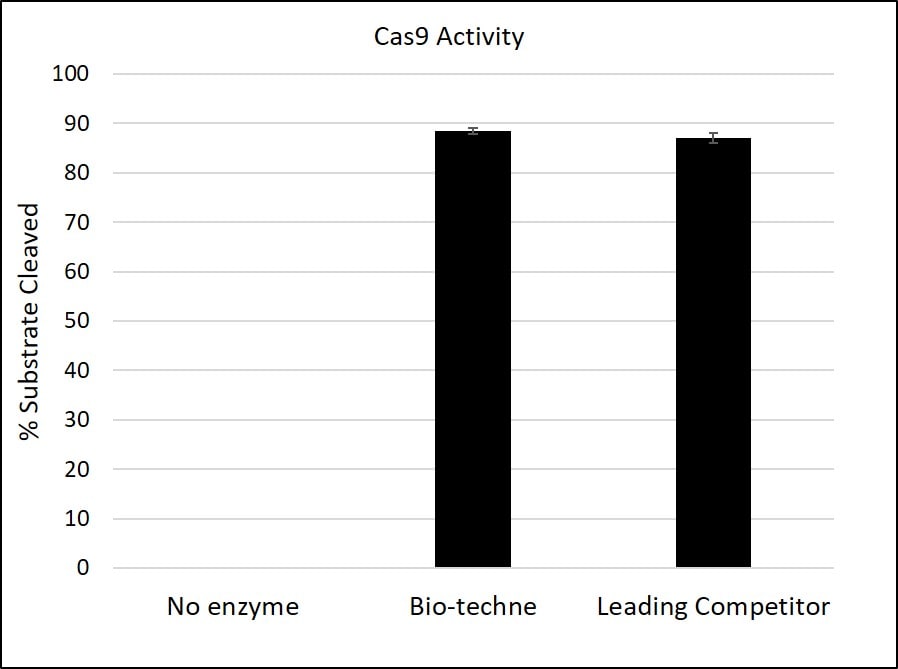
Recombinant S. pyogenes CRISPR-associated Protein 9 Bioactivity
Quantitative analysis of the substrate cleavage by densitometry of the agarose gel. Error bars display standard error of 3 replicates. 9957-C9 has equivalent activity to a Leading Competitor's Cas9 using the insert assay protocol.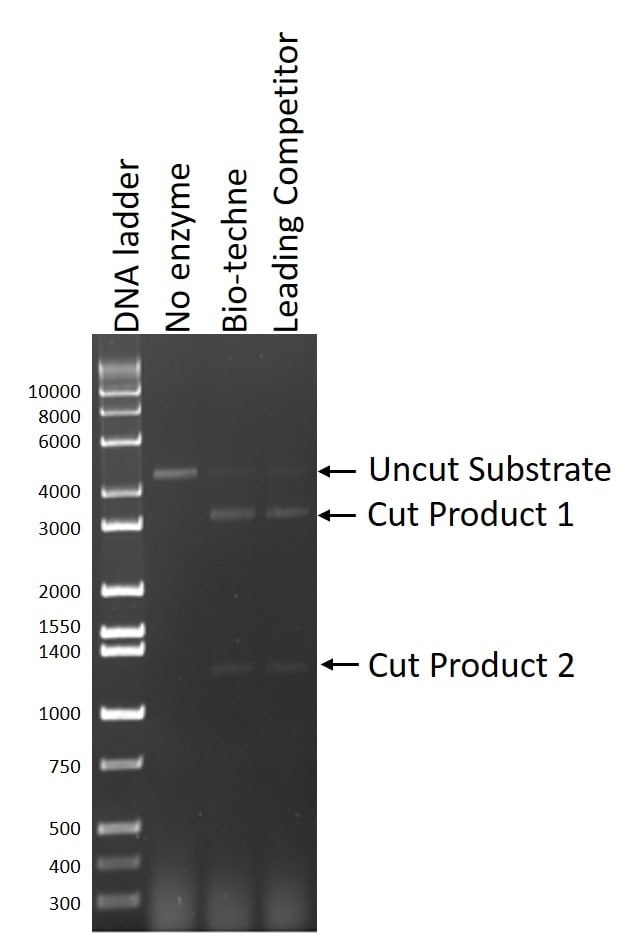
Recombinant S. pyogenes CRISPR-associated Protein 9 Bioactivity
Agarose gel image of in vitro cleavage of DNA substrate into two DNA products by 9957-C9 and a Leading Competitor's Cas9.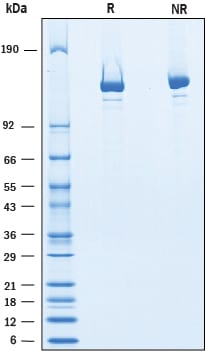
Recombinant S. pyogenes CRISPR-associated Protein 9 SDS-PAGE
2 μg/lane of Recombinant S. pyogenes CRISPR-Cas9 was resolved with SDS-PAGE under reducing (R) and non-reducing (NR) conditions and visualized by Coomassie® Blue staining, showing a band at ~130 kDa.Formulation, Preparation, and Storage
9957-C9
| Formulation | Supplied as a 0.2 μm filtered solution in Tris, NaCl, EDTA, Glycerol and TCEP. |
| Shipping | The product is shipped with polar packs. Upon receipt, store it immediately at the temperature recommended below. |
| Stability & Storage | Use a manual defrost freezer and avoid repeated freeze-thaw cycles.
|
Background: CRISPR-Cas9
References
- Feng, Z. et al. (2013) Cell 154:1380.
- Moineau. et al. (2010) Nature 468:67.
- Barrangou, R. et al. (2014) Molecular Cell 54:234.
- Charpentier, E. et al. (2011) Nature 471:602.
- Heler, R. et al. (2015) Nature 519:199.
- Thomson, J.A. et al. (2013) PNAS,110:15644.
- Cong, L. et al. (2013) Science 339:819.
Long Name
CRISPR-associated Protein 9
Alternate Names
Cas9, CRISPR-associated endonuclease Cas9/Csn1, CRISPR-Cas9/Csn1, CRISPR/Cas9, csn1, SPy_1046, SPy1046, SpyCas9
Entrez Gene IDs
901176 (S. pyogenes)
Gene Symbol
CAS9
Additional CRISPR-Cas9 Products
Product Documents for Recombinant S. pyogenes CRISPR-associated Protein 9, CF
Certificate of Analysis
To download a Certificate of Analysis, please enter a lot or batch number in the search box below.
Note: Certificate of Analysis not available for kit components.
Product Specific Notices for Recombinant S. pyogenes CRISPR-associated Protein 9, CF
For research use only
Customer Reviews for Recombinant S. pyogenes CRISPR-associated Protein 9, CF
There are currently no reviews for this product. Be the first to review Recombinant S. pyogenes CRISPR-associated Protein 9, CF and earn rewards!
Have you used Recombinant S. pyogenes CRISPR-associated Protein 9, CF?
Submit a review and receive an Amazon gift card!
$25/€18/£15/$25CAN/¥2500 for a review with an image
$10/€7/£6/$10CAN/¥1110 for a review without an image
Submit a review
Protocols
View specific protocols for Recombinant S. pyogenes CRISPR-associated Protein 9, CF (9957-C9):
Materials
- Assay Buffer: 50 mM NaCl, 10 mM Tris-HCl, 10 mM MgCl2, 100 µg/mL BSA, pH 7.9
- Recombinant Streptococcus pyogenes CRISPR-Cas9 (rS. pyogenes Cas9) (Catalog # 9957-C9)
- PBR322 vector (NEB, Catalog # N3033S) digested with EcoRI-HF (NEB, Catalog # R3101S)*
- Dharmacon synthetic sgRNA, targeting sequence: GAGGCAGACAAGGTATAGGG
- Ethidium Bromide, 10 mg/mL (Amresco, Catalog # X328)
- Ultrapure DNase/RNase-Free Distilled Water (Invitrogen, Catalog # 10977015), to prepare Assay Buffer
- DNA gel
*Digest was gel purified using gel purification kit and eluted in EB buffer (10 mM Tris-HCl, pH 8.5).
- Prepare RNP Complex:
a. 600 nM sgRNA (6 µL addition from 3 µM stock prepared in Assay Buffer)
b. 0.25 μg rS. pyogenes Cas9
c. Add Assay Buffer for a final RNP Complex volume of 26.5 µL
d. Incubate for 5 minutes at 37 °C. - Mix RNP Complex with 3.5 μL of 8.6 ng/µL of DNA Substrate (diluted in Assay Buffer, if possible).
- Incubate for 1 hour at 37 °C.
- Incubate for 10 minutes at 65 °C to dissociate enzyme from DNA.
- Load total reaction with loading dye on a 1% agarose gel.
- Run gel at 140 V for 40 minutes.
- Soak gel in 200 mL TAE with 150 μL of 10 mg/mL ethidium bromide for 1 hour.
- Use imaging software to detect and quantify hydrolysis of the DNA substrate.
- rS. pyogenes Cas9: 0.25 μg
- DNA Substrate: 30 ng
- sgRNA: 600 nM
Loading...