
SARS-CoV-2, which causes the global pandemic coronavirus disease 2019 (Covid-19), belongs to a family of viruses known as coronaviruses that are commonly comprised of four structural proteins: Spike protein (S), Envelope protein (E), Membrane protein (M), and Nucleocapsid protein (N) (1). SARS-CoV-2 Spike Protein (S Protein) is a glycoprotein that mediates membrane fusion and viral entry. The S protein is homotrimeric, with each ~180-kDa monomer consisting of two subunits, S1 and S2 (2). In SARS-CoV-2, as with most coronaviruses, proteolytic cleavage of the S protein into the S1 and S2 subunits is required for activation. The S1 subunit is focused on attachment of the protein to the host receptor while the S2 subunit is involved with cell fusion (3-5). The S protein of SARS-CoV-2 shares 75% and 29% amino acid (aa) sequence identity with the S protein of SARS-CoV-1 and MERS, respectively.The S Protein of the SARS-CoV-2 virus, like the SARS-CoV-1 counterpart, binds Angiotensin-Converting Enzyme 2 (ACE2), but with much higher affinity and faster binding kinetics through the receptor binding domain (RBD) located in the C-terminal region of S1 (6). Based on structural biology studies, the RBD can be oriented either in the up/standing or down/lying state with the up/standing state associated with higher pathogenicity (7). Polyclonal antibodies to the RBD of the SARS-CoV-2 protein have been shown to inhibit interaction with the ACE2 receptor, confirming RBD as an attractive target for vaccinations or antiviral therapy (8). It has been demonstrated that the S Protein can invade host cells through the CD147/EMMPRIN receptor and mediate membrane fusion (9, 10). A SARS-CoV-2 variant carrying the S protein aa change D614G has become the most prevalent form in the global pandemic and has been associated with greater infectivity and higher viral load (11, 12).
Recombinant SARS-CoV-2 Spike His Protein, CF
R&D Systems | Catalog # 10549-CV

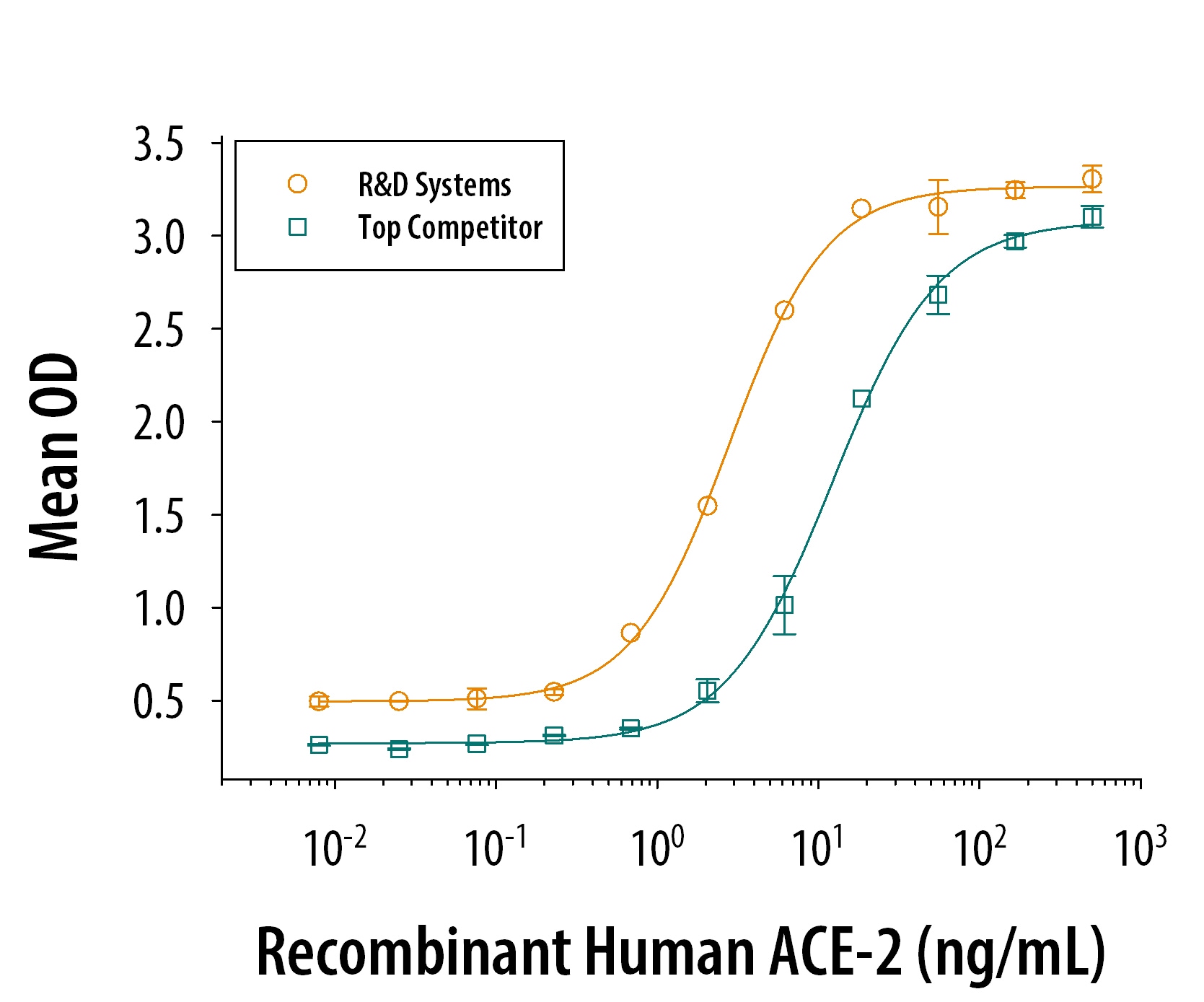
Key Product Details
- R&D Systems HEK293-derived Recombinant SARS-CoV-2 Spike His Protein (10549-CV)
- Quality control testing to verify active proteins with lot specific assays by in-house scientists
- All R&D Systems proteins are covered with a 100% guarantee
Source
Accession Number
Applications
Why choose R&D Systems SARS-CoV-2 Spike Protein?
- Val16-Lys1211 with a C-term His tag.
- Stabilizing mutations K986P and V987P promote the prefusion conformation.
- Two mutations, R682S and R685S, eliminate a Furin protease cleavage site.
- Guaranteed Bioactivity and High Purity: Bioactivity tested by functional ELISA and purity determined by SDS-PAGE to be greater than 95%.
- Lot-to-Lot Consistency: Stringent QC testing performed on each lot to ensure consistent activity and purity.
- Bulk Quantities Available: Bulk up and save with large mass quantities to meet your research needs. Supply agreements available, partner with us. Please contact us.
- Most Respected, Most Cited Brand in Proteins: With over 35 years of providing the best recombinant proteins to the scientific community, R&D Systems continues to lead the industry in quality, activity, and purity.
Interested in other Coronavirus proteins including SARS-CoV-2 Spike proteins? View Products
Product Specifications
Source
Val16-Lys1211 (Arg682Ser, Arg685Ser, Lys986Pro and Val987Pro) with a C-terminal 6-His tag
Suitable for use in serological assay development
Purity
Endotoxin Level
N-terminal Sequence Analysis
Predicted Molecular Mass
SDS-PAGE
Activity
Reviewed Applications
Read 4 reviews rated 5 using 10549-CV in the following applications:
Scientific Data Images for Recombinant SARS-CoV-2 Spike His Protein, CF
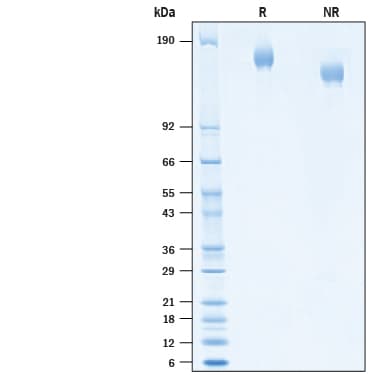
Recombinant SARS-CoV-2 Spike His Protein SDS-PAGE
2 μg/lane of Recombinant SARS-CoV-2 Spike His Protein (10549-CV) was resolved with SDS-PAGE under reducing (R) and non-reducing (NR) conditions and visualized by Coomassie® Blue staining, showing bands at 144-175 kDa.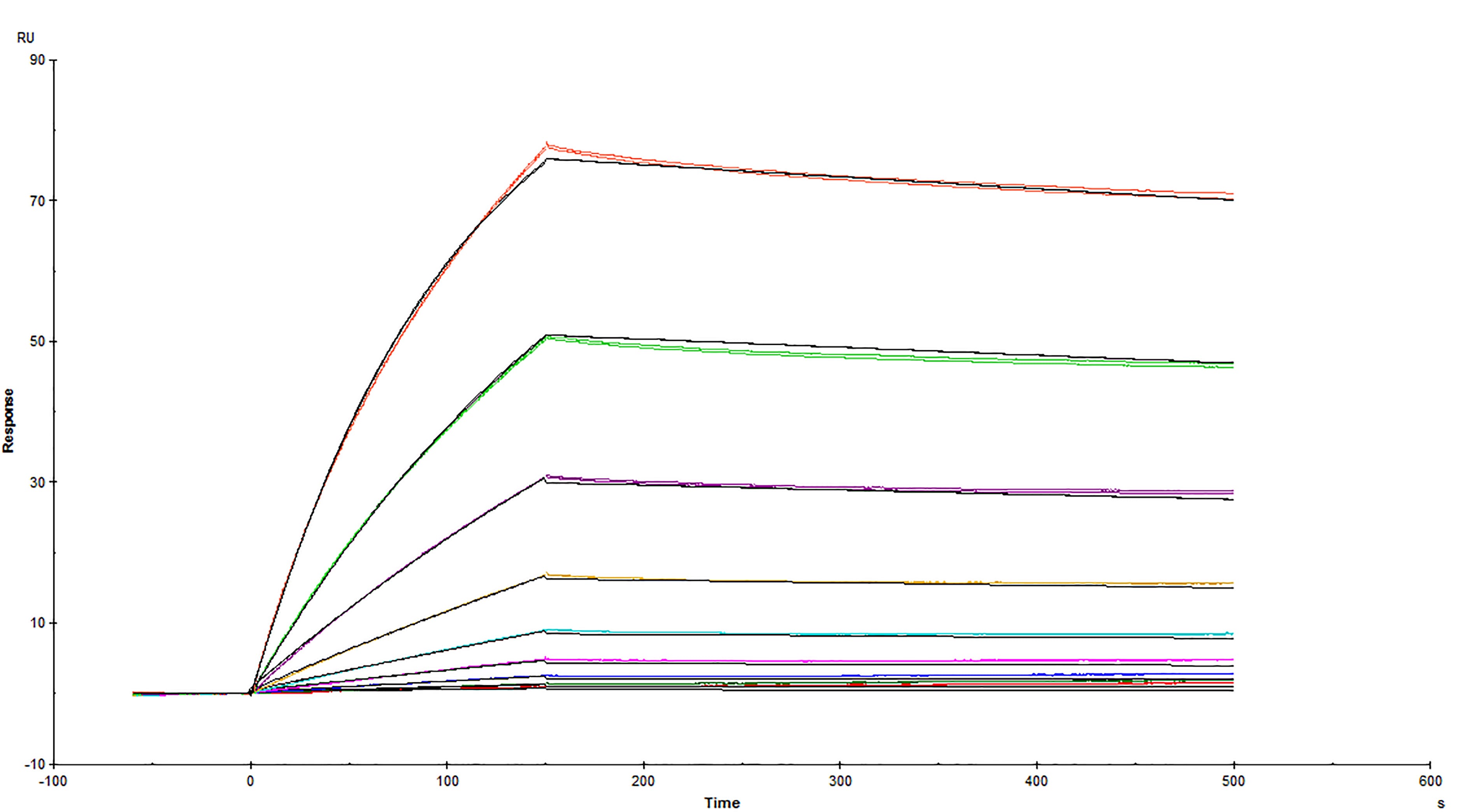
Binding of ACE-2 to SARS-CoV-2 Spike by surface plasmon resonance (SPR).
Recombinant SARS-CoV-2 Spike His Protein (Catalog # 10549-CV) was immobilized on a Biacore Sensor Chip CM5, and binding to recombinant human ACE-2 (Catalog # 933-ZN) was measured at a concentration range between 0.37 nM and 93.5 nM. The double-referenced sensorgram was fit to a 1:1 binding model to determine the binding kinetics and affinity, with an affinity constant of KD=1.720 nM.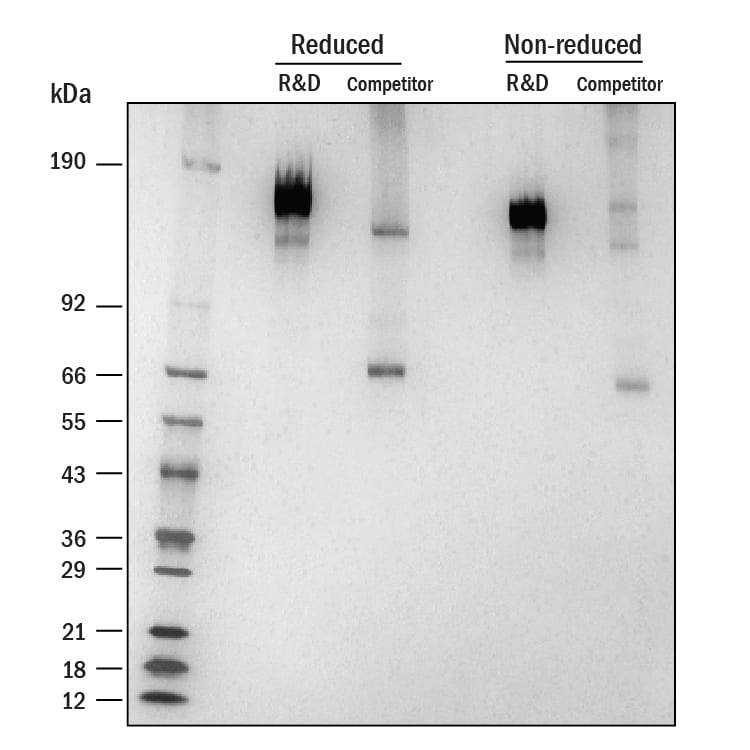
Recombinant SARS-CoV-2 Spike His Protein SDS-PAGE
SDS-PAGE of 1 µg of R&D Systems Recombinant SARS-CoV-2 Spike (10549-CV) or a competitor’s Spike protein were run under reducing or non-reducing conditions and visualized by silver staining. The R&D Systems Spike protein runs as a single band compared to the competition.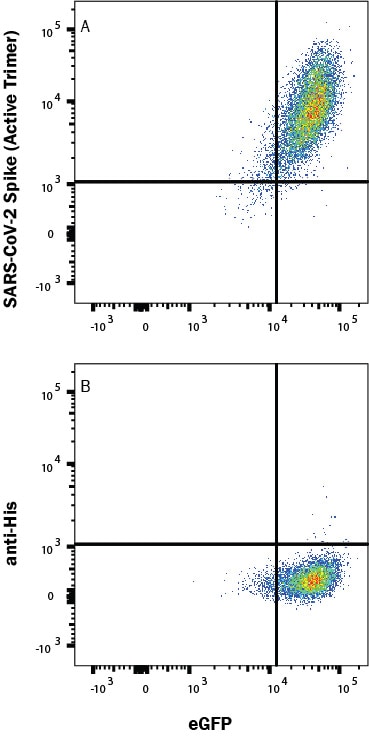
Detection of SARS-CoV-2 Spike Protein bound to ACE-2 expressing cells by flow cytometry.
In a functional flow cytometry test, (A) Recombinant SARS-CoV-2 Spike His-tag Protein (Catalog # 10549-CV) binds to HEK293 human embryonic kidney cell line transfected with recombinant human ACE-2 and EGFP. Ligand binding was detected by staining cells with APC-conjugated anti-His Monoclonal Antibody (IC050A), which does not stain the cells in the absence of recombinant protein (B).Formulation, Preparation, and Storage
10549-CV
| Formulation | Lyophilized from a 0.2 μm filtered solution in PBS with Trehalose. |
| Reconstitution | Reconstitute at 500 μg/mL in PBS. |
| Shipping | The product is shipped at ambient temperature. Upon receipt, store it immediately at the temperature recommended below. |
| Stability & Storage | Use a manual defrost freezer and avoid repeated freeze-thaw cycles.
|
Calculators
Background: Spike
References
- Wu, F. et al. (2020) Nature 579:265.
- Tortorici, M.A. and D. Veesler (2019). Adv. Virus Res. 105:93.
- Bosch, B.J. et al. (2003). J. Virol. 77:8801.
- Belouzard, S. et al. (2009) Proc. Natl. Acad. Sci. 106:5871.
- Millet, J.K. and G.R. Whittaker (2015) Virus Res. 202:120.
- Ortega, J.T. et al. (2020) EXCLI J. 19:410.
- Yuan, Y. et al. (2017) Nat. Commun. 8:15092.
- Tai, W. et al. (2020) Cell. Mol. Immunol. https://doi.org/10.1016/j.it.2020.03.007.
- Wang, X. et al. (2020) https://doi.org/10.1038/s41423-020-0424-9.
- Wang, K. et al. (2020) bioRxiv https://www.biorxiv.org/content/10.1101/2020.03.14.988345v1.
- Korber, B. et al. (2020) Cell 182, 812.
- Zhang, L. et al. (2020) bioRxiv https://www.biorxiv.org/content/10.1101/2020.06.12.148726v1.
Long Name
Alternate Names
Entrez Gene IDs
Gene Symbol
UniProt
Additional Spike Products
Product Documents for Recombinant SARS-CoV-2 Spike His Protein, CF
Certificate of Analysis
To download a Certificate of Analysis, please enter a lot or batch number in the search box below.
Note: Certificate of Analysis not available for kit components.
Product Specific Notices for Recombinant SARS-CoV-2 Spike His Protein, CF
For research use only
Related Research Areas
Citations for Recombinant SARS-CoV-2 Spike His Protein, CF
 Powered by Bioz
Customer Reviews for Recombinant SARS-CoV-2 Spike His Protein, CF (4)
Have you used Recombinant SARS-CoV-2 Spike His Protein, CF?
Submit a review and receive an Amazon gift card!
$25/€18/£15/$25CAN/¥2500 for a review with an image
$10/€7/£6/$10CAN/¥1110 for a review without an image
Submit a review
Customer Images
-
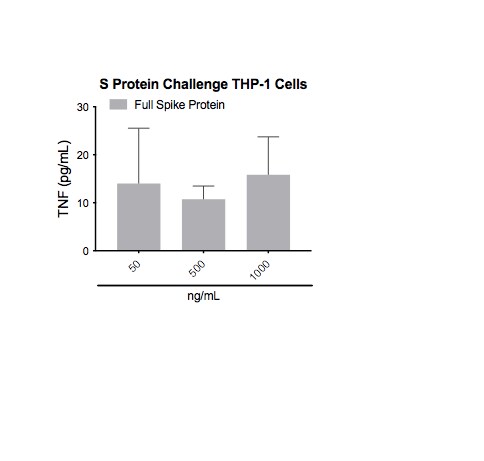
Application: In vitro bioactivity in cell cultureVerified Customer | Posted 08/06/2023

-
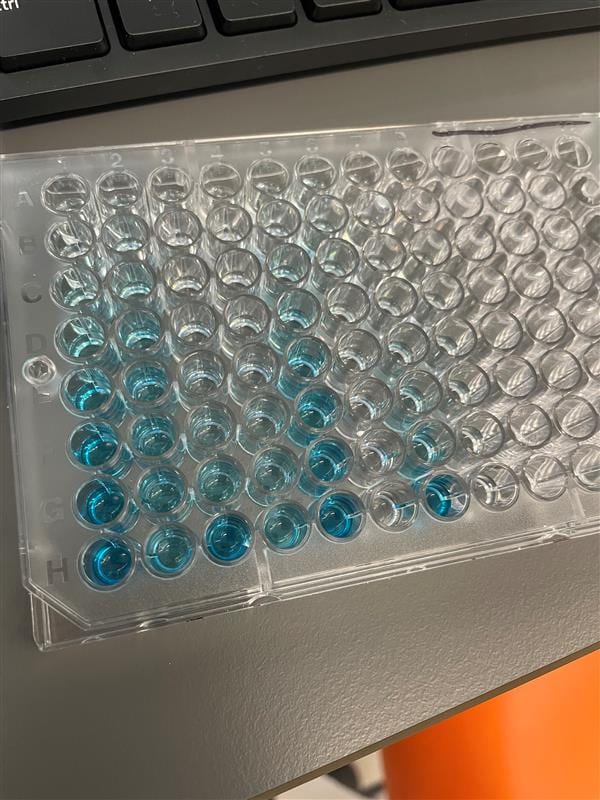
Application: ELISAVerified Customer | Posted 05/10/2023
-
Application: FACSVerified Customer | Posted 02/15/2021
-
Application: Immunoassay StandardVerified Customer | Posted 10/09/2020
There are no reviews that match your criteria.
FAQs for Recombinant SARS-CoV-2 Spike His Protein, CF
-
Q: What is the strain of 10549-CV?
A:
10549-CV is the wild-type Wuhan strain, and the NCBI reference sequence from Accession # YP_009724390.1 identifies the strain (https://www.ncbi.nlm.nih.gov/protein/YP_009724390.1).