
SCP3/SYCP3 Antibody - BSA Free
Novus Biologicals | Catalog # NB300-231

![Immunocytochemistry/ Immunofluorescence: SCP3/SYCP3 Antibody [NB300-231]](https://resources.rndsystems.com/images/products/SCP3-SYCP3-Antibody-Immunocytochemistry-Immunofluorescence-NB300-231-img0014.jpg "Immunocytochemistry/ Immunofluorescence: SCP3/SYCP3 Antibody [NB300-231]")
Scientific images may be resized, cropped, or adjusted for brightness or contrast for presentation purposes. These updates are limited to presentation and do not affect the underlying scientific interpretation of the data. Where available, additional source data may be provided upon request.
Key Product Details
Species Reactivity
Validated:
Cited:
Applications
Validated:
Cited:
Label
Antibody Source
Format
Product Specifications
Immunogen
Reactivity Notes
Clonality
Host
Isotype
Scientific Data Images for SCP3/SYCP3 Antibody - BSA Free
Immunocytochemistry/ Immunofluorescence: SCP3/SYCP3 Antibody [NB300-231]
SCP3-SYCP3-Antibody-Immunocytochemistry-Immunofluorescence-NB300-231-img0014.jpg![Immunohistochemistry: SCP3/SYCP3 Antibody [NB300-231]](https://resources.rndsystems.com/images/products/SCP3-SYCP3-Antibody-Immunohistochemistry-NB300-231-img0005.jpg "Immunohistochemistry: SCP3/SYCP3 Antibody [NB300-231]")
Immunohistochemistry: SCP3/SYCP3 Antibody [NB300-231]
Immunohistochemistry: SCP3/SYCP3 Antibody [NB300-231] - Punctate staining of murine SCP3 in mouse ovary using NB300-231.![Immunocytochemistry/ Immunofluorescence: SCP3/SYCP3 Antibody [NB300-231]](https://resources.rndsystems.com/images/products/SCP3-SYCP3-Antibody-ICC-IF-Negative-NB300-231-img0006.jpg "Immunocytochemistry/ Immunofluorescence: SCP3/SYCP3 Antibody [NB300-231]")
Immunocytochemistry/ Immunofluorescence: SCP3/SYCP3 Antibody [NB300-231]
Immunocytochemistry/Immunofluorescence: SCP3/SYCP3 Antibody [NB300-231] - Distinct forms of ubiquitin regulation by RNF8 and SCML2. (C-F) Immunostaining on meiotic chromosome spreads of FK2 and SYCP3 antibodies. Dotted circles are sex chromosomes and Scale bar are 10 micrometers. At least 30 spermatocytes from each substage are shown from at least 3 independent mice per mouse model. Immunostaining intensity is qualified by densitometry across the indicated path and plotted in a relative intensity of 0-1 (normalized among stages). Citation: Adams SR, Maezawa S, Alavattam KG, Abe H, Sakashita A, Shroder M, et al. (2018) RNF8 and SCML2 cooperate to regulate ubiquitination and H3K27 acetylation for escape gene activation on the sex chromosomes. PLoS Genet 14(2): e1007233. https://doi.org/10.1371/journal.pgen.1007233![Immunocytochemistry/ Immunofluorescence: SCP3/SYCP3 Antibody [NB300-231]](https://resources.rndsystems.com/images/products/SCP3-SYCP3-Antibody-ICC-IF-Negative-NB300-231-img0007.jpg "Immunocytochemistry/ Immunofluorescence: SCP3/SYCP3 Antibody [NB300-231]")
Immunocytochemistry/ Immunofluorescence: SCP3/SYCP3 Antibody [NB300-231]
Immunocytochemistry/Immunofluorescence: SCP3/SYCP3 Antibody [NB300-231] - (A-D) Immunostaining of D27C4 and SYCP3 on meiotic chromosome spreads. Dotted circles indicate sex chromosomes and scale bar is 10 micrometers. At least 30 spermatocytes from each substage are shown from at least 3 independent mice per mouse model. Immunostaining intensity is qualified by densitometry across the indicated path and plotted in a relative intensity of 0-1 (normalized among stages).Citation: Adams SR, Maezawa S, Alavattam KG, Abe H, Sakashita A, Shroder M, et al. (2018) RNF8 and SCML2 cooperate to regulate ubiquitination and H3K27 acetylation for escape gene activation on the sex chromosomes. PLoS Genet 14(2): e1007233. https://doi.org/10.1371/journal.pgen.1007233![Immunocytochemistry/ Immunofluorescence: SCP3/SYCP3 Antibody [NB300-231]](https://resources.rndsystems.com/images/products/SCP3-SYCP3-Antibody-ICC-IF-Negative-NB300-231-img0008.jpg "Immunocytochemistry/ Immunofluorescence: SCP3/SYCP3 Antibody [NB300-231]")
Immunocytochemistry/ Immunofluorescence: SCP3/SYCP3 Antibody [NB300-231]
Immunocytochemistry/Immunofluorescence: SCP3/SYCP3 Antibody [NB300-231] - (A) Immunostaining of D27C4 and SYCP3 on wild-type meiotic chromosome spreads. Representative images are shown for each category through the early pachytene stage for spermatocytes from 9 independent mice. (C) Immunostaining of SYCP3 and D27C4 on Mdc1-KO meiotic chromosome spreads. Representative images are shown through the early pachytene stage for spermatocytes from 3 independent Mdc1-KO mice. (A and C) Dotted circles indicate sex chromosomes and scale bar is 10 micrometers. Immunostaining intensity is qualified by densitometry across the indicated path and plotted in a relative intensity of 0-1 (normalized among stages).Citation: Adams SR, Maezawa S, Alavattam KG, Abe H, Sakashita A, Shroder M, et al. (2018) RNF8 and SCML2 cooperate to regulate ubiquitination and H3K27 acetylation for escape gene activation on the sex chromosomes. PLoS Genet 14(2): e1007233. https://doi.org/10.1371/journal.pgen.1007233![Immunocytochemistry/ Immunofluorescence: SCP3/SYCP3 Antibody [NB300-231]](https://resources.rndsystems.com/images/products/SCP3-SYCP3-Antibody-ICC-IF-Negative-NB300-231-img0009.jpg "Immunocytochemistry/ Immunofluorescence: SCP3/SYCP3 Antibody [NB300-231]")
Immunocytochemistry/ Immunofluorescence: SCP3/SYCP3 Antibody [NB300-231]
Immunocytochemistry/Immunofluorescence: SCP3/SYCP3 Antibody [NB300-231] - (A-D) Immunostaining of E6C5 and SYCP3 on meiotic chromosome spreads. Dotted circles indicate sex chromosomes and scale bar is 10 micrometers. At least 30 spermatocytes from each substage are shown from at least 3 independent mice per mouse model.Citation: Adams SR, Maezawa S, Alavattam KG, Abe H, Sakashita A, Shroder M, et al. (2018) RNF8 and SCML2 cooperate to regulate ubiquitination and H3K27 acetylation for escape gene activation on the sex chromosomes. PLoS Genet 14(2): e1007233. https://doi.org/10.1371/journal.pgen.1007233![Immunocytochemistry/ Immunofluorescence: SCP3/SYCP3 Antibody [NB300-231]](https://resources.rndsystems.com/images/products/SCP3-SYCP3-Antibody-ICC-IF-Negative-NB300-231-img0010.jpg "Immunocytochemistry/ Immunofluorescence: SCP3/SYCP3 Antibody [NB300-231]")
Immunocytochemistry/ Immunofluorescence: SCP3/SYCP3 Antibody [NB300-231]
Immunocytochemistry/Immunofluorescence: SCP3/SYCP3 Antibody [NB300-231] - (A, B) Immunostaining of SCML2 and SYCP3 on meiotic chromosome spreads. Dotted circles indicate sex chromosomes and scale bar is 10 micrometers. At least 30 spermatocytes from each substage are shown from at least 3 independent mice per mouse model.Citation: Adams SR, Maezawa S, Alavattam KG, Abe H, Sakashita A, Shroder M, et al. (2018) RNF8 and SCML2 cooperate to regulate ubiquitination and H3K27 acetylation for escape gene activation on the sex chromosomes. PLoS Genet 14(2): e1007233. https://doi.org/10.1371/journal.pgen.1007233![Immunocytochemistry/ Immunofluorescence: SCP3/SYCP3 Antibody [NB300-231]](https://resources.rndsystems.com/images/products/SCP3-SYCP3-Antibody-ICC-IF-Negative-NB300-231-img0011.jpg "Immunocytochemistry/ Immunofluorescence: SCP3/SYCP3 Antibody [NB300-231]")
Immunocytochemistry/ Immunofluorescence: SCP3/SYCP3 Antibody [NB300-231]
Immunocytochemistry/Immunofluorescence: SCP3/SYCP3 Antibody [NB300-231] - (A-D) Immunostaining of H3K4me2 and SYCP3 on meiotic chromosome spreads. Dotted circles: sex chromosomes. (E) Regulation of H3K4me2. (F, G) Immunostaining of H3K4me2 and SYCP3 on wild-type and Scml2-KO meiotic chromosome spreads. All: Dotted circles indicate sex chromosomes and scale bar is 10 micrometers. Immunostaining intensity is qualified by densitometry across the indicated path and plotted in a relative intensity of 0-1 (normalized among stages).Citation: Adams SR, Maezawa S, Alavattam KG, Abe H, Sakashita A, Shroder M, et al. (2018) RNF8 and SCML2 cooperate to regulate ubiquitination and H3K27 acetylation for escape gene activation on the sex chromosomes. PLoS Genet 14(2): e1007233. https://doi.org/10.1371/journal.pgen.1007233![Immunocytochemistry/ Immunofluorescence: SCP3/SYCP3 Antibody [NB300-231]](https://resources.rndsystems.com/images/products/SCP3-SYCP3-Antibody-ICC-IF-Negative-NB300-231-img0012.jpg "Immunocytochemistry/ Immunofluorescence: SCP3/SYCP3 Antibody [NB300-231]")
Immunocytochemistry/ Immunofluorescence: SCP3/SYCP3 Antibody [NB300-231]
Immunocytochemistry/Immunofluorescence: SCP3/SYCP3 Antibody [NB300-231] - (A-D) Immunostaining of H3K27ac and SYCP3 on meiotic chromosome spreads. At least 30 spermatocytes from each substage are shown from at least 3 independent mice per mouse model. Immunostaining intensity is qualified by densitometry across the indicated path and plotted in a relative intensity of 0-1 (normalized among stages). (E) Model of the regulation of H3K27ac. (F) Immunostaining of SYCP3 and H3K27ac on wild-type and Rnf8-KO round spermatids. At least 30 round spermatids shown from at least 3 independent mice. All: Dotted circles indicate sex chromosomes and scale bar is 10 micrometers.Citation: Adams SR, Maezawa S, Alavattam KG, Abe H, Sakashita A, Shroder M, et al. (2018) RNF8 and SCML2 cooperate to regulate ubiquitination and H3K27 acetylation for escape gene activation on the sex chromosomes. PLoS Genet 14(2): e1007233. https://doi.org/10.1371/journal.pgen.1007233![Immunocytochemistry/ Immunofluorescence: SCP3/SYCP3 Antibody [NB300-231]](https://resources.rndsystems.com/images/products/SCP3-SYCP3-Antibody-Immunocytochemistry-Immunofluorescence-NB300-231-img0013.jpg "Immunocytochemistry/ Immunofluorescence: SCP3/SYCP3 Antibody [NB300-231]")
Immunocytochemistry/ Immunofluorescence: SCP3/SYCP3 Antibody [NB300-231]
Immunocytochemistry/Immunofluorescence: SCP3/SYCP3 Antibody [NB300-231] - Mouse spermatocytes stained with biotin-conjugated anti-SYCP3 detected with streptavidin-Alexa Fluor 594 (left panel), streptavidin Alexa Fluor 488 (right panel). Image from verified customer review.![Immunocytochemistry/ Immunofluorescence: SCP3/SYCP3 Antibody [NB300-231]](https://resources.rndsystems.com/images/products/SCP3-SYCP3-Antibody-Immunocytochemistry-Immunofluorescence-NB300-231-img0003.jpg "Immunocytochemistry/ Immunofluorescence: SCP3/SYCP3 Antibody [NB300-231]")
Immunocytochemistry/ Immunofluorescence: SCP3/SYCP3 Antibody [NB300-231]
Immunocytochemistry/Immunofluorescence: SCP3/SYCP3 Antibody [NB300-231] - SCP3 labeled in mouse pachytene preparation (red), using NB 300-231. CDK2 staining, near teleomeres, is also present (green).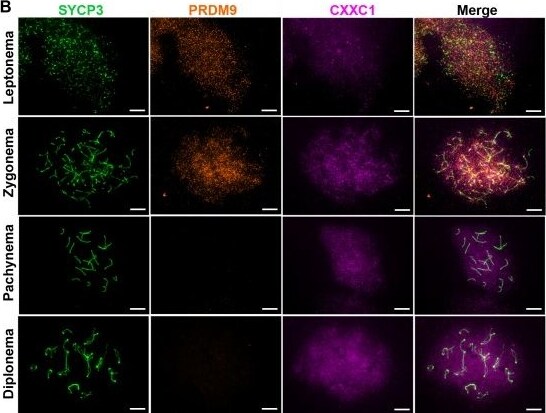
Immunocytochemistry/ Immunofluorescence: SCP3/SYCP3 Antibody [NB300-231] -
Immunocytochemistry/ Immunofluorescence: SCP3/SYCP3 Antibody [NB300-231] - CXXC1 is expressed in the spermatocytes in the presence or absence of PRDM9.(A) Immunofluorescence staining for CXXC1 & PRDM9 in adult B6, 14-dpp B6 & 14-dpp Prdm9-/- seminiferous tubule cross sections. Green, CXXC1; red, PRDM9; blue, DAPI. SC, Sertoli cell; Z, zygonema; P, pachynema; RS, round spermatid. Scale bars, first 4 columns: 50 μm, last column: 10 μm. (B) Immunofluorescence staining for CXXC1 & PRDM9 on chromosome spreads from adult B6. Green, SYCP3; orange, PRDM9; magenta, CXXC1. Scale bars, 10 μm. Image collected & cropped by CiteAb from the following publication (https://pubmed.ncbi.nlm.nih.gov/30365547), licensed under a CC-BY license. Not internally tested by Novus Biologicals.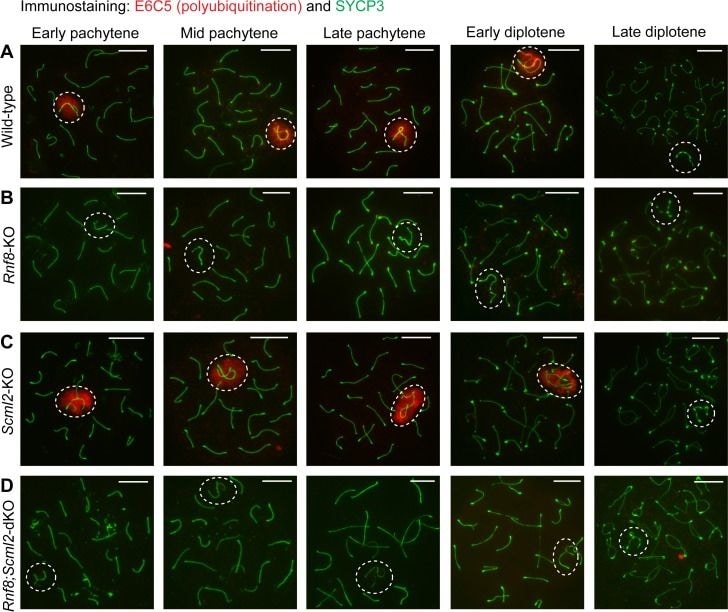
Immunocytochemistry/ Immunofluorescence: SCP3/SYCP3 Antibody [NB300-231] -
Immunocytochemistry/ Immunofluorescence: SCP3/SYCP3 Antibody [NB300-231] - RNF8 is required for polyubiquitination of the sex chromosomes: Immunostaining with E6C5 antibody, which recognizes polyubiquitination.(A-D) Immunostaining of SYCP3 & E6C5 on meiotic chromosome spreads. Dotted circles: sex chromosomes. Scale bar: 10 μm. Representative images are shown for at least 30 spermatocytes from each substage, from at least 3 independent mice per mouse model. (E) Schematic of ubiquitin targets recognized by the E6C5 antibody in each mouse model. Image collected & cropped by CiteAb from the following publication (https://dx.plos.org/10.1371/journal.pgen.1007233), licensed under a CC-BY license. Not internally tested by Novus Biologicals.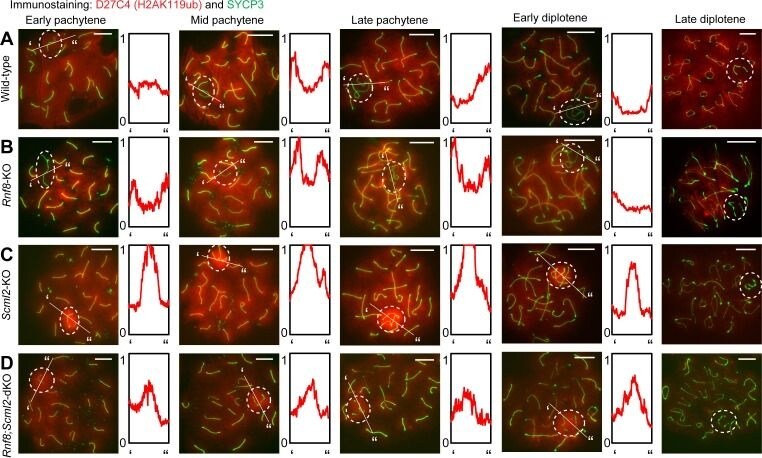
Immunocytochemistry/ Immunofluorescence: SCP3/SYCP3 Antibody [NB300-231] -
Immunocytochemistry/ Immunofluorescence: SCP3/SYCP3 Antibody [NB300-231] - RNF8-dependent H2AK119ub is removed by SCML2: Immunostaining with D27C4 antibody, which recognizes H2AK119ub.(A-D) Immunostaining of SYCP3 & D27C4 (H2AK119ub) on meiotic chromosome spreads. Dotted circles: sex chromosomes. Scale bar: 10 μm. Representative images are shown for at least 30 spermatocytes from each substage, from at least 3 independent mice per mouse model. The intensity of immunostaining is quantified by densitometry across the indicated path (‘ to”) & plotted in a relative intensity range of 0–1, which is normalized among all images in this figure, Fig 3 & S2 Fig. (E) Updated model of distinct forms of regulation of ubiquitination by RNF8 & SCML2, including RNF8-dependent H2AK119ub, which is removed by SCML2 based on data in this figure. (F) Schematic of ubiquitin targets recognized by the D27C4 (H2AK119ub) antibody in each mouse model. Image collected & cropped by CiteAb from the following publication (https://dx.plos.org/10.1371/journal.pgen.1007233), licensed under a CC-BY license. Not internally tested by Novus Biologicals.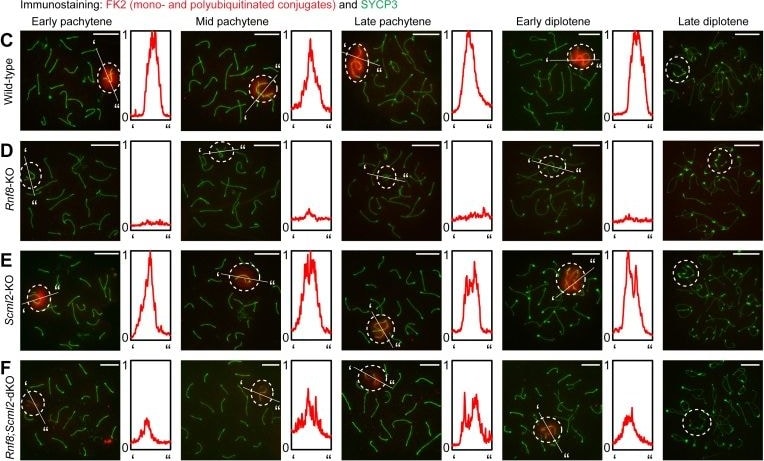
Immunocytochemistry/ Immunofluorescence: SCP3/SYCP3 Antibody [NB300-231] -
Immunocytochemistry/ Immunofluorescence: SCP3/SYCP3 Antibody [NB300-231] - Distinct forms of ubiquitin regulation by RNF8 & SCML2: Immunostaining with FK2 antibody, which recognizes both mono- & polyubiquitinated conjugates.(A) Schematic of spermatogenesis. (B) Model of distinct forms of regulation of ubiquitination by RNF8 & SCML2. (C-F) Immunostaining of SYCP3 & FK2 on meiotic chromosome spreads. Dotted circles: sex chromosomes. Scale bar: 10 μm. Representative images are shown for at least 30 spermatocytes from each substage, from at least 3 independent mice per mouse model. The intensity of immunostaining is quantified by densitometry across the indicated path (‘ to”) & plotted in a relative intensity range of 0–1, which is normalized among the samples at the same stage. (G) Schematic of ubiquitin targets recognized by the FK2 antibody in each mouse model. A pink circle denotes RNF8-dependent ubiquitination & an orange circle denotes events mediated by a different E3 ubiquitin ligase. Image collected & cropped by CiteAb from the following publication (https://dx.plos.org/10.1371/journal.pgen.1007233), licensed under a CC-BY license. Not internally tested by Novus Biologicals.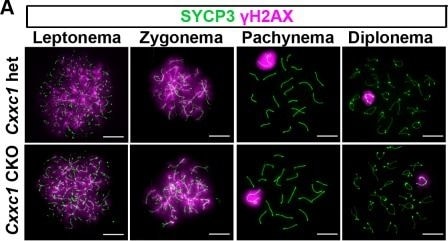
Immunocytochemistry/ Immunofluorescence: SCP3/SYCP3 Antibody [NB300-231] -
Immunocytochemistry/ Immunofluorescence: SCP3/SYCP3 Antibody [NB300-231] - No major meiotic DSB repair or chromosome synapsis defects are observed in Cxxc1 CKO testis.(A) Immunostaining of SYCP3 & gamma H2AX on adult Cxxc1 het & CKO chromosome spreads. Green, SYCP3; magenta, gamma H2AX. Scale bar, 10 μm. (B) Spermatocyte stage proportion in adult Cxxc1 het (n = 1,062 from two individuals) & CKO (n = 1,105 from two individuals) spermatocytes based on SYCP3/SYCP1/ gamma H2AX staining. p = 0.7 by Chi-square test. (C) Immunostaining of SYCP3 & SYCP1 on adult Cxxc1 het & CKO chromosome spreads. Green, SYCP3; orange, SYCP1. Scale bar, 10 μm. (D) Crossover number measured by MLH1 staining on chromosome spreads of adult Cxxc1 het & CKO spermatocytes. Left, magenta, SYCP3; green, MLH1. Scale bar, 10 μm. Right, number of MLH1 foci per late pachynema in Cxxc1 het (n = 32 from two individuals) & CKO (n = 33 from two individuals). Bars represent mean ± SD. p = 0.4 by Student’s t-test. Image collected & cropped by CiteAb from the following publication (https://pubmed.ncbi.nlm.nih.gov/30365547), licensed under a CC-BY license. Not internally tested by Novus Biologicals.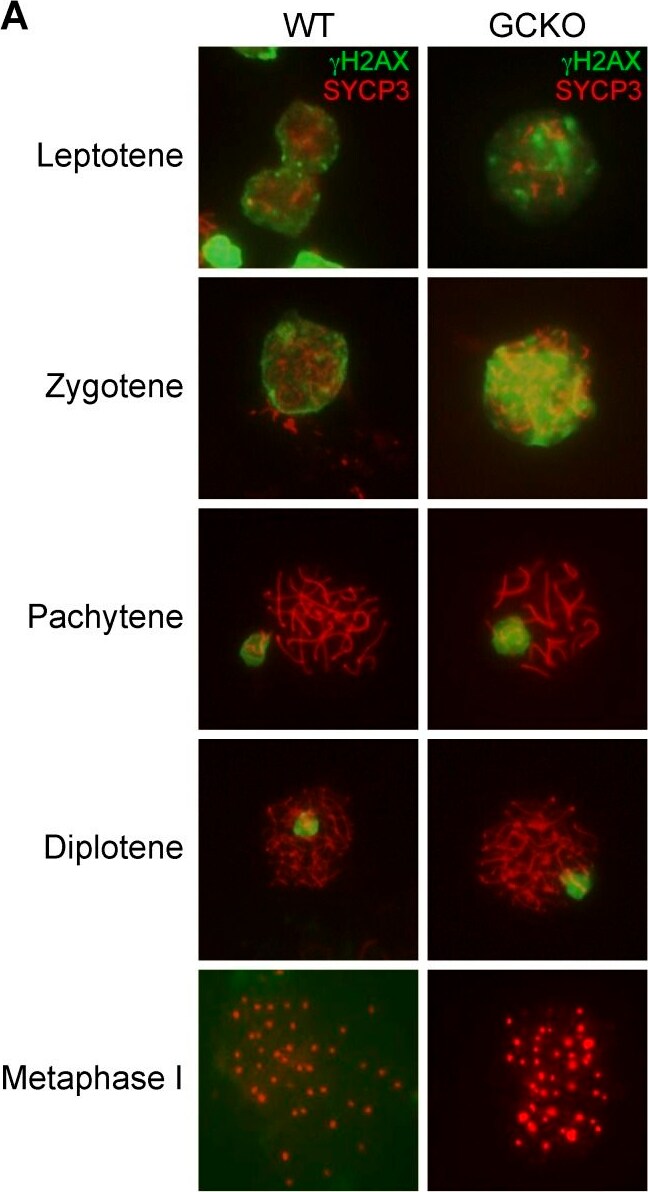
Immunocytochemistry/ Immunofluorescence: SCP3/SYCP3 Antibody [NB300-231] -
Immunocytochemistry/ Immunofluorescence: SCP3/SYCP3 Antibody [NB300-231] - Meiotic spreads show deletion of Dicer1 disrupts progression of meiosis I.(A) It was possible to identify the 5 sub-stages of meiosis I by combining the reactivity patterns of two antibodies against synaptonemal complex protein 3 (SYCP3) & gamma H2AX. SYCP3 is a protein essential for synapsis of homologous chromosomes & gamma H2AX localizes to double-strand breaks & XY bodies during meiosis. A total of 200 spreads were counted in testis cell preparations from WT & GCKO mice at P22. (B) Chi square analysis shows GCKO testes contained significantly higher numbers of germ cell spreads at the leptotene & zygotene stages of meiosis I & fewer spreads at pachytene, diplotene & metaphase I stages (P<0.001), suggesting that the loss of Dicer1 lead to disruptions in progression through meiosis I. Image collected & cropped by CiteAb from the following publication (https://pubmed.ncbi.nlm.nih.gov/23056286), licensed under a CC-BY license. Not internally tested by Novus Biologicals.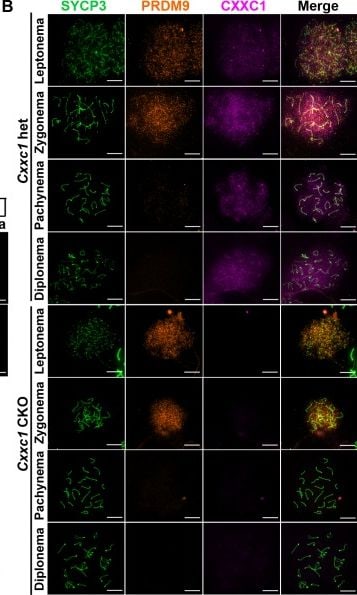
Immunocytochemistry/ Immunofluorescence: SCP3/SYCP3 Antibody [NB300-231] -
Immunocytochemistry/ Immunofluorescence: SCP3/SYCP3 Antibody [NB300-231] - PRDM9 expression & catalytic function are not impaired in Cxxc1 CKO.(A) Immunostaining of PRDM9 shows unchanged pattern in adult CKO seminiferous tubules compared to the heterozygous control. Red, PRDM9; grey, DAPI. Scale bar, 20 μm. (B) PRDM9 & SYCP3 expression patterns are not changed in CXXC1 CKO chromosome spreads compared to the heterozygous control. Co-immunostaining of CXXC1 & PRDM9 on chromosome spreads from adult Cxxc1 het & CKO mice. Green, SYCP3; orange, PRDM9; magenta, CXXC1. First 4 rows, het control; last 4 rows, Cxxc1 CKO. Scale bar, 10 μm. (C) Meiosis progression occurs normally in Cxxc1 CKO testes. Immunostaining of H3K4me3 in adult Cxxc1 het & CKO chromosome spreads. Green, SYCP3; magenta, H3K4me3. Scale bar, 10 μm. (D) Testis-specific gene expression is not changed in Cxxc1 CKO testes. H3K4me3 ChIP-qPCR with chromatin isolated form Cxxc1 het & CKO mice. Promoter regions form Actinb & Sycp3, Dom2 hotspots PbxI & Fcgr4 were amplified. Cst hotspot HlxI was used as a negative control. Bars present mean ± SD of three biological replicates. Image collected & cropped by CiteAb from the following publication (https://pubmed.ncbi.nlm.nih.gov/30365547), licensed under a CC-BY license. Not internally tested by Novus Biologicals.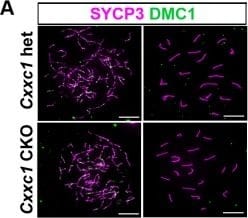
Immunocytochemistry/ Immunofluorescence: SCP3/SYCP3 Antibody [NB300-231] -
Immunocytochemistry/ Immunofluorescence: SCP3/SYCP3 Antibody [NB300-231] - DSB number is not affected in Cxxc1 CKO.The DSB number was determined by three markers reflecting different stages of their processing. (A) DMC1 staining on Cxxc1 control & CKO chromosome spread. Bottom panels, distribution plot of DMC1 foci in early zygotene (n = 22 in het, n = 34 in CKO), late zygotene (n = 29 in het, n = 36 in CKO) & pachytene (n = 36 in het, n = 26 in CKO) spermatocytes. (B) RAD51 staining on Cxxc1 control & CKO chromosome spread. Bottom panels, distribution plot of RAD51 foci in early zygotene (n = 22 in het, n = 13 in CKO), late zygotene (n = 24 in het, n = 11 in CKO) & pachytene (n = 52 in het, n = 36 in CKO) spermatocytes. (C) RPA staining on Cxxc1 control & CKO chromosome spread. Bottom panels, distribution plot of RPA foci in early zygotene (n = 35 in het, n = 43 in CKO), late zygotene (n = 33 in het, n = 28 in CKO) & pachytene (n = 89 in het, n = 92 in CKO) spermatocytes. For A-C, two individuals per genotype were measured. Bars represent mean ± SD. Scale bar, 10 μm. Image collected & cropped by CiteAb from the following publication (https://pubmed.ncbi.nlm.nih.gov/30365547), licensed under a CC-BY license. Not internally tested by Novus Biologicals.Applications for SCP3/SYCP3 Antibody - BSA Free
Immunocytochemistry/ Immunofluorescence
Immunohistochemistry
Immunohistochemistry-Paraffin
Immunoprecipitation
Formulation, Preparation, and Storage
Purification
Formulation
Format
Preservative
Concentration
Shipping
Stability & Storage
Background: SCP3/SYCP3
Long Name
Alternate Names
Gene Symbol
Additional SCP3/SYCP3 Products
Product Documents for SCP3/SYCP3 Antibody - BSA Free
Certificate of Analysis
To download a Certificate of Analysis, please enter a lot or batch number in the search box below.
Product Specific Notices for SCP3/SYCP3 Antibody - BSA Free
This product is for research use only and is not approved for use in humans or in clinical diagnosis. Primary Antibodies are guaranteed for 1 year from date of receipt.
Citations for SCP3/SYCP3 Antibody - BSA Free
 Powered by Bioz
Customer Reviews for SCP3/SYCP3 Antibody - BSA Free
There are currently no reviews for this product. Be the first to review SCP3/SYCP3 Antibody - BSA Free and earn rewards!
Have you used SCP3/SYCP3 Antibody - BSA Free?
Submit a review and receive an Amazon gift card!
$25/€18/£15/$25CAN/¥2500 for a review with an image
$10/€7/£6/$10CAN/¥1110 for a review without an image
Submit a review
Protocols
View specific protocols for SCP3/SYCP3 Antibody - BSA Free (NB300-231):
Immunofluorescence Procedure
1. Freshly prepared slides are soaked in 1X ADB for 75 minutes.
2. Primary antibodies are added concurrently (SCP3 and CDK2).
3. The primary antibodies are incubated overnight in a humid chamber (37 degrees Celsius).
4. The slides are washed for 40 minutes in 1X ADB.
5. The slides are detected with the appropriate secondary antibodies (RDAR for SCP1 and FDAM for CDK2).
6. The slides are incubated for 4 hours in a humid chamber (37 degrees Celsius).
7. The slides are washed for 20 minutes in 1X ADB, followed by 3 washes, 10 minutes each, in 1X PBS.
8. The slides are counterstained with DAPI.
9. Images are captured after allowing the slides to remain in the dark overnight at RT.
Find general support by application which include: protocols, troubleshooting, illustrated assays, videos and webinars.
- Antigen Retrieval Protocol (PIER)
- Antigen Retrieval for Frozen Sections Protocol
- Appropriate Fixation of IHC/ICC Samples
- Cellular Response to Hypoxia Protocols
- Chromogenic IHC Staining of Formalin-Fixed Paraffin-Embedded (FFPE) Tissue Protocol
- Chromogenic Immunohistochemistry Staining of Frozen Tissue
- ClariTSA™ Fluorophore Kits
- Detection & Visualization of Antibody Binding
- Fluorescent IHC Staining of Frozen Tissue Protocol
- Graphic Protocol for Heat-induced Epitope Retrieval
- Graphic Protocol for the Preparation and Fluorescent IHC Staining of Frozen Tissue Sections
- Graphic Protocol for the Preparation and Fluorescent IHC Staining of Paraffin-embedded Tissue Sections
- Graphic Protocol for the Preparation of Gelatin-coated Slides for Histological Tissue Sections
- ICC Cell Smear Protocol for Suspension Cells
- ICC Immunocytochemistry Protocol Videos
- ICC for Adherent Cells
- IHC Sample Preparation (Frozen sections vs Paraffin)
- Immunocytochemistry (ICC) Protocol
- Immunocytochemistry Troubleshooting
- Immunofluorescence of Organoids Embedded in Cultrex Basement Membrane Extract
- Immunofluorescent IHC Staining of Formalin-Fixed Paraffin-Embedded (FFPE) Tissue Protocol
- Immunohistochemistry (IHC) and Immunocytochemistry (ICC) Protocols
- Immunohistochemistry Frozen Troubleshooting
- Immunohistochemistry Paraffin Troubleshooting
- Immunoprecipitation Protocol
- Preparing Samples for IHC/ICC Experiments
- Preventing Non-Specific Staining (Non-Specific Binding)
- Primary Antibody Selection & Optimization
- Protocol for Heat-Induced Epitope Retrieval (HIER)
- Protocol for Making a 4% Formaldehyde Solution in PBS
- Protocol for VisUCyte™ HRP Polymer Detection Reagent
- Protocol for the Fluorescent ICC Staining of Cell Smears - Graphic
- Protocol for the Fluorescent ICC Staining of Cultured Cells on Coverslips - Graphic
- Protocol for the Preparation & Fixation of Cells on Coverslips
- Protocol for the Preparation and Chromogenic IHC Staining of Frozen Tissue Sections
- Protocol for the Preparation and Chromogenic IHC Staining of Frozen Tissue Sections - Graphic
- Protocol for the Preparation and Chromogenic IHC Staining of Paraffin-embedded Tissue Sections
- Protocol for the Preparation and Chromogenic IHC Staining of Paraffin-embedded Tissue Sections - Graphic
- Protocol for the Preparation and Fluorescent ICC Staining of Cells on Coverslips
- Protocol for the Preparation and Fluorescent ICC Staining of Non-adherent Cells
- Protocol for the Preparation and Fluorescent ICC Staining of Stem Cells on Coverslips
- Protocol for the Preparation and Fluorescent IHC Staining of Frozen Tissue Sections
- Protocol for the Preparation and Fluorescent IHC Staining of Paraffin-embedded Tissue Sections
- Protocol for the Preparation of Gelatin-coated Slides for Histological Tissue Sections
- Protocol for the Preparation of a Cell Smear for Non-adherent Cell ICC - Graphic
- R&D Systems Quality Control Western Blot Protocol
- TUNEL and Active Caspase-3 Detection by IHC/ICC Protocol
- The Importance of IHC/ICC Controls
- Troubleshooting Guide: Immunohistochemistry
- Troubleshooting Guide: Western Blot Figures
- Western Blot Conditions
- Western Blot Protocol
- Western Blot Protocol for Cell Lysates
- Western Blot Troubleshooting
- Western Blot Troubleshooting Guide
- View all Protocols, Troubleshooting, Illustrated assays and Webinars
FAQs for SCP3/SYCP3 Antibody - BSA Free
-
Q: What Antigen Retrieval Methods do you use to do the Immunohistochemistry using NB300-231? What dilution do you used to stain the murine SCP3 in mouse ovary ?
A: This antibody was used at a dilution of 1:750 to stain the murine SCP3 protein in mouse ovary. Our lab most commonly uses HIER for antigen retrieval, please see this link, Antigen Retrieval Protocol.