
SIX2 Antibody (3D7) - Azide and BSA Free
Novus Biologicals | Catalog # H00010736-M01

![Western Blot: SIX2 Antibody (3D7) [H00010736-M01]](https://resources.rndsystems.com/images/products/SIX2-Antibody-3D7-Western-Blot-H00010736-M01-img0008.jpg "Western Blot: SIX2 Antibody (3D7) [H00010736-M01]")
Scientific images may be resized, cropped, or adjusted for brightness or contrast for presentation purposes. These updates are limited to presentation and do not affect the underlying scientific interpretation of the data. Where available, additional source data may be provided upon request.
Key Product Details
Species Reactivity
Validated:
Cited:
Applications
Validated:
Cited:
Label
Antibody Source
Format
Product Specifications
Immunogen
Reactivity Notes
Specificity
Clonality
Host
Isotype
Scientific Data Images for SIX2 Antibody (3D7) - Azide and BSA Free
Western Blot: SIX2 Antibody (3D7) [H00010736-M01]
Western Blot: SIX2 Antibody (3D7) [H00010736-M01] - Analysis of SIX2 expression in transfected 293T cell line by SIX2 monoclonal antibody (M01), clone 3D7.Lane 1: SIX2 transfected lysate(32.3 KDa).Lane 2: Non-transfected lysate.![Immunocytochemistry/ Immunofluorescence: SIX2 Antibody (3D7) [H00010736-M01]](https://resources.rndsystems.com/images/products/SIX2-Antibody-3D7-Immunocytochemistry-Immunofluorescence-H00010736-M01-img0010.jpg "Immunocytochemistry/ Immunofluorescence: SIX2 Antibody (3D7) [H00010736-M01]")
Immunocytochemistry/ Immunofluorescence: SIX2 Antibody (3D7) [H00010736-M01]
SIX2-Antibody-3D7-Immunocytochemistry-Immunofluorescence-H00010736-M01-img0010.jpg![Western Blot: SIX2 Antibody (3D7) [H00010736-M01]](https://resources.rndsystems.com/images/products/SIX2-Antibody-3D7-Western-Blot-H00010736-M01-img0006.jpg "Western Blot: SIX2 Antibody (3D7) [H00010736-M01]")
Western Blot: SIX2 Antibody (3D7) [H00010736-M01]
Western Blot: SIX2 Antibody (3D7) [H00010736-M01] - Analysis of SIX2 over-expressed 293 cell line, cotransfected with SIX2 Validated Chimera RNAi ( Cat # H00010736-R01V ) (Lane 2) or non-transfected control (Lane 1). Blot probed with SIX2 monoclonal antibody (M01), clone 3D7 (Cat # H00010736-M01 ). GAPDH ( 36.1 kDa ) used as specificity and loading control.![Immunocytochemistry/ Immunofluorescence: SIX2 Antibody (3D7) [H00010736-M01]](https://resources.rndsystems.com/images/products/SIX2-Antibody-3D7-Immunocytochemistry-Immunofluorescence-H00010736-M01-img0011.jpg "Immunocytochemistry/ Immunofluorescence: SIX2 Antibody (3D7) [H00010736-M01]")
Immunocytochemistry/ Immunofluorescence: SIX2 Antibody (3D7) [H00010736-M01]
SIX2-Antibody-3D7-Immunocytochemistry-Immunofluorescence-H00010736-M01-img0011.jpg![ELISA: SIX2 Antibody (3D7) [H00010736-M01]](https://resources.rndsystems.com/images/products/SIX2-Antibody-3D7-ELISA-H00010736-M01-img0009.jpg "ELISA: SIX2 Antibody (3D7) [H00010736-M01]")
ELISA: SIX2 Antibody (3D7) [H00010736-M01]
ELISA: SIX2 Antibody (3D7) [H00010736-M01] - Detection limit for recombinant GST tagged SIX2 is 0.03 ng/ml as a capture antibody.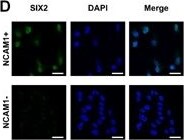
Immunocytochemistry/ Immunofluorescence: SIX2 Antibody (3D7) [H00010736-M01] -
Immunocytochemistry/ Immunofluorescence: SIX2 Antibody (3D7) [H00010736-M01] - Characterization of immunosorted NCAM1+ subpopulationA. RT-PCR analysis of gene expression in NCAM1 cell fractions. GAPDH was used as endogenous control & NCAM1− cell were used as the calibrator sample for RQ calculation (therefore = 1). Data were analysed using SDS 3.2 software & presented as average RQ ± SDEV of three replicates. ***p < 0.001, *p < 0.05 versus NCAM1−.B–D. Immunofluorescence staining of NCAM1+ & NCAM1− subpopulations for E-cadherin (E-cad) (B, red) vimentin (C, green) & SIX2 (D, green). Nuclei stained with Dapi (blue). (B–C) Images were obtained using Olympus DP72 camera attached to Olympus BX51 fluorescence microscope & processed via cellSens standard software, bar represents 200 μm. (D) Images were obtained using Zeiss LSM 510 confocal microscope, bar represents 50 μm.E. Fluorescent quantification of SIX2 immunostaining as represented in (D).F. Double labelling of sorted NCAM1+ cells for NCAM1 & SIX2: NCAM1 with DAPI (upper panel; red & blue channels), NCAM1 with SIX2 (lower panel; red & green channels), indicating both NCAM1+ SIX2+ (arrows) & NCAM1+ SIX2− (arrowheads) cells.G. Graph represents percentage of NCAM1+ SIX2+ cells & NCAM1+ SIX2− cells.H. Clonogenic efficiency of NCAM1+ cells sorted from hFK & cultured in SFM. Data are presented as average CE(%) ± SDEV. **p < 0.01 versus NCAM1−.I. Representative morphology of NCAM1+ & NCAM1− clones. Cells were observed using a Nikon Digital Sight camera attached to a Nikon Eclipse TS100 microscope.J. Clonogenic capacity of hFK cells treated with IMGN901(ADC 55 nM), huN901 (Ab55 nM) or not treated (control). Data are presented as average CE(%) ± SDEV. ***p < 0.001, *p < 0.05 versus control group. Image collected & cropped by CiteAb from the following publication (https://pubmed.ncbi.nlm.nih.gov/23996934), licensed under a CC-BY license. Not internally tested by Novus Biologicals.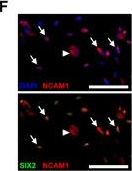
Immunocytochemistry/ Immunofluorescence: SIX2 Antibody (3D7) [H00010736-M01] -
Immunocytochemistry/ Immunofluorescence: SIX2 Antibody (3D7) [H00010736-M01] - Characterization of immunosorted NCAM1+ subpopulationA. RT-PCR analysis of gene expression in NCAM1 cell fractions. GAPDH was used as endogenous control & NCAM1− cell were used as the calibrator sample for RQ calculation (therefore = 1). Data were analysed using SDS 3.2 software & presented as average RQ ± SDEV of three replicates. ***p < 0.001, *p < 0.05 versus NCAM1−.B–D. Immunofluorescence staining of NCAM1+ & NCAM1− subpopulations for E-cadherin (E-cad) (B, red) vimentin (C, green) & SIX2 (D, green). Nuclei stained with Dapi (blue). (B–C) Images were obtained using Olympus DP72 camera attached to Olympus BX51 fluorescence microscope & processed via cellSens standard software, bar represents 200 μm. (D) Images were obtained using Zeiss LSM 510 confocal microscope, bar represents 50 μm.E. Fluorescent quantification of SIX2 immunostaining as represented in (D).F. Double labelling of sorted NCAM1+ cells for NCAM1 & SIX2: NCAM1 with DAPI (upper panel; red & blue channels), NCAM1 with SIX2 (lower panel; red & green channels), indicating both NCAM1+ SIX2+ (arrows) & NCAM1+ SIX2− (arrowheads) cells.G. Graph represents percentage of NCAM1+ SIX2+ cells & NCAM1+ SIX2− cells.H. Clonogenic efficiency of NCAM1+ cells sorted from hFK & cultured in SFM. Data are presented as average CE(%) ± SDEV. **p < 0.01 versus NCAM1−.I. Representative morphology of NCAM1+ & NCAM1− clones. Cells were observed using a Nikon Digital Sight camera attached to a Nikon Eclipse TS100 microscope.J. Clonogenic capacity of hFK cells treated with IMGN901(ADC 55 nM), huN901 (Ab55 nM) or not treated (control). Data are presented as average CE(%) ± SDEV. ***p < 0.001, *p < 0.05 versus control group. Image collected & cropped by CiteAb from the following publication (https://pubmed.ncbi.nlm.nih.gov/23996934), licensed under a CC-BY license. Not internally tested by Novus Biologicals.
Immunocytochemistry/ Immunofluorescence: SIX2 Antibody (3D7) [H00010736-M01] -
Immunocytochemistry/ Immunofluorescence: SIX2 Antibody (3D7) [H00010736-M01] - NCAM1 expression in mouse embryonic kidney organ & hFK serum-free culturesMouse embryonic kidney organ culture stained for Ncam1, Six2 & E-cad as indicated. An enlargement of the Ncam/Six2 signal is shown to emphasize the nuclear localization of Six2. White arrow illustrates the absence of Six2 signal in E-cad positive cells. An occurrence of Six2/E-cad positive cells is indicated with the asterisk. Images were obtained using Nikon A1R confocal microscope with & processed in ImageJ/Fiji software.Morphology of hFK cells cultured in SFM or SCM after 3 days (passage 0 Day 3—left panels) & towards confluence (14 days in SFM or 7 days in SCM—right panels). Distinct borders appear in SFM cultures (arrows) whereas cells with different morphology (arrows) are observed in SCM culture. Cells were observed using a Nikon Digital Sight camera attached to a Nikon Eclipse TS100 microscope.qRT-PCR analysis of gene expression in hFK cells cultured in SFM (three independent replicates). hPRT1 was used as endogenous control & SCM cells were used as the calibrator sample for RQ calculation (therefore = 1). Data were analysed using SDS 3.2 software.Representative FACS analysis of NCAM1 expression in hFK cells cultured in SFM at passage1. Data is presented in a histogram graph showing NCAM1 staining in blue & the isotype controls staining (negative control) in red.Immunofluorescence staining of NCAM1 (red) in total hFK cells cultured in SFM. Nuclei stained with Dapi (blue). Images were obtained using Olympus DP72 camera attached to Olympus BX51 fluorescence microscope & processed via cellSens standard software. Image collected & cropped by CiteAb from the following publication (https://pubmed.ncbi.nlm.nih.gov/23996934), licensed under a CC-BY license. Not internally tested by Novus Biologicals.Applications for SIX2 Antibody (3D7) - Azide and BSA Free
ELISA
Western Blot
Flow Cytometry Panel Builder
Bio-Techne Knows Flow Cytometry
Save time and reduce costly mistakes by quickly finding compatible reagents using the Panel Builder Tool.
Advanced Features
- Spectra Viewer - Custom analysis of spectra from multiple fluorochromes
- Spillover Popups - Visualize the spectra of individual fluorochromes
- Antigen Density Selector - Match fluorochrome brightness with antigen density

Formulation, Preparation, and Storage
Purification
Formulation
Format
Preservative
Concentration
Shipping
Stability & Storage
Background: SIX2
Alternate Names
Entrez Gene IDs
Gene Symbol
OMIM
UniProt
Additional SIX2 Products
Product Documents for SIX2 Antibody (3D7) - Azide and BSA Free
Certificate of Analysis
To download a Certificate of Analysis, please enter a lot or batch number in the search box below.
Product Specific Notices for SIX2 Antibody (3D7) - Azide and BSA Free
This product is produced by and distributed for Abnova, a company based in Taiwan.
This product is for research use only and is not approved for use in humans or in clinical diagnosis. Primary Antibodies are guaranteed for 1 year from date of receipt.
Citations for SIX2 Antibody (3D7) - Azide and BSA Free
 Powered by Bioz
Customer Reviews for SIX2 Antibody (3D7) - Azide and BSA Free
There are currently no reviews for this product. Be the first to review SIX2 Antibody (3D7) - Azide and BSA Free and earn rewards!
Have you used SIX2 Antibody (3D7) - Azide and BSA Free?
Submit a review and receive an Amazon gift card!
$25/€18/£15/$25CAN/¥2500 for a review with an image
$10/€7/£6/$10CAN/¥1110 for a review without an image
Submit a review
Protocols
Find general support by application which include: protocols, troubleshooting, illustrated assays, videos and webinars.
- 7-Amino Actinomycin D (7-AAD) Cell Viability Flow Cytometry Protocol
- Antigen Retrieval Protocol (PIER)
- Antigen Retrieval for Frozen Sections Protocol
- Appropriate Fixation of IHC/ICC Samples
- Cellular Response to Hypoxia Protocols
- Chromogenic IHC Staining of Formalin-Fixed Paraffin-Embedded (FFPE) Tissue Protocol
- Chromogenic Immunohistochemistry Staining of Frozen Tissue
- ClariTSA™ Fluorophore Kits
- Detection & Visualization of Antibody Binding
- ELISA Sample Preparation & Collection Guide
- ELISA Troubleshooting Guide
- Extracellular Membrane Flow Cytometry Protocol
- Flow Cytometry Protocol for Cell Surface Markers
- Flow Cytometry Protocol for Staining Membrane Associated Proteins
- Flow Cytometry Staining Protocols
- Flow Cytometry Troubleshooting Guide
- Fluorescent IHC Staining of Frozen Tissue Protocol
- Graphic Protocol for Heat-induced Epitope Retrieval
- Graphic Protocol for the Preparation and Fluorescent IHC Staining of Frozen Tissue Sections
- Graphic Protocol for the Preparation and Fluorescent IHC Staining of Paraffin-embedded Tissue Sections
- Graphic Protocol for the Preparation of Gelatin-coated Slides for Histological Tissue Sections
- How to Run an R&D Systems DuoSet ELISA
- How to Run an R&D Systems Quantikine ELISA
- How to Run an R&D Systems Quantikine™ QuicKit™ ELISA
- ICC Cell Smear Protocol for Suspension Cells
- ICC Immunocytochemistry Protocol Videos
- ICC for Adherent Cells
- IHC Sample Preparation (Frozen sections vs Paraffin)
- Immunocytochemistry (ICC) Protocol
- Immunocytochemistry Troubleshooting
- Immunofluorescence of Organoids Embedded in Cultrex Basement Membrane Extract
- Immunofluorescent IHC Staining of Formalin-Fixed Paraffin-Embedded (FFPE) Tissue Protocol
- Immunohistochemistry (IHC) and Immunocytochemistry (ICC) Protocols
- Immunohistochemistry Frozen Troubleshooting
- Immunohistochemistry Paraffin Troubleshooting
- Intracellular Flow Cytometry Protocol Using Alcohol (Methanol)
- Intracellular Flow Cytometry Protocol Using Detergents
- Intracellular Nuclear Staining Flow Cytometry Protocol Using Detergents
- Intracellular Staining Flow Cytometry Protocol Using Alcohol Permeabilization
- Intracellular Staining Flow Cytometry Protocol Using Detergents to Permeabilize Cells
- Preparing Samples for IHC/ICC Experiments
- Preventing Non-Specific Staining (Non-Specific Binding)
- Primary Antibody Selection & Optimization
- Propidium Iodide Cell Viability Flow Cytometry Protocol
- Protocol for Heat-Induced Epitope Retrieval (HIER)
- Protocol for Liperfluo
- Protocol for Making a 4% Formaldehyde Solution in PBS
- Protocol for VisUCyte™ HRP Polymer Detection Reagent
- Protocol for the Characterization of Human Th22 Cells
- Protocol for the Characterization of Human Th9 Cells
- Protocol for the Fluorescent ICC Staining of Cell Smears - Graphic
- Protocol for the Fluorescent ICC Staining of Cultured Cells on Coverslips - Graphic
- Protocol for the Preparation & Fixation of Cells on Coverslips
- Protocol for the Preparation and Chromogenic IHC Staining of Frozen Tissue Sections
- Protocol for the Preparation and Chromogenic IHC Staining of Frozen Tissue Sections - Graphic
- Protocol for the Preparation and Chromogenic IHC Staining of Paraffin-embedded Tissue Sections
- Protocol for the Preparation and Chromogenic IHC Staining of Paraffin-embedded Tissue Sections - Graphic
- Protocol for the Preparation and Fluorescent ICC Staining of Cells on Coverslips
- Protocol for the Preparation and Fluorescent ICC Staining of Non-adherent Cells
- Protocol for the Preparation and Fluorescent ICC Staining of Stem Cells on Coverslips
- Protocol for the Preparation and Fluorescent IHC Staining of Frozen Tissue Sections
- Protocol for the Preparation and Fluorescent IHC Staining of Paraffin-embedded Tissue Sections
- Protocol for the Preparation of Gelatin-coated Slides for Histological Tissue Sections
- Protocol for the Preparation of a Cell Smear for Non-adherent Cell ICC - Graphic
- Protocol: Annexin V and PI Staining by Flow Cytometry
- Protocol: Annexin V and PI Staining for Apoptosis by Flow Cytometry
- Quantikine HS ELISA Kit Assay Principle, Alkaline Phosphatase
- Quantikine HS ELISA Kit Principle, Streptavidin-HRP Polymer
- R&D Systems Quality Control Western Blot Protocol
- Sandwich ELISA (Colorimetric) – Biotin/Streptavidin Detection Protocol
- Sandwich ELISA (Colorimetric) – Direct Detection Protocol
- TUNEL and Active Caspase-3 Detection by IHC/ICC Protocol
- The Importance of IHC/ICC Controls
- Troubleshooting Guide: ELISA
- Troubleshooting Guide: Fluorokine Flow Cytometry Kits
- Troubleshooting Guide: Immunohistochemistry
- Troubleshooting Guide: Western Blot Figures
- Western Blot Conditions
- Western Blot Protocol
- Western Blot Protocol for Cell Lysates
- Western Blot Troubleshooting
- Western Blot Troubleshooting Guide
- View all Protocols, Troubleshooting, Illustrated assays and Webinars