
STEP Antibody (23E5) - BSA Free
Novus Biologicals | Catalog # NB300-202

![Western Blot: STEP Antibody (23E5) [NB300-202]](https://resources.rndsystems.com/images/products/STEP-Antibody-23E5-Western-Blot-NB300-202-img0002.jpg "Western Blot: STEP Antibody (23E5) [NB300-202]")
Scientific images may be resized, cropped, or adjusted for brightness or contrast for presentation purposes. These updates are limited to presentation and do not affect the underlying scientific interpretation of the data. Where available, additional source data may be provided upon request.
Key Product Details
Species Reactivity
Validated:
Cited:
Applications
Validated:
Cited:
Label
Antibody Source
Format
Product Specifications
Immunogen
Localization
Specificity
Clonality
Host
Isotype
Scientific Data Images for STEP Antibody (23E5) - BSA Free
Western Blot: STEP Antibody (23E5) [NB300-202]
Western Blot: STEP Antibody (23E5) [NB300-202] - Analysis of STEP protein in striatal rat protein homogenates![Immunohistochemistry-Paraffin: STEP Antibody (23E5) [NB300-202]](https://resources.rndsystems.com/images/products/STEP-Antibody-23E5-Immunohistochemistry-Paraffin-NB300-202-img0003.jpg "Immunohistochemistry-Paraffin: STEP Antibody (23E5) [NB300-202]")
Immunohistochemistry-Paraffin: STEP Antibody (23E5) [NB300-202]
Immunohistochemistry-Paraffin: STEP Antibody (23E5) [NB300-202] - STEP was detected in immersion fixed paraffin-embedded sections of human brain basal ganglia using Mouse Anti-Human STEP (23E5) Monoclonal Antibody (Catalog # NB300-202) at 1:100 for 1 hour at room temperature followed by incubation with the Anti-Mouse IgG VisUCyte™ HRP Polymer Antibody (Catalog # VC001). Tissue was stained using DAB (brown) and counterstained with hematoxylin (blue). Specific staining was localized to the cytoplasm in neurons.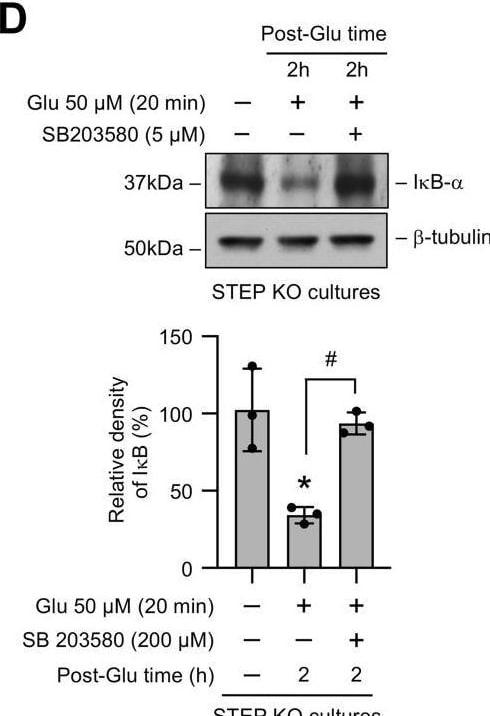
Western Blot: STEP Antibody (23E5) - BSA Free [NB300-202] -
Role of NF-kappa B in glutamate-induced increase in the COX-2 protein level in STEP-deficient neurons.A and B, neuronal cultures from (A) WT and (B) STEP KO mice were treated with 50 μM glutamate (Glu) for 20 min and then maintained in their original medium for the specified times (post-Glu time). C–F, neuronal cultures from STEP KO mice were treated with 50 μM glutamate (Glu) for 20 min followed by recovery (post-Glu time) in the absence and presence of (C) MK801 (5 μM), (D) SB 203580 (5 μM), or (E and F) Bengamide B (500 nM). Equal amounts of protein from each sample were analyzed by immunoblotting using (A–D) anti-I kappa B alpha (top) and anti-beta -tubulin (bottom) antibodies, or (E) anti-COX-2 (top) and anti-beta -tubulin (bottom) antibodies. Corresponding bar diagrams represents quantitative analysis of (A–D) I kappa B alpha or (E) COX-2 protein levels as the mean +/- SD. F, equal amounts of culture media from each sample were analyzed for PGE2 level using ELISA. Statistical analysis has been performed using ANOVA with Tukey’s post hoc test. Values are expressed as the mean +/- SD (n = 3–4). ∗p < 0.01 and ∗∗p < 0.001 compared with the untreated control and #p < 0.01 from 2 h postglutamate time. COX-2, cyclooxygenase-2; I kappa B, inhibitor of nuclear factor-kappa B; STEP, striatal-enriched phosphatase. Image collected and cropped by CiteAb from the following open publication (https://pubmed.ncbi.nlm.nih.gov/34246631), licensed under a CC-BY license. Not internally tested by Novus Biologicals.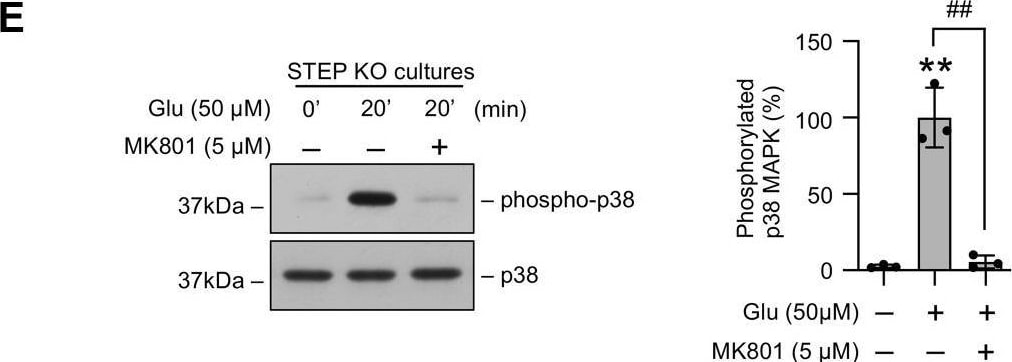
Western Blot: STEP Antibody (23E5) - BSA Free [NB300-202] -
Glutamate induces sustained p38 MAPK phosphorylation in STEP-deficient neurons. Neuronal cultures from (A and C) WT and (B and D) and STEP KO mice were treated with 50 μM glutamate (Glu) or 50 μM NMDA for the specified times. A–D, equal amounts of protein from each sample were analyzed by immunoblot analysis using anti-phospho-p38 (top), anti-p38 (middle), and anti-STEP (bottom) antibodies. E, neuronal cultures from STEP KO mice were treated with glutamate (50 μM) for 20 min in the absence or presence of MK801 (5 μM). Protein extracts were analyzed by immunoblotting with anti-phospho-p38 (top) and anti-p38 (bottom) antibodies. Corresponding bar diagrams represent quantitative analysis of p38 MAPK phosphorylation as the mean +/- SD (n = 3). ∗p < 0.01 and ∗∗p < 0.001 compared with the untreated control. Statistical analysis has been performed using ANOVA with Tukey’s post hoc test. #p < 0.001 and ##p < 0.0001 from 5 min glutamate treatment. NMDA, N-methyl-D-aspartic acid; p38 MAPK, p38 mitogen-activated protein kinase; STEP, striatal-enriched phosphatase. Image collected and cropped by CiteAb from the following open publication (https://pubmed.ncbi.nlm.nih.gov/34246631), licensed under a CC-BY license. Not internally tested by Novus Biologicals.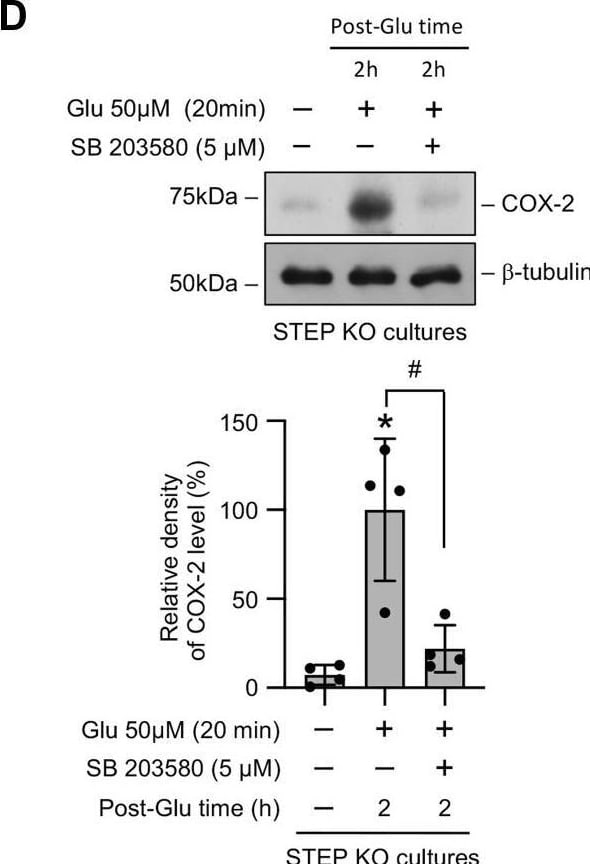
Western Blot: STEP Antibody (23E5) - BSA Free [NB300-202] -
Role of the NMDAR and p38 MAPK in glutamate-induced increase in the COX-2 protein level in STEP-deficient neurons. Neuronal cultures from (A) WT and (B) STEP KO mice were treated with 50 μM glutamate (Glu) for 20 min and then maintained in their original medium for the specified times (post-Glu time). C and D, neuronal cultures from STEP KO mice were treated with 50 μM glutamate (Glu) for 20 min followed by recovery (post-Glu time) in the absence and presence of (C) MK801 (5 μM) or (D) SB 203580 (5 μM). Equal amounts of protein from each sample were analyzed by immunoblotting using anti-COX-2 (top) and anti-beta -tubulin (bottom) antibodies. Corresponding bar diagrams represents quantitative analysis of COX-2 protein level as the mean +/- SD (n = 3–4). Statistical analysis has been performed using ANOVA with Tukey’s post hoc test. ∗p < 0.001 and ∗∗p < 0.0001 compared with untreated control and #p < 0.01 and ##p < 0.001 from 2 h postglutamate time. COX-2, cyclooxygenase-2; p38 MAPK, p38 mitogen-activated protein kinase; STEP, striatal-enriched phosphatase. Image collected and cropped by CiteAb from the following open publication (https://pubmed.ncbi.nlm.nih.gov/34246631), licensed under a CC-BY license. Not internally tested by Novus Biologicals.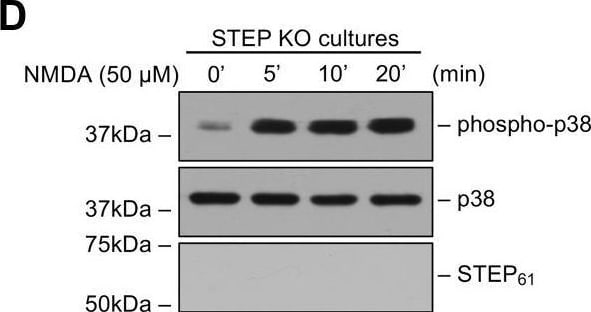
Western Blot: STEP Antibody (23E5) - BSA Free [NB300-202] -
Glutamate induces sustained p38 MAPK phosphorylation in STEP-deficient neurons. Neuronal cultures from (A and C) WT and (B and D) and STEP KO mice were treated with 50 μM glutamate (Glu) or 50 μM NMDA for the specified times. A–D, equal amounts of protein from each sample were analyzed by immunoblot analysis using anti-phospho-p38 (top), anti-p38 (middle), and anti-STEP (bottom) antibodies. E, neuronal cultures from STEP KO mice were treated with glutamate (50 μM) for 20 min in the absence or presence of MK801 (5 μM). Protein extracts were analyzed by immunoblotting with anti-phospho-p38 (top) and anti-p38 (bottom) antibodies. Corresponding bar diagrams represent quantitative analysis of p38 MAPK phosphorylation as the mean +/- SD (n = 3). ∗p < 0.01 and ∗∗p < 0.001 compared with the untreated control. Statistical analysis has been performed using ANOVA with Tukey’s post hoc test. #p < 0.001 and ##p < 0.0001 from 5 min glutamate treatment. NMDA, N-methyl-D-aspartic acid; p38 MAPK, p38 mitogen-activated protein kinase; STEP, striatal-enriched phosphatase. Image collected and cropped by CiteAb from the following open publication (https://pubmed.ncbi.nlm.nih.gov/34246631), licensed under a CC-BY license. Not internally tested by Novus Biologicals.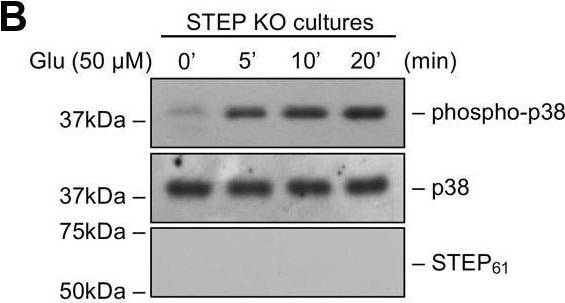
Western Blot: STEP Antibody (23E5) - BSA Free [NB300-202] -
Glutamate induces sustained p38 MAPK phosphorylation in STEP-deficient neurons. Neuronal cultures from (A and C) WT and (B and D) and STEP KO mice were treated with 50 μM glutamate (Glu) or 50 μM NMDA for the specified times. A–D, equal amounts of protein from each sample were analyzed by immunoblot analysis using anti-phospho-p38 (top), anti-p38 (middle), and anti-STEP (bottom) antibodies. E, neuronal cultures from STEP KO mice were treated with glutamate (50 μM) for 20 min in the absence or presence of MK801 (5 μM). Protein extracts were analyzed by immunoblotting with anti-phospho-p38 (top) and anti-p38 (bottom) antibodies. Corresponding bar diagrams represent quantitative analysis of p38 MAPK phosphorylation as the mean +/- SD (n = 3). ∗p < 0.01 and ∗∗p < 0.001 compared with the untreated control. Statistical analysis has been performed using ANOVA with Tukey’s post hoc test. #p < 0.001 and ##p < 0.0001 from 5 min glutamate treatment. NMDA, N-methyl-D-aspartic acid; p38 MAPK, p38 mitogen-activated protein kinase; STEP, striatal-enriched phosphatase. Image collected and cropped by CiteAb from the following open publication (https://pubmed.ncbi.nlm.nih.gov/34246631), licensed under a CC-BY license. Not internally tested by Novus Biologicals.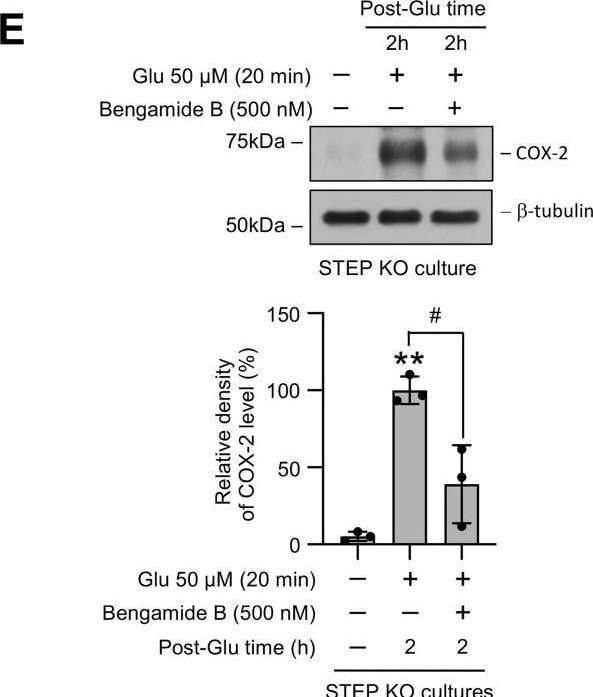
Western Blot: STEP Antibody (23E5) - BSA Free [NB300-202] -
Role of NF-kappa B in glutamate-induced increase in the COX-2 protein level in STEP-deficient neurons.A and B, neuronal cultures from (A) WT and (B) STEP KO mice were treated with 50 μM glutamate (Glu) for 20 min and then maintained in their original medium for the specified times (post-Glu time). C–F, neuronal cultures from STEP KO mice were treated with 50 μM glutamate (Glu) for 20 min followed by recovery (post-Glu time) in the absence and presence of (C) MK801 (5 μM), (D) SB 203580 (5 μM), or (E and F) Bengamide B (500 nM). Equal amounts of protein from each sample were analyzed by immunoblotting using (A–D) anti-I kappa B alpha (top) and anti-beta -tubulin (bottom) antibodies, or (E) anti-COX-2 (top) and anti-beta -tubulin (bottom) antibodies. Corresponding bar diagrams represents quantitative analysis of (A–D) I kappa B alpha or (E) COX-2 protein levels as the mean +/- SD. F, equal amounts of culture media from each sample were analyzed for PGE2 level using ELISA. Statistical analysis has been performed using ANOVA with Tukey’s post hoc test. Values are expressed as the mean +/- SD (n = 3–4). ∗p < 0.01 and ∗∗p < 0.001 compared with the untreated control and #p < 0.01 from 2 h postglutamate time. COX-2, cyclooxygenase-2; I kappa B, inhibitor of nuclear factor-kappa B; STEP, striatal-enriched phosphatase. Image collected and cropped by CiteAb from the following open publication (https://pubmed.ncbi.nlm.nih.gov/34246631), licensed under a CC-BY license. Not internally tested by Novus Biologicals.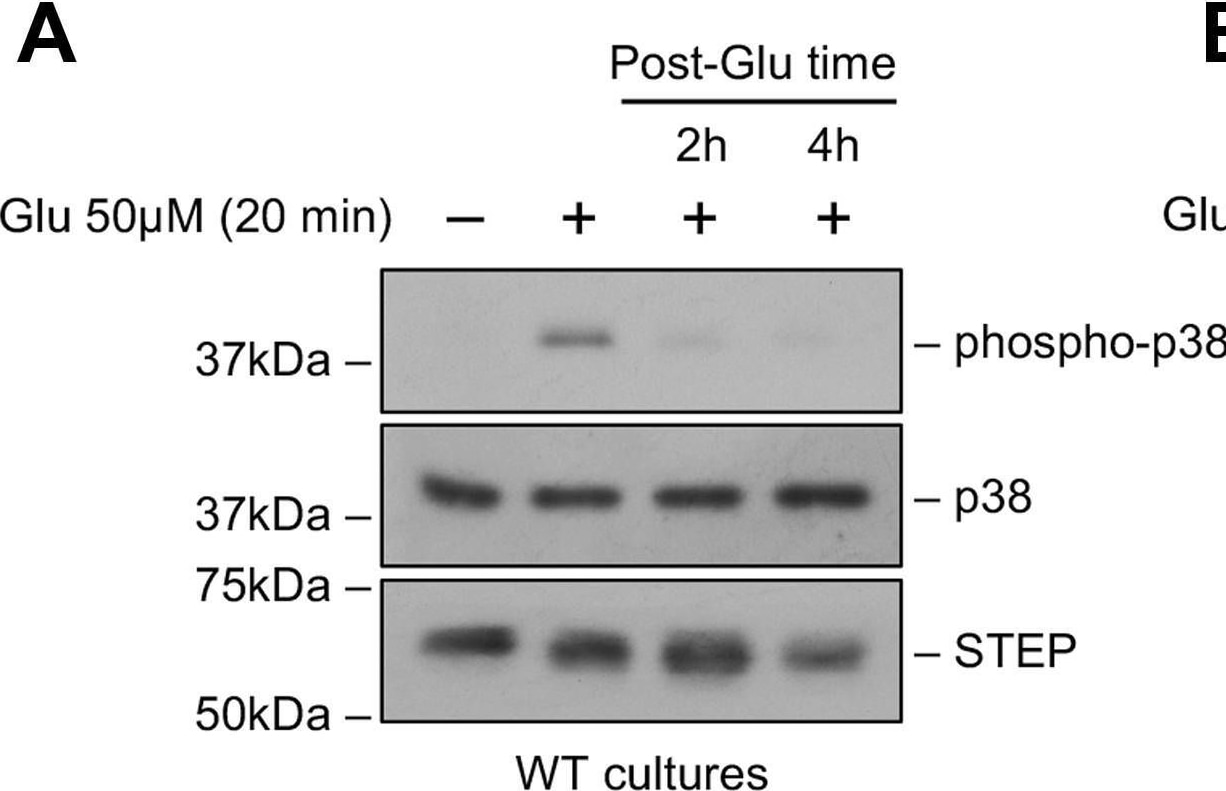
Western Blot: STEP Antibody (23E5) - BSA Free [NB300-202] -
Sustained p38 MAPK phosphorylation in STEP-deficient neurons in the postglutamate recovery phase. Neuronal cultures from (A) WT and (B) and STEP KO mice were treated with 50 μM glutamate (Glu) for 20 min and then maintained in their original medium for the specified times (post-Glu time). Protein extracts were analyzed by immunoblotting with anti-phospho-p38 (top), anti-p38 (middle), and anti-STEP (bottom) antibodies. Corresponding bar diagrams represent quantitative analysis of p38 MAPK phosphorylation as the mean +/- SD (n = 3). Statistical analysis has been performed using ANOVA with Tukey’s post hoc test. ∗p < 0.01 and ∗∗p < 0.001 compared with the untreated control. #p < 0.01 from 20 min glutamate treatment. p38 MAPK, p38 mitogen-activated protein kinase; STEP, striatal-enriched phosphatase. Image collected and cropped by CiteAb from the following open publication (https://pubmed.ncbi.nlm.nih.gov/34246631), licensed under a CC-BY license. Not internally tested by Novus Biologicals.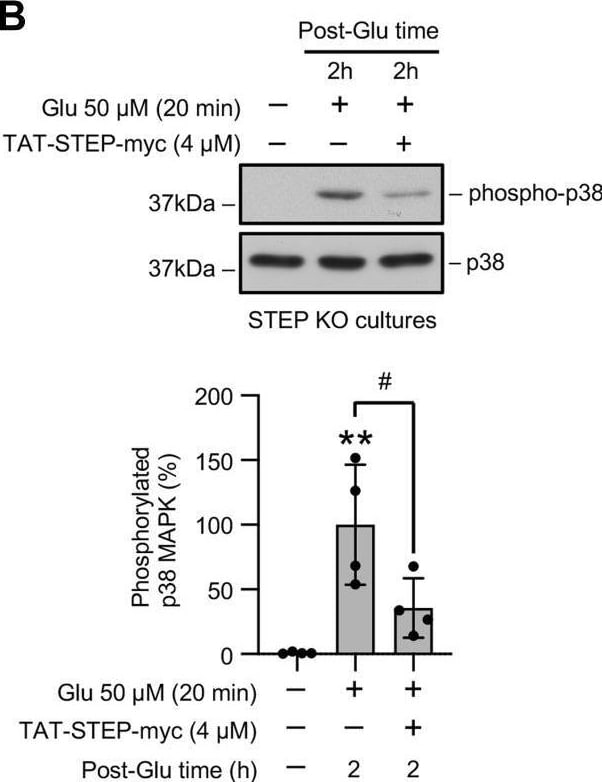
Western Blot: STEP Antibody (23E5) - BSA Free [NB300-202] -
A STEP mimetic attenuates glutamate-induced increase in p38 MAPK phosphorylation, COX-2 expression, and PGE2release in STEP-deficient neurons.A, schematic representation of TAT-STEP-Myc peptide generated from STEP61. The diagram of STEP61 shows the positions of the phosphatase domain, transmembrane domain (TM), kinase-interaction motif (KIM), kinase specificity sequence (KIS), and the phosphorylation sites in the KIM and KIS domains. The diagram of the TAT-STEP-Myc peptide (STEP mimetic), derived from STEP61, shows the positions of the TAT domain at the N terminus, myc-tag at the C terminus, the serine residue in the KIM domain that was mutated to alanine to allow the peptide to bind to its substrates, and the threonine and serine residues in the KIS domain, which were mutated to glutamic acid to render the peptide resistant to degradation. B–D, neuronal cultures from STEP KO mice were treated with 50 μM glutamate (Glu) for 20 min in the absence and presence of TAT-STEP-myc peptide and then maintained in their original medium for 2 h (post-Glu time). B and C, equal amounts of protein from each sample were analyzed by immunoblotting using anti-phospho-p38 (top) and anti-p38 (bottom) antibodies. Corresponding bar diagrams represent quantitative analysis of p38 MAPK phosphorylation as the mean +/- SD (n = 3–4). D, equal amounts of culture media from each sample were analyzed for the PGE2 level using ELISA. Statistical analysis has been performed using ANOVA with Tukey’s post hoc test. Values are expressed as the mean +/- SD (n = 4). ∗p < 0.01 and ∗∗p < 0.001 compared with the untreated control. #p < 0.05 and ##p < 0.01 from 2 h post-glutamate time. COX-2, cyclooxygenase-2; p38 MAPK, p38 mitogen-activated protein kinase; STEP, striatal-enriched phosphatase. Image collected and cropped by CiteAb from the following open publication (https://pubmed.ncbi.nlm.nih.gov/34246631), licensed under a CC-BY license. Not internally tested by Novus Biologicals.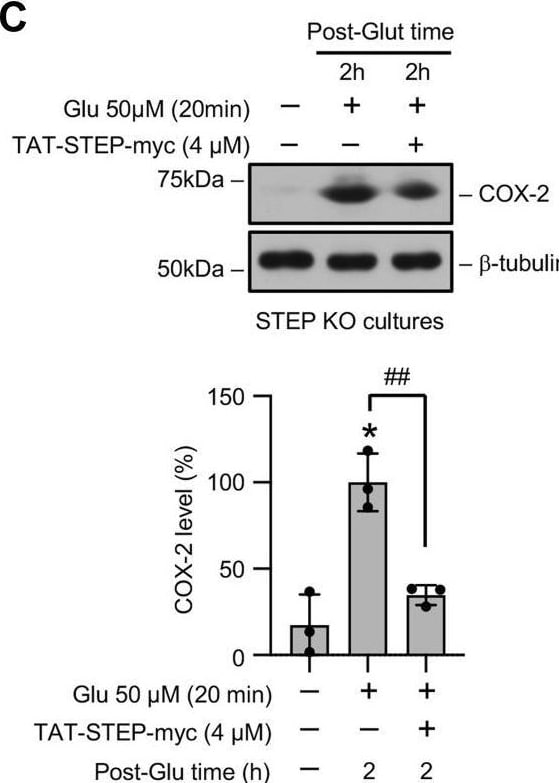
Western Blot: STEP Antibody (23E5) - BSA Free [NB300-202] -
A STEP mimetic attenuates glutamate-induced increase in p38 MAPK phosphorylation, COX-2 expression, and PGE2release in STEP-deficient neurons.A, schematic representation of TAT-STEP-Myc peptide generated from STEP61. The diagram of STEP61 shows the positions of the phosphatase domain, transmembrane domain (TM), kinase-interaction motif (KIM), kinase specificity sequence (KIS), and the phosphorylation sites in the KIM and KIS domains. The diagram of the TAT-STEP-Myc peptide (STEP mimetic), derived from STEP61, shows the positions of the TAT domain at the N terminus, myc-tag at the C terminus, the serine residue in the KIM domain that was mutated to alanine to allow the peptide to bind to its substrates, and the threonine and serine residues in the KIS domain, which were mutated to glutamic acid to render the peptide resistant to degradation. B–D, neuronal cultures from STEP KO mice were treated with 50 μM glutamate (Glu) for 20 min in the absence and presence of TAT-STEP-myc peptide and then maintained in their original medium for 2 h (post-Glu time). B and C, equal amounts of protein from each sample were analyzed by immunoblotting using anti-phospho-p38 (top) and anti-p38 (bottom) antibodies. Corresponding bar diagrams represent quantitative analysis of p38 MAPK phosphorylation as the mean +/- SD (n = 3–4). D, equal amounts of culture media from each sample were analyzed for the PGE2 level using ELISA. Statistical analysis has been performed using ANOVA with Tukey’s post hoc test. Values are expressed as the mean +/- SD (n = 4). ∗p < 0.01 and ∗∗p < 0.001 compared with the untreated control. #p < 0.05 and ##p < 0.01 from 2 h post-glutamate time. COX-2, cyclooxygenase-2; p38 MAPK, p38 mitogen-activated protein kinase; STEP, striatal-enriched phosphatase. Image collected and cropped by CiteAb from the following open publication (https://pubmed.ncbi.nlm.nih.gov/34246631), licensed under a CC-BY license. Not internally tested by Novus Biologicals.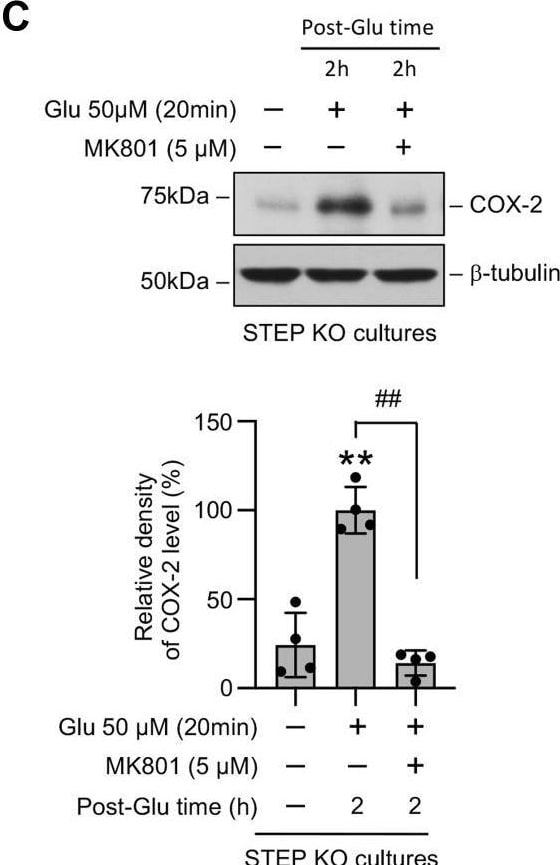
Western Blot: STEP Antibody (23E5) - BSA Free [NB300-202] -
Role of the NMDAR and p38 MAPK in glutamate-induced increase in the COX-2 protein level in STEP-deficient neurons. Neuronal cultures from (A) WT and (B) STEP KO mice were treated with 50 μM glutamate (Glu) for 20 min and then maintained in their original medium for the specified times (post-Glu time). C and D, neuronal cultures from STEP KO mice were treated with 50 μM glutamate (Glu) for 20 min followed by recovery (post-Glu time) in the absence and presence of (C) MK801 (5 μM) or (D) SB 203580 (5 μM). Equal amounts of protein from each sample were analyzed by immunoblotting using anti-COX-2 (top) and anti-beta -tubulin (bottom) antibodies. Corresponding bar diagrams represents quantitative analysis of COX-2 protein level as the mean +/- SD (n = 3–4). Statistical analysis has been performed using ANOVA with Tukey’s post hoc test. ∗p < 0.001 and ∗∗p < 0.0001 compared with untreated control and #p < 0.01 and ##p < 0.001 from 2 h postglutamate time. COX-2, cyclooxygenase-2; p38 MAPK, p38 mitogen-activated protein kinase; STEP, striatal-enriched phosphatase. Image collected and cropped by CiteAb from the following open publication (https://pubmed.ncbi.nlm.nih.gov/34246631), licensed under a CC-BY license. Not internally tested by Novus Biologicals.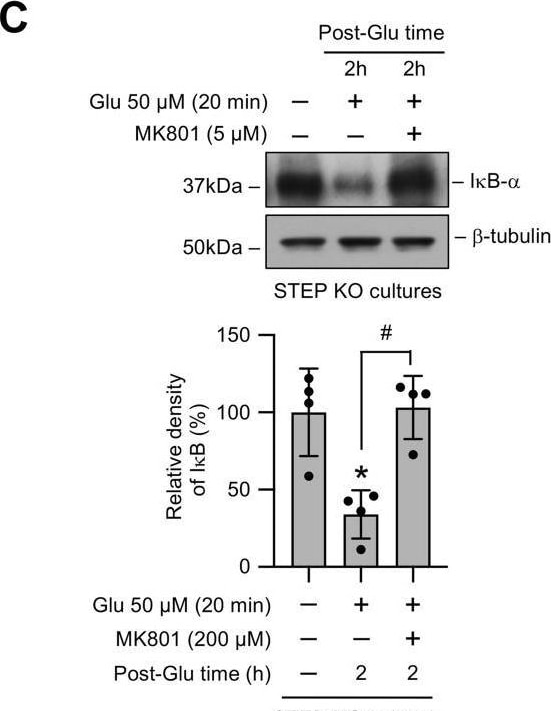
Western Blot: STEP Antibody (23E5) - BSA Free [NB300-202] -
Role of NF-kappa B in glutamate-induced increase in the COX-2 protein level in STEP-deficient neurons.A and B, neuronal cultures from (A) WT and (B) STEP KO mice were treated with 50 μM glutamate (Glu) for 20 min and then maintained in their original medium for the specified times (post-Glu time). C–F, neuronal cultures from STEP KO mice were treated with 50 μM glutamate (Glu) for 20 min followed by recovery (post-Glu time) in the absence and presence of (C) MK801 (5 μM), (D) SB 203580 (5 μM), or (E and F) Bengamide B (500 nM). Equal amounts of protein from each sample were analyzed by immunoblotting using (A–D) anti-I kappa B alpha (top) and anti-beta -tubulin (bottom) antibodies, or (E) anti-COX-2 (top) and anti-beta -tubulin (bottom) antibodies. Corresponding bar diagrams represents quantitative analysis of (A–D) I kappa B alpha or (E) COX-2 protein levels as the mean +/- SD. F, equal amounts of culture media from each sample were analyzed for PGE2 level using ELISA. Statistical analysis has been performed using ANOVA with Tukey’s post hoc test. Values are expressed as the mean +/- SD (n = 3–4). ∗p < 0.01 and ∗∗p < 0.001 compared with the untreated control and #p < 0.01 from 2 h postglutamate time. COX-2, cyclooxygenase-2; I kappa B, inhibitor of nuclear factor-kappa B; STEP, striatal-enriched phosphatase. Image collected and cropped by CiteAb from the following open publication (https://pubmed.ncbi.nlm.nih.gov/34246631), licensed under a CC-BY license. Not internally tested by Novus Biologicals.Applications for STEP Antibody (23E5) - BSA Free
Immunocytochemistry/ Immunofluorescence
Immunohistochemistry
Immunohistochemistry-Frozen
Immunoprecipitation
Western Blot
Reviewed Applications
Read 1 review rated 5 using NB300-202 in the following applications:
Formulation, Preparation, and Storage
Purification
Formulation
Format
Preservative
Concentration
Shipping
Stability & Storage
Background: STEP
Long Name
Alternate Names
Gene Symbol
Additional STEP Products
Product Documents for STEP Antibody (23E5) - BSA Free
Certificate of Analysis
To download a Certificate of Analysis, please enter a lot or batch number in the search box below.
Product Specific Notices for STEP Antibody (23E5) - BSA Free
This product is for research use only and is not approved for use in humans or in clinical diagnosis. Primary Antibodies are guaranteed for 1 year from date of receipt.
Citations for STEP Antibody (23E5) - BSA Free
 Powered by Bioz
Customer Reviews for STEP Antibody (23E5) - BSA Free (1)
Have you used STEP Antibody (23E5) - BSA Free?
Submit a review and receive an Amazon gift card!
$25/€18/£15/$25CAN/¥2500 for a review with an image
$10/€7/£6/$10CAN/¥1110 for a review without an image
Submit a review
-
Application: Western BlotSample Tested: See PMID 22266371Species: MouseVerified Customer | Posted 12/23/2014
There are no reviews that match your criteria.
Protocols
Find general support by application which include: protocols, troubleshooting, illustrated assays, videos and webinars.
- Antigen Retrieval Protocol (PIER)
- Antigen Retrieval for Frozen Sections Protocol
- Appropriate Fixation of IHC/ICC Samples
- Cellular Response to Hypoxia Protocols
- Chromogenic IHC Staining of Formalin-Fixed Paraffin-Embedded (FFPE) Tissue Protocol
- Chromogenic Immunohistochemistry Staining of Frozen Tissue
- ClariTSA™ Fluorophore Kits
- Detection & Visualization of Antibody Binding
- Fluorescent IHC Staining of Frozen Tissue Protocol
- Graphic Protocol for Heat-induced Epitope Retrieval
- Graphic Protocol for the Preparation and Fluorescent IHC Staining of Frozen Tissue Sections
- Graphic Protocol for the Preparation and Fluorescent IHC Staining of Paraffin-embedded Tissue Sections
- Graphic Protocol for the Preparation of Gelatin-coated Slides for Histological Tissue Sections
- ICC Cell Smear Protocol for Suspension Cells
- ICC Immunocytochemistry Protocol Videos
- ICC for Adherent Cells
- IHC Sample Preparation (Frozen sections vs Paraffin)
- Immunocytochemistry (ICC) Protocol
- Immunocytochemistry Troubleshooting
- Immunofluorescence of Organoids Embedded in Cultrex Basement Membrane Extract
- Immunofluorescent IHC Staining of Formalin-Fixed Paraffin-Embedded (FFPE) Tissue Protocol
- Immunohistochemistry (IHC) and Immunocytochemistry (ICC) Protocols
- Immunohistochemistry Frozen Troubleshooting
- Immunohistochemistry Paraffin Troubleshooting
- Immunoprecipitation Protocol
- Preparing Samples for IHC/ICC Experiments
- Preventing Non-Specific Staining (Non-Specific Binding)
- Primary Antibody Selection & Optimization
- Protocol for Heat-Induced Epitope Retrieval (HIER)
- Protocol for Making a 4% Formaldehyde Solution in PBS
- Protocol for VisUCyte™ HRP Polymer Detection Reagent
- Protocol for the Fluorescent ICC Staining of Cell Smears - Graphic
- Protocol for the Fluorescent ICC Staining of Cultured Cells on Coverslips - Graphic
- Protocol for the Preparation & Fixation of Cells on Coverslips
- Protocol for the Preparation and Chromogenic IHC Staining of Frozen Tissue Sections
- Protocol for the Preparation and Chromogenic IHC Staining of Frozen Tissue Sections - Graphic
- Protocol for the Preparation and Chromogenic IHC Staining of Paraffin-embedded Tissue Sections
- Protocol for the Preparation and Chromogenic IHC Staining of Paraffin-embedded Tissue Sections - Graphic
- Protocol for the Preparation and Fluorescent ICC Staining of Cells on Coverslips
- Protocol for the Preparation and Fluorescent ICC Staining of Non-adherent Cells
- Protocol for the Preparation and Fluorescent ICC Staining of Stem Cells on Coverslips
- Protocol for the Preparation and Fluorescent IHC Staining of Frozen Tissue Sections
- Protocol for the Preparation and Fluorescent IHC Staining of Paraffin-embedded Tissue Sections
- Protocol for the Preparation of Gelatin-coated Slides for Histological Tissue Sections
- Protocol for the Preparation of a Cell Smear for Non-adherent Cell ICC - Graphic
- R&D Systems Quality Control Western Blot Protocol
- TUNEL and Active Caspase-3 Detection by IHC/ICC Protocol
- The Importance of IHC/ICC Controls
- Troubleshooting Guide: Immunohistochemistry
- Troubleshooting Guide: Western Blot Figures
- Western Blot Conditions
- Western Blot Protocol
- Western Blot Protocol for Cell Lysates
- Western Blot Troubleshooting
- Western Blot Troubleshooting Guide
- View all Protocols, Troubleshooting, Illustrated assays and Webinars
FAQs for STEP Antibody (23E5) - BSA Free
-
Q: Is it possible this antibody can detect phospho form of that? Some paper shows that phosphorylated STEP was detected by an pware shift in the mobility of the STEP band. The paper is 17814, The Journal of Neuroscience, November 6, 2013, 33(45):17814 -17826.
A: This antibody may detect both phosphorylated and non-phosphorylated STEP although it has never specifically been tested for this.