
TRAP1 Antibody - BSA Free
Novus Biologicals | Catalog # NBP2-47597

![Immunocytochemistry/ Immunofluorescence: TRAP1 Antibody [NBP2-47597]](https://resources.rndsystems.com/images/products/TRAP1-Antibody-Immunocytochemistry-Immunofluorescence-NBP2-47597-img0004.jpg "Immunocytochemistry/ Immunofluorescence: TRAP1 Antibody [NBP2-47597]")
Scientific images may be resized, cropped, or adjusted for brightness or contrast for presentation purposes. These updates are limited to presentation and do not affect the underlying scientific interpretation of the data. Where available, additional source data may be provided upon request.
Key Product Details
Validated by
Species Reactivity
Validated:
Cited:
Predicted:
Applications
Validated:
Cited:
Label
Antibody Source
Format
Product Specifications
Immunogen
Clonality
Host
Isotype
Scientific Data Images for TRAP1 Antibody - BSA Free
Immunocytochemistry/ Immunofluorescence: TRAP1 Antibody [NBP2-47597]
Immunocytochemistry/Immunofluorescence: TRAP1 Antibody [NBP2-47597] - Immunofluorescent staining of human cell line MCF7 shows localization to mitochondria.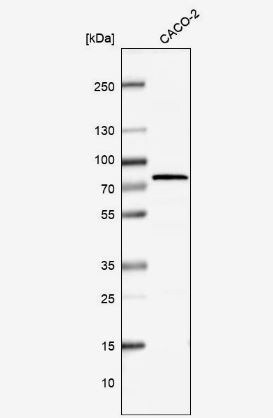
Western Blot: TRAP1 Antibody [NBP2-47597] -
Western Blot: TRAP1 Antibody [NBP2-47597] - Analysis in human cell line CACO-2.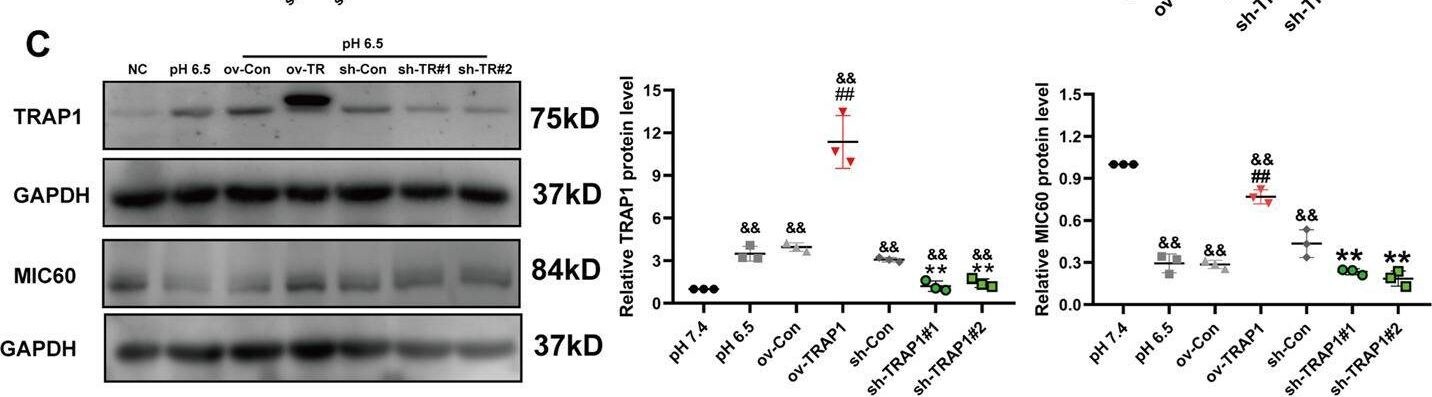
Western Blot: TRAP1 Antibody - BSA Free [NBP2-47597] -
TRAP1 increased MIC60 protein levels of H9C2 cells via alleviating MIC60 ubiquitin-dependent degradation in extracellular acidosis.A, B RT-qPCR and western blot were used to determine the transfection efficiency of TRAP1 in H9C2 cells. C Western blot was used to detect TRAP1 or MIC60 protein levels of H9C2 cells. D, E Western blot was used to detect the degradation of MIC60 protein. F Western blot was used to detect whole cell lysate ubiquitination. G Western blot was used to detect MIC60 protein ubiquitination. CHX (cycloheximide, 20 uM) was used to inhibit protein synthesis. MG132 (10 uM) was used to inhibit proteasome. CQ (Chloroquine phosphate, 10 uM) was used to inhibit lysosomes. Data were the means +/- SD from three independent experiments. Group comparisons were performed by one-way analysis of variance followed by Tukey’s post hoc test. &&P < 0.01 vs. pH 7.4 group. ##P < 0.01 vs. ov-Con group. *P < 0.05 vs. 0 h, CQ or Con group. **P < 0.01 vs. sh-Con or 0 h group. Image collected and cropped by CiteAb from the following open publication (https://pubmed.ncbi.nlm.nih.gov/34907169), licensed under a CC-BY license. Not internally tested by Novus Biologicals.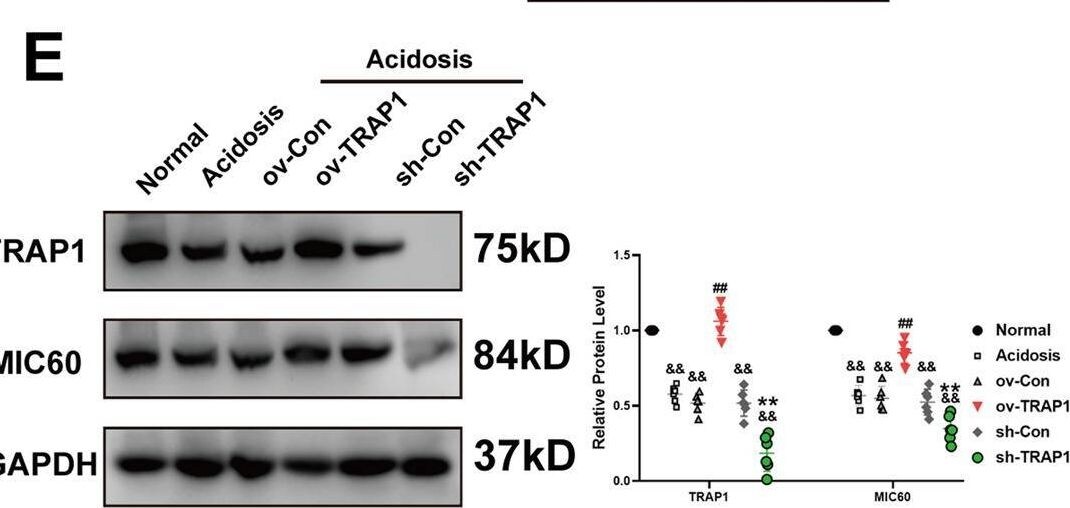
Western Blot: TRAP1 Antibody - BSA Free [NBP2-47597] -
TRAP1 interacted with MIC60 and decreased MIC60 ubiquitination to increase MIC60 protein levels in rats’ heart tissue in extracellular acidosis.A Detection of the colocalization of MIC60 (green) and TRAP1 (red) using confocal microscopy in rat’s heart tissue. B Immunoblotting analysis of TRAP1 and MIC60 expression in a co-IP assay performed in protein lysate of rat’s heart tissue with anti-TRAP1 or anti-MIC60 Magnetic beads, respectively. C–D Western blot was used to determine the transfection efficiency of TRAP1 (C) and MIC60 (D) in rats’ heart tissue. E Western blotting was used to detect MIC60 protein levels regulated by TRAP1. F Western blot was used to detect MIC60 protein ubiquitination. Data were the means +/- SD from three independent experiments. Group comparisons were performed by one-way analysis of variance followed by Tukey’s post hoc test. &P < 0.05 vs. Normal group. #P < 0.05 vs. ov-Con group. ##P < 0.01 vs. ov-Con group. *P < 0.05 vs. sh-Con group. **P < 0.01 vs. sh-Con group. Image collected and cropped by CiteAb from the following open publication (https://pubmed.ncbi.nlm.nih.gov/34907169), licensed under a CC-BY license. Not internally tested by Novus Biologicals.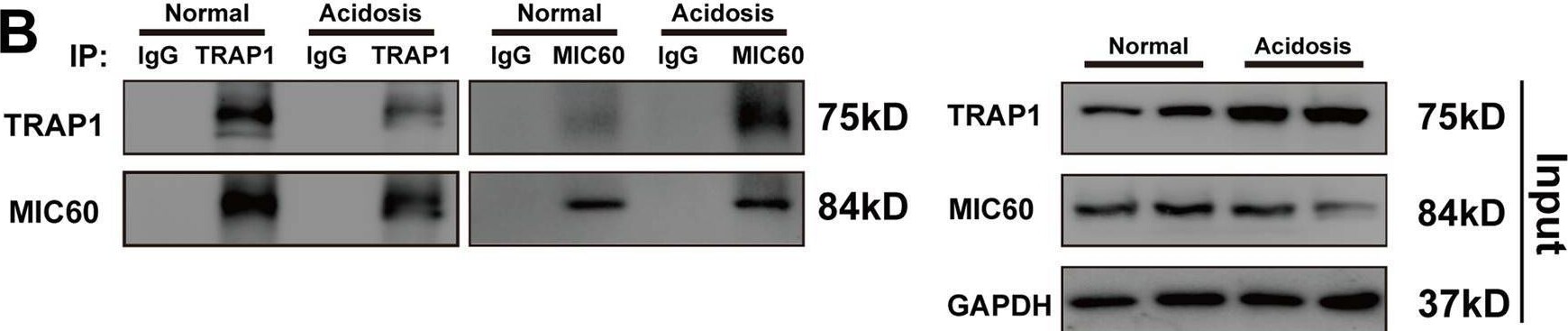
Western Blot: TRAP1 Antibody - BSA Free [NBP2-47597] -
TRAP1 interacted with MIC60 and decreased MIC60 ubiquitination to increase MIC60 protein levels in rats’ heart tissue in extracellular acidosis.A Detection of the colocalization of MIC60 (green) and TRAP1 (red) using confocal microscopy in rat’s heart tissue. B Immunoblotting analysis of TRAP1 and MIC60 expression in a co-IP assay performed in protein lysate of rat’s heart tissue with anti-TRAP1 or anti-MIC60 Magnetic beads, respectively. C–D Western blot was used to determine the transfection efficiency of TRAP1 (C) and MIC60 (D) in rats’ heart tissue. E Western blotting was used to detect MIC60 protein levels regulated by TRAP1. F Western blot was used to detect MIC60 protein ubiquitination. Data were the means +/- SD from three independent experiments. Group comparisons were performed by one-way analysis of variance followed by Tukey’s post hoc test. &P < 0.05 vs. Normal group. #P < 0.05 vs. ov-Con group. ##P < 0.01 vs. ov-Con group. *P < 0.05 vs. sh-Con group. **P < 0.01 vs. sh-Con group. Image collected and cropped by CiteAb from the following open publication (https://pubmed.ncbi.nlm.nih.gov/34907169), licensed under a CC-BY license. Not internally tested by Novus Biologicals.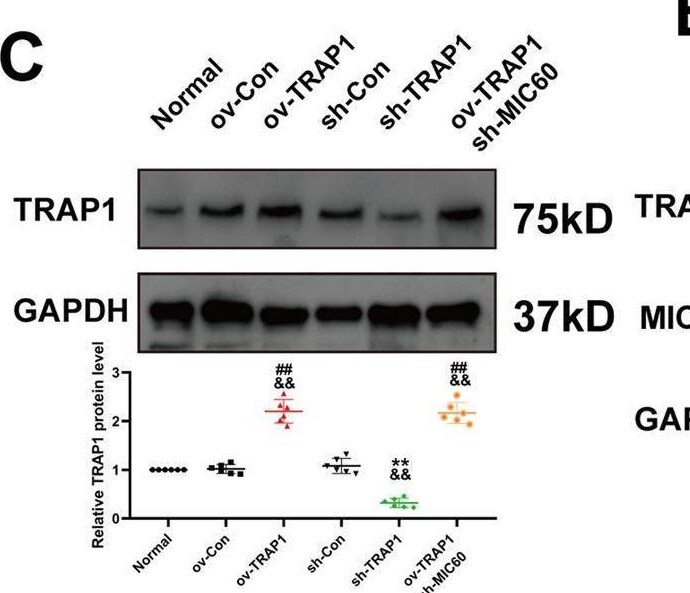
Western Blot: TRAP1 Antibody - BSA Free [NBP2-47597] -
TRAP1 interacted with MIC60 and decreased MIC60 ubiquitination to increase MIC60 protein levels in rats’ heart tissue in extracellular acidosis.A Detection of the colocalization of MIC60 (green) and TRAP1 (red) using confocal microscopy in rat’s heart tissue. B Immunoblotting analysis of TRAP1 and MIC60 expression in a co-IP assay performed in protein lysate of rat’s heart tissue with anti-TRAP1 or anti-MIC60 Magnetic beads, respectively. C–D Western blot was used to determine the transfection efficiency of TRAP1 (C) and MIC60 (D) in rats’ heart tissue. E Western blotting was used to detect MIC60 protein levels regulated by TRAP1. F Western blot was used to detect MIC60 protein ubiquitination. Data were the means +/- SD from three independent experiments. Group comparisons were performed by one-way analysis of variance followed by Tukey’s post hoc test. &P < 0.05 vs. Normal group. #P < 0.05 vs. ov-Con group. ##P < 0.01 vs. ov-Con group. *P < 0.05 vs. sh-Con group. **P < 0.01 vs. sh-Con group. Image collected and cropped by CiteAb from the following open publication (https://pubmed.ncbi.nlm.nih.gov/34907169), licensed under a CC-BY license. Not internally tested by Novus Biologicals.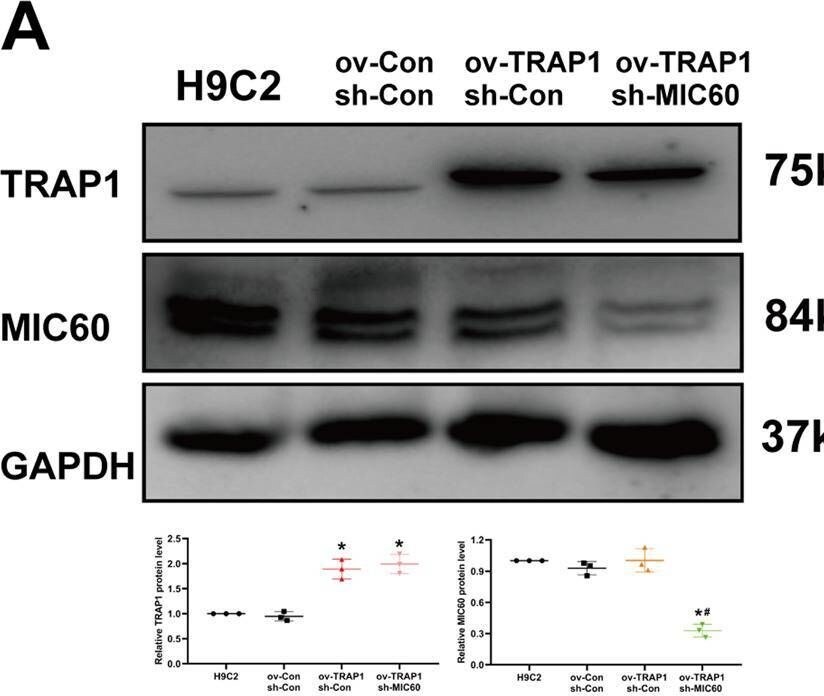
Western Blot: TRAP1 Antibody - BSA Free [NBP2-47597] -
TRAP1 protected mitochondrial cristae and function by increasing MIC60 protein levels in extracellular acidosis.A Western blot was used to determine the transfection efficiency of TRAP1 and MIC60 in H9C2 cells. B Methyl tetramethylrhodamine staining was used to detect mitochondrial membrane potential of H9C2 cells. C CCK8 assay was used to detect the cell viability of H9C2 cells. D ATP assay was used to detect ATP levels of H9C2 cells. E Transmission electron microscopy was used to detect the ultrastructure of mitochondria of H9C2 cells. Twenty-one images were obtained from three independent experiments for each group. The average cristae number in one mitochondrion (n = 30 mitochondria for each group randomly selected from 21 pictures) of each group was quantified. Data were the means +/- SD from three independent experiments. Group comparisons were performed by one-way analysis of variance followed by Tukey’s post hoc test. *P < 0.05 vs. ov-Con/sh-Con group. #P < 0.05 vs. ov-TRAP1/sh-Con group. Image collected and cropped by CiteAb from the following open publication (https://pubmed.ncbi.nlm.nih.gov/34907169), licensed under a CC-BY license. Not internally tested by Novus Biologicals.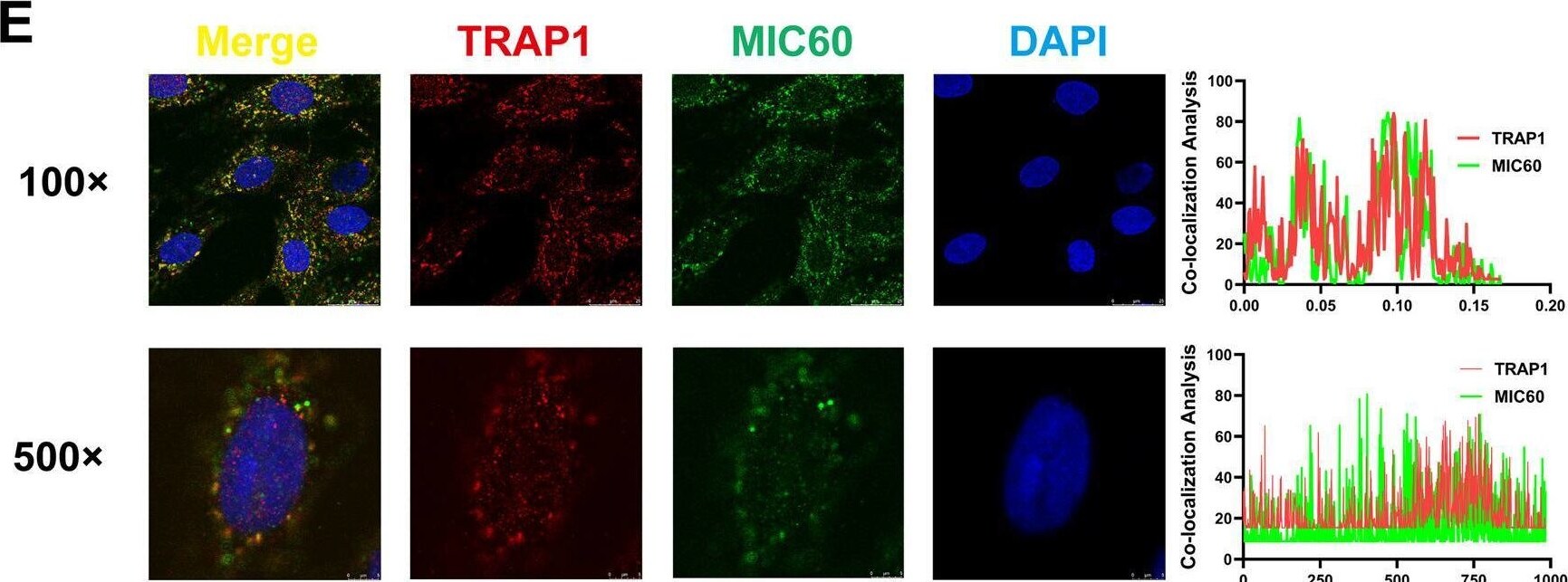
Immunocytochemistry/ Immunofluorescence: TRAP1 Antibody - BSA Free [NBP2-47597] -
TRAP1 directly interacted with MIC60 in H9C2 cells.A Silver staining of TRAP1 immunoprecipitates. B LC-MS/MS of TRAP1 immunoprecipitates. C Representative fragmentation spectrum of the identified MIC60 peptides. D Immunoblotting analysis of TRAP1 and MIC60 expression in a co-IP assay performed in H9C2 cells with anti-TRAP1 or anti-MIC60 Magnetic beads, respectively. E Detection of the colocalization of MIC60 (green) and TRAP1 (red) using confocal microscopy in H9C2 cells. Nuclei were stained using DAPI (blue), (Scale bars, 25 um). Data were the means +/- SD from three independent experiments. Image collected and cropped by CiteAb from the following open publication (https://pubmed.ncbi.nlm.nih.gov/34907169), licensed under a CC-BY license. Not internally tested by Novus Biologicals.![TRAP1 Antibody - BSA Free Immunohistochemistry-Paraffin: TRAP1 Antibody [NBP2-47597]](https://resources.rndsystems.com/images/products/nbp2-47597_-immunohistochemistry-paraffin-639173123445743809.jpg "Immunohistochemistry-Paraffin: TRAP1 Antibody [NBP2-47597]")
Immunohistochemistry-Paraffin: TRAP1 Antibody [NBP2-47597]
Staining of human testis shows moderate to strong granular cytoplasmic positivity in seminiferous ducts.![TRAP1 Antibody - BSA Free Immunohistochemistry-Paraffin: TRAP1 Antibody [NBP2-47597]](https://resources.rndsystems.com/images/products/nbp2-47597_-immunohistochemistry-paraffin-639173124801239608.jpg "Immunohistochemistry-Paraffin: TRAP1 Antibody [NBP2-47597]")
Immunohistochemistry-Paraffin: TRAP1 Antibody [NBP2-47597]
Staining of human kidney shows strong to very strong granular cytoplasmic positivity in cells in tubules.![TRAP1 Antibody - BSA Free Immunohistochemistry-Paraffin: TRAP1 Antibody [NBP2-47597]](https://resources.rndsystems.com/images/products/nbp2-47597_-immunohistochemistry-paraffin-639173132393626080.jpg "Immunohistochemistry-Paraffin: TRAP1 Antibody [NBP2-47597]")
Immunohistochemistry-Paraffin: TRAP1 Antibody [NBP2-47597]
Staining of human cerebellum shows moderate to strong granular cytoplasmic positivity in Purkinje cells.![TRAP1 Antibody - BSA Free Immunohistochemistry-Paraffin: TRAP1 Antibody [NBP2-47597]](https://resources.rndsystems.com/images/products/nbp2-47597_-immunohistochemistry-paraffin-639173132771200127.jpg "Immunohistochemistry-Paraffin: TRAP1 Antibody [NBP2-47597]")
Immunohistochemistry-Paraffin: TRAP1 Antibody [NBP2-47597]
Staining of human fallopian tube shows strong to very strong granular cytoplasmic positivity in glandular cells.![TRAP1 Antibody - BSA Free Immunohistochemistry-Paraffin: TRAP1 Antibody [NBP2-47597]](https://resources.rndsystems.com/images/products/nbp2-47597_-immunohistochemistry-paraffin-639173302788542355.jpg "Immunohistochemistry-Paraffin: TRAP1 Antibody [NBP2-47597]")
Applications for TRAP1 Antibody - BSA Free
Immunocytochemistry/ Immunofluorescence
Immunohistochemistry-Paraffin
Western Blot
Formulation, Preparation, and Storage
Purification
Formulation
Format
Preservative
Concentration
Shipping
Stability & Storage
Background: TRAP1
Alternate Names
Gene Symbol
Additional TRAP1 Products
Product Documents for TRAP1 Antibody - BSA Free
Certificate of Analysis
To download a Certificate of Analysis, please enter a lot or batch number in the search box below.
Product Specific Notices for TRAP1 Antibody - BSA Free
This product is for research use only and is not approved for use in humans or in clinical diagnosis. Primary Antibodies are guaranteed for 1 year from date of receipt.
Citations for TRAP1 Antibody - BSA Free
 Powered by Bioz
Customer Reviews for TRAP1 Antibody - BSA Free
There are currently no reviews for this product. Be the first to review TRAP1 Antibody - BSA Free and earn rewards!
Have you used TRAP1 Antibody - BSA Free?
Submit a review and receive an Amazon gift card!
$25/€18/£15/$25CAN/¥2500 for a review with an image
$10/€7/£6/$10CAN/¥1110 for a review without an image
Submit a review
Protocols
Find general support by application which include: protocols, troubleshooting, illustrated assays, videos and webinars.
- Antigen Retrieval Protocol (PIER)
- Antigen Retrieval for Frozen Sections Protocol
- Appropriate Fixation of IHC/ICC Samples
- Cellular Response to Hypoxia Protocols
- Chromogenic IHC Staining of Formalin-Fixed Paraffin-Embedded (FFPE) Tissue Protocol
- Chromogenic Immunohistochemistry Staining of Frozen Tissue
- ClariTSA™ Fluorophore Kits
- Detection & Visualization of Antibody Binding
- Fluorescent IHC Staining of Frozen Tissue Protocol
- Graphic Protocol for Heat-induced Epitope Retrieval
- Graphic Protocol for the Preparation and Fluorescent IHC Staining of Frozen Tissue Sections
- Graphic Protocol for the Preparation and Fluorescent IHC Staining of Paraffin-embedded Tissue Sections
- Graphic Protocol for the Preparation of Gelatin-coated Slides for Histological Tissue Sections
- ICC Cell Smear Protocol for Suspension Cells
- ICC Immunocytochemistry Protocol Videos
- ICC for Adherent Cells
- IHC Sample Preparation (Frozen sections vs Paraffin)
- Immunocytochemistry (ICC) Protocol
- Immunocytochemistry Troubleshooting
- Immunofluorescence of Organoids Embedded in Cultrex Basement Membrane Extract
- Immunofluorescent IHC Staining of Formalin-Fixed Paraffin-Embedded (FFPE) Tissue Protocol
- Immunohistochemistry (IHC) and Immunocytochemistry (ICC) Protocols
- Immunohistochemistry Frozen Troubleshooting
- Immunohistochemistry Paraffin Troubleshooting
- Preparing Samples for IHC/ICC Experiments
- Preventing Non-Specific Staining (Non-Specific Binding)
- Primary Antibody Selection & Optimization
- Protocol for Heat-Induced Epitope Retrieval (HIER)
- Protocol for Making a 4% Formaldehyde Solution in PBS
- Protocol for VisUCyte™ HRP Polymer Detection Reagent
- Protocol for the Fluorescent ICC Staining of Cell Smears - Graphic
- Protocol for the Fluorescent ICC Staining of Cultured Cells on Coverslips - Graphic
- Protocol for the Preparation & Fixation of Cells on Coverslips
- Protocol for the Preparation and Chromogenic IHC Staining of Frozen Tissue Sections
- Protocol for the Preparation and Chromogenic IHC Staining of Frozen Tissue Sections - Graphic
- Protocol for the Preparation and Chromogenic IHC Staining of Paraffin-embedded Tissue Sections
- Protocol for the Preparation and Chromogenic IHC Staining of Paraffin-embedded Tissue Sections - Graphic
- Protocol for the Preparation and Fluorescent ICC Staining of Cells on Coverslips
- Protocol for the Preparation and Fluorescent ICC Staining of Non-adherent Cells
- Protocol for the Preparation and Fluorescent ICC Staining of Stem Cells on Coverslips
- Protocol for the Preparation and Fluorescent IHC Staining of Frozen Tissue Sections
- Protocol for the Preparation and Fluorescent IHC Staining of Paraffin-embedded Tissue Sections
- Protocol for the Preparation of Gelatin-coated Slides for Histological Tissue Sections
- Protocol for the Preparation of a Cell Smear for Non-adherent Cell ICC - Graphic
- R&D Systems Quality Control Western Blot Protocol
- TUNEL and Active Caspase-3 Detection by IHC/ICC Protocol
- The Importance of IHC/ICC Controls
- Troubleshooting Guide: Immunohistochemistry
- Troubleshooting Guide: Western Blot Figures
- Western Blot Conditions
- Western Blot Protocol
- Western Blot Protocol for Cell Lysates
- Western Blot Troubleshooting
- Western Blot Troubleshooting Guide
- View all Protocols, Troubleshooting, Illustrated assays and Webinars