
TRIM8 Antibody - BSA Free
Novus Biologicals | Catalog # NBP1-89776

![Immunocytochemistry/ Immunofluorescence: TRIM8 Antibody [NBP1-89776]](https://resources.rndsystems.com/images/products/GERP-Antibody-Immunocytochemistry-Immunofluorescence-NBP1-89776-img0005.jpg "Immunocytochemistry/ Immunofluorescence: TRIM8 Antibody [NBP1-89776]")
Loading...
Key Product Details
Validated by
Knockout/Knockdown
Species Reactivity
Validated:
Human
Cited:
Human
Predicted:
Mouse (99%), Rat (99%). Backed by our 100% Guarantee.
Applications
Validated:
Immunocytochemistry/ Immunofluorescence, Knockdown Validated
Cited:
Western Blot, Flow Cytometry
Label
Unconjugated
Antibody Source
Polyclonal Rabbit IgG
Format
BSA Free
Loading...
Product Specifications
Immunogen
This antibody was developed against Recombinant Protein corresponding to amino acids: QDIEDQLYKLESDKRLVEEKVNQLKEEVRLQYEKLHQLLDEDLRQTVEVLDKAQAKFCSENAAQALHLGERMQEAKKLLGS
Clonality
Polyclonal
Host
Rabbit
Isotype
IgG
Scientific Data Images for TRIM8 Antibody - BSA Free
Immunocytochemistry/ Immunofluorescence: TRIM8 Antibody [NBP1-89776]
Immunocytochemistry/Immunofluorescence: TRIM8 Antibody [NBP1-89776] - Immunofluorescent staining of human cell line U-251 MG shows localization to nucleoplasm & vesicles.![TRIM8 Antibody - BSA Free Immunohistochemistry-Paraffin: TRIM8 Antibody - BSA Free [NBP1-89776]](https://resources.rndsystems.com/images/products/nbp1-89776_rabbit-polyclonal-trim8-antibody-15520258564374.jpg "Immunohistochemistry-Paraffin: TRIM8 Antibody - BSA Free [NBP1-89776]")
Immunohistochemistry-Paraffin: TRIM8 Antibody - BSA Free [NBP1-89776]
Staining of human skeletal muscle shows strong cytoplasmic positivity in myocytes.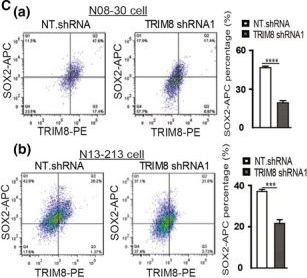
Flow Cytometry: TRIM8 Antibody [NBP1-89776] -
Flow Cytometry: TRIM8 Antibody [NBP1-89776] - Knockdown of TRIM8 promotes differentiation & impairs GBM stemness & self‐renewal capacity. (A) Western blot analysis shows reduced CD133, NESTIN, SOX2, & c‐MYC, & upregulated GFAP in GBM neurosphere cells following TRIM8 knockdown by TRIM8 shRNA1 or TRIM8 shRNA2. NT shRNA = nontargeting control shRNA. Western blot also shows upregulated PIAS3 & reduced phosphorylated STAT3 (Tyr705) following shRNA knockdown of TRIM8. (B) ICC shows reduced expression of TRIM8 (red), NESTIN (white), & SOX2 (red) in TRIM8 shRNA1‐knockdown cells compared to NT shRNA cells. Nuclei were counterstained with DAPI (blue). Scale bar = 10 μm. (C) Flow cytometric analysis & statistical analysis of SOX2 expression in TRIM8‐overexpressing neurosphere cells. SOX2 was tagged by APC (blue: 676 nm) with TRIM8 tagged by PE (red: 555 nm). ***P < 0.001, ****P < 0.0001. Statistics: Data are means ± SD (n = 3), by nonparametric t‐test. (D,E) TRIM8 knockdown impairs neurosphere formation. Representative images of neurosphere expressing NT shRNA & TRIM8 shRNA1 at specific time points are shown. Scale bar = 30 μm. Statistical analysis of average sphere size: by one‐way analysis of variance (ANOVA). Data are means ± standard deviation (SD) (n = 6). **P < 0.01, ***P < 0.001, ****P < 0.0001. (F) Western blot analysis shows reduced TRIM8 & activated STAT3 (Tyr705), with increased GFAP expression following differentiation induced by serum. (G) ICC reveals reduced TRIM8 (red) & increased GFAP (white) after four days of differentiation induced by serum. Nuclei were counterstained with DAPI (blue). Scale bar = 10 μm. Image collected & cropped by CiteAb from the following publication (https://pubmed.ncbi.nlm.nih.gov/28100038), licensed under a CC-BY license. Not internally tested by Novus Biologicals.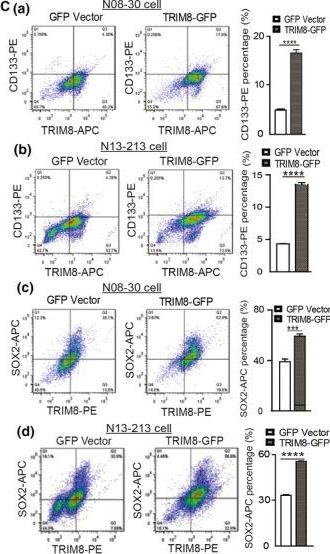
Flow Cytometry: TRIM8 Antibody [NBP1-89776] -
Flow Cytometry: TRIM8 Antibody [NBP1-89776] - Ectopic expression of TRIM8 enhances stemness & self‐renewal of GBM‐derived neurospheres. (A) Western blot analysis shows upregulation of CD133, NESTIN, SOX2, & c‐MYC following ectopic expression of TRIM8‐GFP fusion protein. WB also shows reduced PIAS3 & increased phosphorylated STAT3 (Tyr705) & total STAT3 following TRIM8 overexpression. (B) ICC staining of TRIM8 (red) with stem cell markers NESTIN (white), & SOX2 (red) in neurosphere cells overexpressing TRIM8. Nuclei were counterstained with DAPI (blue). Scale bar = 10 μm. (C) Flow cytometric analysis & statistical analysis showing CD133 & SOX2 upregulation in neurosphere cells with TRIM8 overexpression. CD133 was tagged by PE (red: 555 nm) with TRIM8 tagged by APC (blue: 676 nm). SOX2 was tagged by APC (blue: 676 nm) with TRIM8 tagged by PE (red: 555 nm). ***P < 0.001, ****P < 0.0001. Statistics: Data are means ± SD (n = 3), by nonparametric t‐test. (D,E) Effects of TRIM8 overexpression on neurosphere formation. Representative images of neurospheres expressing GFP vector or TRIM8‐GFP vector at specific points. Scale bar = 30 μm. Statistical analysis of average sphere size: by one‐way analysis of variance (ANOVA). Data are means ± standard deviation (SD) (n = 6). **P < 0.01, ***P < 0.001, ****P < 0.0001. (F) Extreme limiting dilution assay (ELDA) shows that TRIM8 overexpression reduces the cell dose required for colony formation, supporting enhanced stem cell properties. Image collected & cropped by CiteAb from the following publication (https://pubmed.ncbi.nlm.nih.gov/28100038), licensed under a CC-BY license. Not internally tested by Novus Biologicals.![Knockdown Validated: TRIM8 Antibody [NBP1-89776]](https://resources.rndsystems.com/images/products/GERP-Antibody-Immunocytochemistry-Immunofluorescence-NBP1-89776-img0007.jpg "Immunocytochemistry/ Immunofluorescence: TRIM8 Antibody [NBP1-89776]")
Immunocytochemistry/ Immunofluorescence: TRIM8 Antibody [NBP1-89776] -
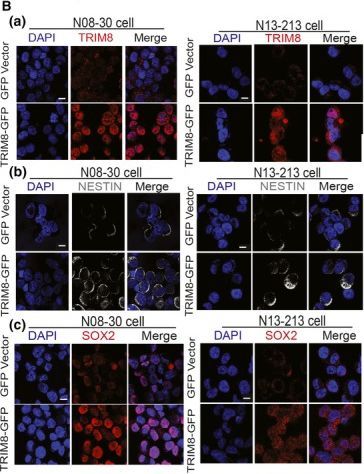
Immunocytochemistry/ Immunofluorescence: TRIM8 Antibody [NBP1-89776] - Ectopic expression of TRIM8 enhances stemness & self‐renewal of GBM‐derived neurospheres. (A) Western blot analysis shows upregulation of CD133, NESTIN, SOX2, & c‐MYC following ectopic expression of TRIM8‐GFP fusion protein. WB also shows reduced PIAS3 & increased phosphorylated STAT3 (Tyr705) & total STAT3 following TRIM8 overexpression. (B) ICC staining of TRIM8 (red) with stem cell markers NESTIN (white), & SOX2 (red) in neurosphere cells overexpressing TRIM8. Nuclei were counterstained with DAPI (blue). Scale bar = 10 μm. (C) Flow cytometric analysis & statistical analysis showing CD133 & SOX2 upregulation in neurosphere cells with TRIM8 overexpression. CD133 was tagged by PE (red: 555 nm) with TRIM8 tagged by APC (blue: 676 nm). SOX2 was tagged by APC (blue: 676 nm) with TRIM8 tagged by PE (red: 555 nm). ***P < 0.001, ****P < 0.0001. Statistics: Data are means ± SD (n = 3), by nonparametric t‐test. (D,E) Effects of TRIM8 overexpression on neurosphere formation. Representative images of neurospheres expressing GFP vector or TRIM8‐GFP vector at specific points. Scale bar = 30 μm. Statistical analysis of average sphere size: by one‐way analysis of variance (ANOVA). Data are means ± standard deviation (SD) (n = 6). **P < 0.01, ***P < 0.001, ****P < 0.0001. (F) Extreme limiting dilution assay (ELDA) shows that TRIM8 overexpression reduces the cell dose required for colony formation, supporting enhanced stem cell properties. Image collected & cropped by CiteAb from the following publication (https://pubmed.ncbi.nlm.nih.gov/28100038), licensed under a CC-BY license. Not internally tested by Novus Biologicals.Applications for TRIM8 Antibody - BSA Free
Application
Recommended Usage
Immunocytochemistry/ Immunofluorescence
0.25-2 ug/ml
Application Notes
IHC-Paraffin, HIER pH 6 retrieval is recommended. ICC/IF, Fixation Permeabilization: Use PFA/Triton X-100.
Formulation, Preparation, and Storage
Purification
Affinity purified
Formulation
PBS (pH 7.2) and 40% Glycerol
Format
BSA Free
Preservative
0.02% Sodium Azide
Concentration
Concentrations vary lot to lot. See vial label for concentration. If unlisted please contact technical services.
Shipping
The product is shipped with polar packs. Upon receipt, store it immediately at the temperature recommended below.
Stability & Storage
Store at 4C short term. Aliquot and store at -20C long term. Avoid freeze-thaw cycles.
Background: TRIM8
Alternate Names
EC 6.3.2.-, GERP, GERPRING finger protein 27glioblastoma expressed ring finger protein, Glioblastoma-expressed RING finger protein, RNF27probable E3 ubiquitin-protein ligase TRIM8, tripartite motif containing 8, tripartite motif protein TRIM8, tripartite motif-containing 8, Tripartite motif-containing protein 8
Entrez Gene IDs
81603 (Human)
Gene Symbol
TRIM8
UniProt
Additional TRIM8 Products
Product Documents for TRIM8 Antibody - BSA Free
Certificate of Analysis
To download a Certificate of Analysis, please enter a lot or batch number in the search box below.
Product Specific Notices for TRIM8 Antibody - BSA Free
This product is for research use only and is not approved for use in humans or in clinical diagnosis. Primary Antibodies are guaranteed for 1 year from date of receipt.
Citations for TRIM8 Antibody - BSA Free
 Powered by Bioz
Customer Reviews for TRIM8 Antibody - BSA Free
There are currently no reviews for this product. Be the first to review TRIM8 Antibody - BSA Free and earn rewards!
Have you used TRIM8 Antibody - BSA Free?
Submit a review and receive an Amazon gift card!
$25/€18/£15/$25CAN/¥2500 for a review with an image
$10/€7/£6/$10CAN/¥1110 for a review without an image
Submit a review
Protocols
Find general support by application which include: protocols, troubleshooting, illustrated assays, videos and webinars.
- Appropriate Fixation of IHC/ICC Samples
- Cellular Response to Hypoxia Protocols
- ClariTSA™ Fluorophore Kits
- Detection & Visualization of Antibody Binding
- ICC Cell Smear Protocol for Suspension Cells
- ICC Immunocytochemistry Protocol Videos
- ICC for Adherent Cells
- Immunocytochemistry (ICC) Protocol
- Immunocytochemistry Troubleshooting
- Immunofluorescence of Organoids Embedded in Cultrex Basement Membrane Extract
- Immunohistochemistry (IHC) and Immunocytochemistry (ICC) Protocols
- Preparing Samples for IHC/ICC Experiments
- Preventing Non-Specific Staining (Non-Specific Binding)
- Primary Antibody Selection & Optimization
- Protocol for VisUCyte™ HRP Polymer Detection Reagent
- Protocol for the Fluorescent ICC Staining of Cell Smears - Graphic
- Protocol for the Fluorescent ICC Staining of Cultured Cells on Coverslips - Graphic
- Protocol for the Preparation and Fluorescent ICC Staining of Cells on Coverslips
- Protocol for the Preparation and Fluorescent ICC Staining of Non-adherent Cells
- Protocol for the Preparation and Fluorescent ICC Staining of Stem Cells on Coverslips
- Protocol for the Preparation of a Cell Smear for Non-adherent Cell ICC - Graphic
- TUNEL and Active Caspase-3 Detection by IHC/ICC Protocol
- The Importance of IHC/ICC Controls
- View all Protocols, Troubleshooting, Illustrated assays and Webinars
Loading...