
PRSS (Protease; serine) genes produce three isoforms of pancreatic trypsinogen. Based on their electrophoretic mobilities, they are named cationic trypsinogen (trypsin 1/PRSS1), anionic trypsinogen (trypsin 2/PRSS2) and meso- (or in the middle) trypsinogen (trypsin 3/PRSS3). PRSS1 is the predominant form (67%). Following secretion from the pancreas, active trypsin is generated in the duodenum through the interaction of brush-border duodenal enterokinase with trypsinogen.
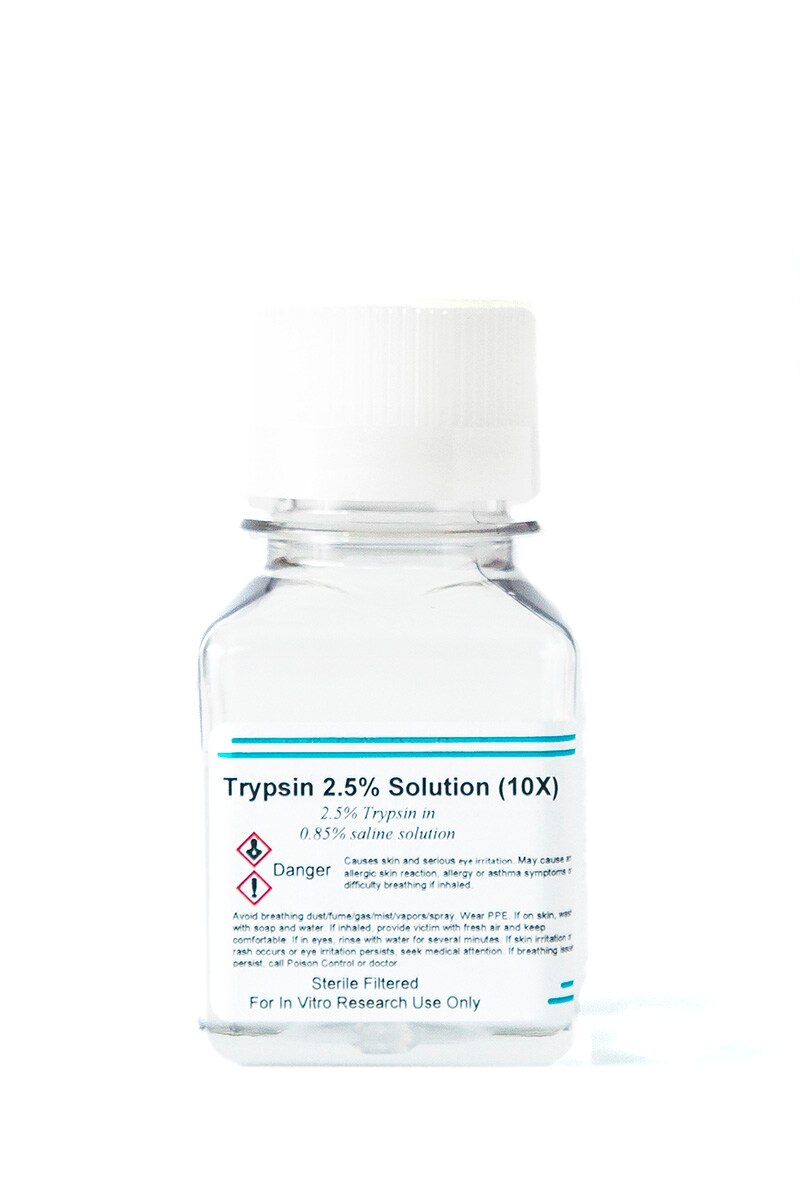
Trypsin 2.5% (10X)
R&D Systems | Catalog # B81710
This item is in process of being discontinued.

Discontinued Product
B81710 has been discontinued.
View all Trypsin products.
Key Product Details
Features
Contains 25 gm/L of trypsin (1:250) in normal saline solution.
Applications
Cell Culture
Product Summary for Trypsin 2.5% (10X)
The importance of Trypsin in Cell Culture.
In cell culture research and cell biology studies enzymes are widely used to dissociate tissues and cell monolayers. The goal of cell isolation is to maximize the yield of functionally viable, dissociated cells. Despite the widespread use of enzymes for cell isolation applications over the years, very little is known about their mechanisms of action in cell dissociation and harvesting. Selection of the trypsin enzyme preparation of choice is dependent upon the type cells in culture. Trypsin solutions are enzyme preparations derived from porcine pancreas, generally used for the isolation and dissociation of anchorage-dependent mammalian cells and tissues. The concentration of trypsin necessary for the successful isolation of cells depends primarily on the cell type and the age of the culture.
Loading...
Product Specifications
Sterility Testing
Pass
Formulation, Preparation, and Storage
Purification
0.2 μm filtered
Shipping
On Dry Ice
Storage
-5 to -20 °C, protected from light
Background: Trypsin
Alternate Names
TRY2, TRY8, TRYP2
Additional Trypsin Products
Product Documents for Trypsin 2.5% (10X)
Certificate of Analysis
To download a Certificate of Analysis, please enter a lot or batch number in the search box below.
Note: Certificate of Analysis not available for kit components.
Related Research Areas
Citations for Trypsin 2.5% (10X)
 Powered by Bioz
Customer Reviews for Trypsin 2.5% (10X)
There are currently no reviews for this product. Be the first to review Trypsin 2.5% (10X) and earn rewards!
Have you used Trypsin 2.5% (10X)?
Submit a review and receive an Amazon gift card!
$25/€18/£15/$25CAN/¥2500 Yen for a review with an image
$10/€7/£6/$10CAN/¥1110 Yen for a review without an image
Submit a review
Protocols
Find general support by application which include: protocols, troubleshooting, illustrated assays, videos and webinars.
- A Guide to the Colony Forming Cell Assay: Methods and Tips
- Cultrex UltiMatrix BME Protocol
- Culture of Mouse Enteric Organoids using Cultrex Basement Membrane Extract
- Culturing BG01V Human Embryonic Stem Cells with Mouse Embryonic Fibroblast (MEF)-Conditioned Media
- Culturing Mouse Cortical Stem Cells: Expansion using the Neurosphere System
- Culturing Rat Cortical Stem Cells: Expansion using the Monolayer System
- Culturing Rat Cortical Stem Cells: Expansion using the Neurosphere System
- Definitive Endoderm Differentiation of BG01V Human Embryonic Stem Cells
- General Support Buffers
- Immunofluorescence of Organoids Embedded in Cultrex Basement Membrane Extract
- Protocol for CEPT Cocktail Kit
- Protocol for Cell Counting Kit-8
- Protocol for Culturing Embryonic Chick Dorsal Root Ganglion Neurons
- Protocol for Culturing Embryonic Rat Spinal Motor Neurons
- Protocol for Culturing Rat Hippocampal Neurons
- Protocol for Culturing Rat Microglia
- Protocol for MortaLIVE™ Non-Toxic Dye
- Protocol for the Differentiation and Characterization of Human Th1 Cells
- Rat Cortical Stem Cell Culture Expansion Protocol
- The Human Colony Forming Cell (CFC) Assay using Methylcellulose-based Media
- The Mouse Colony Forming Cell (CFC) Assay using Methylcellulose-based Media
- The Mouse Pre-B Colony Forming Cell (CFC) Assay Using Methylcellulose-based Media
- Use of Cultrex Basement Membrane Extract to Improve Take and Growth of Xenografts in Mice
- View all Protocols, Troubleshooting, Illustrated assays and Webinars
Loading...